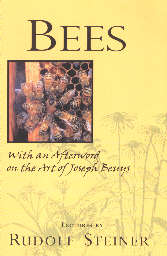
Bees, by Rudolf Steiner
A Book Review by Bobby Matherne ©2002
See: http://www.doyletics.com/arj/beesrvw.htm
Rudolf Steiner: 8 Lectures in Dornach, Nov 26, 1923 to Dec 22, 1923
Translation: Thomas Braatz. Intro: Gunther Hauk. Afterword: David Adams
Published by Anthroposophic Press/NY in 1998
A Book Review by Bobby Matherne ©2002
This book is a celebration of love. It is also a celebration of health. Love and health come together in the life of bees in a unique way. The hive of the honeybee exhibits a life process that mirrors that of the human head. The queen bee is like the round protein cells of the brain, the worker bees like the red blood cells, and the drones like the nerve cells. Bees were the first domesticated animal, the result of human-engineering of wasps so that their purified sweetness could be harvested (1). The poisons found in bees, wasps, and ants are pure distillations of spiritual substance and are essential to maintaining life in the plant world. Bee and wasp stings can be health-giving to humans with normally strong hearts. Bees vacate a hive for the same reason souls vacate the human body. Queen bees have a larval gestation period of 16 days, workers of 21 days, drones of 23 to 25 days. Our Sun has a rotation cycle of 21 days, the same as the worker bees. There is an intimate connection between the gestation cycle of the various categories of bees and the rotation of the Sun that correlates with the bees’ division of labor and sexual habits. Humans at a future stage of evolution will develop similar characteristics to honeybees. Honey is an amazing natural production that promotes growth in human beings. Growing children past the infant stage and senior citizens can benefit their health greatly by eating honey from bees as part of their daily fare.
In keeping with my basic rule of teaching and learning that goes, “When learning a new subject, it’s best to know all about it before you start,” I have outlined for you in the paragraph above what I recall as the most important concepts I received from Steiner in these lectures. There are many more, and as this review proceeds, I will elaborate on the above concepts and introduce some new ones. Be prepared to learn more about bees than you ever imagined possible. And about human nature and evolution.
In the Prelude lecture, Steiner has these prefatory remarks about bees:
[page 2] The bees have a life in which the element is suppressed, very strongly suppressed, which in other animals is expressed through their sexual life. With bees, this element is very much repressed.
[page 2,3] That which we experience within ourselves only at a time when our hearts develop love is actually the very same thing that is present as a substance in the entire beehive. The whole beehive is permeated with life based on love. In many ways the bees renounce love, and thereby this love develops within the entire beehive.
To understand this next passage it will help some of you if I explain the love life of plants a bit. Plants have only a physical and etheric body. The etheric body is what distinguishes a living reed from an empty stalk, a live petunia from a wilted blob. Plants grow until they are mature and ready to reproduce, at which time, the uppermost leaves modify in color and structure to become what we call flowers. These flowers attract beings that exist in kingdoms higher than the plant kingdom to come to them, to admire them, to sip from them, to pollinate them, to leave traces of life-giving spiritual essence (bee, wasp, ant, insect poisons like formic acid). During the blooming of flowers, the uppermost part of the plant takes on an astral glow, a residue, if you will, from the attention given to the flowers by beings with astral bodies such as insects, animals, humans, etc. Without such attention no plant is able to reproduce itself. A planet with only plants is impossible(2).What’s important is to understand that the sexual organs of plants are near the top of their physical bodies, exactly the opposite as for humans. If you have ever seen the glow of new love on someone’s face, it should be easy to understand that plants take on this glow when they are in bloom.
[page 3] But the thing that a bee profits from the most is that it derives its sustenance from the very parts of a plant that are pervaded by the plant’s love life. The bee sucks its nourishment, which it makes into honey, from the parts of a plant that are steeped in love life. And the bee, if you could express it this way, brings love life from the flowers into the beehive. So you’ll come to the conclusion that you need to study the life of bees from the standpoint of the soul.
[page 3, 4] You can study the matter further by eating the honey. What does the honey do? . . . Honey creates sensual pleasure, at the most, on the tongue. At the moment when you eat honey, it creates the proper connection and relationship between the airy and fluid elements in the human being. There is nothing better for a human being than to add a little honey in the right quantity to food . . . it makes human beings strong.
[page 4] Whoever looks at a beehive should actually say with an exalted frame of mind, “Making this detour by way of the beehive, the entire cosmos can find its way into human beings and help to make them sound in mind and body.”
Few people who paid any attention at all over the past twenty years could have missed the New Agers’ obsession with quartz crystals. If you look at quartz crystals in their natural state, you’ll find a hexagonal structure with the point growing out of rocks. We humans have quartz minerals flowing within our body [silicic acid], but in its own wisdom, our body prevents it from becoming crystallized. Take a quartz crystal, hold its point down and you will notice two things, it is hexagonal, and, if it were an empty shell, the point would be a good receptacle for an insect egg such as a honey bee. In fact, honeycombs are designed as the exact shape of a quartz crystal and the egg develops into a larva which begins to fill the six-sided compartment until it’s ready to climb out of it into the world.
[page 51] The bee is formed by the same force that resides in the Earth and can construct a quartz crystal. It’s the finely distributed silicic acid that has this effect. . . . In this process the honey, having been worked upon by the bee’s body, has such an effect that it can create wax in just such a form that human beings can use, because all human beings need to have these six-sided spaces within themselves. Human beings need the same things that bees do . . . a form of nourishment that can carry over into our bodies . . . a force that produces a six-sided effect.
Steiner mentions that this six-sided force can be found in the shapes of our muscles, but these shapes are not easily visible, however, inside our bones, the hexagonal shapes are easily to view. Engineers have only in the past fifty years begun to mimic bone structures by building extra strong structures of honeycombed metals. A living bone, with its low density and weight, is one of the strongest structural materials known. When we eat honey, we are ingesting a food infused with this hexagonal force, and it helps our bodies to grow stronger. Steiner was very aware of this force and its benefits. After childhood, we develop this force in ourselves naturally, but at times of weakened health or advanced age, its power may wane, and then honey is an enormous boon to health.
[page 51, 52] You see, gentlemen, if you eat honey, you will take into yourselves a tremendously strengthening force. If you have become too weak to develop within yourself this six-sided force that must flow from your head to the rest of your body, if you don’t have any longer the power to give your blood a certain degree of solidity so that this six-sided force is continually present, then honey must step in to make up for the loss, or, in the case of children, milk will be necessary. Children don’t have this six-sided force as yet — they still must obtain it through that which a woman produces in herself in the form of milk.
About 25 years ago, I encountered an experiment in which oysters were moved from Long Island, NY to Wisconsin by airplane in order to answer the following question, “Will the oysters, who open their shells when the Moon is overhead, open their shells in Wisconsin when the Moon is overhead in Wisconsin or when it is overhead in New York?” On the face of it, this seems to be a trivial question, but its results are important and its implications far-reaching. Here’s what researchers found: for the first three weeks, the oyster continued to open their shells when the Moon was over Long Island, and thereafter when the Moon was overhead in Wisconsin. About the time I read that article, I had just moved several times, to an apartment, then to another place, then to a house, and I realized that three weeks was about the time span during which the following happened to me: that door into which I placed a key each night upon returning from work became my door! What the researchers had discovered was that 21 days was the time it takes for a new behavior to form into a habit. The time it takes us to become accustomed to some new thing in our lives.
The Sun undergoes a complete rotation every 21 days. Coincidence or insight into a cosmic connection of us with the Sun? You decide. Steiner takes us through the gestation of the various bees, showing us that the Queen Bee only stays in the larval stage for 16 days, and as such she does not experience every aspect of the Sun in its rotation. The Queen is fully developed while she is still very much connected with the Sun. The worker, on the other hand, has spent the full Sun cycle of 21 days in the larval stage and has all of the effects of the Sun inside of it. The drones, however, have remained several days longer than the workers in their larval stage and developed thereby an attachment to the Earth. Steiner tells us that because of their different gestation periods, the Queen Bee remained attached to the Sun, the workers to the Queen Bee, and the drones to the Earth. Read his explanation for why this is important to the operation of the hive and relate it to the 21 day habit formation process.
[page 9] The queen can lay eggs because the Sun effect is always within it, and it hasn’t anything at all of the Earth’s effect upon development. The worker continues its development for four to five days longer. It makes use of every influence the Sun has to offer. But then it enters slightly, for just a moment, into the Earth development’s sphere of influence . . . This is why it can’t lay eggs. The drones are fertile males; this fertilization capability comes from the Earth. The drones acquire the power to fertilize from the few days longer they are exposed, as incomplete insects, to the influence of Earth development. This leads us to the conclusion that with bees you can see clearly that the male’s fertilization powers come from the energies given by the Earth, whereas the female capability to develop eggs derives from the Sun’s energies.
There are two dramatic events in the life of a beehive: the nuptial flight of the Queen Bee and swarming. During its nuptial flight, the Queen takes off during a day when the Sun is present and flies towards the Sun, to which it is still attached, as high as it can. Following close behind it is a flight of drones who will attempt to impregnate the Queen. At the highest point of the Queen’s flight she is fertilized and returns to the hive to begin laying her eggs.
Why do bees leave the hive in a swarm? Steiner’s explanation is that the poison in the bee’s body causes its eyes to almost entirely close. Bees live in a twilight world and depend mostly upon their sense of smell for collecting honey from flowers. When a new Queen Bee is hatched, the Sun influence from the new Queen neutralizes the poison in the worker bees and suddenly they are dazzled by the light emanating from the new Queen and rush around madly within the hive till they finally exit the hive in a swarm, leaving behind the original bees(3). [These two paragraphs summarized from Lecture One.]
In the next passage, Steiner explains the similarity between the human head and the beehive:
[page 16, 17] Inside the beehive things basically happen the same way, only with slight differences, as they do in the head of a human being. The only difference is that the substances do not develop and mature as much. In the human head we have nerves, blood vessels, and also individual protein cells, which remain round. They are always somewhere in there. . . . If the nerve cells in the human head could develop in all directions like the beehive, then these nerve cells would become drones. Second, the blood cells, flowing in the arteries, would become worker bees. Third, the protein cells, particularly those in the middle of the head, having undergone the shortest development, can be compared to the queen bee.
The sterile female worker bees bring back to the hive the nectar within their body which they convert into honey and wax. The blood cells in the human body do something similar. They collect nourishment from our internal organs and distribute it to the various cells of the human body for the building of six-sided cells in our muscles and bone structure. The basis of organic chemistry is the six-sided chain of molecules known as the benzene ring. Is it possible that the forces that lead to the structure of honeycombs, muscles, and human bones originate in the structure of the six-sided benzene ring?
The nerves are constantly being worn out in the same way that the worker bees battle the drones within a hive once a year. Death is the end result of that perennial weakening or fraying of nerves in the human being.
[page 18] It is actually because of this weakening of the nerves that the human being dies. We are then no longer able to sense the body as well as we once did, and human being always die because they have frayed their nerves and worn them out.
Like a modern jet liner that progressively loses its sensors and the motor controls to its engines and ailerons will eventually crash, so, too, a human body will have a catastrophic failure at some point. Steiner’s insight helps us to understand why the oldest humans we meet tend to be calm and collected and evince no sign of frayed nerves. We likely have it reversed when we deem their calm demeanor to be a result rather than a cause of their long life.
Speaking almost eighty years ago, Steiner used the word ecology in this sentence, “You need to take a deep look into the entire ecology that nature has to offer.” (Lecture 7, page 127) There is a present issue at the present time in the USA where radical conservationists want us to stop drilling for oil, or drill less for oil so as to extend the time over which we will have access to this natural resource. It pleases me to hear Steiner weighing in on the side of utilizing present resources and allowing the future to take care of itself. He was saying these words just at the time when coal was soon to be replaced by oil and later by nuclear energy.
[page 21] We could figure out approximately when the Earth’s reserves of coal would be exhausted. Then we could decide to extract a smaller amount of coal, so that the reserves would last until the Earth reaches the projected end of its existence. You can’t say that you must do this, because you really ought to be optimistic and put some trust in the future. You must then tell yourself, well, all right, we’ll rob the Earth of all its coal, which means, in reality, that we’ll rob our descendants of coal. But they will be able to find another source of energy, so that they won’t need coal.
The more I read of Steiner’s lectures the more I discover that he was aware of processes in his day that I discovered from others in my day. The “dormitive principle” is one of those things. I first heard of it from Gregory Bateson, I believe. Doctors used to attribute morphine’s sleep-inducing effects to a dormitive principle. What is a dormitive principle? Something that makes one go to sleep. By using such an explanatory principle, we have in fact said nothing of interest. Steiner explains on page 43 that Heine once explained that poverty comes from pauperism, another example of the dormitive principle at work. Also Steiner tells of someone who claimed that the comic elements comes about when someone has thevis comica, or “power of being comical.” Again – the dormitive principle at work.
Another process is that of “Klüge Hans” or “Smart John” that Steiner relates on pages 57 through 60. A Mr. van Osten owned a horse that could perform amazing numerical calculations. Scientists were dispatched from all over to examine this horse and they were astounded. The range of questions the horse could answer seem endless. Finally a scientist came and did the following simple test: he had everyone removed from the room who knew the answer to the question, and “Smart John” was unable to answer the question. Seems that there was a calibrated communication between the horse and anyone in the room who knew the answer to the question, and the horse would stop pawing the ground when he received the signal of a correct answer. I first heard of this story about 25 years ago when I was studying therapy. One of the messages I got from this story was that there is an intimate interaction between the therapist and the client. This interaction is open to multiple levels of interpretation, and thus one would be wiser not to posit explanations, but rather be satisfied with results.
I cannot resist sharing this quote about the horse experiments because I think it illustrates a rather rare display of Steiner’s sense of humor. A learned professor suspected that Mr. van Osten was prompting the horse when to stop stamping and placed himself in front of Mr. van Osten to scrutinize him carefully while the horse did a calculation.
[page 58] This he did, but he noticed nothing at all. But he didn’t let himself get confused by his own theory. So he said to himself, “This change in expression is so minute that I can’t detect it, but the horse can.” Well, gentlemen, what we can conclude from this is that a horse can see more and better than a professor. There can be no other conclusion.
Steiner goes on to explain how the horse managed its wondrous feats. Apparently each time the horse was successful in a calculation, he was given a sugar cube. This reminded me of how kids react when adults give them candy or a woman reacts when a man gives her chocolates.
[page 59] The horse senses what is going on in your brain when you are thinking “nine” and then stamps his foot. If the horse had not received the sugar, the horse’s love might have transformed itself somewhat into hate and then it would not have stamped its foot.
He uses this to explain why bees will attack someone who is afraid or angry. Fear causes the blood to retract from the skin making you pale, while anger causes blood to flow more to the skin area making you red-faced, as we say. If you’re afraid, the bees sting you because they want to obtain from you honey or wax, whereas if you’re angry, the bees sting you because it senses you’re trying to take away its six-sided force from them. Only in a calm person who is neither afraid or angry will the bees sense that this person has the same amount of six-sided force as they have and leave them alone. It should not surprise you that plants can also respond to a person’s feelings (“exhalations, vapors, perspiration, and so forth”) and thrive for one person and not for another. Perhaps our expression “green thumb” should be better expressed by the phrase, “green breath.”
Reading the next passage, I gave thanks that breast feeding of infants is returning to favor after many years of being replaced by manufactured formulas. Steiner discusses how the medical profession of his time took a short-term view of things, whereas the results only show up in the long term. It would be good to remember this story when you encounter a doctor prescribing some new procedure, drug, or method of diet – doctors haven’t really changed all that much in 80 years. [The lime-rich cow’s milk of Steiner’s time may be likened in its effect to “Calcium-Enriched” products, such as orange juice, that line the grocery shelves today.]
[page 74] Along comes a medical doctor of the modern day sort and shows you one such child who was raised on milk from a cow that grazed on land with a predominant lime content and another child who had received only mother’s milk, and such a doctor says, “It doesn’t make any difference which type of milk the child gets.” But it turns out that the child raised on mother’s milk is still fresh in appearance at an age of sixty-five or sixty-six, and the other, raised on cow’s milk, has suffered from calcification at the same age.
Do you know someone who cannot tolerate honey? I don’t. But I can imagine from reading what Steiner says below, that such a person would tend to be thin and pale due to restricted blood flow. What honey does is to increase the blood flow, to which a normal person has a healthy response, a feeling of increased vitality.
[page 79] People of the type that can’t tolerate any honey are usually those who tend toward getting sclerosis, an inclination towards hardening throughout the body, which causes the body’s metabolic rate to be quite slow. This is why they can’t tolerate honey, the primary effect of which is to increase the metabolic rate. Within their bodies a split in their metabolism occurs when their bodies want an abnormally slow metabolism and the honey makes it faster. As a result, they get indigestion, which manifests itself in a number of ways.
One of my favorite fruits is figs and I always have a fig tree close by for picking fruit and preserving it. In Greece the sweetness of the figs on the wild fig tree can be doubled by a process called “caprification,” which derives from caprificus which means “wild fig.” Fig growers in that region since long ago have noticed that figs in which the gall wasp laid its eggs produced a juicier, better-tasting fig. The grower waits till the wasp has laid its eggs in a couple of figs, then removes the figs, ties them together with a length of string and hangs them over the branches of another fig tree. As the two figs dry up, the wasps inside speed up their developmental process and mature so quickly that they are able to emerge from the figs in time to lay their eggs in the figs of the new fig tree. These figs, that are picked before this new brood has matured, will have twice the sweetness of the other wild figs due to a honey-like secretion of the larval wasps within the figs.
[page 97] A wasp is unable to prepare honey the same way that a bee does; the organization of this insect isn’t even suited for that. But if you force the wasp to take this detour, it can transfer, during its reproductive cycle, to one plant the sweetness of the honey it has extracted from another plant. . . . they can make possible a certain type of honey creation involving the transfer of something from one fig to another.
Steiner tells us that the bee is an animal that was bred from wasps a very long time ago, during Atlantean times, in fact, when wasps’ bodies were not as hardened as they are now. The forced sweetening of the wild figs using wasps over a long time resulted in the generation of a modified wasp that was able to “carry on independently, away from the tree, the process that the wasp can carry on only in the tree itself,” and this modified wasp began to be called a honeybee. What the wasp was able to create only while a larva within a fig, the modified wasp or honeybee was able to create as an adult. [paraphrased from page 98]
In this next passage, we get an insight to how the circulation of the blood creates the pulse which we correctly call a “heartbeat.” In our modern enchantment with things mechanical, we imagine the human heart to be a pump and that the heartbeat is the result of the pumping action of the heart. This makes so much sense that “everybody knows it is true.” Doctors have even built mechanical pumps that replace the human heart. Doesn’t that prove that the heart is a pump? Well, doctors have never taken a human corpse and by pumping blood through it caused life to appear within it, have they? The best they can do, and will ever be able to do, is to sustain a life that is already present in its quaternity of physical body, etheric body, astral body and “I” or Ego body. And that I-force powers the circulation of the blood. What is the function of the heart, then, if it’s not a source of pumping as in our crude mechanical hearts? It is an hydraulic ram that exists to provide an intimate mixing of the oxygen and carbon dioxide molecules with the red corpuscles immediately before the oxygen enriched blood flows out to the arteries to the body.
Steiner says if you must use a mechanical metaphor for the heart, it is not a pump, but rather a turbine, against whose resistance the circulating blood pushes and causes the generation of the heartbeat. If you’ve ever seen the movie clip of a heartbeat in a month-old fetus before the heart is even well-formed, you would have trouble explaining how a seriously incomplete mechanical pump could be responsible for the circulation of the blood that is so clearly visible. If the heart were a mechanical pump and responsible for the circulation of the blood, it would need to be completely formed before the circulation began, not after (4).
[page 106] Likewise a human being has such places of resistance within. The blood hits this resistance and drives the heart. The only difference is that the blood comes up against this resistance only once, and while oxygen and carbon dioxide are combining, it pushes backward. In so doing, the blood snaps forward once and then backward once. This is how the heartbeat arises. In this way it comes about that the I activates the blood circulation in human beings.
That I-force present in your circulation is present in bee poison. Thus a bee sting will increase your heart rate immediately. This has curative effects for some people, and I have heard of bee and wasp stings being used to cure people of various illnesses just recently. Steiner was asked about a man who had a heart attack after being stung by a bee. He explained that in a normal human heart, a bee sting can have a salubrious effect, but in a person with a history of heart disease, a bee sting may have a deleterious effect.
[page 107] If, however, the heart is diseased, then the I is strengthened and increased dangerously by the effect of the additional bee poison entering the bloodstream. This poison will push hard against a somewhat diseased heart valve, the result being that a person may become unconscious or even die. . . The strange thing, however, is that anything and everything that can make a person sick or even kill a person can also have curative powers that bring about healing.
Rheumatism and gout leave deposits in the body due to the I being unable to move the blood properly. A bee sting or bee poison in the proper dose can get the blood moving again properly. Steiner was an expert in mixing such medicines and deciding whom to administer them to. See “Extending Practical Medicine,” that he co-authored with Ita Wegman.
[page 108] For what reason does a person get rheumatism or gout? Because the I-organization is too weak. It is unable to influence the blood to move properly. It needs a special stimulus. If the blood does not have the correct amount of movement — for example, it may flow too slowly in a person’s system — then tiny crystals may settle our all over, and these crystals will move into the area around the arteries. These tiny crystals consist of uric acid. They begin filling the entire body. This condition is gout or rheumatism, and it arises when the I-organization is too weak.
The question of a man who had just bought an apiary and became a beekeeper. He went unconscious after a bee sting. His doctor told him to give up beekeeping or he would die if he got another bee sting. Here’s how Steiner responded to this doctor’s advice.
[page 112] I’m astonished that the doctor who observed this case that you’ve told us about didn’t tell the man that the second time the effects would not be so bad and the third time he’d be immunized. But perhaps he had such a severe heart condition that he couldn’t be exposed to this danger.
Ants leave a trail of formic acid wherever they walk. This formic acid is essential to living plants and but for the ants, much of the life of the Earth would suffer. Think of that next time you grouse over ants when you see them crawling around in nature — the Earth would become completely dead, covered in mold, but for the action of these tiny creatures(5).
[page 136] But ants also give in what they transmit as formic acid something directly to rotten, dead material, and by doing this, they stimulate life to a certain degree, and they contribute to the fact that the Earth in its decaying substance remains alive at all. You could really say that the spirit that is present and prevails in all these things is certainly one to be marveled at.
What good is formic acid to human beings? Steiner says that we’ll find it everywhere in our “arms and legs, muscles and other tissues, heart, lung, liver, spleen” – everywhere in our bodies. We are saturated with formic acid, in very small concentrations, to be sure. Lacking formic acid, a person may be appear pale and be unable to eat. Someone who had sufficient formic acid and suddenly too little of it might speak about themselves this way:
[page 145] Assume, for instance, that you have before you an individual who tells you, after being inspired to think along certain lines, “Several months ago I could remember just about everything. I could think back and reflect on past occurrences very well. Now I have trouble with that; I don’t seem to be able to do it anymore. Every time I try to think back, I just can’t remember.”
For such a person, their body needs to be making more formic acid internally, not getting formic acid from ants. Where do humans get oxalic acid from? The German word for oxalic acid is Kleesäure or literally “clover acid” since clover has a high concentration of oxalic acid. All plants have oxalic acid in them, however, so an increased diet of green vegetables may be helpful to such a person.
As we age, it may become more difficult for our body to make formic acid. When that happens, the attraction of our soul and spirit to our body diminishes until they eventually abandon the body. Interestingly, Steiner tells us that a similar thing happens within a beehive to cause the bees to leave in a swarm.
[page 153] Let’s look at the human being first. Let’s assume it’s a young child. As long as this child is still young, it can transform very easily the oxalic acid located in the lower body into formic acid. The organs get enough formic acid. The human soul develops within the child. So here we have formic acid as the foundation of soul and spirit. And when a human becomes old and can’t develop enough formic acid anymore, the soul and spirit leave. It’s the formic acid that attracts and mobilizes the soul and spirit; otherwise the spirit would go away.
As above, so below. The Earth has a spirit that would leave during the winter when the Earth becomes rigid and stiff, but in spring it enlivens the Earth again due to the formic acid that the insect world has created in its interactions with the plant world. In the life of a beehive, the time comes when a young queen arrives from her egg sac. The bees, normally held to seeing only as in twilight due to the present of the formic acid in their bee poison, sense that their formic acid has gone, become agitated, and finally leave the beehive in a swarm. [paraphrased from page 155,156]
[page 156] This is truly a grand sight, to see a horde of bees swarming away. In the same way in which the human soul leaves the body, so also does the old queen, after a young queen reaches adulthood, leave the hive with her company. You can really see, by looking at the escaping swarm of bees, an image of the human soul flying away from the body.
In Lecture 8, given on December 22, 1923, Steiner was speaking a couple of days before Christmas. It was fitting that he described the origin of the tradition of the Christmas tree in the Kranewittbaum, a juniper tree. The juniper is an evergreen shrub with berries that are used to flavor gin. The berries have a poison that attracts the birds to them. When the bird peck at the berries, a weak acid is released over the area that allows a spiritual element to arise in it. [paraphrased from page 158] I imagine the holly with its red berries is an apt substitute for regions without indigenous juniper trees.
[page 158] The people of antiquity knew this instinctively and said to themselves that during winter, when the juniper stands there and the bird come to pick its berries, the Earth is once again rejuvenated, reenlivened by means of the juniper. From this natural phenomenon people formed a picture in their minds, one with a moral sense: Christ is reenlivening the Earth.
In pedagogical circles, the “bank” system of education has been discredited for some time. This refers to a method of teaching in which the teacher deposits some educational material in a student and then returns later to withdraw the deposit, as if the student were a bank or safe deposit vault. In this next passage from a lecture he gave in 1905, Steiner explains that way of teaching will especially not work for student of spiritual science.
[page 169] A student does not receive a mass of material that must be learned in a strict manner when learning about hidden spiritual matters, but rather he or she is given a profound statement containing an inner power. That is the way it was done in earlier times. The student had to meditate on this statement while maintaining a complete inner calm. In this way the student would be illuminated from within.
In the next passage I fulfill my goal to provide a statement for you to meditate on about how humans at a future stage of evolution will become like bees today, not individual bees, but the entire living beehive.
[page 170] The consciousness of a beehive, not the individual bees, is of a very high nature. Humankind will not attain the wisdom of such consciousness until the next major evolutionary stage — that of Venus— which will come when the evolution of the Earth stage has finished. Then human beings will possess the consciousness necessary to construct things with a material they create within themselves.
When we look at another human, one we haven’t seen for 14 years, we know that every cell in his body has changed twice since we last saw him and yet when we look into his eyes, we see his I and know that it is him, our old friend. Animals have three bodies: physical, etheric, and astral. Humans have a fourth component, called variously, the I, the I-being, the I am, or the Ego. My pet Schnauzer, as bright as he is, does not possess an I — he looks up to me with eyes that seem to be looking upon the very thing he most wants for himself in a future stage of evolution, an I. When he dies, he will return to the group soul which hovers above in the astral world. I write all this by way of introduction to this next passage about the group souls of animals and the individual Egos of humans.
[page 172] We also stated that these group souls play the same role in the astral world as our human soul, if gifted with an I-being, does in the physical world. In reality the human I is a group-self that descended from the astral to the physical plane. In so doing, it has become an individual (nondivisible) I.
Sometimes the animal dies and is not able to send back to the spiritual world all that they brought down to physical plane. When that happens, these torn off things remain behind as what are called “elemental beings.” When a bee sucks on a flower, these elementals hover nearby because they find nourishment from the glow around the flower. In addition to these elementals left behind by animals when they die, there are also elementals created by human beings by their very thoughts. As I read the next passage, I was reminded of the elementals drawn to the chief antagonist at the end of the movie “Ghost” starring Patrick Swayze.
[page 174, 175] Wherever there is an opportunity for certain things to exist, they are always there. When a person, by entertaining very evil sentiments, spreads these feelings all around himself or herself, then these sentiments also become alive around this person; and this is exactly what attracts existing beings that only wait for something like this, just as any physical being would wait for nourishment. I once compared this to a clean room without flies. If all sorts of left-over food sits around in a room, flies appear. This is how it is with spiritual beings: all you have to do is provide the proper nourishment.
If you go to someone’s home or apartment and notice all kinds of leftover food hanging around to attract flies, you have a pretty good indication of the ecology of that person’s mind: they are entertaining thoughts that are becoming alive and subsequently attracting existing beings to their source of nourishment. Few mothers would not be upset to find their adult offspring living in such a condition, even though their motherhood training had never explained the spiritual implications of someone living in such conditions. The best tonic for establishing a wholesome ecology of mind is EAT-O-TWIST!, which reminds us when we say it, that Everything Allways Turns Out The Way It’s Supposed To, where supposing is how we entertain thoughts within our minds from now on.
~^~^~^~^~^~^~^~^~^~^~^~^~~ footnotes ~~^~^~^~^~^~^~^~^~^~^~^~^
1 In 1964, an article appeared Datamation Magazine to the effect that the structure of a software system mirrors the structure of the organization that designed it. Computers, I have come to understand, we design such that their organization mirrors the internal structure of our human brain. In effect, what humans did by domesticating wasps into bees was this: they trained wasps to have a similar structure to the human brain, and thereby created what we call honeybees.
~^~^~^~^~^~^~^~^~^~^~^~^~^~^~^~^~^~^~^~^~^~^~^~^
2. This has interesting implications for evolution because it implies that humans must have been the first beings on the Earth, followed by plants and then animals. It is this salient point that distinguishes Steiner’s view of evolution from the materialistic Darwinian view. For details on this, read his An Outline of Occult Science or read my review of his lectures on Spiritual Hierarchies and the Physical World.
~^~^~^~^~^~^~^~^~^~^~^~^~^~^~^~^~^~^~^~^~^~^~^~^
3. Steiner discusses how its poison is like a concentrated spiritual essence that is released in minute quantities inside of the bee and prevents it from seeing, causing the bee to live in a twilight world. Might it be that materialism for human beings is such a concentrated spiritual essence of the Thrones’ sacrifice? If so, it could lead to spiritual blindness unless our equivalent of a new Queen Bee neutralizes the poison long enough for us to view the dazzling light of the Sun Being, Christ Jesus?
~^~^~^~^~^~^~^~^~^~^~^~^~^~^~^~^~^~^~^~^~^~^~^~^
4. Some of you may be thinking, “Isn’t the explanation for this that the mother’s heart supplies the pumping power?” . That’s a very good question — I assume that is the typical materialistic medical science explanation. The answer would seem to hinge on whether there is a pulsation in the umbilical cord or not. What I do know is that the placenta is like a sponge growing off of the womb or even such places as the intestinal wall in extra-uterine pregnancies. Its job is to supply the oxygen-rich blood to the fetus through the umbilical cord. How could the pulsing motive force of the mother’s heart get through the maze of capillary vessels in the placenta? Don’t think it’s possible. If there is a pulse in the cord, more likely it’s the baby’s independent heart beat — hmmm — I think there’s one answer — babies have faster heartbeats than their mothers! They must have an independent heart creating the pulse by its turbine/hydraulic ram action. My point is the blood in the fetus flows at the same rate through its no heart, primitive heart, to full-term heart stages, but the pulsing action matures during gestation. What the pulsing does is mix the oxygen and carbon dioxide according to Steiner above. During early months the fetus gets all its oxygen directly from the mother’s blood. In order for it to survive independently of the mother, it must develop the pulsing mixing action, which it usually has available by the fifth month, which I think is about the earliest a fetus can live outside the womb, and even then it needs enriched oxygen to survive as the heart may not yet be up to the full task.
After some help from a friend, I discovered that another answer is that actually the mother’s blood and the child’s blood never mingle, so it’s not possible that the mother could supply the pumping power. The placenta is where osmosis of oxygen/nutrients from mom to baby — and of carbon dioxide from baby to mom — takes place…. But the two blood streams never actually mingle — which is why your blood type can vary from your mother’s. The typical rH compatibility problems stem from the fact that antibodies from the mother can transfer to the child via the placenta, which may have a different blood type from its mother.
~^~^~^~^~^~^~^~^~^~^~^~^~^~^~^~^~^~^~^~^~^~^~^~^
5. This should give one a new appreciation for the Jains of India who will not step on or harm the smallest insect in their path.