Review: The Temple of Hekate

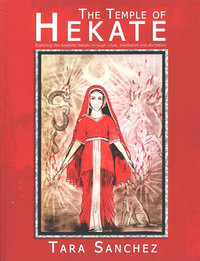
The Temple of Hekate
Tara Sanchez

Cover of the book The Temple of Hekate

(The Cover art for the Temple of Hekate is by Georgi Mishev, Bulgaria)

http://avaloniabooks.co.uk/catalogue/hellenismos/the-temple-of-hekate

ISBN 978-1-905297-49-8.  Price UK  RRP £12.99

This is an excellent follow-up book to Sorita & David’s book ‘Hekate, Liminal Rites’ in that it is a collection of modern rituals. Tara has used her own experiences and presented in book form a working modern day Temple of Hekate.

From the basic introduction to Hekate and general magical practice (the necessity of keeping a magical journal for example) Tara discusses many aspects of temple practice. This in itself is important. However I was extremely interested in the description of the ‘Oracle of Her Sacred Fires’.

Using three six-sided dices she has gleaned the book ‘Her Sacred Fires’ for appropriate texts. She has given a table with the various correspondences.

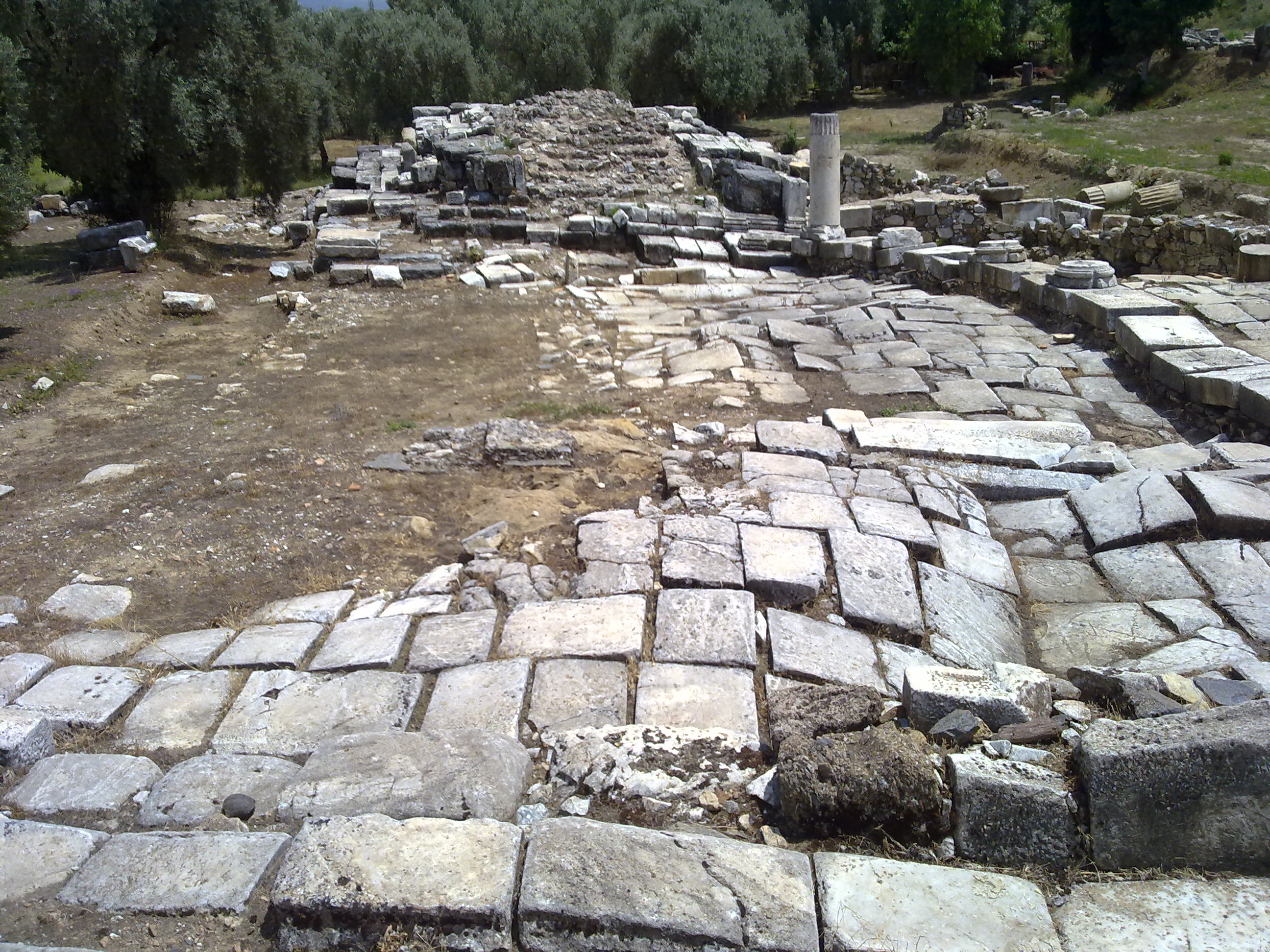
For example she used one of my quotes for 5-5-5 “Ten rows of steps ..leading to the stone-paved road. The temple, encircled with five rows of steps…”  (Morgana Sythove, Sacrifices will be made, from Hekate, Her Sacred Fires 2010) 🙂

Of course Tara encourages everyone to create their own form of divinationary system but this is a wonderful way of creating a link with modern priests and priestesses of Hekate.

Filled with many other insights and personal experiences Tara has presented us with a book not only honouring the past but pointing the way to new ways of working with Hekate.

From: http://avaloniabooks.co.uk/about/authors

Tara Sanchez
Tara is the author of The Temple of Hekate. She is a Torchbearer of the Covenant of Hekate, and previously contributed to the anthology Hekate: Her Sacred Fires (2010).  She was also one of the key facilitators of the Rite of Her Sacred Fires (2010) with Sorita d’Este, a worldwide ceremony which was held for the first time during the Full Moon of May 2010. Tara currently resides on the Cheshire/Derbyshire border with her long suffering husband, beautiful and precocious daughter and a gaggle of cats.  For more information visit her website: www.templeofhekate.net.


Geplaatst in Boeken, English articles, Recensies | Getagged , | Reacties uitgeschakeld voor Review: The Temple of Hekate

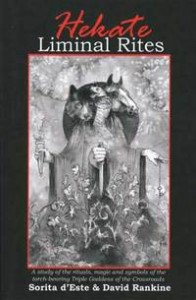
Review: Hekate Liminal Rites

Cover of the book Hekate liminal rites

Hekate Liminal Rites (Rituals Magic & Symbols)
by
 Sorita d’Este & David Rankine
http://avaloniabooks.co.uk/catalogue/hellenismos/hekate-liminal-rites
2009. Paperback, 196 p. ISBN 978-1905297238. RRP £12.99.

For devotees of the Goddess Hekate this is a *must have* book. In an easy to read style Sorita and David have  included many sources and references to Hekate spanning 3000 years. From the Odyssey (Homer) to the famous Theogony (Hesiod), from Greek drama to Macbeth (Shakespeare) we come to see how Hekate has influenced magical en spiritual thought.

We can read how Hekate was slowly demonised and came to be feared. However in this book we can see how Hekate has been fused, syncretised and adapted to become an influential and modern day Goddess.

Perhaps it is Hekate who more than most ancient goddesses has come back into our lives. My own encounter with her is one of many. I feel that it is however important that we look to original sources when working with ancient deities.

David & Sorita have done an excellent job  with this book by giving us a few signposts. An important section of the book is the closer look at the Greek Magical Papyri (PGM) and the charms and spells. Not only is Hekate mentioned (and her symbols… the key, blackdog/bitch etc.) but also other gods and goddesses closely associated with her. Hermes/Hermekate, Ereschigal, Zeus, Aphrodite, Artemis and Selene. In the chapter ‘Fusions’ they look at these connections in more detail.

Hekate in her liminal nature, standing on the threshold, with her two torches was also known by many names: from Chthonia “earthly one” to Phosphorus “light-bearer” to Soteira “saviour”. Gradually we begin to see why Zeus also exhalted her… “she is honoured amongst all the deathless gods…”


Geplaatst in Boeken, English articles, Recensies | Getagged , | Reacties uitgeschakeld voor Review: Hekate Liminal Rites

Tales from Anatolia: Hekatesia 2005

 NB This is the report I wrote after the first visit to Lagina in 2005.

In June 2012 I finally returned to Bodrum and whilst some things had changed … the road to Labranda for example is a complete mess due to lorries constantly transporting stones from the quarries … the tranquility of the temple is still there.

For my follow-up article elsewhere in WR-online, see here.

Hail and welcome!

***

“PFI Turkey – Hekatesia 2005”

Once upon a time… well this really does sound like a fairytale come true. In September 2004 I met a Turkish dance student at one of our Witches cafes. One thing lead to another and at Yule I met a girlfriend of his who lives in Istanbul. We chatted and ended up having this wonderful idea of setting up PFI Turkey. Many hours of Instant Messaging and emailing ensued but by February we had a website in Turkish, www.tr.paganfederation.org.

During our conversation I had expressed an interest in visiting Turkey and  Atheneris just happened to mention some festivals, which are still celebrated in Turkey that are not particularly Islamic. Now I should mention immediately that Turkey is secular and there is complete separation between state and religion. At least this is their vision and in many respects Turkey is far more secular than most western so-called democracies, but that is another story!

To hear of pagan festivals still being celebrated was new to me and of course I wanted to hear more. Atheneris mentioned one very small village festival being held near to the site of the Temple of Hekate, Lagina. Lagina is not well known, partly because excavations have only been restarted recently – in 1999. The first excavations were made in the later 1800’s.

Lagina 5

(Lagina)


lagina 6

I expressed interest and so she started making inquiries. After many months of meetings with local archaeologists, the mayor of the village, tour guides and historians, plus booking flights and arranging accommodation Flora and I met in Bodrum, Western Turkey.

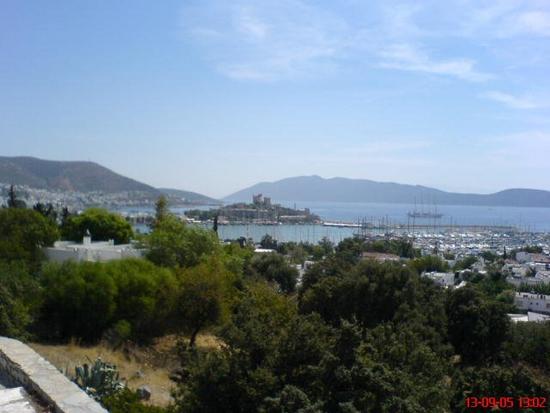
Our first few days were spent in visiting the local attractions in Bodrum or Halicarnassus (Bodrum’s ancient name), including the Castle of St. Peter. This was built on the ruins of an older castle, now known to have been built by the Dorians around 1100 BC.

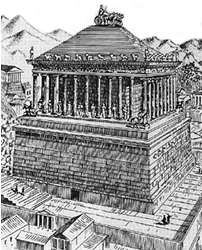
Perhaps the most famous ancient monument in Bodrum however is the Mausoleum, one of the Seven Wonders of the World.

Mausoleum


Overlooking the Mausoleum are the ruins of an ancient theatre, which offers a marvellous view over Bodrum and the Castle.

Bodrum 1


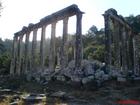
Temple of Zeus

On another occasion we had a private tour to Euromos where we saw the Temple of Zeus, followed by a visit to Didyma and the Temple of Apollo. Not far from Didyma is the ancient city of Miletos, where we saw a marvellous example of a theatre.


We were later joined by our guests from the UK and made a return journey to visit the wonderful Temple complex at Ephesus.  Semih our tour guide on this particular occasion told us much about Turkish and Anatolian history. He also told us about the ‘Hellenisation of Turkey’ and the settlement of Greeks in this area, which explains why many of the best examples of Greek architecture are in fact in modern Turkey. One begins to understand how important Anatolia is to European history – it is veritable open-air museum here. But so far we had visited the more touristy areas. And I could also spend much more time writing about these wonders.

Ephesus too is another one of the ‘Seven Wonders of the World’…

Ephesus 1

(Ephesus) 


Ephesus 2

However the aim of this visit was about to unfold. We picked up our last guests – three pagan friends from  the US – at Bodrum Airport and journeyed to Turgut, via Milas, north-east of Bodrum.

Fred Lamond, who had also joined us, continues the story:

“(I was)… just in time to join the main party in the minibus to Turgut Village on 16 September, with a visit to an opencast coal mine on the way, where many archaeological artefacts are frequently found.

Turgut dancers 2

(Turgut dancers) 


Turgut dancers

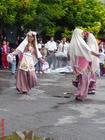
The Hekatesia festival, that has been taking place since 2000, is mostly a video show for the benefit of the inhabitants of neighbouring Turgut village of who Hekate was in Ancient Anatolia and of the progress of the excavations, but included this year for our benefit a splendid procession by the students of an Istanbul drama school. This was unfortunately spoiled by a swarm of press photographs that accompanied the procession taking constant photographs from all angles as it proceeded.

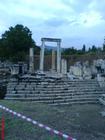
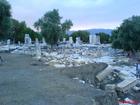
The day after the official festival, on the evening of 17 September, our group was allowed to hold a private ceremony in the temple ruins, which in the bright moonlight had a remarkable atmosphere.

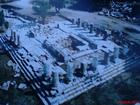
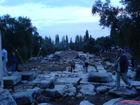
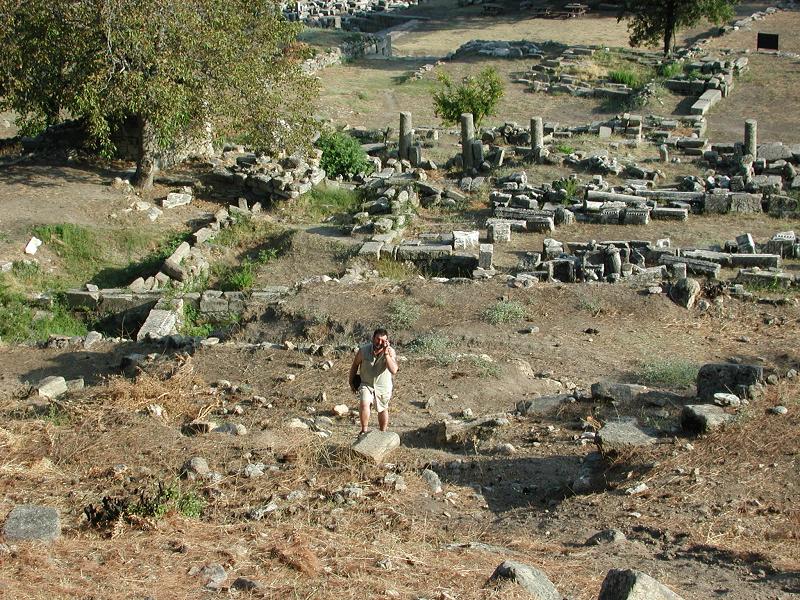
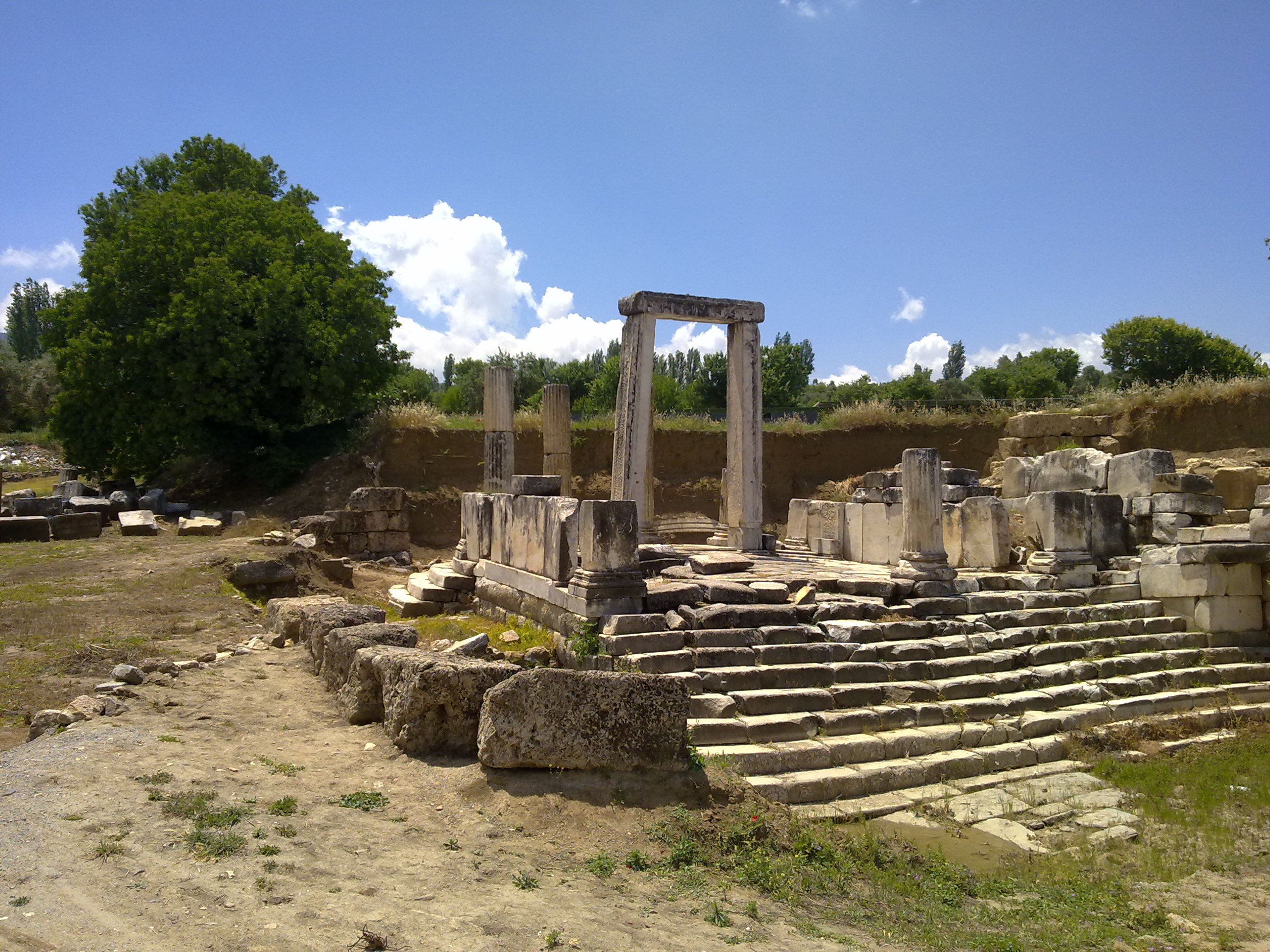
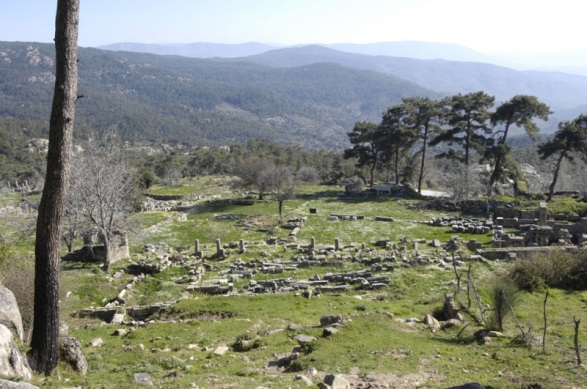
Lagina 1

(Sanctuary of Hekate, Lagina) 


Lagina 4

The place was full of power despite not having been used as a place of Pagan worship for 1600 years. The 1000 previous years of continuous worship must have left their mark, or else it is a natural power spot and was chosen for that reason as the location of a temple to Hekate. After linking in a circle we each of us went individually to address our own personal prayers to Hekate, and I felt a very strong personal contact with the Goddess.”

Turgut hekate

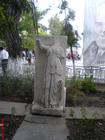
(Statue of Hekate) 

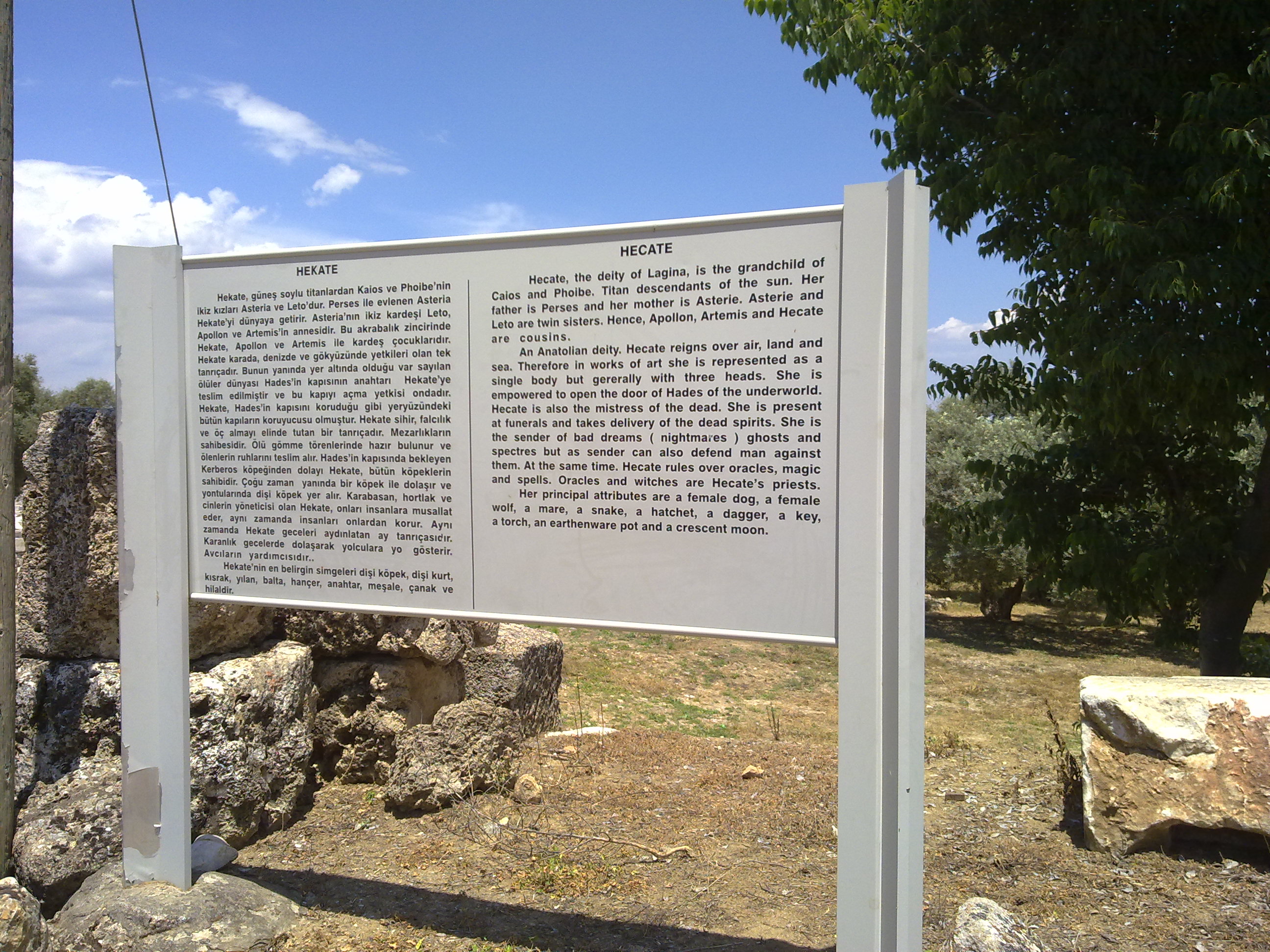
Indeed the Carian Hekate is quite different to the Hellenic or Shakespearian image of Hekate many of us are used to. However the image we saw was quite different. Pictured as a young maiden carrying one and sometimes two torches, she is the one who lights the way.

From Albert Henrichs:

“Hectare was a popular and ubiquitous goddess from the time of Hasid until late antiquity… she emerges by the 5th cent. As a more sinister divine figure associated with magic and witchcraft, lunar lore and creatures of the night, dog sacrifices and illuminated caves, as well as doorways and crossroads.”

From Hekate’s History:

“Hekate probably originated in the mythology of the Karians in southwest Asia Minor, and was integrated into Greek religion around the sixth century BCE. However, there is evidence that Hekate evolved from the Egyptian midwife goddess Heqit, (alternatively spelt ‘Heket’ or ‘Hekat’.) The frog headed goddess Heqit assisted with the daily birth of the Sun and was associated with the apparently magical germination of the seemingly lifeless corn seed. In pre-dynastic Egypt the matriarch and wise woman of the tribe was called the ‘heq’. It’s interesting to note that Hekate is associated with childbirth.”

See also the article ‘Triads and Trinities – The origin of the Modern Pagan Goddess’ by Prudence Jones, updated and published in Wiccan Rede Lammas 2005.

She writes of the early Hekate:

“Inscriptions from the 3rd–2nd century BCE in the adjoining city, Stratonikeia, describe her as ‘Greatest Goddess’; she is paired with the local Zeus, himself called ‘Greatest God’; and like Cybele in Phyrgia she was served in her temple by sacred eunuchs.  Images there show her as a single figure, seated on a throne, or sometimes with lions, often standing, her veil inflated in a crescent-shaped nimbus above her head.  We may suspect that a goddess so richly honoured by the all-powerful Olympian Zeus was a local ruling goddess who was being ‘bought off’ by a newly-dominant priesthood, and so it appears to be.  Hesiod’s father came from the neighbouring province, Lycia in Asia Minor, which had been colonised by Greek-speaking peoples as recently as the ninth and eighth centuries BCE, and so the importance of the ancestral deities was no doubt vivid in the memory of his son the poet.

Hekate’s original name, Akta, is Carian, its meaning unknown, but to the average Ancient Greek its naturalised form would recall hekaton, one hundred, and thus with her abundant riches she was, so to speak, the goddess of millionaires, invoked by everyone for prosperity and good fortune in all areas of life (Theogony 416 ff.).  As the goddess at home in all worlds (the three levels of heaven into which the sun and planets moved throughout their cycles, called the Three Ways in Babylonian astro-cosmology), she was goddess of the roads, guardian of the gates and guarantor of safe conduct.  She was called ‘Protectress’ and Lady of the Ways, and sometimes shown holding a key.”

Her Temple at Lagina was a thriving centre and was linked by a processional way to Stratoniceia

“The city was named after Stratonice, the wife of Seleucus Nicator who forced the old king to divorce in order to marry his son Antiochus I Soter who founded the city in honour of his erstwhile step-mother and present wife. The most significant Hellenistico–Roman vestiges are the Entrance Gate, the Gymnasium, the Bouleuterion located at the centre of the city, the Theatre.

The 11 km/ 7 miles long Sacred Road, lined with tombs and starting from the entrance gate, connected Stratoniceia, which was the political centre, to Lagina Sanctuary, the prominent religious centre of Caria dedicated to Hecate. This Anatolian goddess was Leto’s  twin sister. She reigned over the air, earth and sea, and she was present at funerals to take care of the deads’ spirits. Oracles and witches were her priests. During religious festivals, a splendid ritual procession carried the key of the Temple of Hecate from Lagina to Stratoniceia.”

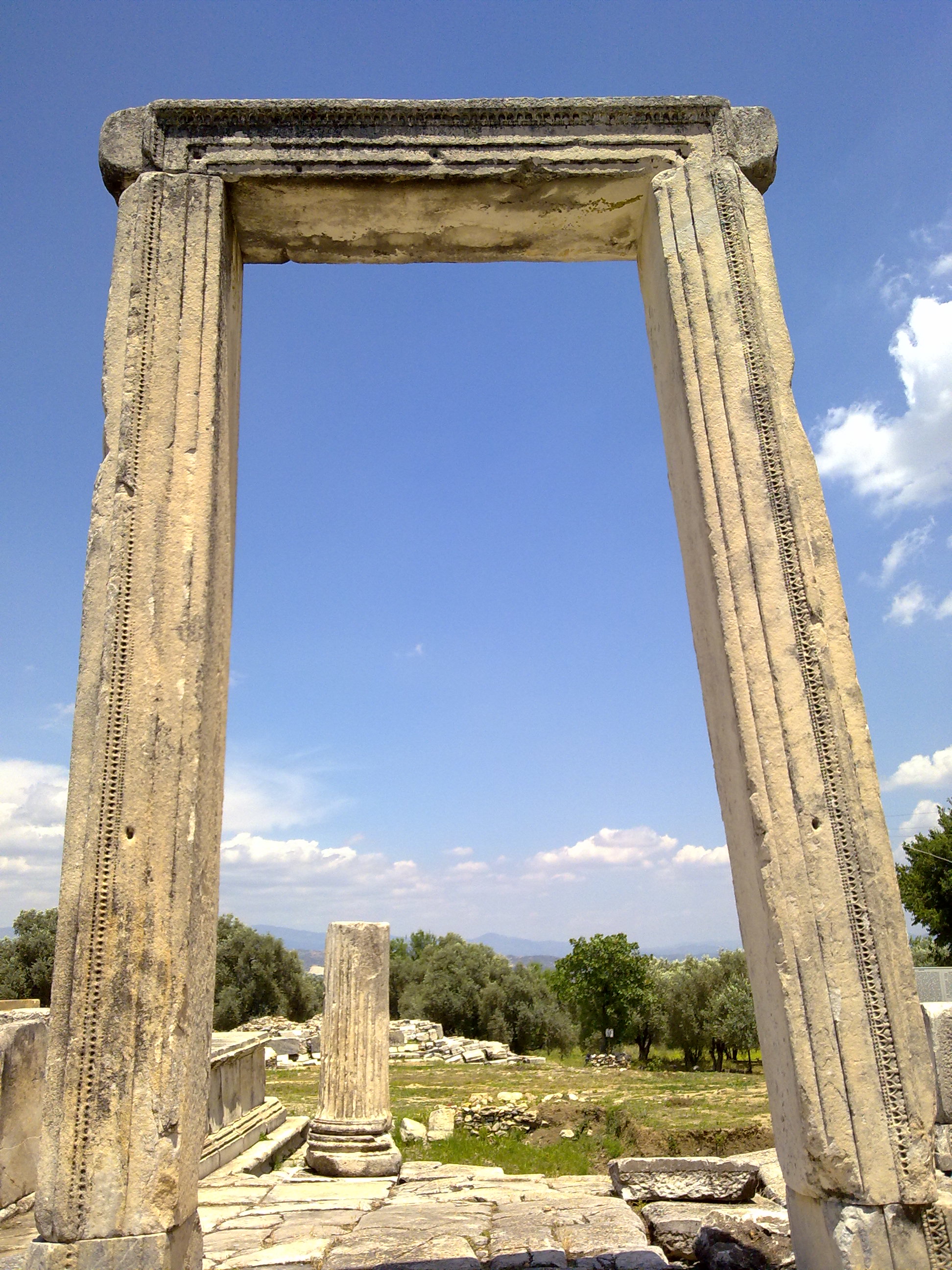
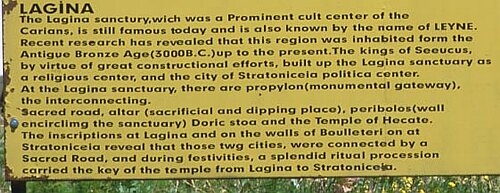
The Lagina Sanctuary, which was a prominent cult centre of the Carians is still famous today and is also known by the name of Leyne. Recent research has revealed that this region was inhabited from the Antique Bronze Age (3000 B.C.) on to the present. The Kings of Selecucid dynasty by virtue of great constructional efforts, built the Lagina sanctuary as a religious centre and the city of Stratoniceia, 11 km. away, was the political centre. At the Lagina sanctuary there are propylon (monumental gateway), the interconnecting Sacred Road, an altar (sacrificial and dipping place), peribolos (wall encircling the sanctuary), Doric stoa and the Temple of Hecate.

The sanctuary is surrounded by walls of about two meters in height, which also form the back wall of the stoa. The monumental entrance building, with three entrances and an apsis at the western end supported by four Ionian columns, is connected to the stoa with a door. From the monumental entrance gate to the altar, there are ten rows of steps leading to the stone-paved road.

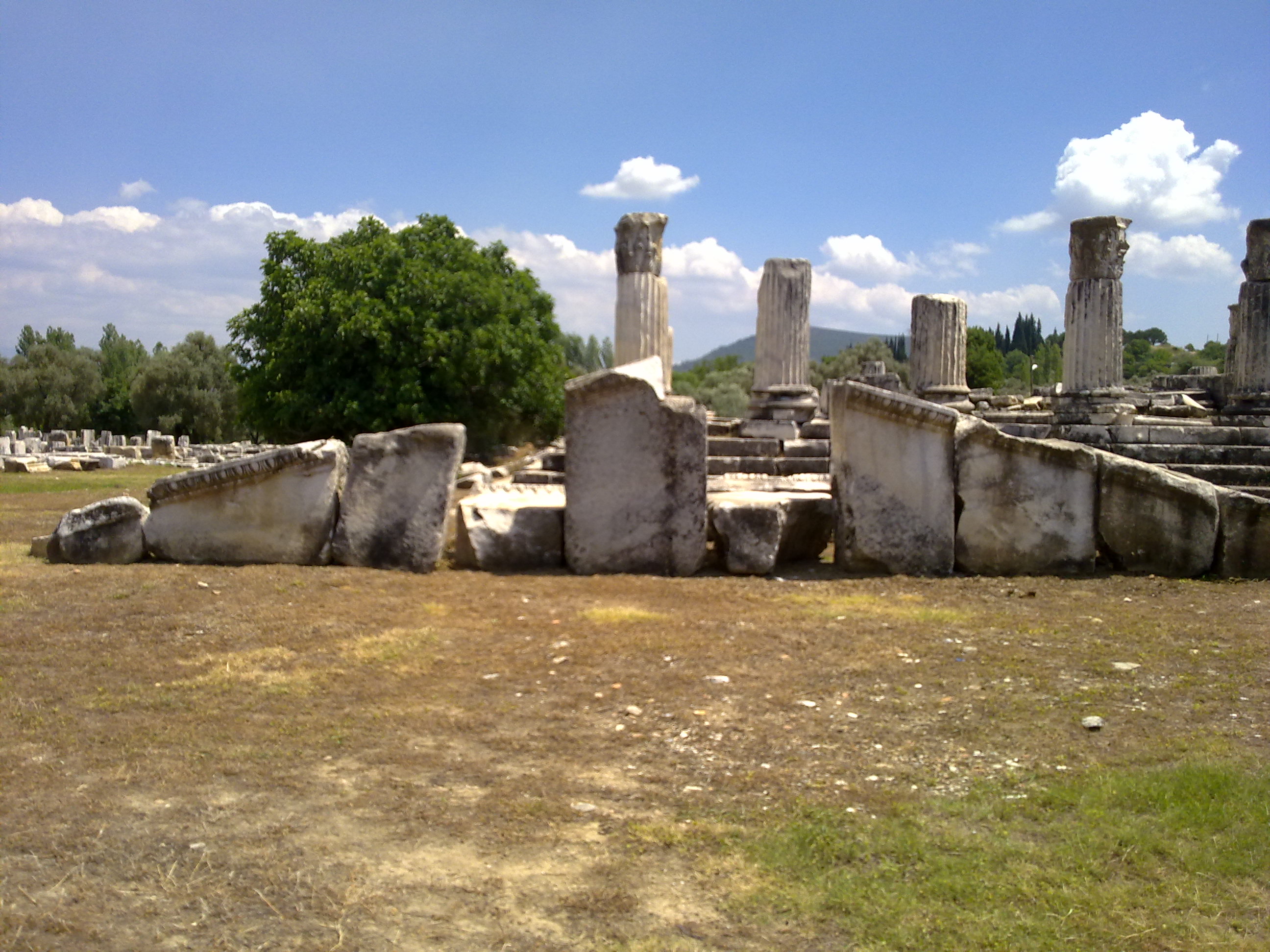
The temple, encircled with five rows of steps, located on an Attic Ionian pedestal, with a single row of columns with Corinthian capital, is at the centre of the sanctuary. The temple is pseudo-dipteral with 8×11 columns, and is built in the Corinthian style.

The inscriptions at Lagina and on the walls of the Bouleterion at Stratoniceia reveal that those two cities were connected by a Sacred Road and during festivities a splendid ritual procession carried the key of the temple from Lagina to Stratoniceia

And on the website http://www.mugla-turizm.gov.tr/en/14120.asp we read:

On the remaining gate there is an inscription, which mentions Augustus having restored it in 27 BC. The temple was built according to Hellenistic fashion of the time in the Corinthian style, though interpreted in a modernist manner by the founders of Stratonikea, the Seleucids, who especially used it in the building of this temple. The father of Turkish museums, Osman Hamdi Bey, carried out excavations at Lagina between 1891-1893. The inscriptions found were taken to the Istanbul Museums of Archaeology. Today excavations are being carried out under the direction of Professor Dr Ahmet A. Tırpan. During recent excavations the architectural portions of the temple were put in an orderly fashion, the propylon was dug up and totally unearthed and a so far undefined sacred structure was discovered.

We were very fortunate to meet Dr. Tirpan and his archaeological team. He has been at the Lagina site since 1999. The video and presentation he gave on the Friday evening was interesting to watch. They are the first Turkish scientists to have excavated a sacred site. Usually it has been the British, German, Swedish who have excavated in Turkey … and taken prize findings to the respective museums. Famous examples are the Gate of Miletos and the Pergamon Altar in Berlin. It is important to the Turkish people that their own scientists are now in charge and that artefacts are kept in Turkey. But this does not prevent cultural exchanges of course.

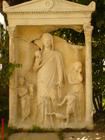
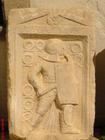
After leaving Turgut we visited the Museum at Milas, a small but lovely museum opened in 1987. There are many statues found for example at Stratonikea, in the 1500 m2 garden.

Milas 1

(Milas Museum) 

milas gladiator

(Gladiators, Milas Museum) 

In the afternoon another ‘wonder’ was waiting for us at Labranda. Again joined by a processional way – this time 20 kms from Milas – the climb up the mountain path must have been strenuous for the ancient pilgrims. The view from this ‘honey country’ was breathtaking. I have been amazed at how green this area of Turkey is. With a Mediterranean climate one would have expected everything to have been brown and burnt by now – in late summer. But no, the greenness of the countryside was unbelievable.

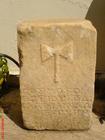
I should mention one other eye-opener. I had always thought that the sacred double-axe, the labrys was a Minoan symbol. However it appears that THE ancient symbol for Karia is the labrys. It was no surprise then to find out that Zeus of Labranda carried a double axe.

Milas labyrs

 (Labrys, Milas Museum) 

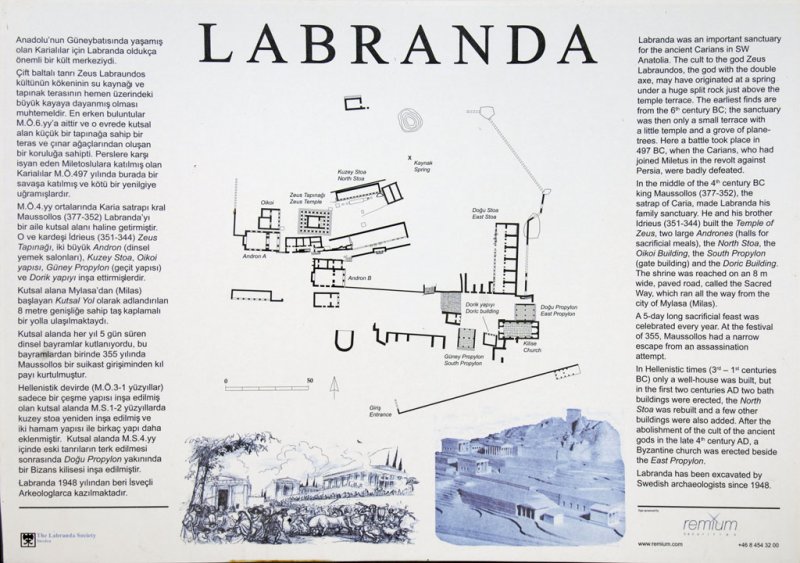
“Labranda, which is the holy area of Zeus Labraundos, is in ancient Karia (South western Anatolia), 14 km north eastern of Mylasa city to which it is affiliated. The most ancient findings belong to the year 600 BC. The area that has been used as holy area in 6th and 5th centuries and then as temple terrace consisted of a single, small, artificial terrace. A war took place in the holy area in 497 and Karia army has been defeated by the Persian army with its alliances.

4th century BC is the most important period of the temple. At the times of the satraps named Mausolos (377 – 352 BC) and Idrieus (351 – 344 BC), this place gained a new appearance. In 355, during the sacrifice festival in Labranda, Mausolos escaped from an assassination towards him at the last moment.

Labranda 1

(Labranda)

Buildings such as a series of artificial terraces here, one or two entrance buildings, a small Dor building (probably a fountain building), monumental stairs, two large feast halls (androns), shed building (named as oikoi), Stoa and Zeus Temple surrounded with columns must be constructed after this event. With the death of Idrieus in 344, such works have been stopped. Because of the big fire disaster that took place in 4th century BC, the holy area has lost its feature of being a cult place.

The excavation works here have been started in 1948 by A.W.Persson and are continuing with intervals since that time. The current excavations are being executed by P. Hellström.

The access from Mylasa to the holy area had been provided via the holy road having a width of 8 m. The laying traces on this road can be seen even today. Access to the area had been provided with one of the two entrance buildings (propylon). These were impressive passage doors made of Milas marble, having two columns and Ionian frontons on each side.

The building called as ‘Dor building’ was located at just east of the southern propylon building with its irregular formation close to a rectangle. It is a building that is turned towards north, has four columns, a front courtyard, a marble side and is in Dor style. It absolutely had the function of a fountain building. This small building has been included in the bath complex.

Labranda 2


200 m west of the holy building lies the stadium whose back side is reinforced with a retaining wall. The starting and end stones of the competitions are still existing at both ends. It is supposed that some competitions have been made here during the feast of 5 days made in the holy area.” (http://www.kultur.gov.tr/EN,39740/labranda.html)

However the most interesting spot for me was at the sacred spring, which still exists today, flowing under a huge rock that has spilt down the centre. As Genghis, our minibus driver noted, “here the sacred water springs form the earth. The sacred bee drinks the sacred water to make the sacred honey…” and indeed the honey was delicious.

Labranda spring

(Sacred well at Labranda)

After Labranda we made our way back to Bodrum where we spent the last couple of days ‘recovering’ from our pilgrimage. No one wanted to leave, nor say good-bye to our Turkish friends. And now looking at my Artemis statue and blue and yellow evil-eye armband and other souvenirs of Karia, I am sure we will be back.

Fred added in his report:

“Turkish official interest in their pagan past, and tolerance for contemporary neo-Paganism contrasts very favourably with attitudes in France, where Paganism like all new religions is viewed with suspicion as a ‘sect’ and can be libelled with impunity, or Greece where Orthodox Christianity is regarded as so much part of the Greek national identity that any alternatives are implicitly if not always explicitly actively discouraged.

Turgut village, where we stayed, gave me a sense of déjà vu although this was my first visit to Turkey. And then I remembered Marcel Pagnol’s films of the 1930s describing life in the Southern French villages of the Midi. People generally assume that Turkish secularism is limited to the sophisticated elites of Istanbul and Ankara, and that the countryside must be still strongly Islamic.

But with 1600 inhabitants and no hotel Turgut fulfilled most of the requirements of a backwoods village. Yet the only women wearing traditional Islamic dress with a scarf around the head were a few older women. Younger people of both sexes wore European style jeans and skirts. The only young women wearing Islamic dress I saw later in Istanbul and was assured by  that they were Arab tourists.

All this removed any doubts that I had about Turkey’s claim to be part of European culture. Of course the picture may be different in Eastern and South-Eastern Anatolia, but then so were Sardinia and Sicily equally different from the Northern Italian mainland 50 years ago and still are.

After we all said our goodbyes on 20 September I spent two days as a tourist in Istanbul, where I had also never been before.”

It is hoped that we will repeat this visit and arrangements are already being made for a return visit in 2006. Many thanks to Atheneris, Boran and Semih and all the PFI delegates who helped in making this a memorable visit.

Morgana.

For more information about future visits to Turkey/Lagina, please email us at morgana@paganfederation.org
General information about Pagan Federation International see www.paganfederation.org and PFI Turkey www.tr.paganfederation.org

Notes

Hekate’s history:     http://hekate.timerift.net/history.htm

“Triads and Trinities – The origin of the Modern Pagan Goddess” by Prudence Jones, updated and published in Wiccan Rede Lammas 2005.

http://www.muglakulturturizm.gov.tr/belge/1-95819/bodrum.html

http://www.muglakulturturizm.gov.tr/belge/1-95829/yatagan.html

Photos of Lagina: http://www.fotografcilar.com/classic/Lagina/

Stratoniceia: http://www.guide-martine.com/aegean10.asp

Labranda: http://www.kultur.gov.tr/EN,39502/archeology.html

http://www.kultur.gov.tr/EN,39740/labranda.html

Photos by Alan & John and published with permission and thanks!!

NB Lagina is the ancient city, Northwest of Yatagan, which belongs to the Yatagan District. This district is part of Mugla, the province on the Aegean Coast of Turkey.

Geplaatst in English articles | Getagged , , , , | 1 reactie

Tales of Anatolia: From Hekatesia to Aphrodisias, Part 1 – July 2012

June 2012 – I finally went back to Bodrum, Turkey after nearly 7 years . Before I left the Sanctuary to Hekate in Lagina in 2005 I uttered the immortal Arnold Schwarzenegger words “I will be back…” and there I was.

But before I write about my latest journey a little update since ‘Hekatesia 2005’.

To say it has been a time of great change in my life would be an enormous understatement and I could no doubt write a book about those 7 years. 7 years in itself is a magical number when concerned with Rites of Passage. Was this indeed the very period of my Second Saturn Return… or as I discovered later also my Third Moon Return? A Saturn return is about 28 years and Moon return is about19 years – so the chronological years of 56-57.

The pages have been written and are archived in my soul. I can’t even begin to share the moments of intense sorrow and joy I have experienced in those years but perhaps I can give you a tiny reflection, an image which may help you on your path.

One thing I have learnt on the path is that if you don’t listen to the insights and lessons given to you, the underlying patterns and discomfort will return with even greater intensity. We are given chances and possibilities to change but only we can change ourselves and our perspective. As healers we know that … and how easy it is to see where other people are making ‘bad’ choices and perpetuating certains patterns. When it comes down to ourselves we often haven’t got a clue.

My awareness of Hekate and the ancient cultures of Anatolia have helped me to understand my own history, my own biography … and perhaps more importantly why I was born in the West and the red thread in this life. That journey has definitely not ended but this visit has been a rounding off if you like. And perhaps like any other 7 year period concluding it also heralds a new phase?

This Tale of Anatolia is not only one of meeting Hekate but one of many other strands from sacred springs, to sacred bees and to the sound of the Labrys as it resonates throughout my journey. The Carian call of Apollo, Zeus and Hermes – of Hekate, Artemis and Aphrodisias – of Cibeles/Kybele and the song of Pudahepa from Hattusa all have found a place.

As I journeyed on the physical road to Mugla… and later to Labranda…  I was overwhelmed by the beauty of the mountains and felt as though I was transported back in time or was I in timeless time? Last time I was here I was with a group … and now alone, but not alone in spirit. I was back where my soul felt at home. I remembered fainting at a mountain restaurant where we had chosen for lunch. I was so sick  that I welcomed this “La petite mort”… if I was to die what better place than this paradise? But no, Hekate wasn’t going to let me die… not yet. That evening we held a private ritual at Lagina. The effects of that ritual would be immense and long lasting.

June 2012: Before visiting Lagina I stopped off at Stratonicea. This was my first visit since after the fainting episode in 2005 I decided to leave the group for the remainder of the afternoon and rest in Turgut. The group excursion for that afternoon was to Stratonicea.

STRATONICEA, Eskihisar, Muğla Province,  It is about 15 kms by modern roads from the village of Turgut and the Sanctuary of Lagina. The processional way to Lagina was about 11 kms.

Dr. Murat AYDAŞ, Classic Philologist and Epigraph, has been doing some recent research into the area round Stratonicea and Lagina. He wrote the following article:

Murat Aydaş, New Inscriptions from Stratonikeia and its Territory, which gives detailed information about recent finds (up to 2009)


06062012403

Stratonicea: Remains of the old City Hall. (Morgana June 2012)

Of particular interest was this reference of the connection between Stratonicea and Lagina and other religious sites in the surrounding area.

http://asiaminor.ehw.gr/Forms/fLemma.aspx?lemmaid=10061&contlang=58

“7. Religion and sanctuaries

In the territory of Stratonicea there were three important sanctuaries: Zeus Chrysaoreus, Hecate at Lagina, to the north of the city and Zeus at Panamara.

According to Strabo the Temple of Zeus Chrysaoreus was found near the city.32 The location of the temple has been identified by some scholars with a place called ‘Leukai Stelai’ (White Pillars), which is mentioned by Herodotus as a meeting place of the Carians.33 The problem of the temple’s location remains a subject for discussion, as well as the topographic confirmation of the place mentioned by Herodotus.34

The sanctuary of Hecate was located 11km to the north-east of the city. A Sacred Way led to the sanctuary, beginning from the northern gate of Stratonicea’s walls through the necropolis. The rules of the religious celebrations of Hecate were written in an inscription found on the north exterior wall of the Bouleuterion of Stratonicea. The region of Lagina had been inhabited since the Bronze Age, which means well before the establishment of the sanctuary at Lagina as a religious centre by the Seleucids. During the cult festivals a procession delivered the key of the temple from Lagina to Stratonicea, as reveal the inscriptions from Lagina.35

The sanctuary of Hecate was surrounded by a wall 2m. high. The entrance was a monumental propylon with three gates. To the west of the propylon there was a stoa with an entrance of an arch supported by four Ionian columns. A stairway with ten steps led from the propylon to a paved way and then to the altar. The temple dominated in the centre of the temenos on a crepidoma. Its architectural type was pseudodipteral with pronaos. The columns, 8 by 11 in number, are in Corinthian order. The sculptural decoration of the temple is exhibited in the archaeological museum of Constantinople, after the excavations and restoration works in the1990’s. The frieze bears representations from the Greek and Carian mythology: on the east episodes from Zeus life circle, on the west the Gigantomachy, on the north the Amazonomachy and on the south the gods of Caria.

The remains of the sanctuary of Zeus Panamareus are scanty. It is located 5 km. to the South of Stratonicea. Nowadays, its location coincides with the centre of the village Bagyaka, thus the archaeological research is impossible. The important festivals Komyria, in honour of Zeus Komyros, were celebrated at Panamara. Komyros was a pre-existing Carian deity that was later identified with Zeus.”

06062012404

Stratonicea: Bouleuterion, (Morgana June 2012)

06062012406

Stratonicea: the theatre, information board, on site, (Morgana June 2012)

As I was walking through the remains of Stratonicea along the path to the theatre it made me realise how important this whole area – Caria –  must have been in antiquity. I caught myself holding my small silver labrys and remembered how important the Labrys was to Caria. After a few words at the Temple of Serapis I continued my journey… to Lagina and Labranda.

LAGINA, Turgut, Mugla, Turkey

It was with a joyful and yet melancholic heart that I approached the Sanctuary of Hekate, or Akta, her Carian name. I was fulfilling my promise made in 2005 and indeed I was back. What was waiting for me? I was struck by the beauty of the trees and wild poppies. It was so fresh and lush, the air so clear and the sky so blue. I stepped and paused … and a kind guide offered to take my photo as if to already acknowledge my return. Later we had a talk and he did indeed remember me from 2005.

I felt as if I was truly coming home. As I walked those last few steps before the Propylon, the gateway, I cast my mind back over nearly seven years since my last visit. Each step bringing back a memory, those moments of elation as Priestess but also those moments of grief we all experience when we have to say farewell to loved ones. Hekate had helped me on more than one occasion in those intevening years. Her strength to help us face the inevitable and also to show us how, and guide us, through even the darkest of nights had helped me to also see her radiance.

And now I stood before the Propylon, without crutches, with two feet firmly on the ground. Who would have thought that I would ever walk again with legs of equal length?

06062012410
Lagina.. approaching the propylon, (Morgana, June 2012)

06062012415
Standing before the Propylon (Morgana, June 2012)

I suddenly remembered Sorita telling me that she had noticed that of about 50 contributors to the book ‘Hekate, Her Sacred Fires’ at least three of us were born with dislocated hips! (Congenital Hip Dislocation/ Displasia).

Were Priestesses of Hekate like shamans… walking between the worlds, often knowing and going beyond physical pain?

Standing firm I called out my name and the intention of my visit. The entrance open I was welcomed. I walked down the steps alone, unaided, and breathed in the fresh and yet what felt like intoxicating air. Or did I feel the drunkenness of the ambrosia pouring into my very being? In any event my feet didn’t touch the ground any more.

I then sat for some time just absorbing the serenity and beauty of the sanctuary.

More memories arise and I can hear a voice, the voice I had heard before. “It’s good, you are doing well.” Those simple words of reassurance and so comforting. Each time when I heard her voice I would be back here in my mind.

And now I was here… contemplating and walking along the temple paths to the Altar and Inner Sanctum. So much I recognised and remembered from the ritual we did at the full moon in September 2005. John found a key here, a real key, and he gave it to me. It played a significant role in our ritual.

After the ritual I left it in the Inner Sanctum. I wondered if I would remember the spot I left it? I walked to the paved area before the high steps of the Inner Sanctum and climbed up slowly. The view was just as I remembered.

06062012425

Looking from on high.. from the Inner Sanctum towards the Altar (Morgana, June 2012)

I knew exactly where I had returned the key. It wasn’t there any more but I was not disappointed. I knew that it had opened other doors… as it had done for me.

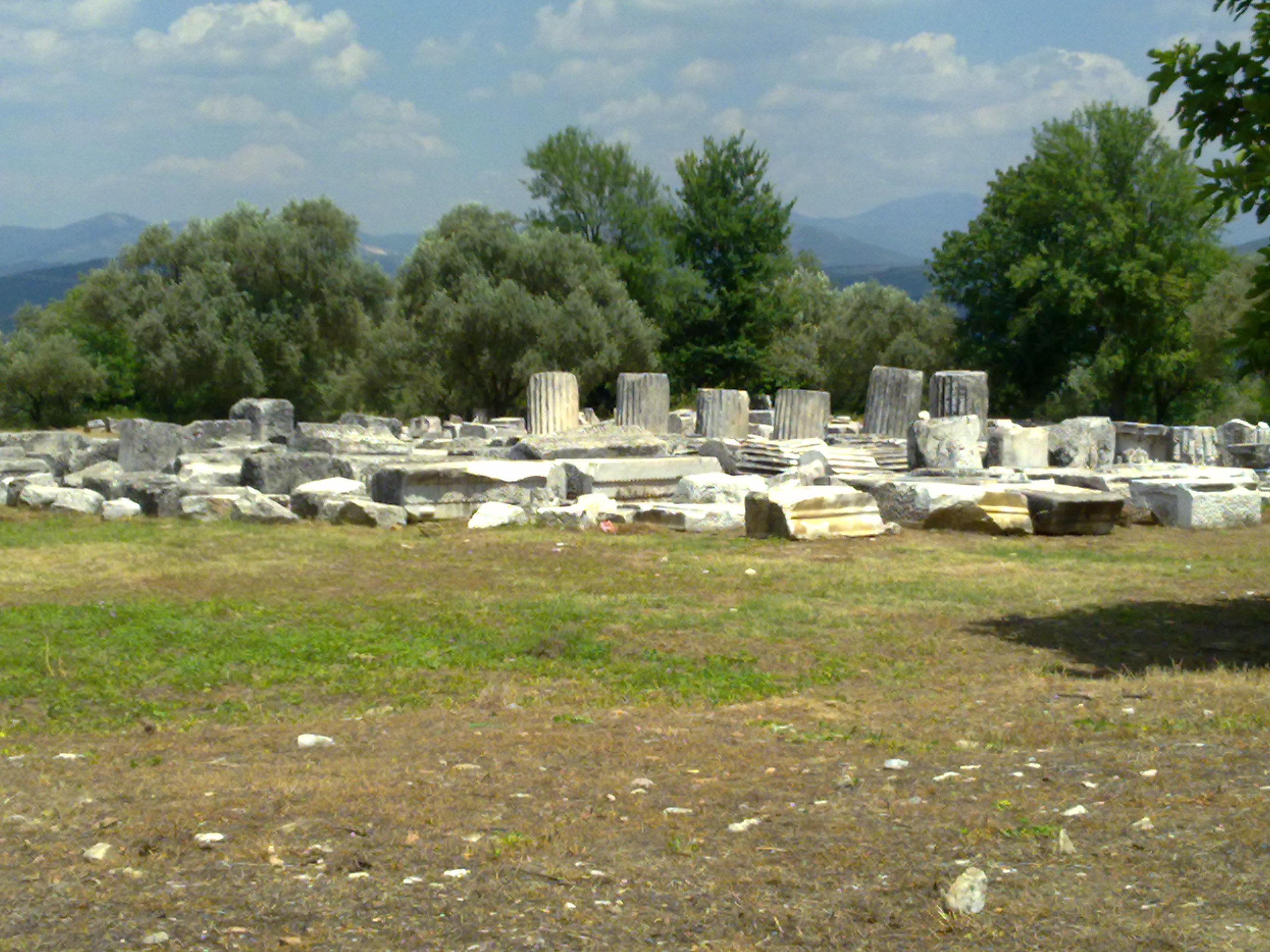
I continued my walk around the sanctuary and noticed several additions. The archaeologists had obviously continued their excavations. I wondered what they had found.

These are some of the photographs I took including what I believe are new finds:

06062012418

Lagina: the Temple looking along the colonnade (Morgana, June 2012)

06062012424
Lagina, part of the Temple frieze (Morgana, June 2012)

06062012429
Lagina, general view (Morgana June 2012)

Before I left I had a lovely talk with Abdullah, one of the security guards. He remembered our visit in 2005 and noted that “you did a ritual with torches..”. He told me that afterwards he made an effort to find out more about Hekate and was delighted that I had come back. He asked me when I was coming back to do a ritual again J

Lagina and the Labrys

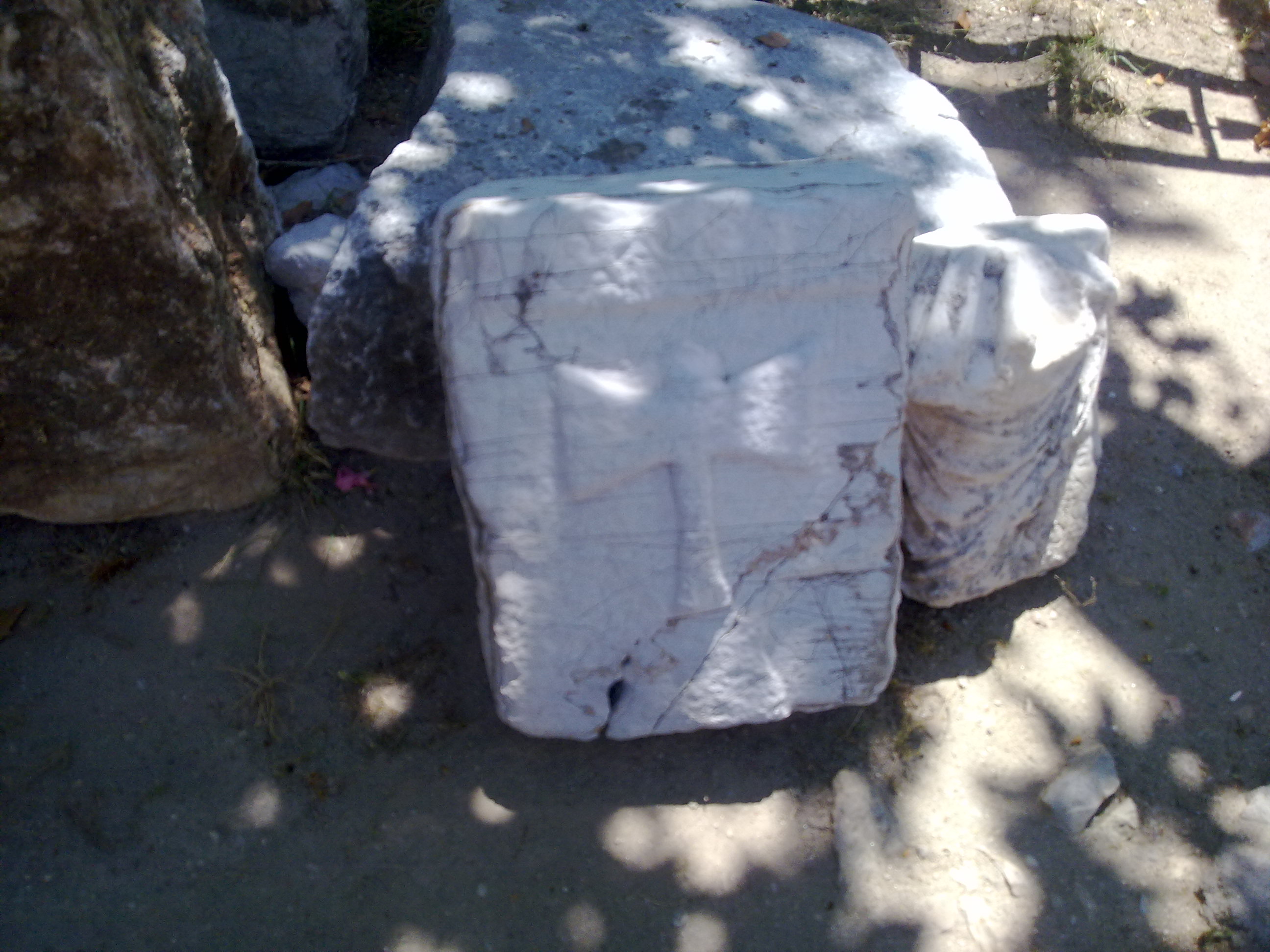
He noticed my labrys and became excited. I should add that in 2005 a number of people had commented on my labrys… and kept say “you are one of us …”. Later I found out that the symbol of Caria was… the labrys. The interesting thing though was his insistence at showing me a stone (probably from the temple roof) which had a labrys on both sides. It was difficult to see but he assured me it was there.

“The friezes of the Hekate Sanctuary are currently being displayed in the Istanbul Archaeology Museums. Four different themes are depicted in these friezes. These are, on the eastern frieze, scenes from the life of Zeus; on the western frieze, a battle between gods and giants; on the southern frieze, a gathering of Carian gods; and on the northern frieze, a battle of Amazons.”

(http://en.wikipedia.org/wiki/Lagina)

When one considers that only a few kilometers away  is the Temple of Zeus … Labranda … one begins to see the further connection between Hekate and Zeus.

06062012413
Lagina, looking towards the Propylon from the temple area (Morgana, June 2012)

old lagina sign Leyne 2

Lagina, An old information board.. notice the name LEYNE


06062012411

The information board June 2012 (Morgana) I think I prefer the old information board 🙂

LABRANDA, 13 kms northeast of Milas (Mylasa), Muğla, Turkey

The road from Lagina to Labranda was a nightmare. The quarrying had continued since 2005 and the lorries going back and forth had done a huge amount of damage to the roads. Amidst the dust we navigated slowly to the site. We did stop a couple of times though. The general views from the mountains are wonderful and the rock formations quite spectacular. It is not difficult to see how these lands inspire poets.

Take a look at Dick Osseman’s photo report of March 2007 here: http://www.pbase.com/dosseman/labranda&page=all  He has included in the captions some of the site information too.

What do we know of Labranda? See my notes in ‘Hekatesia 2005’ (elsewhere in this edition of WR-Online) where I gave a details of the origin of the Temple of Zeus.

And here too:

Labranda, information board on site (Dick Osseman, March 2007)

It was good to be back and note the connection between Lagina and Labranda. Hekate & Zeus. Zeus who had in the Theogony praised Hekate:

“Then the goddess through the love of the god conceived and brought forth dark-gowned Leto, always mild, kind to men and to the deathless gods, mild from the beginning, gentlest in all Olympus. Also she bare Asteria of happy name, whom Perses once led to his great house to be called his dear wife.

And she conceived and bare Hecate whom Zeus the son of Cronos honoured above all. He gave her splendid gifts, to have a share of the earth and the unfruitful sea. She received honour also in starry heaven, and is honoured exceedingly by the deathless gods. For to this day, whenever any one of men on earth offers rich sacrifices and prays for favour according to custom, he calls upon Hecate.

Great honour comes full easily to him whose prayers the goddess receives favourably, and she bestows wealth upon him; for the power surely is with her. For as many as were born of Earth and Ocean amongst all these she has her due portion. The son of Cronos did her no wrong nor took anything away of all that was her portion among the former Titan gods: but she holds, as the division was at the first from the beginning, privilege both in earth, and in heaven, and in sea.”

(The Theogony of Hesiod)

The view from Labranda, Caria 1 (photo by Dick Osseman) (The view from Labranda, Caria 1 (Dick Osseman)[/caption]


And there is the connection with the Labrys.. as I was reminded earlier that day when I saw it at Lagina.

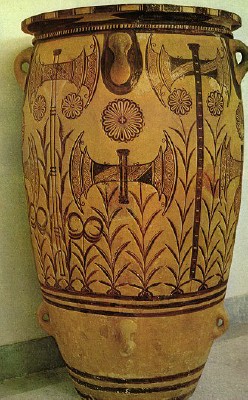
labrys vase

The Labrys used to decorate a vase (Greek)

Etymology

“The word, labrys first appears in Plutarch as the Lydian word for axe

Herakles, having slain Hippolyte and taken her axe away from her with the rest of her arms, gave it to Omphale. The kings of Lydia who succeeded her carried this as one of their sacred insignia of office, and passed it down from father to son until it was passed to Candaules, who disdained it and gave it to one of his companions to carry. When Gyges rebelled and was making war upon Candaules, Arselis came with a force from Mylasa to assist Gyges; Arselis then slew Candaules and his companion and took the axe to Caria with the other spoils of war. And, having set up a statue of Zeus, Arselis put the axe in his hand and invoked the god, “Labrandeus”.

Archeology suggests that the veneration of Zeus Labraundeos at Labraunda was far older than Plutarch imagined. As with its apparent cognate, ‘labyrinth‘, the word entered the Greek languageas a loanword, so that without Plutarch’s specific reference its etymology, and even its original language, would not be positively known. The loanword labyrinth was used in Greek, but the designation “The house of the Double Axe” for the palace at Knossos is doubted because the same symbols were discovered elsewhere.

In England, ‘labrys’ was introduced by Sir Arthur Evans in the Journal of Hellenic Studies XXI. 108 (1901): “It seems natural to interpret names of Carian sanctuaries like Labranda in the most literal sense as the place of the sacred labrys, which was the Lydian (or Carian) name for the Greek πέλεκυς [pelekys], or double-edged axe.” And, p. 109, “On Carian coins, indeed of quite late date, the labrys, set up on its long pillar-like handle, with two dependent fillets, has much the appearance of a cult image.” It should be noted that the priests at Delphi were called Labryades (the men of the double axe). Evans’ article induced the word’s inclusion in the Oxford English Dictionary (OED).”

My own feelings on the origin of the labrys differ from the above in that I have never felt comfortable with the assumption that it is an axe.  Shortly before my visit to Lagina in 2005 I had attended a conference in Uppsala, Sweden. One of the local archaeologists took us out to see the Kings Mounds the day after the conference. These are magnificient tombs but he was more interested in showing us what he called Cultus Houses, which were very reminiscent of the Dutch Hunebedden.

We talked about the funerary rites and he explained that the body was first burned and then the bones were smashed by pouring cold water over the burning embers. The larger bones were then put into a funerary urn and buried.

He also showed us a rather strange stone. He held a small round rock and hit it against the shaft of a standing stone. It gave a dull sound. He then hit the other end of the stone and it rang like a bell.

My immediate repsonse was … the body is burned (fire) drenched with (water) the remains buried in urns (earth) … and the spirits are called by means of a stone bell (air). Later when I was in Lagina (and in other temples) I noticed that if you walk along paved paths of marble… your steps actually ring. I remembered both in Lagina and Labranda there were also processional ways. Would the people coming to the temples see the Labrys as they walked the path?

At Bodrum Castle, in 2005, Atheneris had been shown a stone with a Labrys flanked by two life sized ears. This is one I also found at Bodrum Castle in 2012. There was also information at the Castle about Labranda making the obvious link with Mausolus, the Satrap of Caria, who made it the family sanctuary. Of course the Mausoleum was built in Bodrum / Halicarnassus.

It suddenly dawned on me that the Labrys was not an axe but human lungs with the windpipe down the middle. What better way to illustrate sound and air  than ears and and lungs!

10062012545

Labrys, Bodrum Castle (Morgana June 2012)

In the intervening years I had made another discovery. I had become more then aware of the presence of bees. Not only the actual abundance of honey in the area I was traveling but also the names of the places directly connected to Melissa… the Greek word for honey-bee. Miletos, Milas all ancient places…  as indeed Halicarnassus is too.

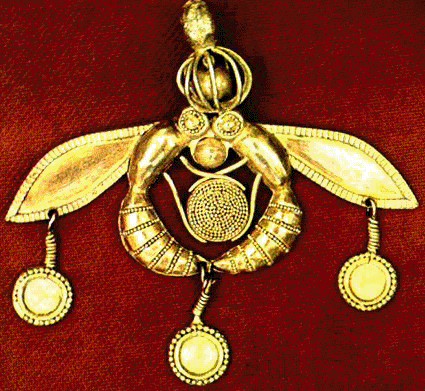
Since 2005 my interest and admiration for bees has grown and they would play a significant role in my journeys both physical and spiritual. Imagine my delight when I came across this image of a bee goddess. It is a gold plaque from the 7th century BC and comes from Rhodes, which is not very far from Caria.

I was struck by the similarity it has with the Labrys.

bee brooch

Cretan Bee pendant, from Chryssolkkos, the Necropolis at Malia c. 1700 BC

And even more striking is the exquisite bee pendant:

This is a Cretan Bee pendant, image of the ‘Double goddess’ (Demeter & Persephone), from Chryssolkkos, the Necropolis at Malia c. 1700 BC (Museum of Herakleion, CRETE). Here you see Demeter and Persephone are both equated with the Bee.

And which Goddess, who Zeus praised above all others, helped Demeter to find Persephone? Yes indeed …  Hekate! She who had “privilege both in earth, and in heaven, and in sea.” Of earth, water, fire and air. She who would guard the Labrys and answer the call of those preparing for the journey to the otherside, the underworld, the place and time all men and women fear. She who held the key.

(To be continued.. the journey goes on to Didyma and the Temple of Apollo and to Aphrodisias.)

****

References:

STRATONICEA: http://asiaminor.ehw.gr/forms/fLemmaBodyExtended.aspx?lemmaID=10061

http://independent.academia.edu/MuratAyda%C5%9F/Papers/1235241/New_Inscriptions_from_Stratonikeia_and_its_Territory

http://www.bodrumpages.com/English/stratoniceia.html

LAGINA and HEKATE:

This is an extensive  article about Hekate by Yukiko Ito : http://www.albany.edu/faculty/lr618/51to.htm

“Hekate, Her Sacred Fires” Edited by Sorita d’Este: http://avaloniabooks.co.uk/catalogue/hellenismos/hekate-her-sacred-fires

and also:  http://hekatecovenant.com/

http://www.fotografcilar.com/classic/Lagina/previewpages/previewpage4.htm

http://en.wikipedia.org/wiki/Hecate

NB “The archaeological research conducted in Lagina is historically significant in that it was the first to have been done by a Turkish scientific team, under the direction of Osman Hamdi Bey and Halit Ethem Bey. In 1993, excavation and restoration work was resumed under the guidance of Muğla Museum, by an international team advised by Professor Ahmet Tırpan.”

LABRANDA & LABRYS:

http://www.pbase.com/dosseman/labranda&page=all

The Theogony of Hesiod, translated by Hugh G. Evelyn-White:

http://www.sacred-texts.com/cla/hesiod/theogony.htm

http://jvpoll.home.xs4all.nl/wdo/GRIEKEN/GEWOON/LABRYS.HTM

http://www.angelfire.com/in3/pukibee/beegoddess3.html

http://womenandmythology.files.wordpress.com/2008/10/big-bee-goddess_bm_gr18604-1234.jpg?w=299&h=300
 

Geplaatst in English articles | Getagged , , , , , , , | 2 reacties

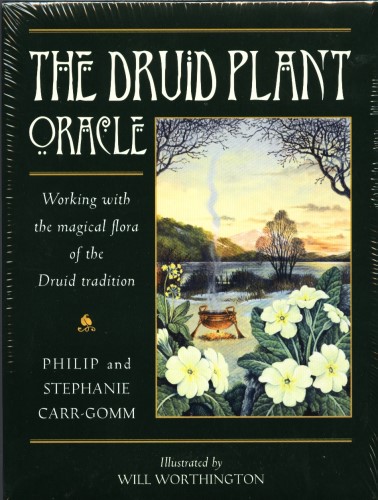
Review: The Druid Plant Oracle

Cover of the Druid Plant Oracle deck
Philip and Stephanie Carr-Gomm. Illustrated by Will Worthington.

The Druid Plant Oracle. Working with the magical flora of the Druid tradition.
New York, St. Martin’s Press, 2007. 36 cards. Book 144 p. € 24,95.$ 24,95
ISBN 978-0-312-36977-4
http://philipcarrgomm.wordpress.com/2007/11/20/the-druid-plant-oracle/
http://philipcarrgomm.druidry.org/The-Druid-Plant-Oracle.html

Many of our readers will be familiar with the other decks illustrated by Will (Bill) Worthington. The Wild Wood Tarot (nu ook in het Nederlands als Tarot van het Wilde Woud) is reviewed by Morgana a year ago – see http://www.silvercircle.org/wiccanrede/wordpress/?p=1637 – and The Druid Craft Tarot by Morgana in the Imbolc 2010 edition of Wiccan Rede. In 1994 the Druid Animal Oracle (in 1998 als Het dierenorakel der druïden) was published. Text by Philip and Stephanie Carr-Gomm, drawings by Bill Worthington.

This Plant Oracle deck is a companion to the Animal Oracle. The cards are even the same size, so that you can combine the two decks to give readings inspired by both the animal and plant realms.
“Druids today use plants to bring health and inspiration. They cultivate plants for their beauty and their properties, they use them to decorate their homes and sanctuaries, and to make incenses, elixirs and magical baths – and they turn to them for the healing of both body and soul.”
The plants in this deck have been chosen for five reasons. Remains were found at archeological sites, the plants are indigenous – with the exception of mandrake, which can be seen as representative for imported species in this oracle. Or they were selected because they are mentioned in old herbals or have been used by herbalists. And “if the modern science of botanical pharmacology affirmed the reputation of a particular plant’s virtues, it felt as if its inclusion was not only historically valid, but of practical value too.”

The beautiful cards depict the plants in ‘Celtic’ surroundings and often with other symbology included in the picture. The book adds the Gaelic and Latin or botanical name of each plant (the cards give the English name) and a description of the characteristics of the plant and its meaning in divination.

The section ‘How to use the cards’ gives several spreads of cards – the Awen spread is familiar for the users of the Animal Oracle – but of course you can meditate on the cards as well. The plants are ordered alphabetically in the book, from Agrimony, via Fern, Mistletoe and Puffballs, to Yarrow, and the last three illustrated cards are dedicated to a series of three plants each: the Banes (Wolfsbane, Henbane and Hemlock), the Guardians (Elder, Hawthorn and Birch) and the Restorers (Roseroot, St. Johns Wort and Valerian).

Since many of the plants also grow in our low lands near the sea, the oracle can be used by Dutch and Belgian people as well. And when you miss your favourite plants: there are three blank cards to fill in the gap.

Geplaatst in Boeken, English articles | Getagged , , , , | Reacties uitgeschakeld voor Review: The Druid Plant Oracle

Volle maan van de speer – ‘Mijn speerpunt’ – 13 augustus 2011

20 juni 2012 vandaag is de condoleance voor de moeder van mijn ‘oudste’ vriendin. We zijn al bevriend vanaf ons vierde jaar. Ik rij zo naar Dordrecht, mijn geboortestad, en zal daar voor de laatste keer in het huis zijn waar ik als klein meisje héél veel uren heb doorgebracht. Ik zal ‘ma’ daar aan het aanrecht bezig ‘zien’ en altijd ‘zien’ zorgen… dat was haar goed toevertrouwd 🙂

En dan lees ik me even in voor het stuk in de WR… dat gaat over de dood. Vorig jaar kwam die rond Lughnassad op mijn pad en nu weer. Ik ben nu op een leeftijd dat ik steeds vaker met deze overgang te maken krijg. Mensen gaan mij voor en zullen mij opwachten als ik dit pad ook betreed.

Ik ga me zo klaar maken voor de reis, morgen is de begrafenis.
De vraag die in deze tijd, rond de Volle maan van De Speer, centraal staat is :”Wat is jouw hoogste ideaal in je leven?” en richt je daar op. Vol vuur richten we ons op ons ideaal, beginnen we ergens aan… maar idealen zijn vaker een zaak van lange adem. Lucht zal ons vuur aan moeten houden!

En vuur kan snel omslaan in een ongecontroleerd gebeuren, zaak dus om het een juiste bedding te geven. Voorheen had ik altijd het gevoel dat ik een vuurplaats had, diep in de grond uitgegraven en met keien omringd… nu voel ik veel meer dat mijn vuur op het water ligt 🙂 als een prachtige drijfkaars, drijvend op de stroming van mijn leven.

Maar nu met deze maan zal ik mijn Speer aansteken met mijn vlam en zal ik haar richten… voor het komende jaar.

Ik heb nog even tijd om die intentie te overdenken… juli een drukke maand. Vol met festivals en vrienden… voorlopig ga ik voor ‘het leven vieren!’


Volle maan van de speer “Mijn speerpunt” 13 augustus 2011

Vandaag, de 14e augustus, is de laatste dag met veel regen. De buienradar liet gisteren zien dat het hierna voorlopig droog is 🙂 Deze zomer is, na een heel hete en droge lente, erg nat. De natuur is er blij mee… het is ook niet echt koud. Het voorjaar was droog en deze nattigheid was dan ook erg nodig. Tussen de buien door hebben we heel wat festivals gehad, het een meer verzopen dan het andere. Toch hebben we gigantisch genoten van elkaar en de bezoekers die in ieder geval wel kwamen. Het is een prachtige zomer geweest tot nu toe… ik ga voor een heerlijke na-zomer 🙂

Volgende week gaan we richting Soest (D) waar we deel gaan uitmaken van een groot Middeleeuws festival in verband met de bevrijding van Soest rond 1500 of zo, waar Kampen aan meegewerkt heeft. Kampen is net als Soest een Hanzestad, dus vandaar dat we uitgenodigd zijn als groep ‘Ridders van de IJssel’, waar we ons dan weer bij aansluiten. Twee jaar geleden was het 35 graden, nu hopelijk wat minder. De jurken zijn klaar en de tenten droog 🙂
Vanuit Duitsland reizen via huis door naar Dorset (GB) waar we een driedaags festival wat gaan opvrolijken in de avond… en daarna heerlijk doorreizen door Zuid-West Engeland. We zien wel waar we aanwaaien 🙂

Een heel druk programma voor de boeg… en mijn intentie staat daar ietwat haaks op 🙂

Rust houden met mijn knie, grenzen bewaken (we gaan er straks vaak overheen :-)) en lief zijn voor mezelf. Sinds acht weken loop ik met, waarschijnlijk, een ontsteking in de linkerknie. Pijn en een gevoel van disbalans; tijdens Castlefest was het zelfs zo bizar dat mijn onderbeen twee á drie centimeter (thuis opgemeten) opgezwollen was na een dag festivalterrein. Dat zag er echt eng uit. Gelukkig was het ’s ochtends weer weg maar in de loop van de dag liep ik weer vol.

De dinsdag na CF had ik al een afspraak staan met de arts. Direct foto’s laten maken, doch meer dan een normale slijtage voor een vrouw van 50 konden ze er niet van maken. We houden het dus maar op een ontsteking van het kraakbeen. Ontstekingsremmers en pijnstilling mee… ben zo blij dat dit aanslaat, de bruisjes van de afgelopen weken deden niets. Dus ik kan weer wandelen!
Gisteravond 22.00 – ik laat het bezoek achter bij man- en dochterlief…”Ik ben zo weer terug, ik kan toch niet ver”. Met de auto rij ik tot vlakbij het bos. Ik parkeer de auto nooit ín het bos, als ik alleen in de nacht ga wandelen… dat zou een punt kunnen zijn waar ik ongewenst opgewacht zou kunnen worden 😛 Dus de auto bij het grote water en lopend het buitengebied in… wat is het aardedonker!

Het heeft net weer geplensd en de donkere wolken zijn nog niet voorbij. Ik realiseer me dat ik, met mijn flutknie, behoorlijk kwetsbaar ben. Ook heb ik voor het eerst mijn mobiel thuis laten liggen. Ik ben echt alleen en afgesloten van thuis. Alles ademt vocht, donkerte… en stilte. Af en toe een piepje in de nacht… er zitten hier toch héél veel ganzen. Het is muisstil, niets van de drukte van afgelopen maanden. Ik voel me niet erg op m’n gemak. Als ik de hoek omsla en het hek doorloop naar het bos, laat ik de enige lantaarnpaal achter me die ik tegenkom op deze wandeling.

En dan is ze er… achter een donkere wolkenflard komt de maan tevoorschijn 🙂 Ik voel me direct beter, niet meer zo afgesloten en alleen. Verbonden met al mijn maanvrienden en -vriendinnen die ook bij deze maan stil staan. Dat is het fijne van het fysiek aanschouwen van de maan. Als ze achter de wolken blijft voel ik altijd een soort van afwijzing / niet aankomen van mijn aandacht 🙂

Ik vervolg mijn weg een stuk opener, blijer. In het weiland richting ‘Boompje’ staan twee reeën. Ze staan dichtbij want ondanks de duisternis zie ik ze staan. En dan op het hek bij de weg naar ‘Boompje’, zit Luca… mijn staartloze metgezel en baas van het Westerveldse bos. Ik praat tegen hem, hij blijft zitten… ik twijfel. Het is donker, toch zit er duidelijk iets zwart/wits op die paal. Maar het reageert niet??? Dan, als ik erop af stap… staat het op en verdwijnt in het weiland waar de reeën staan. Dat kan Luca niet zijn… een vermeende vriend blijkt geen vriend te zijn. Weer alleen… de reeën vinden dat ik nu dan toch te dichtbij kom. Als ik het bospad naar ‘Boompje’ op kom, verdwijnen zij over de weg die ik net gelopen heb… het open veld in. Wat is het bos donker! De maan is weer achter de wolken. Alleen, echt alleen… geen geluid. Dan loop ik op ‘Boompje’ toe. Het is dat ik weet waar hij staat… wat is tie klein en onbenullig in vergelijk met zijn stevige knotwilg-buren. ‘Boompje’ was een iel knotwilgje dat netjes in een rij stevige wilgen stond. Hij had een half gebarst stammetje en bleef achter in de groei en rotte in op zijn oude wond. Anderhalf jaar geleden is hij onderaan afgeknapt en nu loopt hij weer uit… en is weer zijn barst voor de helft kwijt.

Met dit boompje heb ik al jaren contact en iedere keer (tijdens zijn afwezigheid heeft zijn buurboom mij van contact voorzien… op aanwijzing van Luca…) krijg ik iets van hem… meestal een woord.

Deze keer hoopte ik iets van “Liefde”, te krijgen… dat is het woord dat ik in mijn hoofd had, vlak voor ik hem aanraakte en contact maakte. Dan krijg ik “Schok!!”… dat is héél wat anders. Daar sta ik dan in the middle of nowhere… shocked.

Dan realiseer ik me de wijsheid van ‘Boompje’… vrijdag de 12e ben ik bij Tineke langs geweest. Zij heeft de zaterdag van Castlefest haar man, (die ik ook goed kende… heerlijke man!) begraven. Ik kon er dus niet bij zijn. Wel heb ik hem donderdags voor CF nog gezien, hij lag thuis opgebaard, en ik heb een lavendelbloempje van hem (op zijn lichaam lag een bosje lavendel) meegenomen en in ons offer gedaan… voor een goede reis.

De 12e was ik dus bij Tineke en we hadden het over het gevoel van gemis, afgesneden zijn van…

er alleen voor staan, er alleen dóór moeten… ondanks alle liefde en zorgen van kinderen en vrienden. Dit is een proces van absolute eenzaamheid… een periode die haar man ook door is gegaan de maanden/weken voor zijn dood. Kanker! Wat een kloteziekte!

Maar ook blij zijn met het geschenk van deze ziekte. De periode van samen zijn, nabijheid, zorg voor elkaar, spreken, realiseren en liefde… oeverloze liefde! Het huis rook al tijden naar de dood… en het stroomde over van liefde. Samen hebben ze de dag van de begrafenis en alles er omheen, kunnen regelen… het is waanzinnig geweest! Vierhonderd mensen en ruim een uur uitgelopen, omdat heel veel mensen iets wilden vertellen. Gelukkig kwam er geen crematie na hen 🙂 anders waren ze eruit gezet.

Ik realiseer me daar staand bij ‘Boompje’… dat deze eenzaamheid deze overgangsrite de ‘Schok’ is die ik ook eens zal ervaren. Dat vrienden… opeens geen vrienden blijken te zijn… anderen op de loop gaan… net als de zwart/witte kat en reeën. Dan sta je alleen… geen mobieltje om even te bellen, contact is niet meer mogelijk. Alhoewel Tineke aangeeft hem te voelen in iedere vezel van haar lijf.

Ik bedank ‘Boompje’ voor deze pas op de plaats… dit diepe realiseren. Dan, als ik me omdraai om terug te lopen, kraakt het wolkendek… en craquelé laat het maanlicht door. Alsof er iemand een deuk in de hemel heeft geslagen. Dan neem ik mijn hazelaarstaf ter hand, zegen haar en neem de Artemishouding aan. Met haar onderkant op de doorbrekende maan gericht… richt ik mij op gezondheid en liefde! De intentie van ons offer dit jaar op CF, gebracht aan het Wickerbeast, een zwijn dit jaar. Daarna vraag ik aan de elementen wijsheid en zorgvuldigheid in spreken, voelen, eigenen en mijn passies.

Zo mijmerend loop ik mijn weg terug, weer onder de lantaarn door, het duistere pad af. Bij het weiland aangekomen roep ik tussen de hekken door… die altijd open staan, Luca! Viermaal roep ik hem… ik zie wel of hij er is. Ik draai me om naar de weg… en daar komt mijn vriend! Luca 🙂

Hij heeft me gehoord! En is gekomen… weer een les, realiseer ik me. Je echte vrienden zullen er altijd zijn als je ze roept! We knuffelen heerlijk, midden op de weg die verder donker en verlaten is… twee vrienden in de duisternis. Gistermiddag heb ik hem ook gezien… en eindelijk een mooie foto van hem gemaakt… zal eens kijken of ik hem kan laten zien 🙂

Ik laat hem alleen achter op de weg… hij loopt nog een stukje mee op en verdwijnt dan in het weiland.

Opgetogen van zo’n mooie wandeling ga ik naar de auto en naar mijn bezoek. De mede staat al klaar en dochterlief heeft heerlijke bladerdeeg-kaaskoekjes gebakken… wat heerlijk om nu nog zo samen te mogen zijn! Me omgeven te weten door gezondheid en liefde…

Liefs, Loes.

Geplaatst in Artikelen, Volle Maan Wandelingen | Getagged | 2 reacties

The Mara Papers, part 1 Polarity

Logo rubriek 'Gedachten' in Wiccan Rede Online Magazine
THE MARA PAPERS – Morgana

Introductory word:

In the Craft we often refer to a group which offers information to newcomers as an Outer Court Group. I believe this is an American term and may not be exclusively Craft terminolo­gy. However it does seem to sum up admirably the feeling such an information group rad­iates. I hasten to add that al­though we talk here of an Outer Court Group there is no similar ‘Inner Court Group’, unless of course we see the Coven as such a group. Some magical orders refer to this inner group as the Inner Sanctum.

During the numerous years that we having been offering information to newcomers I have accumulated quite a store of written notes and so forth. It occurred to me that perhaps it would be a good idea to begin a column in which some of the results of the discussions and eve­nings could be presented. It would also be extremely interesting if readers par­ticipated actively by submit­ting their own questions, for example concerning philosophical aspects of the Craft, or practical queries about magical work, making magical weapons, etc. I’m not saying that I will know all the answers, but I’m sure that I’ll be able to find someone who can help you, the reader, with your quest. And of course your comments will be of great impor­tance in choosing a topic of discussion. Parts of this column will be a kind of ‘questions and answers’ piece, whilst I envisage other parts to be lengthy dis­cus­sions. Much depends on the reader. By the way, to participate you don’t have to be newcomer: everyone is wel­come to join in!

Just a couple of sentences about the name for this series of papers. Many years ago we were invited by the Fellowship of Isis to be a contact point for the Nether­lands. We were only too happy to ob­lige and consequently we choose the name ‘Mara’ as our central name. Mara is the name of a sea goddess, which we felt was appropriate for a Dutch centre. Although the name is used occasional­ly – we still hear from people who have been referred to us by the F.O.I. – I felt that it was time we gave Mara more ‘body’.

The original series was written between 1994 and 2000. It has now been decided to bundle the articles together into a booklet of the same title ‘The Mara Papers’. And to use it as a primer for newcomers who want to play an active role in finding their feet on the path we know as ‘Wicca’.

This is part 1 and deals with the concept of Polarity.

Morgana, July 2012

**

Getting back to basics.

Many people see the Craft as a path in which one’s individual develop­ment plays a paramount role. We have few dogma’s, no Holy Scriptures and even less ‘rules’. On the one hand this gives the seeker an amazing amount of spiritual freedom whilst on the other hand it demands a great deal of devotion and commit­ment. Having someone to tell you what to do and how to think can be extremely comforting: if you do everything ‘according to the book’ you will be assured of the prize of peace of mind and ultimately happiness. This in itself is no mean goal and for many thousands of people has proven to be the ideal way for them. But it is not the way for everyone.  The Dutch constitution guarantees us ‘freedom of expression’ and yet how many of us ever exercises our political right to individual freedom of thought etc.? Of course it is not easy to break away from traditional ideas and values and look at them with new eyes. And yet one of the things that the Craft is trying to achieve is precisely this. Although we can help each other on the way we still have to understand the need for making our own decisions. And then to act accordingly to our own decisions.

One of the ways in which we can be­come aware is by building up our own frame of reference. This frame need not be worked out in one year – it should be seen as a living organism. Parts will need to be re-adjusted just as the gar­dener needs to weed his garden. New insights – like new plants – need room to grow and flourish. But we do need to realise that this frame of reference will become the foundation from which we will grow further. It will be the base to which we can return after a long jour­ney. It is our inner fundament, which will provide the link to our outer con­nections. It can be seen as a framework that works on many different levels – from the pure physical, waking state of consciousness to the realms of faery and devic consciousness.

Polarity

One of the main principles of Craft philosophy is that of polarity. In fact understanding the principle of polarity can allow us to interpret many situations normally beyond our intellectu­al grip. However we need to define what we mean by ‘polarity’. It is not a static thing in which we see two opposite poles, rather the understanding that two extremes exist which cannot operate without each other. In other words black cannot exist without white: we cannot be aware of white unless we recognise the existence of black. In practical terms we become aware of the many shades of grey, which also exist between the two extremes. In fact we generally work with these ‘shades of grey’. Hardly ever does our con­sciousness swing to the outermost extreme. We would soon experience imbalance and we would usually find ourselves veering back to the centre of equilibrium. In effect between the two poles we ex­perience ‘movement’. This is basically why in the Craft we don’t see polarity as a static thing. It is the root of move­ment and change and in­evitably the creation of something new. As each person is unique, so too is the myriad of pos­sibilities in solving prob­lems. Natur­ally there are things that are going to be similar, just as humans share similar emotions and feelings etc. The outcome is however unique.

Between the two poles there is always a tension, which could be described as a dynamic balance. Absolute equilibrium is always short lived because the two poles are constantly pulling away at each other. In fact we come to realise that balance is based on a much broader band of acceptability. The ancient sym­bol of Yin-Yang seems to underline this feeling of movement and knowledge that perfection in nature is not based on absolutes but on acceptability. It is not a fatalistic view that we can’t ever reach perfection, but the acknow­ledgement that we can reach a level of accept­ability with what we have, including the pos­sibility that we may have a portion of the opposite quality within us. In other words we can only achieve perfec­tion when we have acknowledged the other extreme or pole, even if that quality is negative by our normal standards.

This ’two-in-one’ concept was one of the things which really made me sit up when I first became acquainted with Craft philosophy. That life is not based on an absolute duality but on the idea that creation is only possible when there is movement, tension. This would then mean that perfection is a momentary flash otherwise life would be static. These flashes of perfection are possibly what we could term as ‘divine’ – mo­ments of pure equilibrium, the ul­timate goal of creation. And yet we realise that these moments are few and far between and the major part of our life is based on striving towards the broader band of balance, or acceptability, I mentioned earlier.

Practical Applications

So far I have discussed polarity from an intellectual point of view. How can we use this principle in our daily lives in an attempt to understand the broader im­plications? As is so often the case we can only fully understand one principle by testing it out on another set of prin­ciples. (Polarity already at work!!)

One of the major ‘reference cards’ we use in the Craft is the Yearly Cycle. This is in itself a huge subject; so let me limit it to the eight major festivals as points on the annual cycle of the seas­ons. We have four seasonal fes­tivals linked with the Equinoxes and Solstices: Spring and Autumn Equinox and the Winter and Summer Solstice. In bet­ween those four we have another set of four festivals called the ‘Cross Quarter Days’. The complete order is as fol­lows: Winter Solstice (December 21st), Candlemas (February 1st), Spring E­quinox (March 21st), Beltane (April 30th), Summer Solstice (June 21st), Lammas (August 1st),  Autumn Equinox (September 21st) and Hallo­we’en (October 31st)

We can apply the principle of polarity by looking at each festival in relation to its opposite festival. For example if we look at the Winter Solstice, the opposite festival is the Summer Solstice. To come to a true understanding of one or both of these festivals we need to take into account the opposite. In Summer we see a lot of activity on the surface of the Earth: in Winter little activity on the surface of the Earth. Does this however mean that there is no activity at all? Or do we need to look further? On further obser­vation we can conclude that whilst there is little evidence of ‘visible’ ac­tivity we know that underground in the Earth itself there is a great deal of ac­tivity, as the new plants begin to ger­minate etc. There is a great deal of ‘invisible’ ac­tivity – rather like the baby growing within the darkness of the womb. Winter is cold and dry, Sum­mer is warm and moist: all different con­ditions needed for the plant to grow and bear fruit.

In Winter the Sun has reached it’s low­est point and will begin the new solar cycle: in Summer the Sun will begin to lose its strength and begin the last leg of the solar cycle. But we also begin to realise that Winter could not ‘be’ with­out the Summer and vice versa. The two seasons, though opposites, have much to offer each other in the way of their own existence. The plants in Summer can only come into fruition if they have been allowed to germinate during the Winter months. And vice versa: the seeds germinating in the Earth in the Winter months can only come into existence if the plants come into fruition in Summer. Opposites they may be, but they are also each other’s complements. In practise when we celebrate the Sum­mer Solstice we also celebrate the exis­tence of the Winter. It is for this reason that we use the symbol of fire in both ritu­als. It is our acknow­ledgement of the diversity but also the complemen­tary qualities of both festivals.

It is worth the effort to look (and also to experience through ritual) the polarity of the festivals and to try and discern the similarities, and opposites, of the fes­tivals. It is also extremely illuminating to try and figure out the ‘perfect balan­ce’ between two festivals, i.e. place yourself at the central point between the two, on a kind of axis. What is the sum total? What do you experience as a new creative aspect? Can you translate this feeling into human terms? In a relation­ship? Can you symbolise this feeling? Or the feeling aroused at each of the individual poles? Can you verbalise the feeling? (For example “The sun of Sum­mer caught within the seed of Winter”.) And ultimately, how does the experien­ce alter your own perception?

Of course not all of these questions will be answered in one session. But it should give you some idea as to what extent a similar path of observation may lead you. Much of our observati­on is done by ritual, meditation and path­working – but in this instance pure observation of nature can provide you with many clues. For example choose a walk through a piece of wood or field that pleases you. During the course of one year make this walk very conscious­ly – make notes of how things look, smell, and feel. After a year compare your notes – how different were things during the year and the different seas­ons? Don’t forget your subjective ex­perien­ce and consciously allow your state of mind to play a role. How are you af­fected? Did you feel freer at other times or did you feel the same the whole year round? Try above all to discern the moments when nature seems to be in balance and when there is a definite period or feeling of discord.

Such observations can help you to build a frame of reference, which is not only there for life but is a personal frame on which you as an individual can unfold. Having your own foundation, based on personal experience, is one of the great­est gifts we can obtain and it is there for the taking.


Geplaatst in English articles | Getagged , , , , , | Reacties uitgeschakeld voor The Mara Papers, part 1 Polarity

Oud nieuws in de verjongingsketel gegooid – Lammas 2012

Voetbal als seculiere religie

In juni begonnen de Europese voetbalkampioenschappen en het enthousiasme was, afgaand op de hoeveelheid oranje merchandise overal, groot. In Trouw opperde Leendert Bikker dat ‘Oranje’ als nieuwe spirituele beweging kon worden beschouwd. De laatste dertig jaar is Nederland sterk ontkerkelijkt en tegelijk is de regelmatig terugkerende oranjekoorts in hevigheid toegenomen, schreef hij. De verzuiling is weggevallen, maar we willen toch een vorm van zingeving en saamhorigheid beleven.

De spirituele dimensie van het voetballen zelf is misschien niet zonneklaar; boeiend zijn in elk geval alle rituelen en voorspellingen eromheen. De octopus Paul is dood, maar het Noordhollands Dagblad maakte in mei al melding van een helderziend Oekraïens orakelvarken dat tijdens de EK elke middag de uitkomst van de wedstrijd van die avond zou voorspellen. De Amsterdamse televisiezender AT5 had zijn eigen “hallucinerende pad Do” (jaja) om de sportverslaggeving iets bovennatuurlijks mee te geven.

Trouw wijdde eind juni zelfs een achtergrondartikel aan ‘Dieren als boodschappers van de goden’. Marije van Beek sprak emeritus hoogleraar oude geschiedenis Fik Meijer, die vertelde dat de oude Romeinen en Etrusken al vormen van waarzeggerij met dieren kenden. Zij keken hiervoor naar de vlucht van vogels of naar de lever van een geslacht dier. Alleen ging het daar om het leren kennen van de wil van de goden over serieuze staatszaken, niet om resultaten in een spel.

Ook sprak zij hoogleraar godsdienstwetenschap Gerard Wiegers, die dierorakels als typisch paganistisch en polytheïstisch bestempelt, “wat vroeger ook wel animisme werd genoemd”. In dit wereldbeeld is het hele universum bezield. Het monotheïstische christendom daarentegen heeft het goddelijke buiten de wereld geplaatst. Daar bestaat geen direct verband meer tussen de goddelijke wil en dieren, sterren of wat er verder in de kosmos is.

Wiegers denkt dat de recente populariteit van voorspellende dieren wel verband houdt met de ontkerkelijking, maar dat het toch vooral entertainment is. Ook gelooft hij dat dieren fotogenieker zijn dan tarotkaartenleggers.

Verbieden of belasting heffen

In sommige landen zou kunnen gelden dat het belastingtechnisch veiliger is om dieren voorspellingen te laten doen, omdat dieren geen belasting betalen. Waarzeggers moeten in steeds meer landen hun beroep laten registreren en er belasting over betalen. Nu ook in Tadzjikistan, hoewel waarzeggerij daar officieel als hekserij geldt en dat is verboden in het islamitische land. Waarzeggers en mensen die magische rituelen voor anderen uitvoeren, noemen zich daarom liever ‘traditioneel genezer’ want dat mag weer wel.

In Saoedi-Arabië zijn ze niet zo mild. Daar staat de doodstraf op ‘hekserij en tovenarij’, of wat men daaronder verstaat want waarzeggen als entertainment valt er ook onder, zoals eerder bleek. Het laatste jaarrapport van Amnesty International signaleert een verdrievuldiging van het aantal executies in Saoedi-Arabië. In elk geval twee van de veroordeelden werden terechtgesteld op beschuldiging van toverij. Recentelijk werd een man onthoofd en in eerdere jaren werden er ook al ‘tovenaars’ ter dood gebracht.  De religieuze politie maakt zelfs gebruik van agents provocateurs om heksen op te sporen en mogelijk van marteling om bekentenissen af te dwingen.

Eildert Mulder opperde in Trouw dat de Saoedische rechters voortaan beter een heksenwaag zoals die in Oudewater kunnen gebruiken. Dan kunnen ze constateren dat iedereen te zwaar is om door de lucht te kunnen vliegen.

Op een Marokkaanse website, schreef hij ook, wordt gediscussieerd over de Saoedische wetgeving. Sommige deelnemers aan de discussie betreuren het dat in Marokko geen doodstraf staat op het bedrijven van magie. Iemand reageert daarop met de opmerking dat als dat werd ingevoerd, de bevolking zou worden gehalveerd.

schaaltje

Water drinken dat in contact is geweest met heilige woorden is een traditionele islamitische geneeswijze

… of in het museum zetten

Ook bij de Vikingen was magie overal in het bestaan aanwezig, vertelde de BBC-commentaarstem in een interview met Sigurdur Atlason van het IJslandse Museum van Toverij en Hekserij. De toverijdeskundige legt daarin uit dat magie tegenwoordig meestal als een soort bijgeloof wordt gezien, maar dat het voor de Vikingen iets reëels en praktisch was. Iets om te overleven en onder slechte omstandigheden toch goede moed te houden. Ze hadden bijvoorbeeld magie om de koe meer melk te laten geven of het gras sneller te laten groeien.

Op IJsland hechtte men vooral belang aan de kracht van de taal. Het vermogen woorden op de juiste manier te hanteren gaf iemand macht. Vervloekingen werden gezien als krachtige wapens, vooral in combinatie met tastbare wapens, zoals blijkt uit de bezwering: “Laat dit zwaard de machtigste man van uw familie verslaan, en moge zijn dood allergruwelijkst zijn.”

Spoken van de rechter hersenhelft

Volgens Richard Wiseman in het tijdschrift Psyche & Brein (2/2012) is het geloof in de mogelijkheid van het beïnvloeden van materie met gedachtenkracht, van helderziendheid en andere paranormale verschijnselen “niet typisch voor een selecte groep mensen die fundamenteel van alle anderen verschilt”.

Als je met een kaars achter je, in een verder donkere ruimte, naar je gezicht in een spiegel staart, kan het zijn dat je dat na enige minuten spookachtig ziet vervormen en veranderen in het gezicht van iemand anders. Dit wordt vaak als een vorm van communiceren met geesten gezien, maar dat vinden psychologen geen bevredigende verklaring. Toch neemt zo’n 70% van de mensen zoiets waar. Psychologen vermoeden dat het te maken heeft met hersenen die in de war raken door de lichtomstandigheden.

Een psychologische verklaring van ‘bovennatuurlijke’ ervaringen is dat ze niets abnormaals zijn, maar voortkomen uit normale, gezonde mechanismen van ons brein. Mechanismen die soms op hol slaan. Het herkennen van vormen en patronen is van belang om je te kunnen oriënteren en om oorzaak en gevolg te begrijpen. Maar hetzelfde vermogen maakt dat mensen gezichten kunnen zien in stopcontacten en verband leggen tussen de vlucht van vogels en de toekomst van de staat. Het geloof daarin wordt bovendien versterkt doordat gevallen waarin ‘het klopt’ beter worden onthouden dan de situaties waarin geen betekenisvol verband werd gezien. Als je droomt van een vriendin van jaren geleden en kort daarna belt zij je ineens op, lijkt daar een verband tussen te zijn en onthoud je die gang van zaken, maar als je van een oude vriendin droomt en daarna vraagt je buurman of je de heg wilt snoeien, zie je geen verband en onthoud je het ook niet.

Een andere verklaring zoekt het in een dominante rechterhersenhelft. Beide hersenhelften kunnen dezelfde dingen doen, maar over het algemeen specialiseert de linker zich in zaken als taal, wiskunde en een rationele benadering van problemen, en de rechter in intuïtie, creativiteit en een ervaringsgerichte benadering van problemen. Mensen maken volgens deze theorie vooral gebruik van één van beide hersenhelften en degenen die vooral van de rechter gebruik maken, zouden ook sneller dingen zien die er (volgens de psychologische opvatting) niet zijn.

Geur, geheugen en emotie

In hetzelfde tijdschrift stond een artikel over de reukzin. Het is al lang bekend dat geuren en herinneringen sterk met elkaar zijn verbonden. Aristoteles behandelde het onderwerp al in de vierde eeuw v.C. en aan het begin van de twintigste eeuw schreef Marcel Proust zijn serie romans À la recherche du temps perdu (Op zoek naar de verloren tijd), waarin de geur van een in lindebloesemthee gedoopt madeleine-cakeje een stroom van herinneringen in gang zet.

In het artikel wordt beschreven hoe een kokkin na een ongeluk haar reukzin kwijtraakte. Behalve dat ze hierdoor haar werk niet meer kon doen, leek ze zich bepaalde gebeurtenissen niet meer goed voor de geest te kunnen halen. Herinneringen aan filmkijkavondjes met haar vader, waarbij ze samen salsachips aten, waren vervlakt. Ze was het niet vergeten, maar ze kon het niet meer in geuren en kleuren herbeleven. Omdat geur voor haar zo belangrijk was, ging de kokkin extra aandachtig ruiken aan kruiden en lekker eten. Door deze training lijkt ze haar reukvermogen gedeeltelijk te hebben teruggekregen, maar de herinnering van de salsachips is (nog?) niet zo levendig als vroeger.

In een tekstkader bij het artikel wordt ingegaan op het verband tussen geur en emotie. Depressieve en chagrijnige mensen blijken (tijdelijk) slechter te ruiken. Omgekeerd kan verdriet het verlies van de reukzin veroorzaken. Dit alles heeft uiteraard weer zijn weerslag op het leervermogen en het geheugen.

Reukzin van planten

Planten kunnen ook ruiken! De Nederlandstalige Scientific American publiceerde in het juli-augustusnummer een artikel over het warkruid, Cuscuta pentagona. Het warkruid heeft geen bladeren en geen bladgroen om zonlicht om te zetten in suiker en zuurstof. Het is daarom voor zijn voeding op een gastheerplant aangewezen.

Jonge warkruidjes bewegen met hun top in cirkeltjes om in de omgeving te speuren naar een gastheerplant. Dit lijkt een willekeurig aftasten, maar is dat niet, want ze groeien vervolgens nooit naar lege bloempotten of nepplanten en wel naar tomatenplanten. Het maakt niet uit of de tomaten in de zon staan of in de schaduw.

citroenmelisse

De jonge topjes van deze citroenmelisse zijn gaaf, terwijl de oudere blaadjes zijn aangevreten: een verschil in chemische samenstelling?

Een onderzoekster vermoedde dat het warkruid op de geur van de tomatenplant afging en maakte ‘tomatenparfum’ dat ze op wattenstaafjes in de buurt van het warkruid zette. Inderdaad bleek de plant daar wel op af te gaan. Tarweplanten bliefde het warkruid echter niet. In ‘eau de tarwe’ zaten voor het warkruid minder aantrekkelijke componenten en zelfs een geurcomponent die het afstoot.

In de jaren tachtig werd al bekend dat planten elkaar door middel van feromonen kunnen waarschuwen dat er bladetende insecten of andere beesten aankomen. Als reactie maken de planten dan stoffen aan die bijvoorbeeld die de groei van rupsen remmen,  kever-etende dieren aantrekken, of gewoon vies smaken.

Planten regageren dus op chemische stoffen in de lucht. De auteur van het artikel, Daniel Chamovitz, vindt daarom dat je gerust kunt zeggen dat planten ruiken, ook al hebben ze geen reukzenuwen die met hersenen in verbinding staan.

Gehoor van planten

En ze ruiken niet alleen, maar ze neuriën ook… Dr. Monica Gagliano is eigenlijk zeebioloog, maar ze heeft ook een kruidentuin. Toen ze daar eens aan het werk was – misschien was ze wel tegen de kruiden aan het praten (dat vermeldt de historie niet) – viel haar de vraag in: Zouden planten kunnen horen? Ze vond het zo’n intrigerende kwestie dat ze een tweejarig wetenschappelijk onderzoek opzette om dit te achterhalen.

Hieruit kwam naar voren dat de wortels van jonge maisplanten in de richting groeien van een geluid van rond de 220 Hz. De wortels brengen zelf ook geluiden voort in dat bereik. Het AD schrijft dat mensen de geluiden niet kunnen horen; dat zal dan zijn omdat ze te zacht zijn, want 220 Hz valt wel binnen het bereik van het menselijk gehoor. Het is een lage A.

Bezorgde planten?

Zouden planten dan ook een soort milieubewustzijn kennen? Bij de Hortus van de Vrije Universiteit in Amsterdam hadden ze de 1-aprilgrap bedacht dat de vleesetende planten uit bezorgdheid om het de klimaatsverandering steeds meer op alternatieven voor vlees overstapten. Zogenaamde biologen voerden de Nepenthes-bekerplanten daarom vleesvervangers.

“Maar het mooist van het verhaal komt nog,” schreef Trouw eind juni. Uit een publicatie in New Phytologist blijkt namelijk dat het vleesetende plantje rondbladig zonnedauw (Drosera rotundifolia) bij stijgende temperaturen inderdaad minder vliegjes eet! Vleesetende planten hebben dat ‘vlees’ nodig als bron van stikstof, en bij het broeikaseffect is stikstof rijkelijker in de lucht en in de grond aanwezig, of daar makkelijker uit op te nemen.

Zorg met planten en muziek

Patiënten in de Amerikaanse staat Pennsylvania die na een galblaasoperatie uitzicht hadden op gebladerte, genazen gemiddeld een dag sneller dan degenen die uitkeken op een muur. Ook hadden ze minder pijnstillers nodig en hadden ze minder last van postoperatieve complicaties.

Oude tradities en gezond verstand zeiden het al langer, schreef Deborah Franklin in de Nederlandstalige Scientific American van mei-juni, maar dit toont nog maar eens aan dat tuinen belangrijk zijn voor een goede gezondheid. Alleen al het zien van bomen, bloemen of water verlicht pijn, stress en geestelijke of emotionele uitputting en geeft het immuunsysteem een zetje in de goede richting. Zelfs een natuurfoto kan al invloed hebben.

Niet alleen patiënten maar ook ziekenhuispersoneel blijkt baat te hebben bij een goed ontworpen ziekenhuistuin. Susan Rodiek uit Texas zette wat punten op een rij waaraan “therapeutische tuinen” zouden moeten voldoen. Het best is het wanneer zo veel mogelijk zintuigen worden aangesproken, maar wel met mate. De paden moeten bijvoorbeeld weinig licht reflecteren omdat slechtzienden er anders geen gebruik van kunnen maken. Planten mogen niet te sterk geuren omdat chemotherapiepatiënten daar slecht tegen kunnen.

Op Facebook schreef ‘Daily Medical Info’ in mei dat een ziekenhuis in Istanbul muziek toepast als geneesmiddel. Het werd daar gepresenteerd als traditioneel islamitische geneeswijze, maar is natuurlijk ook buiten de wereld van de islam bekend. Muziek maken in een tuin moet dan wel het toppunt van gezond zijn! En de planten hebben er ook plezier van.

Pythonpil

Moleculair biologe Leslie Leinwand, schrijft Discover (June 2012), werd raar aangekeken door haar collega’s toen ze aankondigde onderzoek te willen doen naar Burmese pythons. Deze slangen kunnen een jaar lang zonder voedsel en als ze dan een prooi eten, versnelt hun stofwisseling in korte tijd enorm. Hun hart moet daarvoor heel hard werken. Leinwand veronderstelde dat hier wellicht een remedie gevonden kan worden voor hart- en vaatziekten.

Ze onderzocht onder meer het bloed van een python die juist een flink maal had verorberd. Het bloed bevatte op dat moment zo veel vet dat het wel melk leek. Bij mensen wordt een hoog gehalte aan vetten in het bloed gezien als risicofactor. Na veel testen ontdekte Leinwand dat juist dit vettige deel van het pythonbloed drie stoffen bevat die hartcellen aanzetten tot groei, dus het hart sterker maken. De huidige medicijnen voor hart- en vaatziekten verbeteren de bloedsomloop, maar maken het hart niet sterker. Als het hart krachtiger werkt, zullen vetten in het bloed minder snel samenklonteren en zich afzetten op de aderwand. Daarnaast voorzien de drie stoffen het hart van nuttige eiwitten en enzymen.

Leinwand hoopt op den duur een pil te kunnen ontwikkelen waarmee de schade na een hartinfarct of ander hartfalen kan worden teruggedraaid. ‘Snake oil’ (slangenolie) is een Amerikaans-Engelse term voor kwakzalversmiddeltjes, boerenbedrog. Is die definitie binnenkort aan herziening toe?

Christelijke wetenschap

De achtergrond van Discover is niet erg duidelijk. Er staan advertenties in die je niet verwacht in een populair-wetenschappelijk blad, bijvoorbeeld voor een boek dat met moderne wetenschap het bestaan van de God uit de Koran wil aantonen. Maar de artikelen zelf lijken me niet religieus gekleurd. Anders ligt dat bij het tijdschrift Weet (ondertitel: “Brengt je bij kennis”) dat duidelijk uit de evangelisch-christelijke hoek komt. In nummer 14 (april 2012) staat onder meer te lezen dat het Berlijnse Pergamonmuseum  een duivels altaar en een poort van de hel herbergt.

De hellepoort is de Babylonische Ishtar-poort. Het duivelse altaar is het grote Pergamonaltaar, dat in de eerste helft van de tweede eeuw v.C. in Klein-Azië werd gebouwd. Men weet niet of het bij een tempel hoorde of op zichzelf stond. Waarschijnlijk werden Athena en Zeus er vereerd. De christenen zijn er van overtuigd dat het de “Troon van Satan” is waarover Johannes in de Openbaringen schreef.

De duivelsheid van het antieke altaar wordt in hun ogen des te meer aangetoond door het feit dat nazi-architect Albert Speer zich er door liet inspireren. Verder hanteren ze een wild-associatieve redenering volgens de lijnen: het altaar was gewijd aan Zeus – Zeus nam soms de gedaante aan van een stier – op de Ishtarpoort staan stieren afgebeeld – de christelijke heilige Antipas werd ter dood gebracht in een metalen beeld van een stier dat werd verhit – Hitler ging op de door Speer ontworpen tribune tekeer als een dolle stier… Wat zouden ze denken van de bronzen stier die onlangs op het Amsterdamse Beursplein werd neergezet? Een duidelijk teken van de naderende eindtijd, waarschijnlijk.

Christelijke privéscholen in Amerika geven onderwijs in dit soort ‘wetenschap’, begrijp ik uit een berichtje in Trouw. Het lesboek Biology 1099 leert dat het bestaan van het monster van Loch Ness is bewezen en dat het een plesiosaurus is. Dat toont volgens deze christenen aan dat dinosaurussen niet zijn uitgestorven, en dat alles in de natuur in één keer is geschapen en niet ontstaan door evolutie.

Ruimte scheppen

“Zie godsdienst als spel, dat schept ruimte” was de kop van een stuk op de opiniepagina van Trouw. Emeritus hoogleraar religieuze antropologie André Droogers zoekt een middenweg tussen twee opvattingen over de rol die iemands eigen religie mag spelen in de interreligieuze dialoog. De ene opvatting zegt dat je om een zinvolle uitwisseling te kunnnen hebben, niet mag claimen de waarheid in pacht te hebben; de andere dat iets geloven nu juist betekent dat je dat voor waarheid houdt, en dat je die overtuiging niet tijdelijk kunt opschorten.

Als we elke godsdienst nu eens zien als spel met eigen regels, schrijft hij. Daarmee worden andere religies in hun waarde gelaten en tegelijk is duidelijk dat elk spel serieus, volgens de eigen regels, gespeeld moet worden. Maar niet te fanatiek! De stichters van de diverse godsdiensten waren zelf eerder zoekend dan verkondigend. Pas nadat hun gedachten aansloegen en er politieke macht in het spel kwam, werden de ideeën rechtlijnig versimpeld, absoluut verklaard en vastgepind in heilige geschriften.

Project Heilig

In het Soeterbeeckprogramma van de Radboud Universiteit wordt de vraag “Wat is ons heilig?”op verschillende manieren gesteld en beantwoord. ‘Heilige geschriften’ worden er ruim opgevat. In Trouw noemden Abdelkader Benali en Erik de Jong (Spinvis) respectievelijk het gedicht ‘Herinnering aan Holland’ van Marsman en Gerard Reves pleidooi in het ezelproces als hun heilige tekst. Benali beweerde desgevraagd dat hij gerust een mes zou willen trekken als het hem niet mocht lukken iemand met argumenten van de eeuwigheidswaarde van het gedicht te overtuigen. Theoloog Jan Borgman verklaarde op de openingsavond van het project dat je het heilige ontheiligt als je anderen wilt dwingen zich eraan te onderwerpen.

Wat is heilig? Hoogleraar cultuurgeschiedenis van de religiositeit Peter Nissen herformuleert de vraag als: “Wat is de grootste waarde in je leven, datgene waar niets voor mag wijken en waaraan je je wilt toewijden?” Nederlanders noemen dan meestal gezondheid, of authenticiteit.

Authenticiteit is vanaf de Romantiek iets heiligs, zegt Nissen. De religieuze invulling van heiligheid is in de westerse wereld en vooral in Nederland op de achtergrond geraakt, of kreeg de vorm van seculiere idealen. In de jaren zestig waren dat maatschappelijke waarden als rechtvaardigheid, vrede en solidariteit. Inmiddels is het verschoven naar alles wat met ‘leven’ te maken heeft: gezondheid, erotiek, een duurzame omgang met de aarde, geluk vinden in dit leven en niet in een hiernamaals.

Perenproject

In het ‘Project Heilig’ is veelvuldig sprake van iets gemeenschappelijks, iets dat de mensen bindt. En dat dat best een “seculiere heiligheid” kan zijn zoals Peter Nissen het noemt. Voetbal dan maar? In Gasselternijveen (Drenthe) kent men een andere mogelijkheid: perenbomen.

In de Hoofdstraat Noord namen de bewoners twintig jaar geleden de zorg voor 74 perenbomen over van de gemeente. Ze snoeien de bomen zelf en hangen nestkastjes op. Sindsdien is de straat een echte gemeenschap geworden, met een feestelijke “eerste plukavond” in september waar iedereen aan meedoet, schreef Trouw.

De oogst brengt zoveel op dat er niet alleen een uitgebreide perenbrunch kan worden georganiseerd, maar er ook peren aan de weg worden verkocht. Het geld gaat in een buurtpotje. Hieruit wordt bijvoorbeeld een bloemetje bekostigd voor zieke of nieuwe buurtbewoners. “Er ontstaat sociale cohesie die er zonder de perenbomen denk ik niet was geweest. Dat is toch bijzonder in een tijd waarin veel mensen voor zichzelf leven,” zegt een buurtbewoonster.

Courgettes ruilen

Degenen die niet in een hechte dorpsgemeenschap leven maar wel een tuintje met groente of fruit of een stel kippen hebben, of zelfs alleen maar te veel hebben ingeslagen in de winkel toen iets in de aanbieding was, kunnen binnenkort deelnemen aan de virtuele ruilgemeenschap op proviandruil.nl, las ik begin juli in Trouw. Bij het schrijven van dit stuk was die site nog niet in gebruik. Het artikeltje kondigt ook een app voor het project aan.

In Griekenland bood de ‘aardappelbeweging’ een vergelijkbaar alternatief voor de supermarkt, waarbij mensen hun aardappels en andere levensmiddelen direct bij de boer konden halen. Maar hier ging het om het uitschakelen van de tussenhandel, zodat de boeren er ondanks de crisis nog voldoende aan konden verdienen en de afnemers niet te veel hoefden te betalen.

Als je een overvloedige courgette-oogst hebt, is de gedachte van het proviandruilen, zijn er vast wel mensen te vinden die wat courgettes willen hebben en jou daar wat eieren voor kunnen geven. De bedoeling van bedenkster Anne Marie Verkade-Diphoorn is dat er op die manier minder voedsel zal worden weggegooid en dat sociale contacten worden versterkt. Zij won een prijs van € 1000 voor dit idee.

Zou het echt gaan werken? Wat als je in Brabant woont en je wilt iets ruilen met iemand die in Friesland blijkt te wonen? De kosten van het vervoer wegen niet op tegen het geld dat je uitspaart en milieuvriendelijk is het evenmin. Je kunt het beter bij je nabije omgeving houden, lijkt me. Maar misschien leer je via die site wel mensen uit je buurt kennen.

Groen in de stad

bessen

Bessenstruiken in de straat kunnen de sociale cohesie bevorderen

In een stedelijke omgeving kan het net zo goed als in een dorpsstraat, blijkt uit een aantal artikelen in Ode (juni 2012). Debra Solomon pleit in Den Haag voor een eetbaar landschap in de stad. Ze plantte in samenwerking met gemeente en buurtbewoners fruitbomen, bessenstruiken en legde groentebedden aan in de Schilderswijk. In Rotterdam en Amsterdam zijn vergelijkbare initiatieven, waar braakliggend terrein wordt omgetoverd in moestuinen.

Stadslandbouw, ook bekend als urban farming, verbindt buurtbewoners die de tuinen onderhouden, er voedsel uit eten, of er met trots naar kijken: “Dat zijn onze appelbomen!” Het maakt dat mensen zich verantwoordelijker voelen en dat de rest van de buurt schoner wordt gehouden. Oogstfeesten waar buurtbewoners samen voedsel uit eigen tuin eten, versterken de verbroedering. De omgeving wordt gezonder door de aanwezigheid van groen. Mensen maken kennis met goedkoop biologisch voedsel.

Zelfs een abri kan allerlei lekkers herbergen, al werd op station Amsterdam Bijlmer Arena een beetje gesmokkeld omdat de tomaten-, aardbeien- en paprikaplanten waar reizigers van mochten plukken, daar niet het hele seizoen groeien. Ze waren er voor de gelegenheid neergezet, om ‘groen ondernemen’ te promoten.

De Rotterdamse voedselbank verbouwt groente en fruit in de eigen achtertuin, die wordt onderhouden door vrijwilligers. Ook in Almelo heeft de voedselbank een eigen moestuin. Andere voedselbanken willen graag samenwerken met volkstuinders en boeren. Wie een courgette- of perenoverschot heeft, kan dus ook overwegen dit aan de dichtstbijzijnde voedselbank te schenken. Die zal er zeker blij mee zijn, want het lukt nu vaak niet eens om iedereen één portie groente of fruit per week (!) mee te geven.

Niet groen in de prehistorie

Wie weet wordt het in de toekomst nog wel eens wat tussen mens en milieu. In de prehistorie leefden de mensen, anders dan velen denken, niet volledig in harmonie met de natuur. De Volkskrant wist zelfs: helemaal niet. Er waren alleen nog niet zoveel mensen. Als de natuurlijke hulpbronnen toen ergens uitgeput raakten, trok men gewoon verder. Tegenwoordig kan dat niet meer.

Midzomer in Letland…

BBC-correspondent Damien McGuinness berichtte uit Letland over het plaatselijke midzomerfeest Ligo. De kortste nacht wordt daar gevierd met veel bier, bloem- en bladerkransen, zingen, mannelijk naaktzwemmen, en met een liefje in het bos verdwijnen ‘om bloeiende varens te zoeken’.

De Letten zijn het er over eens dat het een traditioneel feest is dat onder Stalin verboden was en dat ook de christenen in de twaalfde eeuw al probeerden deze gebruiken te onderdrukken. Dat laatste zou verklaren waarom ze de langste dag op Sint-Jan vieren, een paar dagen na de eigenlijke zonnewende. Maar is dat ook Sint-Jan volgens de Oosterse kalender? In elk geval hebben ze nu veel lol. Een groep Fransen zette de Ligo-viering dit jaar luister bij met een chaotische cancan.

… maar niet in de prehistorie?

Meer naar het westen, in Stonehenge bijvoorbeeld, zouden de druïden in de oudheid rituelen hebben voltrokken bij de zomerzonnewende. Maar dat klopt ook al niet, schreef druïde Mike Williams in het artikel ‘Did the Summer Solstice Exist in Prehistory? The Strange Case of the Missing Ritual’. Dat wil zeggen, er is nooit enig bewijs voor gevonden dat midzomer in de prehistorie een belangrijke feestdag was.

“Vervelende archeologen” (kill-joy archaeologists) wezen er daarentegen al jaren op dat de bouw van Stonehenge een veel spectaculairder schouwspel opleverde bij zonsondergang op de dag van midwinter dan bij zonsopkomst op midzomer. En recentelijk is bij Durrington Walls het ‘festivalterrein’ van Stonehenge opgegraven. Hier werden veel varkensbotten gevonden, van varkens van acht of negen maanden oud. Aangenomen dat de biggetjes in de lente werden geboren, wijst dit op een feest met varkensvlees in de winter.

De meeste andere prehistorische monumenten en woningen blijken net als Stonehenge vooral gericht op de winterzonnewende. Niet allemaal. Maar uit twee passages in klassieke geschreven bronnen valt af te leiden dat de druïden met midzomer nu net géén rituelen hielden. Maar wat maakt het eigenlijk uit, besluit de moderne druïde: wij vieren het zoals we het vieren en dat blijft mooi, ook als onze voorouders het anders deden.

~ Met dank aan iedereen die me (indirect) op nieuws attendeerde ~

Geplaatst in Nieuws | Getagged , , , , , , , , , , | Reacties uitgeschakeld voor Oud nieuws in de verjongingsketel gegooid – Lammas 2012

Recensie: Eten en drinken met wilde planten

Laurette van Slobbe
Eten en drinken met wilde planten. Gids voor het herkennen, oogsten en bereiden van wilde planten, het hele jaar door
Twello, Hof van Twello, 2009. 160 p. € 24,75. ISBN 978-94-90404-01-7
www.hofvantwello.nl, www.florae.nl en www.eetbarewildeplanten.nl/

Voorkant van het boek Eten en drinken met wilde planten

Eeuwenlang hebben we ons gevoed met wilde planten, maar nu is het exotisch voedsel geworden. Waar vroeger de kennis omtrent welke planten eetbaar en welke giftig zijn vrij algemeen was, hebben we nu deskundigen als Laurette van Slobbe nodig. Zij neemt ons mee naar buiten en door het jaar heen, en vertelt ons welke planten we kunnen eten. Ook legt ze uit wat er zo nuttig is aan die planten, bijvoorbeeld dat wilde planten in het voorjaar hoge concentraties vitamine C bevatten, soms zelfs meer dan citrusvruchten. En dat je ook weer niet teveel van dezelfde planten moet eten, omdat een teveel bepaalde organen kan overprikkelen.

De gids begint met een overzicht van eet- en drinkbare planten met twee foto’s per plant en aanwijzingen over waar en in welke maand je ze kunt vinden. Ook worden de gerechten al genoemd die in het tweede deel, per maand, uitgebreid beschreven worden. De recepten zijn heel eenvoudig, maar zien er onweerstaanbaar uit. Op twee pagina’s onder ‘augustus’ worden bijvoorbeeld deze recepten gegeven, met foto’s bij drie ervan: kornoeljetoetje met bramen en vlierbessen, vla met peenzaad, bramen-paardenbloemsmoothie en confiture met engelwortelbloem. En in februari vind je gevulde portobello’s met brandnetelpesto, kraailookmuffins en roomkaas met daslook achter elkaar. En natuurlijk staan er ook salades en soepen beschreven. Bij de recepten wordt ook nog aangegeven of ze vegetarisch of rauw en veganistisch zijn.

Bij dit soort boeken let ik ook altijd op de waarschuwingen. Bij de peenbloem staat niet dat die verwant is aan scheerling, wel dat de bloemen van peen zich onderscheiden van andere schermbloemigen door één purperen bloemetje in het midden van het witte scherm. Bij klein hoefblad niet dat het in wat grotere hoeveelheden schadelijk kan zijn bij zwangerschap. Maar bij speenkruid wordt nadrukkelijk gezegd de plant alleen te eten voor de bloei, omdat daarna het gehalte aan gifstoffen in de bladeren te hoog wordt. En de schrijfster waarschuwt in tekst en beeld om smeerwortel niet te verwarren met het giftige vingerhoedskruid en geeft hele goede algemene aanwijzingen. “Laat je gerust inspireren maar ga zorgvuldig om in het toepassen van deze informatie.” En inspireren, dat doet dit prachtige boek, mét indexen op soortnaam en recepten, absoluut!

Geplaatst in Boeken | Getagged , , | Reacties uitgeschakeld voor Recensie: Eten en drinken met wilde planten

Recensie: Leven als de bomen

Hans Bouma en Aly Brug
Leven als de bomen
Zoetermeer, Meinema, 2012. € 13,50. ISBN 989-90-211-4424-5
www.uitgeverijmeinema.nl

Voorkant boek Leven als de bomen

Dit boek beschrijft – en stimuleert tot – een wandeling door de vier seizoenen, met prachtige foto’s van Aly Brug en een inleiding en gedichten van Hans Bouma. “Een wandeling in gezelschap van de bomen is ook een wandeling door de seizoenen van je eigen levensverhaal.” Bouma is duidelijk christen, en ziet samenhang tussen zijn geloof en wat bomen betekenen. De liefde van Bouma voor bomen – en voor God – spreekt uit zijn gedichten, en die van Aly Brug uit de ontroerend mooie foto’s. Maar zijn poëzie overstijgt zijn eigen geloof. Ik als als heiden kan me er ook vaak in vinden, al heb ik een ander godsbeeld en een andere religieuze taal.
In zijn inleiding refereert Bouma op een respectvolle manier aan andere religies en hij legt er – voor wie er niet vertrouwd mee is – uit wat Genesis 1 en Psalm 92 betekenen. En daarmee verbindt hij niet alleen de mensen en de bomen, maar ook mensen van verschillende levensbeschouwelijke en religieuze stromingen:
“Ondertussen heeft de mens qua aardsheid ook weer veel gemeen met de bomen. In Genesis 1 krijgt hij de naam Adam: hij/zij die uit de aarde is genomen. Aardeling, aardman, aardvrouw. Bij alle afstand is er ook nabijheid. Bomen – ze zijn familie van ons, verre familie, maar niettemin. Oudere broers, oudere zussen. Er is een mysterieuze verwantschap, stamverwantschap. Het is dezelfde aarde die ons draagt en voedt.”

Geplaatst in Boeken | Getagged , , | Reacties uitgeschakeld voor Recensie: Leven als de bomen