Pathfinder extraordinaire – an interview with Jean Williams, part 2

Pagan Pathfinders, a Humanistic Outer Court, An Interview with Jean Williams by Ash Russell, 2004

The idea of an ‘outer court’ as a place where group leaders can meet potential initiates, give them some basic training, and then decide if people are ready for initiation, is growing more common.  I spoke with Jean Williams about how Pagan Pathfinders evolved into an outer court, and got her views on how this has happened and what value it has added.

I understand that you became acquainted with the Craft as an experiential tradition back in the mid-1960s.

Jean:  That’s right.  The coven was not a training coven.  It didn’t have any formal training and was sometimes informal in other ways: this notion that you have to ask and you have to wait a year and a day, it was more like “We are going to initiate you tonight unless you say no.”

And you later became High Priestess of the group?

Jean:  Yes, in the mid-‘70s; this was about the time that I started Pagan Pathfinders.  I started that partly as a result of all the work I had done in Humanistic Psychology.

How did you get involved in Humanistic Psychology?

Jean:  As a psychologist who was also on a spiritual path, I became very interested in the ideas about human potential and personal fulfilment beginning to be put forward by the avant garde psychotherapists. Humanistic Psychology emerged from a synthesis of new “whole person” approaches in psychotherapy and the consciousness-expanding psychedelic adventures of the ‘60s. People began to realise that everyone, not just the neurotic, can benefit from these new therapeutic techniques and that we all have enormous potential for personal development. In fact, this application of the new therapies was called “the Human Potential movement”: it used mainly group work, using the therapeutic techniques but in a context where every individual was responsible for their own participation and for going at their own pace. There was no one-to-one patient-therapist relationship. The group work included personal interactions such as problems dealing with anger, expressing emotions, assertiveness etc., as well as working through personal hang-ups.

How did these tie up with being on a spiritual path?

Jean:  People tend to find, when they embark on a quest for personal fulfilment, that they experience high states of expanded consciousness, a sense of oneness with everything. It arouses their sense of the spiritual, but not necessarily a desire for the monotheistic religions. In the ‘70s people in the Human Potential movement went in their droves to India or joined the Rajneesh organisation in Britain. I was already a witch and couldn’t understand why they couldn’t find what they were looking for in our own Pagan traditions. The reason, of course, was that Pagans were disorganised and witches (including me) tended to be very secretive about our spiritual activities.

How did you come to start Pagan Pathfinders?

Jean:  I think it was Fred’s first wife said to me, “When are you going to start teaching some of the things you’ve been learning?”  “Um, um, um, what am I going to do with this?”  I thought well, the Humanistic Psychology people really need some sort of a link with indigenous British spiritual paths, and not always have to go off to the Far East.  At the time I could see there were Wiccan groups falling out with each other and splitting up and members not speaking to each other, and things like that, so I thought, “They need Humanistic Psychology”.  So I thought I’d try to make a sort of blend of the two.  So Pagan Pathfinders became our exoteric training and sieving process, because we got quite a few members who came through Pagan Pathfinders at that time.

It wasn’t meant to be an outer court as such?

Jean:  It wasn’t meant to be that in the first place.  I thought I would rather like to try my hand at something of this sort, and then found that I had a bit of a gift for it, because I used to find all these ideas popping into my head as things do when you’re on the right path.  So it felt as if it were taking on a life of its own.  I thought, “Well if I can do it, anybody can do it.  Why aren’t more people doing this sort of thing?”  Gradually I suppose people have started doing the same type of thing.  Pagan Pathfinders has always had a hefty Humanistic Psychology input:  we use body awareness, dance and meditation for inner exploration of ways in which we limit ourselves and then use pagan myths and images as sources of archetypal inspiration, wisdom and empowerment. 

So if you were interested in mythology and archetype, was this British myth?

Jean:  No, it wasn’t actually, because my whole educational background had been much more in Greek and Roman myth.  They were the stories I had read, and they had been sort of built into my education.  Traditional, old-style classical education I suppose.  Then I was very attracted by Egyptian myths. And iconography.  In fact I have never been that much immersed in the British myths.  I always found it extremely confusing.  I suppose somehow it was never very clear with me, the archetypal personalities haven’t emerged.  I suppose it is partly that the Greek and Roman myths and gods and goddesses are so woven into astrology, the naming of the days of the week and things of this sort.

So, Pagan Pathfinders started out as a way to express and teach some of the Humanist training you’d had before.

Jean:  Yes, that’s right:  to explore that particular type of creativity using meditation and pathworkings, and I found I could actually lead a group and get people going into themselves and having an experience.  That again has always been experiential.

So members have the opportunity to learn to about tools for self-exploration, such as pathworking?

Jean:  The idea of Pagan Pathfinders is that people gain insights about themselves, gain new perspectives on their problems and to get inspiration for the way ahead: what they might do to change things in their lives or to let aspects of themselves flower more – that sort of thing.  So hopefully I will be giving people tools for doing that and for empowering themselves, and exciting them about the possibilities and giving them optimism about their lives; but also I hope to show how really easy and simple it is to pass this sort of thing onto other people.  I hope from this that people would be able to prepare their own pathworkings, their own rituals, and manage their own inner exploration and empowerment.

Jean:  Pagan Pathfinders isn’t a one-woman show.  I encourage people who have been attending for a while to have a go.  I might say, “Who’s going to volunteer do a Samhain ritual for Pagan Pathfinders this year?”  Some people, who come, also have experience of other forms of spiritual development. There’s somebody very much into the Gabriel Roth dancing thing (five rhythms) and so once a term she does an evening of dancing and movement.   We have had evenings on Norse seidr, the Celtic tree alphabet and a whole short tarot course.

So instead of being just a guided meditation shop for inner exploration, it has become a place for people with varied skills to come and share them.

Jean:  That’s right, amongst other things.  Some people just come along for the experience.  Each Pagan Pathfinders session usually starts off with some sort of movement, like moving meditation, dancing or chanting, which gets the energy moving, and then there is a sitting meditation followed by either a pathworking or an informal ritual.  That’s the general sort of pattern.

So how have the years of experience in PP fed into the group experience?

Jean:  If something has really worked well in Pagan Pathfinders, I will introduce into a coven meeting, without telling them that that’s where it started.

What about people?  Have you felt a difference in the way that people come in and the way it feels when you get them in with that kind of background?

Jean:  Yes.  It used to be very laborious process bringing people in before, unless they were part of our circle of friends.  Because we had to sort of bring them into our circle of friends, and if they lived outside of London, that often took quite a long time.  So it might well be more than a year and a day, before we knew them well enough to say, “Right, we’ll initiate you.” There wasn’t much of a route for them to come in, and we relied very much on somebody knowing somebody.

Pagan Pathfinders allows us to get to know people much more.  A lot of people who come to Pagan Pathfinders aren’t that aware that there’s a coven.  We don’t publicise it or say there’s a coven.  There are people who are already initiated who come – they tend to talk a little more uninhibitedly than we would.  So other people pick up that maybe there is a coven here.

We sort of take things rather easily in our old age.  We don’t feel a pressure to find new members or to bring new people in, though if someone asks we might possibly consider it, but we are rather happy trundling along with our little group of people who are very faithful attendees for a long time now.  There is a sort of easygoing comfort and closeness in that.  I was very happy to see a couple of initiates set up their own coven, consisting entirely of people from PP.

So when did Pagan Pathfinders start?

Jean:  I started Pagan Pathfinders in 1974 or ’75 – that’s almost 30 years.

Are people sometimes passed into a various groups via a single, linked outer court?

Jean:  I think it does happen.  I have heard of it, yes.  We’re not part anymore of a network of covens – at one point we used to all meet up in a wood outside of Guildford.  That group of covens used to discuss things a bit.  I can’t recall that we ever passed people to each other.   Certainly Madge W. used to do that.  Madge was a great trainer of people.  We could never bear to throw people out, to say, look, go away, and start your own coven.  But Madge would say, look, you’ve got to start your own coven now.  Here’s your High Priest, you two get together and you start a coven, and here is your first initiate.

So perhaps families of covens within lineages.

And that’s what Madge used to do.  I think that’s the best way, yes, families of covens within a tradition.

So much of what I have read that has been absolutely both inspired and inspirational, has come to me privately and quietly.  I don’t think we share our inspired art publicly very often.  We seem to be hanging onto that privacy.

The Americans are much more open about this.  I think that the Starhawk tradition has a lot of very lovely stuff in some of her rituals in her books.

I’m amazed actually at what can sometimes happen in Pagan Pathfinders: we’ve meditated on a particular goddess or god, or a particular personification of some aspect of a season.  I get them to go into it and feel a yearning to contact that deity, and then say “Now, write an invocation.”  I’m amazed at the quality of the stuff.  We draw a circle and then do a pathworking and then everybody reads their invocation, and it’s really powerful, and amazing quality.  Each person has written maybe only about five lines but they all add together to something that’s very beautiful.  People get these wonderful images, and so individual, too.  They all have different perspectives.  I try to encourage Pagan Pathfinders people to let me have copies of what they wrote, so that I can then put them in the Pagan Pathfinders book: they discover that they too can write wonderful things. They can find that little thread of inspiration within themselves.

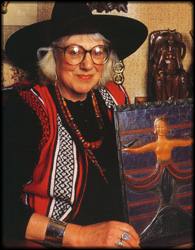
Fairfield Hall, Jean ( Ellen ) Williams

Jean Williams leading the attunement at a PF conference, Fairfield Hall, London

See part 1 of the interview.

Geplaatst in English articles, Interviews | Getagged , , , | Reacties uitgeschakeld voor Pathfinder extraordinaire – an interview with Jean Williams, part 2

Review: Riven – Full Moon, Dark Moon

Review: Riven – Full Moon, Dark Moon – Jyoti Verhoeff & Maya Fridman 

Riven CD cover

See: http://www.jyotiverhoeff.nl/  to purchase and http://www.jyotiverhoeff.nl/music/ which includes several excerpts from this double CD.

Jyoti Verhoeff piano and vocals; Maya Fridman cello and vocals; Henosis Choir and diverse musicians. Recorded in 2014 at the Wisseloord Studio’s in Hilversum, the Netherlands.

All music and lyrics written by Jyoti Verhoeff.
Sound engineer, mixing, editing and graphic design: Fieke van den Hurk

See also the video clip Crack like lovers from Frits de Beer.

JyotiVerhoeff2014-Paradiso-Banner-Square2

This was the flyer announcing the launch of Jyoti & Maya’s new CD Riven – Full Moon Dark moon at Paradiso,  Amsterdam. And what a concert! Having seen Jyoti & Maya on numerous occasions over the last couple of years this was still something quite different. The evening opened with the sonorous sound of huge Gongs, played by Joy Catsburg and Wendy Neuzerling. Jyoti and Maya came on to the stage and were accompanied by Fieke van den Hurk, Joris Van de Kerkhof, and Majsa Koperberg (Harp in “9 circles”).

After the break they were joined by the “Classic Frog Choir” and the  “Symphony Orchestra  Midden Nederland” conducted by Ghislain Bellefroid.

Despite technical difficulties at the beginning of the set Jyoti managed to keep calm. Once the sound technicians had sorted out the problem the hall filled with the warm symphonic sounds backing these two very talented musicians. This was indeed a magical evening.

See Jyoti’s Facebook page for many photos of the evening and a short excerpt on YouTube.

Riven  is the second album that Jyoti & Maya have released. Phoenix the first EP was reviewed in WROnline (Jan. 2013).  Many months of recording, mixing and promotion have gone into realising this double album. But what a result!

“Full Moon” opens with ‘Heroes of Bones” followed by “The Ghost”…  with haunting bell-like sounds. One of my favourite number is “Talking with the Devil”  with a very interesting use of cello from Maya. “He falls down, down, down… Running, running around… Thinking he has found his freedom…” I think even the devil would be tempted by these two sirens 🙂

When the moon is full we think of those lunatic moments when madness overwhelms us. Whether it is sadness or joy we cannot escape the pull of the moon. ‘Silently he took her in his arms… She didn’t notice…’ In “Broken mirror” we can feel the frenetic chase but it is an illusion… a dream.

And the journey ends in the “Labyrinth” as the even the Lion  searches for his hidden heart. Is this too an illusion?

The perfect partnership of piano and cello plus Jyoti’s strong but vulnerable  voice  keeps us wondering…

Whereas “Full Moon” is dreamy and a fairy-like “Dark Moon” is much darker and mysterious. A true dark night of the soul where the dawn is far away. Opening with the enigmatic “Crack Like Lovers” the soul fragments. Frits de Beer has produced a video clip using this track.

“Binah” (Understanding) is more or less an instrumental and has also been used for a short video clip. This time for the Dutch nature film De nieuwe wildernis.

In true gothic style the third track is called “If Roses were the Blood” followed by “Real Science comes after Life” where we are in deep space… or deep sleep?

“Nude” was the opening song with the Symphony Orchestra at Paradiso. As the first rays appear the dawn is finally breaking … or is it the first sliver of a new moon after the dark moon?

Part I Evenfall and Part II Dyad are instrumentals and are as panoramic  backdrops to the final – part III – “Royal Sweet”. “We are all and nothing here…”

I know that I am biased having watched Jyoti and Maya grow into a formidable duo over the past couple of years, but do go and listen to their music on You tube if you don’t know them already.

And of course try and catch them live 🙂

The double CD at EUR 18 is incredible value. Well done everyone who helped to make this all possible!

WP_20140223_001

A more informal setting… Jyoti & Maya, Alkmaar February 2014 – (Morgana). 


Geplaatst in English articles, Muziek | Getagged , , | Reacties uitgeschakeld voor Review: Riven – Full Moon, Dark Moon

Wicca and Initiation

By Luthaneal Adams

There is often a great deal of dissension over the issue of Wicca and initiation. Many people believe that you can be a Wiccan without initiating or that a person can perform a “self-initiation”, while others (mostly Wiccan) declare that initiation is definitely needed and that self-initiation is generally a ridiculous concept.

So which is it, really? In many ways a lot of this really does just boil down to one question:
Do you believe Gardner?
Once that question is answered, all other questions and answers slide firmly into place. Though it is ironic and perhaps somewhat fitting, that whether your answer is “yes” or “no”, we still arrive to the same destination. All that differs is the journey that is taken in getting there.

So, we’ll begin with this question and start of at the easiest answer: Do you believe Gardner?
“No.”
If you don’t believe that Gardner was really initiated into a coven of witches, with reference to Wica, as he claimed, then the situation automatically becomes very simple to resolve. For if he wasn’t really initiated, then that would mean that he created the entire religion himself (though using other sources as influences) and that there was no Wicca/Wica before him.

If this is the case then what can we take away from that? Well first of all we immediately get a distinct view onto what Gardner’s intentions for the religion really were. After all, he created it and he could make it anything he wanted. But in this scenario he made it a mystery religion, in which the only way to practice it was through initiation.

Obviously this is no accident. On the contrary, it is a direct reference for what he intended the religion to be and what he wanted it to be. If he wanted to make it open to everyone, then he could do, but he didn’t. He knew full well what a mystery religion was and had connections to a good few other initiatory organisations.

So from the view of Wicca originating only from Gardner, we can see directly that it was only ever intended for initiates.

But, we can’t just end it there. Though we will take a brief intermission to acknowledge that it is among the foremost opinions that Gardner was probably not initiated into a witch cult as he described and that he instead created Wicca from a combination of the folklore he knew, the influence of the works of Margaret Murray, the influence of OTO teachings, his personal interest in naturalism, Thelema and no doubt a good few other sources that I have neglected here.

It’s worth mentioning this here, as the works of scholars such as Ronald Hutton are not to be absently ignored. Indeed, Prof. Hutton has done extensive research in this area and indeed, in the area of studying historical witchcraft in general and remains the foremost expert on the subject today.
For further references to this line of enquiry and an examination of Prof. Hutton’s work, read his book Triumph of the Moon.
Now, with that said, let’s try and tackle the more difficult subject of examining Gardner’s intentions for Wicca, while allowing for the possibility that his own claims to initiation into a witch cult were true.

When approaching this, there are several angles that need to be considered: Who were these supposed witches and what was the nature of their craft?
What was Gerald Gardner’s relationship to them?
What was their view/tradition regarding initiation and the Wicca?

This last question is very relevant in that its answer will help us to understand not only the traditions that Gardner may have been following, but also the beliefs regarding initiation that were held by the first traceable followers of Wicca and just what initiation may have meant to them. Unfortunately we have no direct words from these witches (at least, not on matters of witchcraft) but we do have the words of Gardner and what he told us about them. But this will be sufficient, as we can all agree that Gardner is the root of the issue and it is his handed down practices that are being followed today.

But before anything, we must tackle that first question:
Who were these supposed witches and what was the nature of their craft?

The identity of the people of the New Forest Coven, to whom Gardner claimed his initiation, cannot be determined with absolute certainty. But although researchers both within and without Wicca have provided us with some very likely candidates, I’ll not spend too much time arguing the different ideas about who was who. For our purposes here it is enough to say that these witches, according to Gardner, had known him for a quite a while and that they lived in or around the area of the New Forest and Christchurch.

But what of their practices? Well Gardner has given us a fair amount of insight into their workings, from his initiation and onwards. For this we can refer to Gardner’s account per Bracelin:
“Gardner felt delighted that he was being let into their secret. Thus it was that, a few days after the war had started, he was taken to a big house in the neighbourhood. This belonged to ‘Old Dorothy’. It was in this house that he was initiated into witchcraft. He was very amused at first, when he was stripped naked and brought into a place ‘properly prepared’ to undergo his initiation.

It was half way through when the word Wica was first mentioned: “and I (Gardner) knew that that which I had thought burnt out hundreds of years ago still survived.
I soon found myself in the circle and took the usual oaths of secrecy which bound me not to reveal any secrets of the cult.”

In just this short account we are able to gather a wealth of information to help us.
We know from this that the practices of these witches were kept secret, so much so in fact that Gardner didn’t even know what he was being initiated into until he was already half way into initiation. We now also know that if these witches existed as Gardner claims, then they definitely had rites of initiation that were needed to be undergone in order to be “let into the secret”. Perhaps more significant though, is that these witches referred to themselves as Wica.

Now, Gardner’s reaction to the word shows us that he was familiar with the old term and its connotations. However, it also implies that both he and they were unaware of how it was pronounced back in the Anglo-Saxon. This leads us to one of two possible conclusions here:

1) Either the pronunciation of the word had changed among this line of witches, so that now it was a different and new word, which now obviously only referred to them.

2) Or, that the word Wica, as used by them, didn’t actually have any connection to the old Anglo-Saxon and so it was still only relevant to them and their practices.

Either way we have a situation in which we have already established that their practices were secret and required initiation, and that the word Wica/Wicca can only refer to their secret hereditary practices.

One could use this alone as a case to drop the subject here and now, acknowledging that Gardner simply maintained this tradition of initiation and secrecy. But there is a lot more information available to us with which we can build a more complete picture as to exactly what their practices were in regards to initiation.

But first, let us stay on the matter of secrecy and examine the answer to our second question:
What was Gerald Gardner’s relationship to these witches?

Well, if we take Gardner at his word, then we already know that he was initiated by them and so thusly he and they were coven mates. But before we look into Gardner’s relationship with them as an initiate, we would probably do well to take a moment to examine their relationship before initiation. As Bracelin records:

“I would have gone through hell and high water even then for any of them.”
– Gerald Gardner on his feelings for the New Forest Coven even before being initiated into them (source: Gerald Gardner: Witch, by Jack Bracelin).

Obviously Gardner felt very strongly for these people and as researchers like Phillip Heselton have shown us in their works, Gardner had a long association with these witches and that this close relationship was built over time. But exactly how close was this relationship?

“I fell in love with a witch when we were fire-watching together during the war.”
– Gerald Gardner to Ralph Merrifield, Deputy Director of the Museum of London, upon asking Gardner where he had learnt his witchcraft.

It is clear to see that Gardner had very strong feelings for the first of these witches that he encountered and although it seems reasonably clear that no lasting romance existed between himself and the afore mentioned witch (probably Edith Woodford Grimes), we do know that he did maintain an extremely close friendship with her and her family, even giving away her daughter at her daughter’s wedding. This event is listed in official records.

It is important to understand at this point that Gardner’s initiation wasn’t taken lightly. No, these witches had known him for a long time and never even mentioned the Craft to him. They kept him in the dark all the while.

We have a picture being painted here. Gardner kept it no secret that he had an interest in the occult and folklore, yet these witches never at any point before initiation even so much as mentioned the Wicca to their good friend. This alone speaks to its secrecy, but it also speaks of what is required for initiation, both then and now. The witches needed to be absolutely comfortable with him and to truly feel that they could bring him into the fold.

Initiation requires trust and love. These things develop over time.
But the nature of their relationship remains an important key in many regards, even after his initiation.
We have seen that secrecy is a necessity to these witches and those oaths were taken that their secret information should not be revealed. But as we know from the existence of his books, Gardner (already a published author), wished to share the existence of the cult with other people via his books.
By all accounts it seems to have been Gardner who broached the subject with them, regarding publishing information on the Wicca and by all accounts they were opposed to the idea.

“I wanted to tell of my discovery. But I was met with a determined refusal. ‘The Age of Persecution is not over’, they told me, ‘give anyone half a chance and the fires will blaze up again’. When I said to one of them, ‘Why do you keep all these things so secret still? There is no persecution nowadays!’ I was told, ‘Oh, isn’t there? If people knew what I was, every time a child in the village was ill, or somebody’s chickens died, I should get the blame for it. Witchcraft doesn’t pay for broken windows.”
– Gerald Gardner, Witchcraft Today

However, there was eventually a compromise made, as Gardner was given permission to publish some information, but only if it was in the form of fiction. This, of course, leads us to his first book on Wicca, which was called “High Magic’s Aid”.

The witches seemed to be okay with this work of fiction and so followed his book Witchcraft Today.
By his own account he went to great lengths to keep secret information out of the book, not just because it was a matter of oath, but because he had so much love and respect for his friends in the New Forest Coven:
“In writing this book, I soon found myself between Scylla and Charybdis. If I said too much, I ran the risk of offending people I had come to highly regard as friends. If I said too little, the publishers would not be interested. In this situation I did the best I could.”
– Gerald Gardner, The Meaning of Witchcraft, referring to his earlier book, Witchcraft Today.

It would seem that the witches were pleased enough with High Magic’s Aid and that later they allowed for a little more flexibility when he came to write Witchcraft Today. However, they were also adamant that no secrets were to be revealed in the book. Perhaps they had seen that his works could be a positive medium to keep their name clean. Gardner quotes of them:
“Write and tell people we are not perverts. We are decent people; we only want to be left alone.”
– Anonymous witch, quoted by Gerald Gardner in Witchcraft Today.

Gardner seems more than happy to honour this request, both to give Wicca a good name and to ensure that they are just left alone. Indeed, Gardner never personally reveals the identity of any member of the New Forest Coven, except by using pseudonyms.

“Now, I simply won’t let my friends, the people who trusted me, be bothered and badgered about”
– Gerald Gardner, 1952 (source: Wiccan Roots, by Philip Heselton)

This, once more, goes to show the close levels of trust and respect that exist within a coven, but it also goes to show that Gardner had respect for their tradition of secrecy and understood their need for it.

But it is deeper than that. In Witchcraft Today, Gardner informs us that in the beliefs of the Wicca, the need for initiation and secrecy goes far beyond a simple fear of persecution:
“witches have a firmly rooted belief in their own powers, and the danger of these being misused if uninitiated people learn the methods. Also, they revere their Gods, and do not wish their names to be known, or bandied about and mocked.”
– Gerald Gardner, Witchcraft Today

Indeed, even today the names of the Wiccan God and Goddess are not revealed to the uninitiated and they are not known to the public. One could argue that this alone makes for a difficult case in regard to uninitiated practice. Fore it is difficult to worship the deities of the Wicca, when you don’t even know who they are.

So we can see that the need for initiation exists as an act of devotion and respect for the Gods of the Wicca, but also in order to keep their magical secrets and rites from being practiced by those who may misuse them.

I am reminded of the Wiccan Rede: “An it harm none, do as thou will.”

Gardner tells us this is the morality of the witches and so it would seem that initiation is also a means to limit potential magical harm. “They do not wish it to be known how they raise power.
– Gerald Gardner, Witchcraft Today

It would seem fair to conclude that this reverence for the divine and desire to do no harm is as true today as was in Gardner’s day. So it is no great surprise that the tradition of initiation is maintained and the inner mysteries of the Wicca remain hidden.

“If I were to disclose all their rituals, I think that it would be easy to prove that witches are not diabolists; but the oaths are solemn and the witches are my friends. I would not want to hurt their feelings. They have secrets which to them are sacred. They have good reason for their secrecy.”
– Gerald Gardner, Witchcraft Today

Good reason indeed. And as a man who was more than familiar with mystery religions, he surely understood better than most.
But as a friend and initiate himself, he respected these secrets and maintained them.

Okay, so we have established quite well that secrecy and initiation were very sacred to the Wicca (assuming they existed before Gardner), but we can even go deeper than that.

Earlier I asked the question: What was their view/tradition regarding initiation and the Wicca?
Well we have already explored a lot of their views and traditions in this regard, but the views so far regard the meaning of being initiated as opposed to being uninitiated. But through Gardner’s words we can also explore the meaning and purpose of initiation within the Wicca. Gardner tells us:

“We ever pick out those who have a little inherent power and teach them, and they practice one with the other and they develop their powers.”
– Anonymous witch, quoted by Gerald Gardner in Witchcraft Today.

“It is no use trying to develop these powers unless you have time and a suitable partner.”
– Gerald Gardner, Witchcraft Today

“They say that witches by constant practice can train their wills to blend this nerve force, or whatever it is, and that their united wills can project this as a beam of force, or that they can use it in other ways to gain clairvoyance, or even to release the astral body.”
– Gerald Gardner, Witchcraft Today

“Being initiated into the witch cult does not give a witch supernatural powers as I reckon them, but instructions are given, in rather veiled terms, in processes that develop various clairvoyant and other powers, in those who naturally possess them slightly. If they have none they can create none. Some of these powers are akin to magnetism, mesmerism and suggestion, and depend on the possibility of forming a sort of human battery, as it were, of combined human wills working together to influence persons or events at a distance. They have instructions in how to learn to do this by practice. It would take many people a long time, if I understand the directions aright to a witch it is all MAGIC [Gardner’s emphasis], and magic is the art of getting results. To do this certain processes are necessary and the rites are such that these processes may be used. In other words, they condition you. This is the secret of the cult.”
– Gerald Gardner

Gardner quite implicitly tells us that one of the key parts of Wicca involves working with your coven and that this is the belief of the witches who initiated him. Indeed, he lets us know quite clearly that not only does the Wicca have secrets, but that their secret practices require a coven – they cannot be done without one.

”To do this certain processes are necessary and the rites are such that these processes may be used. In other words, they condition you. This is the secret of the cult.”

The secret rites of Wicca open up a person’s personal power and unite it with that of their coven. These rites teach and condition the individual to become stronger and more capable in this regard. To practice them requires a coven and these practices remain a secret of the Wiccan priesthood.

Okay, so we have explored the beliefs of Gardner as they were allegedly handed down to him by the New Forest Coven, and they quite clearly state that one must be initiated. The reasons for this are due to reverence for the Gods, personal protection, limiting potential harm and also because the rites of the Wicca are specifically designed to be utilised by a coven.

We also established earlier that “Wicca”, as a word, can only possibly apply to these practices. But when considering these practices in the way that we are, it would be sensible to consider whether any other witches out there may have passed down the teachings of the Wicca.

Again, we can explore Gardner’s own words: “They are the people who call themselves the Wica, the ‘wise people’, who practice the age-old rites and who have, along with much superstition and herbal knowledge, preserved an occult teaching and working process which they themselves think to be magic or witchcraft.”
– Gerald Gardner, Witchcraft Today

Okay, so according to Gardner the witches of the New Forest were following a religious path that had been handed down for a very long time. It would be fair to assume that over the course of that tradition, that religion had undergone some gradual changes that would make it unique, even if other lines existed elsewhere. The two would now be separate and different. Prof. Ronald Hutton does well to evidence that the existence of hereditary witchcraft dating back to ancient times is utterly unlikely and more than not such claims can be seen to be inaccurate at best, or just untrue at worst. So the idea of one such tradition surviving like this to modern day is unlikely let alone several identical traditions spanning from the same source.

But we need not speculate about this, once more we can quote Gardner: “To them the cult has existed unchanged from the beginning of time, though there is also a vague notion that the old people came from the East”
– Gerald Gardner, 1954 (source: Wiccan Roots, by Philip Heselton)

Here we can see that although they claim to have practiced an unbroken tradition, things have definitely been lost along the way, if only with regard to history.

Gardner also says: “My great trouble in discovering what their beliefs were is that they have forgotten practically all about their God; all I can get is from the rites and prayers addressed to him.”
– Gerald Gardner, 1954 (source: Wiccan Roots, by Philip Heselton)

Of course, Gardner is not implying that these witches do not know about their own God or that they don’t know who he is. Indeed, in the same quote Gardner is confirming that the passed down rites and prayers reveal who he is.

What Gardner is referring to is the history of the God and the religion. The witches essentially don’t know where they came from or who the first people were that worshipped their God. He confirms this later as he continues to explore their beliefs: “The witches do not know the origin of their cult.”
– Gerald Gardner, 1954 (source: Wiccan Roots, by Philip Heselton)

It is actually interesting to note that Gardner tends to move back and forth between the words “cult” and “religion” when he speaks of the Wicca. But it isn’t very hard to see why. He reveals to us in Witchcraft Today that he believes the Wicca to be a dying cult and by all accounts it seems he was probably correct. Those identified as his coven mates were aging quickly and in no rush to initiate others into their line. By all accounts it seems that Gardner’s initiation was a rarity and that Wiccan covens were few and on the decline, with members dying within his lifetime.

He has been quoted as saying: “How wonderful to think that these things still survive”
– Gerald Gardner (Source: Gerald Gardner: Witch, by Bracelin)

However, he was of the opinion that its survival was coming to an end and the idea of that was something that he didn’t want to entertain. This was the reason that he wanted to make the existence of the Wicca publicly known, so that he could quicken it.

But as we can see above, there were certain problems. Firstly the witches didn’t want too much to be known about their ways (a wish that Gardner honoured) and secondly they didn’t have a very clear understanding of their own history. Indeed, Gardner is quoted by Doreen Valiente as saying that the teachings that were handed down to him were fragmented and that he filled in the gaps himself.
(Source: Witchcraft for Tomorrow, by Doreen Valiente).

However, we can see that Gardner (if he is taken at his word) had a strong motivation to reveal the existence of Wicca to the world, but he was also obliged to keep it a secret. So we have a rock and a hard place situation.
But as he says in Witchcraft Today, he worked with what he could, revealing a few basics of the religion, but making initiation a necessity to maintain its secrets just as it was taught to him.

Gardner even goes to great lengths to maintain the traditional practices of initiation:

“The witches tell me: “The law always has been that power must be passed from man to woman or from woman to man, the only exception being when a mother initiates her daughter or a father his son, because they are part of themselves”. (The reason is that great love is apt to occur between people who go through the rites together.)”

Man to woman and woman to man remains the tradition by which initiations take place. But in this quote is also outlines another belief that makes initiation important. It is a transference of power an energy exchange. The power of one witch to another.

Gardner effectively made the change from cult to religion. Although the beliefs of the Wicca before Gardner (still assuming there were any) would technically be defined as religious beliefs, the actual religion had been denigrated to the status of a small cult and a dying one at that. Gardner revived it and took in from the status of cult up to recognised religion.

But we have to remember that regardless of anything, it is his religion. As has been shown, the teachings were fragmented, the history has been lost and all the original members from before Gardner are now long dead. All that remains is what Gardner learnt and what Gardner created from it. So nobody can lay claims to the teachings of Wicca, unless they came via him.

Gardner made Wicca initiatory and he made it so that the real teachings would only ever be revealed to those that were initiated. This practice maintains today by all those that have followed him in his lineage.

But this is not merely a matter of protecting secrets. No, it is also a matter of keeping a promise that Gardner made long ago. If the New Forest Coven existed, Gardner swore oaths to them that he would keep their secrets. This was the promise of a witch, but more importantly, it was the promise of a friend.

Initiation honours this promise and honours the promise of every Wiccan that has ever been initiated. With each new person the promise grows as each new person takes on the responsibility of upholding it. It is an issue of trust and of love.

Eclectic Wicca?
It’s established then, I feel, that the case has been made for the necessity of initiation in Wicca, whether based on pre-Gardnerian ideas or just upon those of Gardner. But how then to address the idea of “eclectic Wicca” and “self-initiation”.

Well, let’s deal with the easy one first: Self Initiation.
“Self-initiation” is technically an incorrect term, but it is one that you may run into from time to time.
Initiation is a gift of acceptance. To be Initiated means that that a group that you don’t belong to is welcoming you into their fold. It is the opening of a door by another person and inviting you to step through.

You couldn’t declare yourself a Catholic Priest and you couldn’t give yourself a Knighthood. Initiation is the same; it is something that other people give to you, not something that you can give to yourself.

What people often refer to as “self-Initiation” is more correctly termed as a Dedication. This is when a person in a solitary capacity declares that they are going to follow a certain path or certain Gods, often by performing a personal ritual.

Dedication Rituals are absolutely fine for the solitary practitioner and a very good way to give your path a sense of personal meaning and structure, as well as an outspoken declaration to the Gods.
But a dedication like this does not make one a member of Wicca.

Referring back to Gardner, it is interesting to note that he doesn’t really refer to Wicca as a religion; instead he tends to refer to Wicca as a group of people.

This is actually very true to form for both Gardner and ancient Pagan religions. Today “Wicca” is often applied offhandedly to name or describe the religion, but in the strictest sense the religion itself doesn’t really have a name. Although Gardner may reference to Wicca and its beliefs, his implication is that Wicca is the people, not the beliefs and that those who are initiated become Wicca.

As I mentioned, this mirrors the practices of older Pagan religions. In ancient times, it was quite rare to name a religion; however certain groups within that religious community would have names. For example, the Celts didn’t really have a collective name for their religion; however the Druids acted as priests. Not everyone following those Gods and those practices was a Druid. No, Druids were specifically a priesthood of law keepers, lore keepers and advisers. The other people simply went by the name of their tribe. Equally, all of Athens may have paid worship to Dionysus, but there was no name for this “religion”. However, there were the Eleusian Mysteries, but that was a title specifically for the initiated members of that sect.

Wicca is the same. “Wicca” isn’t really the name of the religion, per sé, that is just simply how the religion has become known through ease of speech. But the word “Wicca” is a specific name for that priesthood. In all truth those outside the priesthood that choose to follow the same Gods, don’t actually have a name, but that doesn’t mean that they can just offhandedly take the name of the Priesthood if they aren’t in it.
A Wiccan is a member of the Wicca priesthood.

Gardner certainly seemed to recognise the distinction. When he spoke of Wicca, he did so not in a reference to a religion, but in regards to the people who were initiated into it and that practiced the initiatory rites of that priesthood.

Of course, there are those who, when considering solitary or eclectic practice, like to bring up the root word of “wicca” and “wicce”. I’ve explained before why these words aren’t really applicable in the sense of Wicca, but of course people can be free to use them at their leisure.

These words are simply the old Anglo Saxon for “witch” and although it would be very odd to regress back into such a linguistic anachronism, it is the choice of the individual to do so if they so choose.

However, it must be pointed out that the words “wicca” and “wicce” are not the same as Wicca and do not mean the same thing. Firstly, both words are pronounced “witch-a” and not “wicka”, so when saying these words you sound totally different. Secondly, if you are using the words properly, then only a male can use the word “wicca” and a female has to use the word “wicce” when writing them. They are the sexual definers of the word and the correct way to use them.

But again, neither “wicca” nor “wicce” are in any way the same as Wicca, nor do they in any way imply a practice that is similar to Wicca. In actuality, the implication is that they describe something totally different from Wicca, as one would expect that if an old word is being used, then it is being used to describe something old. Wicca isn’t old and so the words “wicca” and “wicce” can’t be describing it.

Moving onto the subject of “eclectic Wicca” it is proper to examine the grammar of such a phrase.

The word “Wicca” is a noun. It is the name of a priesthood.
The word “eclectic” is an adjective and in this case defines the way in which one approaches Wicca, or implies that Wicca is the sphere within which one is eclectic.

Eclectic means to borrow freely from many different sources. That isn’t what Wicca is. Wicca is a defined religion that exists within a structure of practices and beliefs. Wicca is not eclectic.

If the term is taken to mean that one is eclectic within the confines of Wicca, then that becomes extremely problematic for the non-initiate. Being as there is only a very small amount of Wicca available to the public and it is often mixed up with things that aren’t Wicca at all, it becomes very hard to pick and choose eclectically and still retain a viable practice that is even slightly like Wicca. Basically, you would be taking a very small amount of available information and then skimming it down to even less. This would effectively make it even less Wicca than it was before.

In short, the term is a grammatical anomaly and makes no great sense.

It’s surely hard enough to practice a religion when you don’t know what it is. Practicing such a religion eclectically only makes it further from the target.

Evolution in Wicca
I have seen that there is common habit to suggest that non-initiated Wicca is in some way an evolution of Wicca, making it better and more than it was. Perhaps this is an ironic statement, being as non-initiatory practices only remove from Wicca and in actuality what they remove is the vast majority of the religion’s teachings and beliefs.

It is very difficult to see this as a positive evolution.
But the other problem with this view of Wicca “evolving” outside of initiation is that it completely reveals the ignorance of the real evolution that Wicca is undergoing by somehow suggesting that initiatory traditions are in some way static and unchanging. But the reality is quite to the contrary. That much is clearly evident by the fact that there are now initiated traditions beside Gardnerian Wicca, even though they all derive from Gardnerian Wicca through initiation.

But of course, the other evolutions within Wicca would require an intimate understanding of the real religion.

But we can once again listen to the words of Gerald Gardner, via Fred Lamond, to gain a little understanding as to how the priesthood progresses together: “Gerald was always at pains to tell us: “The Book of Shadows’ is not a Bible or Koran, but a personal ‘cookbook’ or spells that the individual witch has found to work. I (Gerald) am giving you my book to copy to get you started: it contains the spells and rituals that worked for me. As you gain in experience, add the successful spells that you have made up, and discard those that didn’t work for you!”-Fred Lamond, 50 Years of Wicca

I feel it is important at this point to explain what is being said here.

As has been discussed earlier, Gardner’s Book of Shadows is a secret text that defines the core of Wicca and every initiate copies it. It is the basis of Wiccan practice, beliefs, ritual, magic and tradition. As such it is the “core book” if you will and remains unchanged and the fundamental basis for all Wiccans within a coven.

The last line in the quote explains the practice of forming your own coven workings and magics, experimenting with the inner secrets of Wicca and finding what works for you. These things are recorded in a Wiccan’s personal Book of Shadows and those things that did not work a left out of their personal Book of Shadows. Again, the Gardnerian Book of Shadows is not changed; it forms the basis of the religious rites and the starting point for the individual within a coven and the coven entire.

Without access to the Book of Shadows and a coven with which to practice the rites within it, one cannot practice Wicca. As Gardner explained in our earlier quotes, a coven is necessary and the rites rely on a coven.

Wicca is also an experiential religion and requires the group on that level, as the rites are performed.
It has already been outlined that the rites that make up the core basis of what Wicca is, require a coven in order to be performed. But in this the coven becomes doubly significant. As an experiential religion the understanding of the mysteries derives from group practice and communal sharing.
The ritual space is sacred and those within it in many ways become one in their workings. Each person in the coven is an intrinsic part of the whole and each adds their energy, mind, power and understanding to the rites, then through this combined essence and inner unity, the mysteries become manifest and are explored.

The group is essentially a singular and united consciousness that exchanges freely between those within it and in that they become of the same essence.
This is the truth of Wicca, whether one believes it was created by Gardner or not. These are the practices, these are the beliefs. The secrets and majority of the religion are hidden and no one on the outside can practice them because of this. No one on the outside is Wiccan.

Wicca is the named priesthood of this faith. This is how it was created, either by tradition or intent, and this is how it remains today.

© Luthaneal Adams 2008

References:
Ronald Hutton: – Triumph of the Moon – Oxford University Press, 2001, ISBN 9780192854490

Gerald B. Gardner: – Witchcraft Today – Literary Licensing, LLC, 2011, ISBN 9781258175979
The Meaning of Witchcraft – Red Wheel/Weiser (March 1, 2004) ISBN 978-1578633098
High Magic’s Aid – AURINIA BOOKS (July 26, 2010) ISBN 978- 978-0956618207

Philip Heselton: – Wiccan Roots Capall Bann Pub (November 2001)  ISBN 978-1861631107
Gerald Gardner And the Cauldron of Inspiration: An Investigation into the Sources of Gardnerian Witchcraft – Holmes Pub Grou Llc (November 30, 2003) ISBN 1861631640
Witchfather : A Life of Gerald Gardner, Volume 1 – Into the Witch Cult – Thoth Publications (June 1, 2012) ISBN 978-187045080
A Life of Gerald Gardner Volume 2. From Witch Cult to Wicca – Thoth Publications (June 1, 2012) ISBN  978-1870450799.


Geplaatst in English articles | Getagged , , , | Reacties uitgeschakeld voor Wicca and Initiation

Recensie: Flexibel geloven

Flexibel geloven. Zingeving voorbij de grenzen van religies
Manuela Kalsky en Frieda Pruim
Skandalon, 2014. 205 p. ISBN 978-94-90708-86-3. € 17,95
Met verklarende woordenlijst.

Voorkant van het boek Flexibel geloven.

“Steeds meer mensen halen religieuze inspiratie uit verschillende levensbeschouwelijke stromingen. Dit boek beschrijft de veelkleurigheid van dit verschijnsel aan de hand van elf boeiende portretten.” Nederland is pluriform geworden, constateren de samenstellers van deze bundel interviews. Maar niet alleen gaan mensen vaker over tot een andere religie dan ze van huis uit meekregen; sommigen laten de oude religie niet los, maar combineren de oude en de nieuwe religie. Omdat ze in beide antwoorden vinden op de vragen die ze hebben, maar niet in een van beide religies antwoord op al hun vragen. Omdat ze in beide religies dezelfde kern vinden. Omdat ze zich niet willen binden aan één religie of omdat ze zich verbonden voelen met beide religies.

“Hier wordt niet gekozen voor het een of het ander, hier wordt bij elkaar opgeteld”, staat in de slotbeschouwing. Die wordt opgehangen aan de roman ‘Het leven van Pi’. Die slaagt er namelijk in om drie religies in zich te verenigen. De meeste gelovigen hadden daar geen moeite mee, maar de geestelijk leiders wel. Nadat de geestelijken probeerden te bewijzen dat de eigen godsdienst toch uiteindelijk de enige ware was, keek iedereen naar Pi. Die alleen maar kon stamelen: “Bapu Gandhi. Alle religies zijn waar. Ik wil gewoon God liefhebben.” Dat verhaal zette Manuela Kalsky op het spoor van multireligieuzen in Nederland. Het Dominicaans Studiecentrum voor Theologie en Samenleving doet onderzoek naar ‘multiple religious belonging’.

De meeste geïnterviewden kozen zelf voor hun nieuwe religie; één werd bi-religieus opgevoed. Zes van hen zijn ‘flexibele gelovigen’ die elementen uit verschillende levensbeschouwelijke tradities met elkaar combineren. Diana is voorganger in een christelijke gemeenschap en boeddhist. Kaouthar combineert soefisme met elementen uit het christendom, jodendom en boeddhisme. Timo werd agnostisch opgevoed, en is nu Taizé-ganger en druïde. Daniël laat zich inspireren door de mystieke kern die hij als verbindend element in alle religies heeft ontdekt. Rohan is al van jongs af christen én hindoe. Nilgün werd vrijzinnig-islamitisch opgevoed en noemt zich nu multireligieus.
Vijf zijn ‘bekeerlingen’ die in de loop van hun leven wisselden van geloof of levensbeschouwing: van christendom naar hindoeïsme, boeddhisme, jodendom en islam en van atheïsme naar christendom.
“Allemaal vertellen ze openhartig over het verloop van hun religieuze zoektocht en hun oude en nieuwe levensovertuigingen. Ze leggen uit wat ze in religieus opzicht gaandeweg op het spoor kwamen, wat ze achter zich lieten en hoe ze hun nieuwe manier van geloven in hun dagelijks leven vormgeven.”
Frieda Pruim hield de interviews die ieder voor zich zeer lezenswaard zijn. In de eerste zinnen van het eerste interview staat de kern van meerdere verhalen eigenlijk al opgesomd. “Ik ben moslim, ik ben jood, ik ben christen, ik ben hindoe, ik ben boeddhist. … De kern van al die geloven is liefde, dus waarom zou ik moeten kiezen?”

Warm aanbevolen voor iedereen die interesse heeft in religie, of die interesse heeft in de medemens.

Geplaatst in Boeken | Getagged , , | Reacties uitgeschakeld voor Recensie: Flexibel geloven

Tales of Anatolia – from Ankara to Hattuşa and the Hittites – part 1

Many years ago (37 to be exact!) I made the journey from Ankara to Samsun. Little did I realise then how important Anatolian history and culture would influence me later. And how fascinated I would be by the Hittites. I only realised now that I passed Hattuşa (modern day Boğazköy) by 30 kms back in 1977  🙂

But first more background information.

Who are the Hittites?

It is widely acknowledged that the Hittites migrated to Anatolia probably from the area round the Caspian Sea about 2000 BC. There was already a flourishing, highly developed civilisation in existence in the region that would later become the core of the Hittite kingdom.

“City principalities had been established and the country was governed according to a feudal system. Anatolian civilisation at that time was characterised by a high level of craftsmanship in metals of all kinds.” (1)

Evidence of this craftsmanship can be seen even today. Here are some of the bronze statuettes I saw at the Museum of Anatolian Civilisations.

Bull statuette

(Bull statuette, bronze, Alacahöyük, 2500 BC. Museum of Anatolian Civilisation, Ankara)

bull statuette 2

(Bull statuette, bronze, Alacahöyük, 2500 BC. Museum of Anatolian Civilisation, Ankara)

“There is evidence from other finds that statuettes of bulls and stags were cult objects representing deities. It is thought that the cults associated with these animals that formed an important part of later religious beliefs started in the Early Bronze Age. This statuette must have been carried as a standard in religious processions”) (2)

Stag Museum_of_Anatolian_Civilizations027

(Stag statuette, bronze, Alacahöyük, 2500 BC Museum of Anatolian Civilisations, photo Georges Jansoone) (6)

Ceremonial standar

(Ceremonial standard, bronze, Alacahöyük, 2500 BC.  Museum of Anatolian Civilisation, Ankara. “Such ritual objects frequently depict a sun disk flanked by bull’s horns, although they come in many different designs. They are often found as grave gifts in the tombs of important people who were clearly buried with much pomp and ceremony. This standard was made by casting and beating.”) (3)

ceremonial standard sun disc 2

(Ceremonial standard bronze, Alacahöyük, 2500 BC Museum of Anatolian Civilisation, Ankara)

Ceremonial standard sun disc

(Ceremonial standard bronze, Alacahöyük, 2500 BC Museum of Anatolian Civilisation, Ankara)

Figurines in silver and gold, elektron, have also been found.

Elektron goddess, own copy

(Statuette of a woman (idol) silver and gold Hasanoğlan, stray find, end of the 3rd millennium BC. Copy, own collection. Original in the Museum of Anatolian Civilisations.)

“Stylised female figurines representing the Mother Goddess were made of precious metal, stone and clay in the Early Bronze Age. Similar diagonal straps are found on statuettes of the Anatolian Mother Goddess and so must be regarded as a significant part of her attire.” (4)

Female statuette

(Statuette of a woman nursing a child, bronze, Horoztepe, end of the 3rd millennium, Museum of Anatolian Civilisations)

“The Alacahöyük and Horoztepe tombs belong to the Kings of Hatti, the people who lived there at that time. The civilisation and art are, therefore, known by that name. Finds from these sites include bronze figurines of bulls and deer; similar figurines decorated with a coating of electron; solar discs on which the sun and rays are worked together; statuettes of bulls and deer surrounded by a solar disc; and other discs decorated with bull’s horns. There are also small female statues symbolising fertility and motherhood, such as the statues from Horoztepe of a woman nursing her child, a small statuette from Hasanoğlan made of bronze, the head of which is gold and is plated with electron. All of these objects are clearly associated with religious practices. Certain deities and divine symbols are first seen in the Early Bronze Age. For example the motif of an eagle perched on a sistrum became very popular in the latter part of the period. These are precursors of the solar discs, deer and bull cults and mother goddess statuettes found in the Assyrian Trade Colonies and Hittite periods.” (5)

There is also evidence of terracotta and alabaster figurines and pottery. Also the tombs found at Alacahöyük attest to a high degree of civilisation.

“The rich tombs discovered there are rectangular in shape, surrounded by stone walls and roofed with wooden beams. The skeletons are usually in the ‘hocker’ position, with the  knees drawn up to the stomach, and lie in the middle of the room together with grave goods. Soil was placed on top of these wooden beams and plastered to make a flat roof, forming a house for the dead.” (7)

“Ceramic vessels were also found in the tombs. In addition there are weapons made of bronze and gold, ritual solar discs, figurines of deer and bulls, goddess statuettes and sistra.” (8)

Various examples of pottery

(Various examples of pottery including the two-handled drinking cup (depas amphikypellon), Karoglan, mid 3rd millennium BC – Museum of Anatolian Civilisations.)

So by the 2nd millennium BC we can see that Central Anatolia was highly civilised. There is also evidence that there was a connection with the area round Troy not to mention the finds at Çatal Höyük.

The Assyrian Colonies period

The 2nd millennium also marks the beginning of written history and the middle Bronze Age.

“In 1960 BC the Old Assyrian State which was located in northern Mesopotamia established a sophisticated trading system with Anatolia. In this period Anatolia was split up into a number of feudal states, mostly governed by the Hattians… The Assyrian merchants introduced into Anatolia their language, the cuneiform script and the use of cylinder seals… These records were kept on rectangular clay tablets written with a specially shaped stylus using the cuneiform script in the language of Old Assyria…

During the Colony period pottery was commonly produced on the potter’s wheel, written history had begun and the Hittites appeared in Anatolia for the first time. The name of the king of Kanis, Anitta, is known from a cuneiform inscription on a bronze dagger. “ (9)

cylinder seal 1

(Cylinder seal, Archaeological Museum, Istanbul, Morgana 2011)

cylinder seal 2

(Cylinder seal. Archaeological Museum, Istanbul, Morgana 2011)

cylinder seal with clip

(An example of how the cylinder seals were carried using a metal pin. Archaeological Museum, Istanbul, Morgana 2011)

“Around 5000 BC, the region centered in Hattuşa, that would later become the core of the Hittite kingdom, was inhabited by people with a distinct culture who spoke a non-Indo-European language. The name “Hattic” is used by Anatolianists to distinguish this language from the Indo-European Hittite language that appeared on the scene at the beginning of the 2nd millennium BC and became the administrative language of the Hittite kingdom over the next six or seven centuries.

The early Hittites, whose prior whereabouts are unknown, borrowed heavily from the pre-existing Hattian and Hurrian cultures, and also from that of the Assyrian colonisers—in particular, the cuneiform writing and the use of cylindrical seals.

Since Hattic continued to be used in the Hittite kingdom for religious purposes, and there is substantial continuity between the two cultures, it is not known whether the Hattic speakers—the Hattians—were displaced by the speakers of Hittite, were absorbed by them, or just adopted their language.

The dominant inhabitants in central Anatolia at the time were Hurrians and Hattians who spoke non-Indo-European languages (some have argued that Hattic was a Northwest Caucasian language, but its affiliation remains uncertain). For several centuries there were separate Hittite groups, usually centered on various cities. But then strong rulers with their center in Boğazköy succeeded in bringing these together and conquering large parts of central Anatolia to establish the Hittite kingdom.” (10)

In part 2 I will be looking at the Hittite capital of Hattuşa in greater detail. From Ankara where we visited the Museum for Anatolian Civilisations and also the Mausoleum of Ataturk it was a journey of approximately 200 kms to Boğazköy. On the road to Çorum and Samsun.

Morgana taking photos

(Having a great time at the Museum of Anatolian Civilisations… June 2014)

Sources:

(10) http://en.wikipedia.org/wiki/Hittites

(1)    The Hittites – Tahsin Özgüç published by The Museum of Anatolian Civilisations (Donmez Offset Ankara ISBN 975-7523-17)

(2-3-4-5-7-8-9) The Museum of Anatolian Civilisations guide book from the Museum of Anatolian Civilisations (Donmez Offset Ankara – 229 7961 / ISBN 975-17-2198-9. (Photographs from the Museum of Anatolian Civlisations, with thanks to Kemal Contay)

(6) Photo by George Jansoone


Geplaatst in English articles | Getagged , , , , | 2 reacties

Review: The Wizard and the Fairy Princess

Wizard and fairy princess

The Wizard and the Fairy Princess
H.F. Galloway
Xlibris. 48 p. ISBN 978-1-4931-7583-3
To order: Bookstore Xlibris
See also: Facebook

On the back cover of this book we read: “A human is accidently transported back to an enchanted world where fairies live, and he begins to acquire magical powers, eventually becoming a wizard. At the same time, a fairy egg is hatched using a special technique by unicorns. They take the newborn with them, raising her to be a humble lady and a fierce warrior. The Lady of the Lake brings them together to challenge the evil witch queen and her minions.”

And indeed it is a classic battle we read of in fairy-tales with the ‘evil witch queen’. There is nothing wrong in using classical themes. However I think it could have been more interesting.

I also missed illustrations. The cover is lovely so even more the pity that there are no illustrations. The name of the illustrator is not mentioned.

Despite this it is a nice book for young teenagers (12-15) or for parents to read to younger children (10+).

Geplaatst in Boeken, English articles | Getagged | Reacties uitgeschakeld voor Review: The Wizard and the Fairy Princess

Review: The Charge of the Goddess. Expanded edition

The Charge of the Goddess. The poetry of Doreen Valiente. Expanded edition.
Doreen Valiente
The Doreen Valiente Foundation, 2014. 140 p. ISBN 978-0-9928430-0-7. € 12,-  £9.99 
www.doreenvaliente.org  www.centre-for-pagan-studies.com

Cover of the expanded edition of The Charge of the Goddess

In 2000 ‘Charge of the Goddess’ was released, with poems of ’the Mother of Modern Witchcraft’ in facsimile, and with photographs of her ritual gear. It was well worth the ƒ 63,50 (NLG) it cost for the beautiful poetry of Doreen Valiente (1922-1999), the pictures and the elucidation on her live. (Morgana reviewed the original booklet, now sold out, in Wiccan Rede, Winter 2000). This book however, was not a complete picture of her work. Many more poems were found in Doreen’s collection of manuscripts and documents. The question was how to structure the book to best present the poems and stories. Editors Ashley Mortimer and Caz Galloway explain in a preface the choice for the seasons as structure. “Each season has universal themes. … In Spring we found the poetry that dwells on youth, growth, innocence and, perhaps, naivety. The Summer poems evoked a sense of misschief, adventure, sexuality and the beginnings of responsibility while Autumn showed the juxtaposition of Doreen’s deep maturity and wry humour before, finally, Winter combined themes of death, parting and stillness with the hope for new life and new beginnings in the deep mysteries of rebirth and reincarnation.”
So this is not a straightforward re-print of the previous edition with a few extra poems, but rather an anthology of Wiccan and Pagan poetry by the true ‘Poet of Modern Witchcraft’. Without photographs but with 80 poems, this is in essence a new book. So even if you were lucky enough to obtain a copy of the first edition, do order this one!

Geplaatst in Boeken, English articles | Getagged , , | Reacties uitgeschakeld voor Review: The Charge of the Goddess. Expanded edition

Review: Niamh Parsons

Niamh Parsons was born in Dublin, Ireland. She started her singing career in 1990 in Belfast. She sings both contemporary and traditional Irish music. I saw her some years ago when she was touring the Netherlands as part of a “Celtic tour”. I remember being totally stunned by her warm, earthy voice and her stage presence.

Recently I saw that a couple of her albums are still available and decided to get them. I am certainly not disappointed and am sure many Wiccan Rede Online readers will also appreciate her music.

See: http://www.niamhparsons.com/

Niamh Parsons Blackbirds and thrushes

“Blackbirds and Thrushes” – Niamh Parsons (Green Linnet Music GLCD 1197, Released 1999)

(See: http://www.greenlinnet.com/)

Niamh writes: “This is a collection of songs I have been singing over the last 15 years or so – many of which I learned or came across at the Góilín Traditional Singer’s Clubwhere I visit as often as I can to listen and sing traditional and newly composed songs.”

The album opens with “Blackbirds and Thrushes /The Blackbird Waltz” a merry traditional song with music composed by Patrick Desaunay.

The following song “Flower of Finae” is of a completely different calibre. A lament accompanied with the low whistle it is a song of the Irish Brigade.

I recognised “Sally Sits Weeping” but as (another) Pentangle song “Once I had a sweetheart”. Sung a cappella with her sister Anne Parsons Dunne.

Another song which sounds very familiar is “Fear a Bhata”. Sung in Gaelic it is translated as “Man of the Oar” and is a Scottish Gaelic song from 1790 written by Sine NicFhionnlaigh of Tong who was courting a young fisherman from Uig, Dòmhnall MacRath.” (Taken from the YouTube house-concert version: https://www.youtube.com/watch?v=7tjKAzgMmOI&index=18&list=PLltle4d3dYuq7KndDh1-ash0TMdYq__B5)

Track 6 is another well-known traditional “The Banks of the Nile” referring to the Napoleonic Wars. Sung totally a cappella Niamh renders this version in an eerie, tragic style. (Sandy Denny fans will no doubt remember that she also recorded this song when she was singing with the band ‘Fotheringay’)

From Egypt the next song takes us to America. “The Water is Wide”… probably one of Niamh’s most famous songs. One cannot help joining in with the chorus.

The water is wide, I can-not swim o’er.
And neither have I wings to fly.
give me a boat that can carry two,
And both shall row, my love and I.

The last track “The Flower of Magherally O” is another favourite.  Another traditional song of love … Niamh sings with great conviction.


Niamh Parsons In my prime

“In My Prime” – Niamh Parsons (Green Linnet MusicGLCD1203 Released 2000) (http://www.greenlinnet.com/)

This album is a collection of 12 numbers

The title track “In My Prime” is a traditional song and begins;

When I was in my prime
I flourished like a vine
There came along a false young man
Come stole the heart of mine…

Some folk die-hards may remember the wistful Jacqui McShee version with “Pentangle”. Niamh says that she too was inspired by the song which appeared on the “Cruel Sister” album in 1970. Niamh delivers an equally haunting rendition.

One of my favourites on this CD is “An Páistín Fionn” (Trad. Arr. N. Parsons/G. Dunne)..

Mo Pháistín Fionn is my heart’s delight
Her heart shines out through her two eyes so bright
And the bloom of the apple in her cheeks so bright
And her neck like the swan on a March morn bright 

Accompanied by a simple guitar, fiddle and harmonica Niamh sings of love and longing.

“Black is the colour” a traditional song which I am sure many will recognise.

Black is the colour of my true loves hair
His lips are like some roses fair
He has the sweetest smile and the gentlest hands
And I love the ground whereon he stands

So two lovely albums from a very talented lady. I hope she will be back in the Netherlands soon 🙂


Geplaatst in English articles, Muziek, Recensies | Getagged , | Reacties uitgeschakeld voor Review: Niamh Parsons

The Morrigan Papers, part 4

Obviously Bride is a girl, and within her, she has the talent of bringing forth life. For me that is the connection with midwifery and the connection with the article mentioned. As a midwife you have to have ‘healing’ hands, use poetry to soothe and to ‘foresee’ the future of the child to be born. And when she reaches the age to become pregnant herself, she is literally the ‘blacksmith of men’.

From Bride, the new born aspect of the Goddess, to the Spring equinox. The origin of this festival lies probably in the rites of ancient Indo-Germanic tribes. After migrations, later tribes, such as the Anglo Saxons, celebrated this Festival and named the Goddess Ostara. For me Ostara is more the name of the festival then it is the name of a Goddess. Nowadays it is used in both ways. So, with this in mind, how can I link the time of the Spring Equinox to the Morrigan.

The Morrigan (or Morrighan) as a name has something to do with one of her titles, Great Queen. But at this time of year it is more the Princess aspect that I am looking for. Was Bride the young girl aspect, she grows, she evolves, precisely the same as on a human level. The ‘new’ Bride still has all of her latent powers but I feel they are developing, she is approaching the age that we call ‘the years of distinction’. Still playful but with a growing knowledge of later responsibilities. For the good of the tribe! And guided by her ancestors.

I believe that one of the Welsh Goddesses has a strong link to the Morrigan and has all of the matured Bride in her as well as developments of her in a later stage of age and that Goddess is Rhiannon. But why?

Rhiannon has the same attributes that Bride has, but more prominent and also attributes of the later so called Dark Goddess. And that (dark versus bright) brought an interesting thought to my mind. It is the brighter time of year, the light is increasing, the sun is getting warmer, plant and animal life is thriving upon the Earth. Keep this thought in mind and let us get back to Rhiannon.

Rhiannon is thought to be predecessor of the Britannic goddess Rigantona (‘Great Queen’), and therefore could have a possible link to the Irish Macha and Morrigan (also ‘Great Queen’). She is also linked to the Gaulish goddess Epona through their association with horses”i.ii

So there was this first link to the Morrigan, but there is more. Rhiannon is also linked to the earth and fertility, birds and dogs.

Rhiannon had three magical birds, the Birds of Rhiannon, whose song can wake the dead or lull the living to sleep.  One of the birds was thought to be Badb, the crow, which deepens Rhiannon’s link to the Morrigan. Rhiannon is a symbol of strength and perseverance in the face of adversity”.

In the above sentences we can read a lot! Not only about the healing aspect, which is developed through the birds (three of them, another triple aspect), but also the poetry, singing. Rhiannon is also linked to horses and dogs, all animals that are connected with the Morrigan. It is interesting that one of the birds was thought to be Badb, the aspect of the Morrigan who stirred the cauldron of dead and rebirth.

Rhiannon is an old Welsh Goddess of the earth and fertility, of horses and birds, who has links to the Underworld. She finds antecedents in the British Goddess Rigatona (‘Great Queen’) and the continental Celtic horse-goddess Epona, who is also linked with dogs and birds like Rhiannon.
Rhiannon is said to possess marvellous birds that can wake the dead, or lull the living to sleep. She is intelligent and wise, and doesn’t hesitate to speak Her mind. Rhiannon is the lunar Welsh Goddess of rebirth, transformation, wisdom, and magic.”.

With the above sentences we can clearly see that Rhiannon (on a human level) is the young Goddess, in her puberty, fighting her good fight, struggling with her transformed attributes but still going on strong, moving towards new possibilities that all need to be ‘remembered’, to make this her own and during this transformation she is becoming the beautiful princess and a promising Queen to be.

Link to information
Link to more information

i Bron: https://thecelticjourney.wordpress.com/category/deities/

ii Bron: https://thecelticjourney.wordpress.com/2013/09/04/rhiannon/

Epilogue 
I am in the fortunate position that there is someone who corrects my English and reads the contents of the articles. This happened also with this piece. In the article there is a part that says that dogs belong to Rhiannon. That is simply, as I feel it, not right, but at the time that I wrote it I did not give it much thought. Dogs, or hounds better, do belong to the Morrighan but in a different aspect / shape of her. In fairness, I must admit I found it most difficult to find valid information about this festival. So I started to think and ponder upon the fact why, why did I have such difficulties with this aspect of the Morrighan?
And here the Morrigan gave me more insight. This is the aspect in my own life that I never really lived to the fullest. There is still some work to be done for me, a kind of reconnection to this aspect of the year and of life itself. But that has to wait to the next issue, because it is too late to rewrite the whole article, and since it is my journey with the Morrighan i just leave it as it is.Nemain.
Geplaatst in English articles | Getagged , , , | Reacties uitgeschakeld voor The Morrigan Papers, part 4

Rhiannon

My promise to you is sacred,
For I am the Mother to be,
So open your eyes my son, my daughter
My promise of fertility

And here I am, growing strong
Into a princess, on my own
But not yet, not yet

Riding my Horse, wind in my hair,
Chasing the lads, caught up in flair,
But not yet, not yet,

Singing with Birds, my voice like a bell,
Healing waters, wishing well
But not yet, not yet

On the cross roads, sounds in the air
Inner messages from everywhere
But not yet, not yet

And then of lively blood a first sign,
Saying goodbye to childhood mine,
But not yet, not yet

My thoughts and hopes, future grain,
Only childhood memories remain
And yet, and yet

Moving on, new state of mind
My whispers leaving Bride behind
And yet, and yet

Transformed in beauty, to nourish new life
A worthy task for the clan, to thrive
And yet, and yet

I am your future, the princess and Bride
The promising queen in a new light

Geplaatst in English articles | Getagged | Reacties uitgeschakeld voor Rhiannon