Review: Ameth – The Life and Times of Doreen Valiente

Ameth – The Life and Times of Doreen Valiente
Jonathan Tapsell
Avalonia Books,126 p. ISBN 978-1-905297-70-2
To order: Avalonia Books

ameth_life and times of DV

Without sounding too harsh the saying “Don’t judge the book by it’s’ cover” is certainly applicable for this slim volume. The cover is illustrated by Rowan Wulfe who also does the artwork for Greenmantle-magazine. I don’t think this was a very good choice judging by her other work.

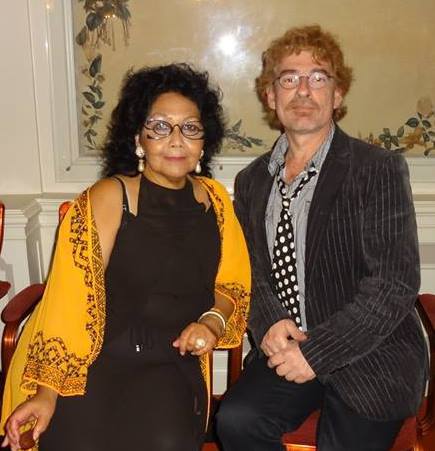
The book itself is much more promising. I remember meeting Jonathan in Brighton in 2001 when he showed me some of the artefacts rescued from the Crotona Fellowship. The bulk of the ‘Doreen collection’ was under the management of John Belham of course. Reading this book however reminded me of that visit. As archivist Jonathan had access too to a large number of photographs. He asked me if I recognised some of the people in the largely black and white shots. Yes I did…  🙂

For this book he has been able to include some interesting images, not only of Doreen but also of Gerald Gardner and Monique Wilson. Having access to the Doreen collection in the early years after her death (in 1999), has meant that Jonathan  has been able to build up a sizeable picture of this remarkable lady.

It is also a book reflecting the social climate of England in the 1950’s and 60’s when Doreen was  first active in Wicca. Her first book didn’t appear until 1962 and was entitled Where Witchcraft Lives. The first edition, which I have, is a rather drab edition with a mousy grey cover. Nothing sensationalist. But that was Doreen, writing as an observer referring to “her informant” who was of course herself. Quietly getting on with things.

Jonathan notes that only after 1964 when both Gerald Gardner and her mother died did Doreen become more public. Her mother was a devout Christian and would not have approved of Doreen “dabbling in Witchcraft”.

After leaving Gerald’s coven in 1957 (she was initiated in 1953) Doreen worked with various people including the somewhat shady character Charles Cardell. She also interacted with “the Coven of Atho, Robert Cochrane and the Clan of Tubal Cain, as well as the Regency coven”.

She later helped Janet & Stewart Farrar with their books especially The Witches Way (1984). Jonathan writes: “Her research to find Dorothy Clutterbuck may have saved the credibility of modern Witchcraft, and took her towards what was arguably the height of her achievements, her contribution to the foundations of the rapidly growing religion of Wicca.”

Jeffrey Russell, an academic historian, had tried to suggest that Gerald Gardner had invented ‘Old Dorothy’ in an attempt to hide the fact the he had invented Wicca.

However as Julia Philips has pointed out: “It is a marvellous piece of investigation, but proving that Old Dorothy existed does nothing to support Gardner’s claims that she initiated him.”

In fact we know now that although Dorothy Clutterbuck did exist Gerald was probably initiated by Dafo/ Edith Woodward Grimes.

Full of interesting details of Doreen’s life we also become aware of her wish to see the Craft evolve. This was reflected too in the Fireheart interview by Michael Thorn (1991) and  in one of  her last public talks at the Pagan Federation Conference in 1996.

doreen1

http://www.earthspirit.com/fireheart/fhdv1.html

Jonathan ends his book by recalling the unveiling of the commemoration plaque at the foot of the Tyson Place tower block where Doreen last lived. A fitting tribute to an extraordinary lady.

**

References:

Julia Phillips – History of Wicca (PDF).


Geplaatst in Boeken, English articles | Getagged , , | 2 reacties

Review: The Witches’ Herbal

The Witches’ Herbal
Michael Howard
Red Thread Books. 119 p. ISBN 978-0-9568114-2-4
www.redthreadbooks.co.uk

Cover of The Witches' Herbal

“The Witches’ Herbal is a guide to the subject of magical herbalism in three parts. It includes a concise history of herbal healing and the use of folk remedies from ancient times to the present day; a comprehensive A-Z herbal and plant glossary, providing the reader with a list of herbs and plants common to the British Isles with their botanical, cultural, magical, folkloric and medical siginficance; and in part three there is information on the magical, folkloric and pagan religious role of common British trees based on the Celtic Tree Alphabet.”

And to start with the latter: the Celtic Tree Alphabet comes from the The White Goddess by ’the poet and historical novelist’ Robert Graves. “In his book Graves formulated what he called the Celtic Tree Alphabet based on the 5th century CE Irish alphabet Ogham, allegedly invented by the god Ogma, and claimed by some as a relic of ancient druidism orally transmitted down the centuries by the bards.” Michael Howard uses the letters of the alphabet and the trees associated to these to give information on tree lore.

The first 22 pages of the book should be on the curriculum of every modern practitioner of ’the Craft of the Wise’. In the past herbal knowledge was the stock-in-trade for the cunning man, wise woman, witch, warlock and wizard. Anyone claiming to be a descendant of those practitioners, should know at least something of the use of herbs and plants. Be it for medical purposes, for magical purposes or for cosmetics. Howard describes the history of herbal knowledge as well as how that was viewed by the authorities. He names several well known books, such as Pliny’s Natural History, the Rosa Medicinae Anglica and the works of William Turner, John Gerard and Nicholas Culpeper. Several incantations or charms are given as well.

The A-Z Herbal and Plant Glossary is preceded by a warning, that some plants are highly toxic or may cause allergies. And that herbs are no substitute for orthodox medicines. “In all cases a doctor should be consulted.” The plants are listed under the common English name. Howard gives the botanical name, popular names, ‘flora’ (details on flowers and when they can be seen, and on the berries), habitat, magical significance and folklore and medicinal properties. Looking for my ‘key herb’, ‘klein hoefblad’ in Dutch (Tussilago farfara), I notice the lack of an appendix. The number of herbs in the book is not too large though, so I find it quickly under ‘Coltsfoot’. And I see that several trees are listed here as well, like Hawthorn and Lime, and the Horse Chestnut where this can be read: “Witches recommended carrying a chestnut to relieve rheumatic pain, however they were only effective if stolen or begged from another person.”

Geplaatst in Boeken, English articles | Getagged , , | Reacties uitgeschakeld voor Review: The Witches’ Herbal

Review: Witchcraft in Yorkshire

Witchcraft in Yorkshire
Patricia Crowther
ISBN 978-09741740-1-3
Collectors 35th Anniversary facsimile limited edition, published by Harvest Shadows 2008

(Available from Silver Circle EUR 12, incl. postage.  FFI morgana_scircle@msn.com )

Witchcraft in Yorkshire

This a lovely small book of about 70 pages written by Patricia Crowther in 1973. This is a special limited edition (750) and facsimile of the original book. Every book is numbered.

Patricia who hails from Yorkshire, England, describes the folklore and customs of the Yorkshire area. From legends to spells and beliefs she also tells of the most famous Yorkshire witch (although Patricia is probably more famous now…  Morgana) Ursula Southeil or better known as Mother Shipton, born July 1488.

She is still remembered for her prophecies. The most famous story is when she prophesied that on hearing of Cardinal Wolsey’s visit to York she said that he would never do so. “This annoyed the cardinal when he heard about her prediction, and he sent the Duke of Suffolk , Lord Percy and Lord Darcy to visit her, all of them disguised…” so the story goes.

And indeed as “the Cardinal gazed at the distant walls of the city, he said’ When I get there, she shall burn as a witch’. That very night he was arrested by order of Henry VIII and taken back to London where he was imprisoned in the Tower.”

The cave is still visited today and is in a beautiful forest. There is the Petrifying Well where people hang small objects to see them turned into stone.

In the the foreword to this edition we read: “The small book you are now holding in your hands was an early effort by one of the first publicly announced practitioners to contribute to a fuller picture of the witch, and of witchcraft. The text provides samplings of how witchcraft and folk-magic manifested themselves, over many years, within the borders of Yorkshire.”

Complete with pen and ink drawings by Arnold Crowther, his poem ‘The Witches’ Sabbath’ is also included. It begins:

Come horse, come hound, come leaping toads,
Down from the forest and over the roads….

This is lovely book for anyone interested in English folklore and especially about witches… 🙂


Geplaatst in Boeken, English articles | Getagged , , | Reacties uitgeschakeld voor Review: Witchcraft in Yorkshire

Reviews: Beyond the Broomstick

Beyond the Broomstick. Thoughts on the Philosophy of Wicca
Morgana Sythove
Whyte Tracks.  ISBN 978-8792632-02-9
www.whytetracks.eu.com / whytetrackshome.html

Reviewed by Yuri Robbers, Leiden University; Animal behaviourist and practicing Wiccan.

broomstick_large
Many people still think Witchcraft doesn’t go much beyond old hags flying on broomsticks. Maybe such a view suffices when reading fairy tales to children, but in daily life it most certainly does not. Witchcraft – or Wicca as it is nowadays known – is an old yet vibrant tradition, and has grown to adapt to the changing times. There is a lot beyond the broomstick, and Morgana Sythove does a great job presenting some of it.
The subtitle of the book is ‘Thoughts on the Philosophy of Wicca’. Often books on the philosophy of religious or spiritual traditions stay on the well-trodden paths of ethics and a description of the world or worlds. Morgana treats those subjects in depth, but she goes further. She not only deals with the outer worlds, but also with the inner worlds, often quoting from or referring to other books and thus showing the strong foundation that underlies her own work. She also does not shrink from delving somewhat into theory of knowledge and history of thought, explaining how people have come to know the philosophical ideas she explains.
Beyond the Broomstick first covers the concepts of polarity, deity, the Goddess and her various aspects, the God and the four elements. With this strong theoretical grounding, Morgana proceeds to the last chapter which deals with the practical application of these concepts.
Beyond the Broomstick is a thorough explanation of Wiccan philosophy that gives a good introduction for the newcomer and a sound overview with proper citations which may be a good starting point for the initiated witch wanting to delve a little deeper. Morgana manages to deal with theoretical issues without getting dogmatic, and with pragmatic issues without losing touch with the divine. Her book shows that even though Witchcraft may not be for everyone, it most definitely is a firmly grounded spiritual tradition. An old religion which has not remained stuck in the past, but evolved and adapted through its polarities, to remain a strong and vibrant form of spirituality, well-suited to this day and age, and with lots of potential for growing with us in to the future.

**

Más Allá de la Escoba - Spanish version

Más Allá de la Escoba – Spanish version

“An incredible book! Morgana goes beyond what we are used to read in books about paganism. She’s straight and clear but she provides value, a very necessary value, to the background that the Old Religion has. Concepts that we may take for granted but shouldn’t lose their importance are reminded and even posed again, to enlighten the flame of our cauldrons.”

Jon

“I have read many books about Wicca – most of them the so called Wicca 101. The major problem of those books was that they were basically about magic, not about Wicca, as religion, as a Craft – the Craft of the Wise.
As a mystery religion, there are few things of Wicca that can be explained, instead of experienced (even though, there are a lot of thing that do enrich that ‘experience’), polarity, the God, the Triple Goddess and the elements, are the main ones of those few.
In this book, Morgana leads us beyond the broomstick, approaching each of these aspects separately, and then weaving all of them together, in a small but invaluable book.”

Daniel Expósito

**

“Twijgen uit de bezem -gedachten over de filosofie van het paganisme” Morgana

ISBN 978-8792632-03-6

Twijgen uit de bezem

Beyond the Broomstick is in het verleden gepubliceerd als een serie artikelen in het tijdschrift Wiccan Rede tussen 1980 en 1982. De serie werd vertaald in het Nederlands en als boekje uitgegeven in 1982. Morgana schreef deze achtdelige serie als introductie tot wicca, met de nadruk op het filosofische gedachtengoed. De centrale concepten zoals polariteit, de drievoudige godin, de god en de vier elementen worden in duidelijke taal beschreven. Prima voor beginners, en ook een goede bron voor degenen die behoefte hebben aan meer filosofische diepgang.

Also available in Spanish, Polish, Turkish, German and Hungarian.

To order a signed copy please send an email to: morgana_scircle@msn.com

Price indication EUR 10, excl. postage

Promoting Beyond the Broomstick at the Atlantis Bookshop, London

Book signing


Geplaatst in Artikelen, Boeken, English articles, Recensies | Getagged , , | Reacties uitgeschakeld voor Reviews: Beyond the Broomstick

Review: Witchcraft in Early Modern Poland 1500-1800

Witchcraft in Early Modern Poland, 1500-1800
Wanda Wyporska
Palgrave Macmillan, 2013. 245 p. ISBN 978-0-230-00521-1
http://witchcraftinpoland.com/

Cover of Witchcraft in early modern Poland

The history of Poland differs in several aspects from that of other European countries. Wyporska explains that the dominant feature of early modern Poland is the all-pervasive power of the szlachta, translated widely as ‘nobility’, and that they played a key role as judges, accusers, victims and witnesses in the witchcraft trials. The judicial system was extremely varied on a regional, local and village level. As in other countries though, torture was a standard procedure. And women were not the only victims of witchcraft accusations. Chapter 3 explores witchcraft and gender. Some accused women were business women like beer brewers, but many were domestic servants.
The Polish borders have not been fixed during the centuries, rather the opposite. The greatest extent was in 1634-1635, but the country suffered wars on all sides during most of the seventeenth century. During the last quarter of the seventeenth century and the first quarter of the eighteenth Poland was sliding towards decline and during this period a peak shows in the witchcraft persecutions.
Contrary to what you may think, by 1660 less than half of the population was Roman Catholic. Others were members of Eastern churches or followers of protestant reformers, and there were Muslims and Jews. And interesting for our readers is this sentence in chapter 5 (and what follows): “There is evidence that rituals and beliefs associated with the pre-Christian religious system were still apparent in Poland, as late as the sixteenth century and conflicting views among historians and ethnographers as to the nature of Slavonic pagan beliefs provoked great debate.”

The themes for this study are:

  • to identify who was defining the paradigms of the witch
  • can we establish a composite, recognized body of attributes commonly ascribed to a ‘witch’
  • did the trials correlate with intellectual discussions of witchcraft?

Another of the key aims of the study is to provide an overview of witchcraft trials heard before the municipal courts in Wielkopolszka, in tandem with a wide variety of contemporary literature in which witchcraft was discussed. The author studied the source materials, in Polish.
The study defines witchcraft as a set of beliefs or practices regarded as using supernatural power to harm or heal.

To highlight only a few aspects of this thorough study, there’s the issue of gender. Many details of the witchcraft trials refer directly to traditionally defined feminine space: the household. Most accusations of maleficia concerned health, fertility and productivity – areas generally seen as responsibilities of women – and their opposites: feeding (poisoning), child-rearing (infanticide), healing (harming), birth (death).
‘Disorderly living’ was indicative of a criminal life, for instance when a widow had a reputation of theft or prostitution. Witchcraft could be the next step. And the possession of herbs – sometimes worn by clients of witches – could be interpreted as evidence of being a witch.
Some men were sentenced – together with their convicted wifes – because they had played music (pipes, dulcimer) during the sabbats. Some men were accused of spoiling milk, but patriarchal Polish society regarded witches as predominantly women, “as evident from demonology”. ‘Diabolic sex’ was mainly a female prerogative in demonology.

A pantheon of Slavonic gods was included in the Annales by Polish chronicler Jan Długosz, writing in the latter half of the fifteenth century. A god named Czarnobóg, black/dark God, led some scholars to surmise there must be a dualist Bialobóg, white God. “The lack of sources for the period makes a conclusive answer unlikely, but there is consensus as to the strong belief in demons and spirits, who dwelt in rivers, lakes and woods, and those who also lived within the home and were placated with gifts, especially in the eastern regions.” Glimpses of these ancient Slavonic beliefs can be seen in trial confessions.

All in all a very interesting read, even for someone like me who never had a great interest in Poland, let alone in the Polish judicial system. Wanda Wyporska is a journalist and writes well. And according to an interview she is writing a trilogy of time slip novels based on the witchcraft trials. Those may be very interesting to a larger audience!

Geplaatst in Boeken, English articles | Getagged , , | Reacties uitgeschakeld voor Review: Witchcraft in Early Modern Poland 1500-1800

Review: When a Pagan Prays

When a Pagan Prays. Exploring prayer in Druidry and beyond
Nimue Brown
Moon Books, 2014. 196 p. ISBN 978-1-78279-633-6
www.moon-books.net

Cover of When a Pagan Prays

According to Nimue Brown this is not a book, but two books that have somehow managed to occupy the same space. “One of those books is an amateur attempt at some academic writing, featuring comparative religious studies, psychology, sociology and a bit of research. The other book is an experiential tale of what happened to me when I started to explore prayer as a personal practice.” The academic approach simply does not work. Although the first question, ‘other religions use prayer extensively and apparently we don’t. Why is that?’ requests for a more academic study. And the first book (How to Pray, by Anglican Christian Jophn Pritchard) gave this idea of prayer: “Essentially it is about entering a mystery, not getting a result.”

Prayer is something that people do as a manifestation of religion or as part of a spiritual practice. You get what you bring. “If you are willing and able to be open, vulnarable, listening, if you are here to be changed, that’s a very realistic possible outcome, no matter which tradition you follow or the methods you adopt.”

The author is a Druid. “Offering up prayers of praise, gratitude and confession are part of the world view in which a relationship between human and divine is clearly defined.” This is not the case in Druidry, or in Pagan traditions in general. But Druidry, as other Pagan traditions, expects its adherents to figure things out for themselves and take responsibility for their own practices.
Prayer is a form of ritual, says Brown. In Druid rituals no one is ordered into the circle. No gods are assumed to put in an appearance. “Instead, we greet whatever is there and express our openness.” But to whom does one pray when everything is open? “Prayer is, in essence, an attempt at starting a conversation with something.” And what to pray for?
Brown started to ask around about praying, and read several books on the subject. Most people addressing the subject are monotheists and for them it’s obvious who to pray to. Brown experimented, and found help in literature on Shinto. And surprisingly in a New Age book by Wendy Stokes, who talks about defining the nature of the kind of entity you want to work with. “Rather than trying to find names and personifications to call upon, she suggests thinking about what the entities do, and calling to that.”

This way Nimue Brown guides her reader through the subject, sharing the experiences she made on her journey. She describes the ethics of prayer, the social functions of prayer and the practicalities of prayer. Also how prayer can fit into the – or a – Druid practice, making Druid prayers, and the use of prayers in ritual. She also speaks about non-verbal prayer traditions and in the end about how prayer changed her life. Very interesting for anyone who is open to this way of addressing the Sacred.

Geplaatst in Boeken, English articles | Getagged | Reacties uitgeschakeld voor Review: When a Pagan Prays

Verslag Grand Heksencafé, 14 September 2014

Jeetje wat was het gezellig! Vooraf waren we met ons allen wat gespannen over hoeveel mensen er zouden komen en hoe de dag zou verlopen, maar het is een succesvolle dag geworden. Het idee achter deze dag was om een fundraising-middag te houden zodat we een startbedrag konden ophalen voor het maken van een documentaire over ‘Wicca in Nederland’.

Na het welkomstwoord van Morgana waren er wat activiteiten gepland en konden mensen hun meegebrachte spullen uitstallen voor verkoop. De producten werden gedoneerd en de opbrengst van de verkoop was voor de opzet van een documentaire. Een heel leuk systeem want iedereen kon zelf bepalen wat een product waard was. Ik denk ook dat menigeen vertrokken is met een paar leuke nieuwe en tweedehands spulletjes!

De twee workshops die werden gegeven werden met enthousiasme bezocht. De eerste werd door Nemain geleid en was een dansworkshop. De tweede werd door Betty gegeven en gaf veel informatie over kruiden. Beide heb ik zelf niet bezocht, maar de reacties waren erg positief!

Om even bij te komen tussen het shoppen, dansen en kletsen door was Cerridwyn’s Cauldron er om de innerlijke mens te voorzien van versnaperingen. Deze dames brachten heerlijke zelfgemaakte taart en soep vers uit eigen keuken mee. Ook de opbrengst hiervan is naar de pot gegaan.

Vervolgens werd er een forum gehouden. Lady Bara, Chovexani, Morgana, Jana, Nemain en Joke en Ko werden als forumleden onderworpen aan diverse vragen. Onder leiding van Marjolein werden er een aantal stellingen de groep ingegooid en was er ook kans voor mensen uit het publiek om vragen te stellen. Hierdoor ontstonden interessante discussies met veel interactie tussen het publiek en de forumleden.

Direct na het forum werd de prijsuitreiking van de loterij gehouden. Mensen konden gedurende de dag lootjes kopen waarmee ze kans maakten op hele mooie (gedoneerde) prijzen. Dit onderdeel heb ik zelf gedaan, wat echt ontzettend leuk was om te doen. De hoeveelheid toevalligheden was erg grappig. Vooral dat Morgana haar zelfgeschreven en gedoneerde boek won zorgde voor een boel hilariteit. Overige prijzen waren onder andere een maankalender in lijst, een prachtige runenset, beeldjes, wijn, sieraden en ga maar door.

Afsluiter van de dag was een akoestisch optreden van Jyoti Verhoeff & cellist Maya Fridman. Deze twee dames maken prachtige sferische muziek die ook in een kleine setting als deze goed tot zijn recht komt. Hun nieuwe cd is net uit en een bezoekster met een winnend lootje is als nieuwe eigenaresse hiermee naar huis gegaan.

Runenset Haagje Heidh 2


(Runenset gedoneerd door Haagje Heidh) 

Alles bij elkaar is het echt een fantastische middag geweest waarbij er veel interactie is geweest tussen iedereen. Er is veel gelachen, bijgekletst, nieuwe informatie uitgewisseld en er is veel gepraat over wat er niet in de documentaire zou mogen ontbreken. Het financiële doel van 500 euro dat we ons hadden gesteld voor deze kick-off is gehaald en hier zijn we iedereen ontzettend dankbaar voor!

Door jullie inzet en donaties (in tijd, energie, producten en financieel) is dit mogelijk gemaakt. Het is duidelijk dat er als community gezamenlijk een hoop bereikt kan worden en we hopen dat het komende jaar voort te zetten.

Tot volgende keer!

Geplaatst in Artikelen | Getagged | 1 reactie

Boeken voor beginners

Artikel oorspronkelijk geplaatst in Wiccan Rede, Imbolc 2003 (uitverkocht).

Als je nu jong bent en net met wicca in aanraking komt, kun je je niet voorstellen hoe lastig het twintig jaar geleden was om boeken te vinden over hekserij en wicca. Er waren, als je goed zocht in de grotere boekwinkels, wel een paar Engelse boeken te vinden, maar als je niet in de grote stad woonde, was het lastig om aan literatuur te komen. Hoe anders is het nu: boekenkasten vol zijn er geschreven over hekserij en wicca, en er is zelfs ruime keus in Nederlandse en in het Nederlands vertaalde boeken. Het probleem is nu eerder om er de goede boeken uit te halen: boeken waar je echt iets aan hebt. Misschien heb je wat aan deze suggesties. Niet al deze boeken zijn nog in de boekwinkel verkrijgbaar, maar de meeste openbare bibliotheken hebben er wel een aantal van in de collectie.

Er is maar één boek dat zich echt richt op jonge heksen: Bezems en pentagrammen van Minerva, een heel sympathiek boekje. Enige nadeel is dat Minerva zelf nog heel jong is, en ook nog niet alles wist. Je kunt er veel uit leren, maar niet alles klopt. Er zijn wel een aantal jeugdboeken die je een idee kunnen geven waar wicca of magie over gaat. Een lijstje:
Heksenkind en Juniper van Monica Furlong
Tot de 13e maan van Arnulf Zitelman
De inwijding van Margaret Mahy
Lena is anders van Nina Rauprich
– De Aardzee-boeken van Ursula LeGuin
Heksendochter van Celia Rees.

Als je ouder bent, kun je ook Nevelen van Avalon lezen van Marion Bradley en Het boek der Schaduwen door Phyllis Curott.
Een goede introductie in wicca (ook handig voor werkstukken op school) is Moderne hekserij van Merlin Sythove. Dit gaat vooral over de religieuze kant van hekserij: Godin en God, de jaarfeesten en de maan, hoe een coven in elkaar zit, welke rituelen er gevierd worden en hoofdstukken over magie en over karma en reïncarnatie. Merlin is Gardnerian en heeft meer boekjes geschreven en uitgegeven.
Melkor schreef het boek Heksen bestaan!, dat hekserij meer als een levenswijze ziet. Het is erg humoristisch geschreven, maar geeft heel duidelijk aan wat belangrijk is in wicca en in de magie. Hij is Alexandrian.
Jan de Zutter begon als journalist te schrijven over wicca, en werd zelf heks. Hij schreef De schaduw van de maan, waarin je kunt lezen over de geschiedenis van wicca, maar ook over de inwijding van de schrijver. De stroming waar hij bij hoort in Vlaanderen heet nu Greencraft.
Ook Susan Smit begon als journalist, en raakte zo geïnteresseerd dat ze een jaar besteedde aan het onderzoeken van hekserij en van zichzelf. Het verschil met andere boeken is dat zij geen aansluiting zocht bij een coven, maar alleen en samen met andere solo-heksen op zoek ging en experimenteerde. In haar boek, Heks, lees je over de donkere kant die je ook tegenkomt als je met hekserij bezig bent. Ze interviewde ook een paar bekende Amerikaanse heksen.
Ko en Joke Lankester schreven De kringloop van het leven als een kennismaking met (Gardnerian) wicca.
Een wat minder makkelijk, maar wel goed boek, is Hekserij van Vivianne Crowley, waarvan net een nieuwe editie is verschenen.

Deze boeken zouden eigenlijk in het Nederlands vertaald moeten worden:
The life & times of a modern Witch van Janet en Stewart Farrar (de beste introductie die ik ken),
Witchcraft, a beginner’s guide van Theresa Moorey (uit een hele serie beginnersboekjes)
The spiral dance van Starhawk. Zij combineert sjamanistische technieken met een levensfilosofie die erop neer komt dat je ook wat moet doen voor de aarde, tegen onderdrukking en onrecht, voor het milieu. De oefeningen in haar boek zijn heel praktisch, en dat geldt ook voor de acties die ze voert.

Je doet er goed aan niet alleen boeken over hekserij en wicca te lezen, maar ook over verwante onderwerpen: kruiden, ‘stenen’, divinatietechnieken zoals tarot en astrologie, maar ook magie in het algemeen.
Alle boeken van Marian Green vormen een goede inleiding. Ik noem Natuurmagie en Magie op eigen kracht. In 1972 verscheen Ware magie van Isaac Bonewits (in het Engels is het opnieuw uitgegeven) en dat is nog steeds zeer de moeite waard. Hij schrijft grappig en lekker tegendraads, maar weet heel goed waar hij het over heeft.

Je kunt waarschijnlijk genoeg boeken vinden die andere paganistische stromingen behandelen: sjamanisme en druïden. De relatie tussen paganisme en de geschiedenis (vóór 1950) komt aan bod in Wijze vrouwen en godinnen van Aat van Gilst.
Wil je verder lezen over wicca, dan is het zaak Engels te leren lezen. Via internet is heel veel te vinden, op heksensites en bij online-boekhandels. Veel leesplezier in de winter, en vergeet niet er zomers gewoon op uit te gaan, de natuur in.

Jana.

P.S. Vergeten te noemen in het oorspronkelijke artikel in Wiccan Rede: de boeken van Scott Cunningham: Wicca-handboek en Wegwijs in wicca (wel besproken in Beltanenummer 2003).

En nu is er ook Wicca Voor Beginners : basisprincipes, filosofie, praktijk. Thea Sabin. Mynx, 2007. 256 blz. € 12,50. ISBN 978 90 225 4765 6. Inhoudelijk heel goed.
En Heidense Hekserij van Jack Stoop.

De website The Well Read Witch bestaat niet meer. Misschien kun je het gelijknamige boek van Carl McColman nog achterhalen.

Geplaatst in Artikelen, Boeken | Getagged , , , , | 1 reactie

Pathfinder Extraordinaire – an interview with Jean Williams, part 1

This is the first part of  2 interviews Ash Russell made with Jean Williams in 2004. Yes 10 years ago!

They appeared for the first time in WR Imbolc 2005 and Beltane 2005.

Since then Jean has handed over the “Pagan Pathfinders” to younger folk. She and Zach Cox, her partner, have also retired from the Pagan Federation. However Jean is still a welcome member and attends the Council Meetings regularly and is often asked for her advice.

An inspiration to us all, she is still an extraordinary lady!

– Morgana, Zeist, June 2014

****

Elen Williams

An Experienced Vision for the Future – An interview with Jean Williams by Ash Russell, 2004

Jean Williams has been Wiccan since the mid-60s, and High Priestess of Gardner’s original coven since the mid-70s.  She has also run Pagan Pathfinders for about 30 years, and worked with the Pagan Federation for about 15 years.  She shares some of her experience, as well as some ideas for directions that the Craft could go in future.

What was your reaction to ‘A Witches’ Bible’ when it came out?  At the time it was very controversial because so much was going into print for the first time.

Jean:   When Stewart Farrar’s book came out, I felt a pang when I saw the Charge published, because I thought that was so beautiful and so precious.  It had such a huge impact on me.  I would like people to come fresh to it.  On the other hand it is something that makes a huge impact on people who read it, because they think “Wow, I want to be where this happens.”  So you see both sides, it achieves something, but at a price.

Do you think there is a difficult balance between getting the Craft experience completely new versus having a lot of material prior to initiation? Has it perhaps gone too public?

Jean:   I don’t think so.  I think we’ve gone past that now, really.  I think there are some very good books about, and I have a great respect for people who decide that what they want to do is go it alone, and use Rae Beth’s book or something of that sort to do their own thing.  There is such a wealth of books, literature, television programmes, Internet, and every source of information that you want, good written stuff, rituals and poetry available.  It’s all part of that ethos of do-it-yourself religion.  I don’t think that you have to be put through a training course particularly.  I think that people can do their own thing – people can reinvent it.  Everybody’s reinvented their religion.  Every time it’s revived, it’s a reinvention.  Gardner reinvented it and Sanders reinvented it again.

There is a tension between what is Craft and books written by non-initiates.  This can cause a tension between what is really Craft and what is Paganism with a more popular name.  We want to support solo practitioners, but do we want them to call it Wicca?

Jean:   I don’t think it matters what you want, because people are going to do whatever they want to do.  They say I follow this book about Wicca, so therefore I am Wiccan.  You can’t stop them or copyright a name like that.  I’m not sure I can get hot under the collar about this.  Some people like to see things in nice, neat categories and they’re never going to get that with the Craft or with Paganism in general.  Everything merges one into the other.  My field of work was surveys and research, and there you are constantly putting people into categories, and you are aware all the time that it’s a sliding scale.  It’s quite arbitrary where you chop things up.  It’s the same with the Craft and Paganism.  Would you call that Craft or ‘just’ Paganism, with a hint that Paganism’s somewhat inferior…  I don’t go there.

Jean:   What really makes me hot under the collar is when people talk about fluffy bunny pagans or fluffy bunny witches.  It’s totally lacking in respect for people who are doing or finding their own particular path at their own particular level.  They should not be treated with contempt, because it doesn’t happen to be the same view of things.  I’ve heard people say ‘Oh, I suppose they’re just fluffy bunnies. We’re not fluffy.  We’re not a bit fluffy.”  And you think, “My goodness I wonder what terrible things they must get up to, in order not to be fluffy.”

I think there is a difference between fluffy and bad research.  I would be disparaging of awful research, because I don’t think people should write things as fact when clearly they haven’t done necessary research.

Jean:   Yes, well writing things to tell other people what to do is quite different to finding your own path and doing your own thing.  If you want to do that just based on walking around the garden and getting into a transcendental state because of a beautiful flower that you see, or the way the squirrels are behaving, then that’s fine, have your own religious experience. 

What about the drive to bring people into the Craft and ensure its survival?

Jean:   We sort of take things rather easily in our old age.  We don’t feel a pressure to find new members or to bring new people in, but if someone asks we might consider possibly it, but we are rather happy trundling along with our little group of people who are very faithful attendees for a long time now.  There is a sort of easygoing comfort and closeness in that.

Jean:   Every new person you bring into a coven changes that coven.  Hopefully it changes them, too, but there is obviously a sort of shifting around to fit them in, and to get to known everyone in the context of the coven and to show them how things are done and so on, and to let them ask questions if they want to.  In a way, too I think that every time you get someone newly initiated, the coven is on its best behaviour for a little while, to show their best side to the new person.

How do you feel about formal outer court arrangements, in terms an outer, outer court for training for people who are just coming into Paganism, and then perhaps a formal outer court for people who are doing the work and training?

Jean:   I think that’s quite a good thing, because there is such a demand now for people interested in Wicca.  There is a huge need for some way of getting access.  We don’t feel that we are necessarily morally obligated to be part of that.  You know, I do Pagan Pathfinders and that’s my contribution to the scene.

What about a formal seminary?

Jean:   I would hate to see it over-formalised, with initiation certificates at the end of it, but I do think it’s a useful way of training people.  In Pagan Pathfinders people get the basic training in meditation techniques, energy raising both within themselves and as a group, and some basics of magic.

So how important would you say aspects of self-discovery are to the Craft itself?

Jean:   I think it’s very important.  I think any spiritual path is going to be a spiritual path and not just a glade you’re sitting in.  You’re going to be moving forward, and there has to be an element of self-discovery, allowing for a sense of growth and development. 

You said you were a little bit concerned about things becoming a bit over-formalised.

Jean:   I think there is a danger of this when things become very popular.  People are doing what they think is the most purist, traditional or firmly original, or have got the secret key, and that they ought to formalise it; they might say, “Well, we’ll call this Wicca” and “we’ll call that witchcraft or Paganism”.  And other people say “I’ll call what I do witchcraft because I’m a solo witch, because Wicca is coven witchcraft”.  I think it can get over-formal that way.  And yet I think that what I would like see is it maintaining very much the sense of freedom but tradition.  Traditions evolve and change, so it must never be a fundamentalist sort of thing, such as this is the way that it’s written down in the Book of Shadows, and you must never change a word. That way lies fundamentalism.

You wouldn’t want to see an orthodoxy, but are there certain things you’d like to see retained, because we can’t disregard our past completely, either?

Jean:   I think it should be regarded as an organic, evolving tradition or set of traditions. You find what you do, and you take it forward in your way.  There are some traditions that perhaps have a stronger personality, maybe because they’ve got a formal and more structured training course that people come through.  Therefore they are sent down a slightly narrower path, rather than something that will proliferate out like a tree.

Jean:   What I would like to see is like the Pagan Federation has tried to do, to set a general ethos for Pagans with the three principles, so we set a direction, and a way of integrity and self-respect.

Jean:   And what I’d like to see is a general sense of what Wicca is about in terms of becoming priests and priestesses of the gods, and that this gives you responsibilities both within and out to the wider community, and that there is some sort of developmental process you go through to reach this, be it formal training or maybe just a period of experience.  We regard the first degree as the one where you get this experience, and then the second degree is when you start to learn to take rituals, and to lead a working.  The first degree you are just sort of sitting there being told what to do, and encouraged and challenged to understand it, learning what magic is actually about, the responsibilities and the pitfalls and so on, the ethics of it.

So perhaps going forward retaining the ethics, retaining the spirit of the Craft, including this flexibility, but continuing to evolve?

Jean:   But also the spirit of respect for differences, I think that’s very important.  Obviously, whenever you allow differences you’ve got to be also prepared to draw a line, and say I don‘t like what you are doing, like you’re doing sexual initiations at the first degree.  I don’t hold with that.  As far as I’m concerned that is outside the boundaries of what we consider ethical.  You also have to be free to say that, but not to go further and say “we don’t consider that it’s ethical to omit outer court training.”

So flexibility, but based on respect?

Jean:   Flexibility but based on respect, but also knowing that there will be boundaries.  I think what is happening too now which is very, very useful is discussion within email groups and things like that, about what is permissible and what isn’t permissible, and ways things should be handled, like things to do with bringing up your children, and when and what sort of meetings you might include them in, what you should exclude them from and why, this sort of thing.  And also what to do with young people who approach you from outside your own families and want to join the Craft or whatever; how do you handle that?

Jean:   What provision do you make for children or teenagers, either with the permission of their families or sometimes in rebellion against their families to find out?  What do you do?  Do you just say, “No, you know, you’re too young, go away,” and leave them to struggle on as best they can, or do you provide some help for them?

Jean:   Usually after these discussions somebody will pop up and say well, “I’d like to take that on, I think what we should do is x, and I’m prepared to put my money where my mouth is and try and make a go of doing this”, and maybe then make awful mistakes and maybe find that it’s much harder work than they thought it was going to be and so on.  That’s a brave thing to do.

To stump up and do the work?

Jean:   To start up and do the work and maybe get it wrong, and then it means it all folds up and someone else starts.  It’s this sort of process of evolution, of change.

Perhaps that’s another thing you’d like to see carried forward in an atmosphere of mutual support?

Jean:   Yes.  If you find that you’ve got somebody in your coven or in the Craft who is bringing it into disrepute or behaves very badly – how the really hard-edged problems of that sort are dealt with.

Supporting each other if something goes badly?

Jean:   Yes, I would really very much like to see that developed more in the future.

Do you think that’s a trend occurring more frequently now, that you’d like to see encouraged? That people are encouraged to hive off and get on with creating groups and training more people?

Jean:   I think that it probably is happening.  We were never that close to other working covens.  I think it is happening more now.  I think it probably is a good idea to encourage people.  I rather gather from talking to Vivianne Crowley that she did that quite a lot. She had quite an intensive outer training course with her Wicca study groups, and then people come to an inner training course, and so she would find herself with more covens than she could possibly run. She sort of set them up.  I got the impression that she had her own coven meetings of coven leaders that she had set up and then they would discuss ideas.

So perhaps families of covens?

Jean:   And that’s what Madge used to do.  I think that’s the best way, yes, families of covens within a tradition.

And perhaps sharing materials, so that you get a consistency?

Jean:   Yes, and that’s a good way in which groups can form to share ideas and so on.  And perhaps they can coalesce with another family group somewhere that is fairly close to them.

And then perhaps sharing an outer court?

Jean:   Yes.

It sounds like a pagan temple arrangement, in which some of the priestly duties would be shared.

Jean:   And that way you spread the load of the training, too.

How would you feel about people actually founding Wiccan or pagan temples as such?

Jean:   I don’t know.  It would be very nice to have a sort of a Wiccan centre.  I’m not sure what it would do to have a building.  A wood seems a much better idea.  I’m not sure that a central working temple quite fits in with my idea of the Craft.  But you know somebody having a farmhouse with farmlands around it and some woods would have a great deal of appeal. I love the idea of being able to plant your own circle of cypress trees.

How do you feel about Craft- inspired art and poetry getting out into the public?

Jean:   I think that it’s one of the things that gives one of the best ideas of what the Craft is about, seeing the art forms and hearing the poetry and so on.  I think that it’s up to the individual whether they want to publish what they have written, and what I have seen is that people move on, like they write stuff that is private for their coven, and then they decide to do yet more, and they think, oh I may as well make that lot public because I wrote it 10 years ago.  I think Vivianne Crowley has done this; when writing her first book, she put quite a lot of inspirational poetry and invocations and so on that she had written earlier.

So you see that as a positive development?

Jean:   I see that as a positive development.  And when Vivianne Crowley talked at the London Pagan Federation conference last February, she read some of her latest stuff – her explorations of the goddess at various times of the year.  I found that very moving. I thought there was some really lovely stuff there.  I think as far as pictorial arts go, that if people are really artists, they will want to do things and be fairly prolific.  They may have things that they keep private, and things they will also put out.

How do you feel about the role of public priesthood?  Whom do we serve, and whom should we be serving?

Jean:   I suppose it’s in concentric rings.  Firstly your coven, secondly your inner circle of friends and fellow pagans, and from there doing your bits for the evolution of humanity towards self-realisation.  I don’t think that for humanity as a whole you should present yourself as a priest or priestess – you’re just a human being.  Any authority you express is purely what comes through you, not what you status say you have.

So behave as a priest or priestess?

Jean:  Behave, but don’t declare yourself as such. Even within the pagan community, don’t declare yourself as a Wiccan High Priestess.  That this is your authority for doing x or y.  You might be declared as a Wiccan High Priestess for giving a talk or running a workshop, because it’s relevant, but not because you have a divine right of authority over anybody else.  Your authority is what you can exert, and is to lead by example and by your own rhetoric and magical personality to achieve things in the outer world.  Remind yourself that this is what you aspire to be, and you’ve got to rise to the occasion as it were.

So sometimes put aside your own desires because you’re there to serve.

Jean:  That’s right, yes, and put aside your own fears and self-doubts, and get on with it, stick your neck out.

How do you feel about organisations such as Liferites, , who are specifically around to help people who need assistance for funerals, rites of passage and this sort of thing?

Jean:  I think that’s fine.  I think that’s a good idea.  It serves a particular need for people who are diffident at about that sort of thing.  We have performed funerals for people and I hope that when I die my friends and coven members and so on will do the same for me, and not have to call Liferites, but I can understand that many people are not in that lucky situation.

Jean:  I think a lot of pagans would like a pagan wedding and they are not members of groups, and they don’t have anyone else to call upon and they want someone who has the resources to give them the support they need, I think that’s fine.

So instead of swanning about being a High Priest, go and join Liferites,

Jean:  If that’s the work you want to do.  If you want to do something of that sort.

If you want to make a contribution, don’t assume authority and play a role, instead get in an organisation where they are doing the work, and do the work.

Jean:  But don’t feel you have to get in an organisation to do the work.  If that’s what you want to do, and you feel that you want to be that public and open about what you’re doing, and you’re prepared to travel and help strangers do things, then join Liferites, but otherwise, you know, just live your life and remember always that you are a priest or priestess of the Gods.


See part 2.

Geplaatst in English articles, Interviews | Getagged , , | 2 reacties

Coupled

By Mo Batchelor

Within the field of esotericism, Witchcraft and magick, heterosexual coupling has long been ascribed alchemical, magical and transformative potential. Many have found great beauty and meaning in this tradition of interpretation and exploration, and the more psychologically inclined have seen validation for this in Jungian psychology. I would like to follow up a few leads on a male same sex equivalent here. I am heavily indebted to Mitch Walker here, whose article at The Institute for Contemporary Uranian Psycholanysis website I have referenced throughout. Mitch Walker’s article [pdf] can be found there.

Jung, individuation and alchemy

Like many people of my generation, as a youngster I found Jung a delightful and open minded ally, especially as there was so much meaning for me in the occult and paranormal. Just his idea of “synchronicity” was an immensely useful tool in validating the way that meaning unfolds in our lives, independent of materialist causation. But both Jung and esoteric tradition seemed to often come up against a barrier of negative judgement or ignorance when it came to homosexuality and same sex relationships. For both it seemed that the model of sacred or normative sexuality and relationship was distinctly heterosexual.

Jung was more open minded, more sympathetic for sure, but he never went far in the direction of validating homosexuality or homosexual themes, and that was reflected in the Jungian influenced counterculture, whether it was areas of magic, or psychological astrology. There was a soft (or not so soft) dogma around the natures of men and women, and what the feminine and masculine must mean to each. It was as tiresome as it was inaccurate. People would serve up secondary causative explanations of gayness, seemingly taken from Jung’s own lack of understanding. No one seemed to stop and ask: “if we don’t even look for an etiology of heterosexuality, why do we assume that homosexuality must have an aberrant cause, rather than being a natural variation?”. It seemed many Jungian therapists had little insight into the processes that might be real for gay people, and this was paralleled by stronger religious intolerance, and esoteric aloofness. It was a world divided into spiritual castes, albeit a world in transition as society changed. Esotericism for its part had a long history of demonizing “the homosexual”, and had a habit of protecting its teachings from public criticism.

Coupled Jung

Carl Jung, standing in front of building in Burghölzi, Zurich  [Public domain], via Wikimedia Commons

There have been a number of things over the years which have significantly shifted the conversation, and the information available for people. For instance Katon Shual’s Sexual Magick which came out in the late 80s (revised two years ago) brought up the subject of homosexual sexual magic positively. Books like Randy Conner’s Blossom of Bone have helped to redress the lack of coverage of homoerotic and transgender sacred themes in antiquity. There have also been books by authors such as Robert Hopcke covering theories and attitudes of Jungians towards homosexuality.

When I found the aforementioned article by Mitch Walker (written over 20 years ago) I was immediately struck by how powerfully it trod a line between the psychological and the esoteric, and that is why I am focusing on this article here, as I feel it has a great deal to offer.

Walker acknowledges and lists some of the distorted theories about male homosexuality that Jung himself expressed (e.g. that it is due to psychological immaturity, a “mother complex”, “anima identification” etc). He then notes:

“Nowhere in his writings does Jung articulate a soul psychology for homosexuals … But starting from his viewpoint on individuality, such a soul psychology of gays can be responsibly developed.  … Models of gay individuation can then be articulated and explored, as has been done so profoundly in the work on individuation as heterosexual (that is, the coniunctio and the anima/animus as soul-image)”¹

Mitch Walker 1991

We already had profound models of straight individuation, and these models have become part of the language of psycho-spiritual growth for quite a few people both inside and outside esoteric studies, as if they were the universal human form. But these were not models of homosexual individuation. There were no formulated models of homosexual individuation, yet they must surely be there to be found. Mitch Walker goes on to say:

“becoming gay and living as gay must then involve the individuation of a homosexual relationship between the ego and the Self parallel to the heterosexually organized relations Jung has articulated, especially that concerning the Anima as soul-figure. Indeed, in a gay person the structures of personality organized by the developing libido will constitutionally individuate homosexually”

Ibid

Here we are not just talking about sexuality, but about personality, and relationships with and within the psyche that fit the developing life, and achievement of maturity, for a homosexual man. There is a point at which one realizes this, without explicit reference to psychology as such, but through personal experience. Everyone needs a language that comprehends that they are a valid person, who grows and matures and makes mature relationships, and homosexuality is as central to that growth and language for a gay man, as heterosexuality is to a heterosexual. It is so simple and so obvious, and yet utterly invisible unless one sincerely takes the beginning and the end to be the individual meaning which is real for that person within their experience. Jung, who was so concerned with meaning, I do think appreciated this in essence, but he was maybe born too early to see how much he was excluding.

As Walker continues, he outlines the understanding that both gay and straight boys identify as male from early on, then:

“in the subsequent stage differentiate alternative yet parallel sexual selves. Thus, in gay boys’ development just as for straights, sexuality and the self are not to be separated and in conflict but intertwined and interdependent, mutually fostering a lifetime of personal growth and fulfillment as gay. Both straights and gays are capable of the adult maturity described by Erikson and Kohut”

Ibid

It seems extraordinary that this would even be in question, but that is how far a lot of theory was from the lived experience of gay persons. In many ways this is reflected in persisting mainstream attitudes towards gayness, which conflate it with a form of transgenderism² and being not-truly-men. The reality of a gay man though is as male as any other man. But note “sexuality and the self are not to be separated and in conflict but intertwined and interdependent, mutually fostering a lifetime of personal growth”. This is a universal human observation. We might then ask what it means when in any religious, cultural or social setting, someone says “you can come in, but you have to leave your sexuality outside”. Or more especially where, such as in certain magical environments, sexuality is seen as centrally relevant and sacralized, but only if it is heterosexual. If sexuality and self-need to be intertwined and interdependent for healthy growth, then excluding a person’s sexuality culturally is a denial of selfhood and maturity.

On the organization of the libido:

“For a homosexually organized man, the ‘orientation’ of the god Eros would have to be gay, the relationship to phallus would be homosexual, the relationship with the feminine and the Anima would be a gay rather than a straight one, the actions of the libido, for example in the constellation of complexes and symbols of transformation, in the transcendent function, and so on, would occur through homosexually differentiated forms. The inner universe would be gay.”

Ibid

And really that is how it is if you are gay. You are not “fitting in” to a heterosexual unconscious. You are not seeking a dispensation from a heterosexual Eros etc, like getting a sick note to be able to watch from the side lines of your own world. Everyone gets their own, authentic relationship and process. Getting it without support can be hazardous, but there aren’t any second class citizens of the psyche.

Walker asks on what kind of basis a Jungian model of individuation can be constructed, where the libido has a homosexual organization?  His answer is:

“Such a basis can be developed through analytic research into homosexually organized archetypes, as they can be studied in symbols and motifs from literature and other arts, mythology, dreams, visions and so on”

Ibid

Twins and doubles – gay male myths and themes

Walker cites an example from Plato’s Symposium which talks of Aphrodite Urania (daughter of Uranos) as the goddess of homosexual love, and Aphrodite Dione (daughter of Zeus and Dione) as the goddess of heterosexual love. Each of these goddesses had their own sons, an Eros each, one of homosexual and one of heterosexual love.

“Plato, thus, proposes two ‘homosexual archetypes,’ one female and one male, counterparts of two heterosexual archetypes, who embody and express a homosexual organization of gendered love and libido as counterpart to a heterosexual organization”

Ibid

He then goes on to describe the famous story of the origin of the emotion of love, where the original doubled humans are split in two, to make the two armed and two legged humans we are familiar with. Those who came from an originally two sexed individual strive to reunite with their other half in heterosexual love, while those who came from a doubly same sexed individual seek to reunite with their other half in homosexual love. Love is the yearning to regain the original unity. The former follow Aphrodite Dione and her Eros, the latter Aphrodite Urania and her Eros.

“In Jungian terms, the original Platonic hermaphrodite broken into male and female describes heterosexual development and the Anima/Animus dynamic, as Jung and other writers have discussed. It is all too typical that, in contrast to this treatment, the ‘union of sames’ in Plato’s story has not been discussed by these authors, or, as in one case, was mentioned but in a distorted, trivialized version. But Plato in his Symposium provides the outline for an archetypally-based image of homosexual love: ‘Each of us when separated, having one side only, like a flat fish, is but the indenture of a man, and he is always looking for his other half’ (Plato, 1956, p. 355)”

Ibid

Coupled Entwined twins.png

Entwined Geminis, Safavid Dynasty. Persia/Iran 1630-1640 C.E. [Public domain], via Wikimedia Commons

You can feel that we are really starting to get somewhere here. Walker continues by making reference to the alchemical image of the coniunctio as the Royal Pair, the King and the Queen. He notes that this same royal pair can be seen in the astrological sign of Gemini, and in The Lovers tarot card.

Coupled Clavis 1

I. CLAVIS, the first key, engraved by Matthaeus Merian (1593–1650) – Chemical Heritage Foundation [Public domain] via Wikimedia Commons

The mythology of Gemini is generally related to the twins Castor and Pollux (Polydeuces in Greek), “born” of one egg to their mother Leda after congress with Zeus in the form of a swan; however whereas Pollux was the immortal son of Zeus, Castor was the son of the mortal king Tyndareus. The twins were inseparable and had many adventures together, but eventually Castor was killed, and Pollux grieved so much that Zeus reunited them in the Heavens as the constellation Gemini. Castor and Pollux are also two stars within the constellation itself. Hyginus and Ptolemy though associated these two stars with Apollo and Heracles, also half-brothers.

Coupled Sign of Gemini

Sign of Gemini – Giovanni Maria Falconetto [Public domain], via Wikimedia Commons

There are intriguing resonances within the myth: the egg that hints at the alchemical, the twins mortal and immortal, dark and light. We can recall other “twins” or pairings of sames that are crucially different: Cain and Abel, Set and Horus, Gilgamesh and Enkidu, Jesus and John the Baptist, John Dee and Edward Kelly, Aleister Crowley and Victor Neuberg, Thelma and Louise, on they roll, receding into the twilight.

Gemini is “the twins”, sames as well as opposites, and The Lovers card is ruled by Gemini (which in turn is ruled by Mercury). In fact Aleister Crowley refers to an alternate title for the card as “The Brothers”³. Walker notes that there are thus two occult images for the same position (carrying the meaning behind the coniunctio or sacred marriage). And in Gemini of course, we meet the Dioscouri, born from Leda’s one egg, placed in the sky by Zeus as a testament to their love.

“Thus, that image of the ‘union of sames’ articulated by Plato as a basis for homosexual love can be seen amplified as the figure of Gemini. The celestial Twins, therefore, express a symbolism of mutual relationship in which libido is homosexually organized. Through analyzing this symbolism, then, a homosexual organization of the developing gay personality can be exploratorily studied”

Ibid

And this is not just in terms of the psychological development of the gay personality. Just as the sacred marriage has both psychological and esoteric resonances, so too does the “union of sames”.

Mitch Walker notes that the Anima is a soul image in classic Jungian psychology, but that when Aphrodite Urania rules romantic love, then the situation of the feminine is going to be different. This has always appeared to be so for me, and the constant harping on the feminine and what it must mean for every man has always been one of the real drags of Jungian (and some esoteric) theorizing. Walker turns away from the motif of the King and the Queen here, and towards Plato’s image of two sames, “the Star Twins“, as a better expression of archetypal gay soul relationship.

 “This image describes a symbolic situation of a man having a special, erotic, twin ‘brother’ who is felt to be the alluringly personified ‘source of inspiration.’ I have previously termed this male soul-figure the Double … It is a different figure than those described by Jung as the Anima, the Shadow or the Self, but can and does enter into the constellation of these other archetypes in a way analogous to the role of Anima”

What he then says about the history of the idea of the soul as a “double” is very interesting. He cites the Sumerian myth of Gilgamesh and Enkidu, a myth which I think probably holds resonances for a lot of gay men:

“In that story, the Sumerian king Gilgamesh is redeemed from a wasteful, purposeless life by … a strong man named Enkidu, specifically created by the gods as a ‘second image’ of Gilgamesh: may the image be equal to the time of his heart’ (Gardner and Maier, p. 68). Their love and union is explicitly likened to that between husband and wife, indeed, it is portrayed as ‘the paradigm of primary social relationships: male bonding, husband and wife, ‘brother and brother in one’ (Gardner and Maier, p. 42). Ultimately, it is through passionate love for manly Enkidu, a same-sex figure too grand and bright to be a Shadow, yet too weak and mortal to be the Self, that every-inch-a-man Gilgamesh finds spiritual realization and maturity”

Ibid

Coupled Gilgamesh and enkidu

Gilgamesh and Enkidu By Bepege (from Mark Zulawski/University of Nicolaus Copernicus Emigration Archives (Own work) (CC-BY-SA-3.0 or GFDL, via Wikimedia Commons)

When Mitch Walker turns to Ancient Egypt we find ourselves delving into the subtle anatomy as envisaged by that culture. Within each person was an invisible being, a “source of life and breath” called the Ka. The Ka was shown as an idealized image of the person themselves.

“Your Ka was born into life with you, always embracing and protecting you with his love, and connecting you with the world of Paradise, with the deity. The Ka served in this capacity because, as the image of the beloved soul, it was itself a body containing within it a soul, just as the person contained the Ka within his or her own body”

Ibid

This “soul within a soul” was called the Ba, and was usually depicted as a small bird with the idealized face of the person. The Ba flew down from heaven during pregnancy and brought the “Light of God”, the Akh into the body of the Ka within the fetus.

“The Ba inseminated the Ka with the seed of Light, from which flowed the Waters of Life, animating the soul. In this way, it was actually the great Akh which brings life to mortal flesh, only to be withdrawn back into heaven upon the person’s demise. However, the Egyptians held an even more sophisticated view of the soul and its workings. They held that the Ka itself was actually the summatory expression of fourteen constituent aspects, each itself considered a Ka. These fourteen Kas, in turn, were grouped in seven pairs as the incarnation of seven distinct Bas, each with its own aspect. The qualities of the seven Ka pairs can be seen to portray a developmental sequence ………… Through development of these fourteen aspects of the Ka, the soul could thereby be ‘perfected.’ Perfection of the Ka was conceived of as a spiritual ‘ladder’ of development, up which a person could move, and thereby obtain a form of spiritual self-realization, portrayed as eternal residence with the Ka soul in heavenly paradise”

Ibid

Coupled Ba bird

Egyptian Ba Bird – Walters Art Museum [Public domain, CC-BY-SA-3.0 (http://creativecommons.org/licenses/by-sa/3.0) or GFDL (http://www.gnu.org/copyleft/fdl.html)%5D, via Wikimedia Commons

Interestingly, this “spiritual ladder” was thought of as belonging to Horus and Set, who helped the ascent up it.

“Horus and Seth are among the most ancient of Egyptian gods, and were seen to personify the workings of the eternal opposites, as they represented light and dark, just and unjust, in and out, and all such dyads. Their eternal struggle yet ultimate reconciliation has been aptly characterized by Joseph Campbell: ‘Mythologically representing the inevitable dialectic of temporality, Horus and Seth are forever in conflict; whereas in the sphere of eternity, beyond the veil of time and space, where there is no duality, they are at one’ (Campbell, 1962, p. 81)”

Ibid

According to Campbell the union of Horus and Set was known as “the Secret of the Two Partners”, and their united form was called “the double god”, shown as a single body with the heads of both Set and Horus. Walker also notes that there are texts where the pair are specifically likened to a man and his Ka, and to a man and his sexual partner.

“The relationship between a man and his Ba soul is also repeatedly likened to that between husband and wife in The Dialogue of the World-Weary Man with his Ba (Jacobsohn, 1968, pp. 29-34). In the latter text (ca. 2000 B.C.), the Ba says to his man, ‘In that stillness shall I alight upon you; then united we shall form the Abode’ of spiritual rebirth (Reed, 1987, p. 83)”

Ibid

As Walker says, the Egyptians held a belief about the development of the soul which involved the struggle and integration of opposites, and this is actually a feature of the coniunctio, which can be related to the unconscious and “soul making”, but based upon a marriage of man and man, man and male double; “a sacred union animated by a male-male eros, which leads to the integration of opposites and to psychic wholeness” (Walker 1991).

“Your soul, BA, become[s] conscious little by little in your incarnate KA. Our texts tell you that “he rises from your vertebrae”; from the dual fire in them, that is. That “he quickens your spiritual heart, opens your mouth and eyes to the Real”; that “being realised in you and having at last stripped you of your transient names, freed you from the humanity that is in your members,” he will “reveal your true face,” your face of Maat, and “make you one of the KAs of universal Horus.” (Schwaller de Lubicz, 1967, pp. 198-99) The idea of gaining this “perfection,” that is, individuation, through a gay sort of love echoes down from these original Egyptian and Sumerian ideas through subsequently recorded mythologies. Plato, of course, discourses at length on how this love leads to union with God, and similar ideas can be seen in Gnostic and Sufi thought. When the eye of homosexual libido is regard-fully opened, its worthy manifestations can be meaningfully perceived, and thus more accurately studied and better understood. Far from nonexistence, the phenomena of homosexual Eros have always been expressed by humanity, and can be reasonably observed when they are approached with respect and openness. From studying such phenomena an accurate conception of a gay male soul-figure and his workings in psyche can be (re)constructed”

Ibid

This is a quite extraordinary passage, both poetically, and with its resonances with Hindu ideas of the raising of the Kundalini, leading to a form of enlightenment.

Walker sees the Ka as an inspiring double through which a person can come to the Divine (in accordance with Egyptian teachings), and similar themes of coming to the Divine through a beloved “twin” or partner he sees reflected in Gilgamesh’s love for Enkidu which leads to “his initiation as a shaman”, in Socrates’ knowing “the truth” through his relationship with a beautiful youth, in Ibn Arabi finding Allah through his “Angel-Soul”. These are relationships of growth and realization that occur “through a cyclic rising and sinking of homosexual libido”.

Mercurius and the son of two fathers

“Jung has formulated the concept of Eros as the secret operator of the transformations by which the processes of individuation occur, a figure who both inspires and guides this process, and he has also seen this operator in the Egyptian Thoth, the Greek Hermes, and the alchemical Mercurius”

Ibid

Coupled Clavis key 2

II. CLAVIS, the second key, engraved by Matthaeus Merian (1593–1650) Chemical Heritage Foundation [Public domain]

And here it is interesting to note that Thoth is himself in some myths considered to be the child of a homosexual congress between Set and Horus, the “son of two fathers” as Walker says. Walker refers to this figure as “Eros as teacher”, and says that in terms of the soul the Egyptians referred to this kind of teaching figure as the “divine ka”, who guides his man towards spiritual self-realization, and a union of the human and the divine.

Of Thoth (Tahuti) Walker says:

“He represented the “fruit” of the sacred union of the Great Opposites: spiritual realization and knowledge. As such, Tahuti was considered the original shaman, the first alchemist, the first Gnostic, the archetypal initiate of the Wisdom of God, who is both the originator and product of the developmental process of self-realization gained through union with the Ka soul”

Ibid

The Ka here starts to look like the inward divine presence in the heart, the Lover or Beloved of various mystics.

On the European alchemical Mercurius Walker says he is:

“the cause and result of the operations which complete the opus. In fact, to effect the operations Mercurius, who is “duplex” (CW 13, par. 267), splits himself up into an active half and a passive half, and it is those two halves that are then called the King and the Queen, and it is they that combine to recreate Mercurius on a more refined level, that is, the process of “perfection” we examined previously, here gained through Mercurius’s submission, by his feminine half, to the inseminating union of his masculine half”

Ibid

So the King and the Queen are the two sides or phases of Mercurius, separated so they can recombine at a higher level. But Mercurius is the start and Mercurius is the end. Walker further claims that during the Middle Ages and Renaissance the figure of Hermaphroditos (“the basis for the alchemical combination”) may have been considered an allusion to homosexuality, as shown in woodcuts depicting the alchemist being inseminated “by the masculine spirit” in an act of anal intercourse. In similar vein, the story of Zeus and Ganymede was also employed by alchemists to represent “alchemical union and transformation”.

Coupled Ganymede

Ganymede abducted by Jupiter – Rubens photo by Jérémy Jännick (Own work) [Public domain or CC0], via Wikimedia Commons


“the twin-ship union could be perceived of as pro-creatively potent, as enacting a form of generation in its own right. Otto Rank was the first modern psychologist to identify ‘the self-creative tendency symbolized in the magic meaning of twin-ship. As the twins appear to have created themselves independently of natural procreation, so they were believed to be able to create things which formerly did not exist in nature;’ the twin-ship union has an ‘inherent creative power’ making the twins ‘independent of [hetero]sexual procreation’ (Rank, 1958, p. 92). Such generative capability gives the twin-ship union ………. the viability to sustain and further the individuation process in gays in a productive manner valuationally parallel to that occurring through heterosexual pro-creativity”

Ibid

In other words, the twins or doubles are an expression of a profound and primal psychic reality, and their union is erotically, magically and spiritually potent in a way which parallels the motif of heterosexual union envisaged as the marriage of the King and the Queen. Their pro-creativity is not physical, but then neither is that of the King and the Queen alchemically.

Sophia, Psyche and the feminine

The last thing that Mitch Walker deals with is the question of “the feminine” in gay men, which is important both for the weight placed upon the feminine by Jung, and on account of popular conceptions and misconceptions about gay men and femininity. To do this he goes back to Plato’s placing of homosexual love under the protection of Aphrodite Urania. Whereas in classical Jungian thought a man’s femininity is projected as the soul figure or Anima, for a gay man under the influence of Aphrodite Urania, the feminine falls into place as “a helpful attitude toward the masculine soul, that is, one of receptivity toward feeling love well”. Walker sees such a feminine homosexual orientation in Gnostic thought about Sophia and Jesus, and in the tale of Amor and Psyche.

Coupled Waterhouse Psyche

Psyche Opening the Door into Cupid’s Garden by John William Waterhouse (1904) in Public Domain. Via Wikimedia Commons

“It is the Sophia, the Psyche in a gay man which allows him to orient to and gain union with the divine Eros (J. Clark, 1987, p. 11). From this perspective, the positions of Psyche and Ganymede are metaphorically the same. It is not a question of effeminizing an otherwise properly masculine person: In becoming and being gay, a gay man’s ego becomes attitudinally “wife” to his masculine soul “husband,” he attends raptly to psyche organized homosexually, so as to undergo the processes of union and transformation with the Angel within”

Ibid

Thus a gay man does not become less of a man, but in alliance with the feminine (not polarization and projection) realizes his own receptivity as a man and:

“becomes the crucible for psychic change and maturation via congress with and insemination by the Spirit of God, that is, the Self, in subsequent order to productively bear the Sacred Child of the Two Fathers. Through quickening relationship with this transformative union a gay man can meaningfully progress towards an individuated androgyny, and thus wholeness and completeness of being”

Ibid

Thus there is a homosexual alchemical opus.

***

The Garden

Jungian writing can appear very wordy, cerebral and over complicated, but I do believe it is useful, when mulled over poetically, digested and played with. Sharing in some of the areas of the esoteric, but being maybe more open to a humanistic and less dogmatic line of inquiry, it can also be a tool for extending our understanding of the esoteric, providing we don’t get too caught up in the head.

There is a way for gay men to mature and reach higher forms of human realization, and while it is not unconnected with the masculine and the feminine, it involves our own relationships to them, but those relationships still have to be genuinely soulful. Similarly the androgyne holds keys here, as it does with other forms of the alchemical opus, though I feel for gay men it holds particular virtues and particular hazards or pitfalls. The source Mercurius and the goal Mercurius are not the same, even if outside of time they ultimately are one.

Separation must still occur before recombination, for a higher form to be reached. I have for quite a few years been intrigued by two contrasting visions of the androgynous: the “mercurial” spirit that is reflected in the youthful, flighty, almost asexual sense of androgyny, and the realized, fully embodied, mature form of the androgyne, which I provisionally called the “gynander” to distinguish it from the former, though it most essentially is an inward realization residing fully in one’s own body at peace.

And lastly, I believe that gay men can come to a state of true peace with being male, being men, in erotic, libidinal and loving relationship with other men. This single-genderedness is part of our meaning and our functioning, and the mature form of our life.

Esotericism has not given same sex relationships anything like an equal place with heterosexual relationships in its scheme, but the esoteric content of same sex relationships returns, from myth and lore, and from the experience of those who have taken the road that is open to them.

It will continue to return. It may flower outside the walled garden, and in the wilderness, but it will continue to flower and to seed, and remind us that the garden was once a very different place.

Coupled mercury on island

Mercury on island of Källskär by ReinerausH (Own work) [CC-BY-SA-3.0, via Wikimedia Commons]

 Footnotes

¹ Not that Jung was ill disposed towards his homosexual patients, he was progressive for his time, and he expressed forward thinking ideas e.g.  “an individual’s homosexuality has its own meaning peculiar to the individual in question and that psychological growth consists of becoming conscious of that meaning”.

² The psychic processes of gay transmen are something which I do not have enough personal insight with to be able to offer any added or alternative suggestions for here, but every individual will have their own valid individuation process, and every grouping must surely have their own characteristic inner patterns.

³ Aleister Crowley – The Book of Thoth.

Mo is a Pagan warlock in his mid fifties. He is from England
and has had a long, idiosyncratic and varied spiritual history,
but has interests in Witchcraft, magick and Thelema going back 40
years, plus more recent influences from Sufism and Heathenry.
He is married to another warlock, with whom he shares his life.
He worked as a nurse for 23 years, before retiring to look after his
husband.

Geplaatst in English articles | Getagged , , , , | Reacties uitgeschakeld voor Coupled