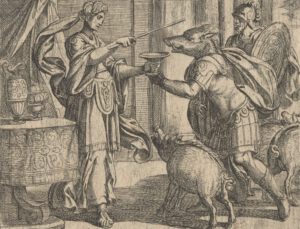
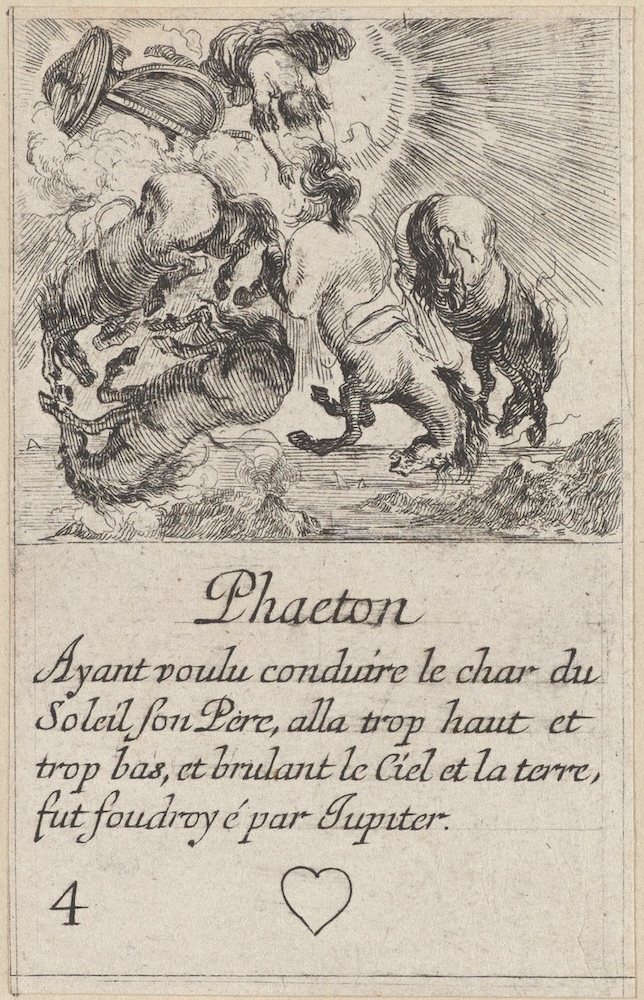
Stier Rosé

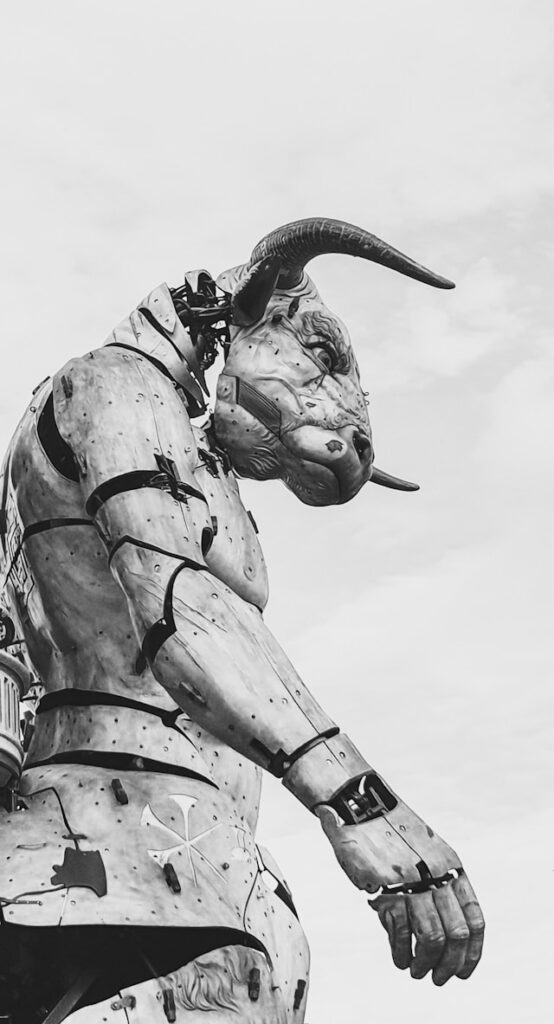
Dromen deed hij – herinnerde zich zijn
illustere voorvader de Minotaurus. De
bron die zich in het midden van het
labyrint bevond. Een stamvader om trots
op te zijn.

Dromen deed hij – wist weer van de kracht
en de macht die de IJslanders hem toe-
dichtten. De Stier die vanuit het westen het
eiland bereikte, de potentie die hij gaf
tijdens rituelen.

Dromen deed hij – van de wedstrijden waar
vrouwen en mannen hun moed testten. De
acrobatische sprong die zij maakten als
hij op hen afstormde. De hoorns die zij
beetpakten en zo hem ontweken.

Dromen deed hij – van zijn soortgenoten die
achter de menigte aangingen. Een menigte
gekleed in witte kleding met een sjaal van
de gekmakende kleur rood. Het doel was
de groep renners te laten vallen.

Dromen deed hij – voordat hij in stukken
werd gehakt. Zijn zachtste mooiste vlees,
zijn rocky mountain oysters, werden op
smaak gebracht in een rosé van framboos,
aardbeien en abrikoos.

Annemarie Kruit

Minotaur in wood

Geplaatst in Gedichten / Poems | Getagged , | Een reactie plaatsen

Ik zie ver, voorbij tijd en ruimte

VIII

Ik zie ver, voorbij
tijd en ruimte
naar toen, dan, daar;

Ik lees de tekenen,
ontraadsel runen
en leg de kaarten;

Ik schouw in de diepte
van de bron, de kosmos,
de kern van je ziel;

Luister naar mijn woorden,
hoor mijn wijze raad,
want voor de oogst van morgen
zaai je vandaag het zaad.

2024

Uit de bundel ‘Heks, een portret in 13 gedichten’, een dichtbundel door Flierefluiter.


Geplaatst in Gedichten / Poems | Getagged , | Een reactie plaatsen

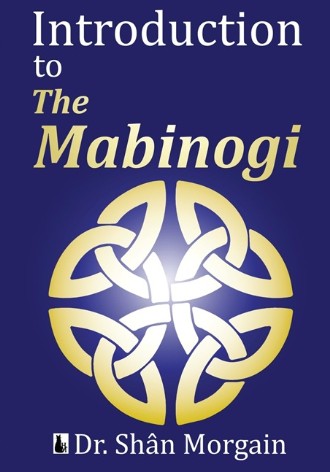
Review: Introduction to the Mabinogi

Introduction to the Mabinogi
Shân Morgain
House Morgain, ‏14 September 2025,‎ 160 pages. ISBN 978-1869973070
Available from Amazon

For those who walk a Pagan path, myths are rarely simply stories of a distant past. They are landscapes of meaning, vessels of memory, and gateways into a deeper relationship with the seen and unseen worlds. Shân Morgain’s Introduction to the Mabinogi, published last September, offers readers a welcoming entrance into one of the great treasures of Welsh literature: the Four Branches of the Mabinogi.

With warmth, clarity, and respect for both scholarship and tradition, Morgain invites us to step into a world where boundaries between human and Otherworld, nature and spirit, life and death, are fluid. Here kings and queens, animals and birds, enchanted realms and ordinary landscapes exist within a web of relationship — a worldview that will resonate deeply with many contemporary Pagans seeking connection with ancestral stories and sacred landscapes.

The Mabinogi has long fascinated those drawn to Celtic traditions. The tales of Pwyll, Rhiannon, Branwen, Manawydan, and Math contain themes that continue to speak powerfully today: sovereignty, honour, transformation, sacrifice, healing, and the consequences of breaking harmony. Morgain’s approach allows these themes to emerge naturally, without forcing modern interpretations upon the material. She recognises the importance of approaching these medieval Welsh texts with care, while also acknowledging their enduring spiritual and imaginative power.

One of the greatest strengths of Introduction to the Mabinogi is that Morgain does not present the tales as simplistic remnants of a “pure” pre-Christian Celtic religion. Such interpretations can easily overlook the complexity of the medieval manuscripts and the centuries of transmission through which these stories have travelled. Instead, she honours the Mabinogi as living literature — a body of wisdom that can be appreciated historically, artistically, and spiritually.

For many Wiccans and Pagans, the attraction of Celtic mythology lies not only in gods and heroes but in the relationship between people, land, and the Otherworld. The Mabinogi reminds us that the landscape itself is alive with presence and meaning. Rivers, forests, animals, hills, and boundaries between worlds are not merely settings; they are participants in the unfolding of the story.

The figure of Rhiannon, in particular, continues to inspire many modern Pagans. Associated with sovereignty, mystery, horses, and Otherworldly power, she represents themes of dignity, endurance, and transformation. Yet Morgain wisely avoids reducing her to a single modern archetype. Instead, she allows Rhiannon — and all the characters of the Mabinogi — to remain complex figures whose meanings continue to unfold.

The book is also valuable for readers interested in the concept of sacred kingship and the relationship between ruler and land. Throughout the Mabinogi, personal actions have consequences not only for individuals but for communities and the wider world. Harmony must be restored when relationships are damaged. This understanding of interconnectedness feels remarkably relevant in an age when many Pagan traditions are once again exploring ecological spirituality, the rights of Nature, and humanity’s responsibilities towards the Earth.

Morgain’s writing style is particularly suited to those approaching the Mabinogi for the first time. She shares her knowledge without creating barriers of academic language, allowing the reader to experience the wonder of the stories themselves. Her affection for the material shines through, encouraging readers to continue their own exploration of Welsh mythology, folklore, and tradition.

Those already deeply familiar with Celtic studies may wish for a more extensive discussion of manuscript history, medieval Welsh society, or the complex debates surrounding possible pre-Christian influences. However, this is not the purpose of the book. Introduction to the Mabinogi is a doorway rather than a final destination — an invitation to enter the landscape and begin the journey.

For Pagan readers, the greatest gift of this book is perhaps the reminder that myths are not fossils preserved behind glass. They are seeds. When approached with respect, they continue to grow, offering insight, inspiration, and a deeper appreciation of the relationships between humans, the natural world, and the mysteries beyond ordinary perception.

Shân Morgain has created a thoughtful companion for anyone wishing to explore the Mabinogi with both heart and mind. Whether one approaches these tales as a scholar, storyteller, seeker, or practitioner of a Pagan path, this book provides a meaningful introduction to a tradition whose voices continue to echo across the centuries.

A highly recommended read for Wiccans, Pagans, lovers of Celtic traditions, and all those who feel called to explore the meeting place between myth, land, and spirit.

Shan Morgain (a.k.a. Shan Jayran)

A grand old matriarch. I live with my family of humans and cats in an ancient house in South Wales. It’s blessedly quiet as the mediaeval walls are 2ft thick. Heaven for a writer.

SEPTEMBER 2025 Introduction to the Mabinogi (House Morgain) followed by Book 2 Studying the Mabinogi; and Book 3 Pedeir Cainc y Mabinogi with parallel English translation, Plus 3rd editions of both Which Craft? and Circlework

MY EARLY BOOKS – new editions 2026 giving the 2nd editions with additional material. These books and associated events UK pioneered the new, modern, open and proud Paganism 1980s 1990s.

Shan (Jayran) WHICH CRAFT? (1985) Brief, intelligent introduction to modern Craft and Goddess Paganism. (House of the Goddess. Red cover. ISBN 978-1-869973003)

Shan (Jayran) CIRCLEWORK : Handbook of Basic Ritual in the style of the Craft (1986. House of the Goddess Red cover. ISBN 1869973011) Step by step guide to creating your own rituals. Not just recipes, how to cook.

Shan (Jayran) WHICH CRAFT? expanded 2nd edition (1993 House of the Goddess. ISBN 978-1869973001 Copper cover)

Shan (Jayran) CIRCLEWORK: a DIY Handbook of Ritual, Psychology and Magic. expanded 2nd edition (1994 House of the Goddess. ISBN 978-1-869973-06-3 Green cover)

Shan Jayran, THE PAGAN INDEX 1995 (1994, House of the Goddess. ISBN 978-1-869973-05-6) A-Z directory of Pagan groups & organisations UK of the 1990s. Contacts, descriptions. Categories of tradition. A powerful historical snapshot.

Some of these earlier books were published under my first name only.

REFERENCES:

House Morgain: Mabinogi series: www.mabinogistudy.com

https://www.amazon.co.uk/Introduction-Mabinogi-1-Shan-Morgain/dp/1869973070

Here is a wonderful review by Simon Rodway:

Readers of Nation.Cymru may well be familiar with Shân Morgain’s inimitable style. You may have read some of her entertaining, eccentric and insightful articles on medieval Welsh literature and other topics.

This useful little book, designed to be an introduction for the uninitiated to the Four Branches of the Mabinogi, is very much in the same vein.


Geplaatst in Boeken, English articles, Recensies | Getagged , , , , | Een reactie plaatsen

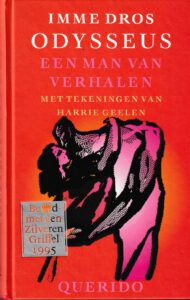
Recensie: Odysseus, een man van verhalen

Imme Dros
Odysseus, een man van verhalen
Met tekeningen van Harrie Geelen
Querido, Amsterdam 1994. ISBN 90-214-6036-X.
In de bibliotheek te leen of tweedehands te koop, of nieuw verkrijgbaar in één band met Ilios (zie hieronder)

Sinds het uitkomen van de film The Odyssey van Christopher Nolan woeden er op social media hevige discussies over zo ongeveer elk aspect van de film waaraan iemand eventueel aanstoot zou kunnen nemen – en social media zijn geknipt voor heftige reacties, dus dat wil wel. Blogs en nieuwsbrieven over de oudheid haken in op de trend en gaan aflevering na aflevering over de Odyssee. Maar ook in boekwinkels is een sterk toegenomen vraag naar vertalingen van Homerus’ Odyssee en naar de diverse navertellingen van het verhaal. Bij mijn moeder lag ineens weer Odysseus, een man van verhalen van Imme Dros op tafel. Ik sloeg het boek open en kon haast niet ophouden met lezen.

De Odyssee is geen chronologisch rechttoe-rechtaan verhaal over de avonturen van Odysseus en dit boek is dat evenmin: verschillende personages die zelf een rol spelen in de mythen worden hier aan het woord gelaten om een gedeelte, en daarmee hun eigen, op de toehoorder afgestemde versie van de gebeurtenissen te vertellen. Odysseus’ oude voedster Eurykleia bijvoorbeeld haalt herinneringen op: zij vertelt hoe deze langgewenste koningszoon de merkwaardige naam Odysseus kreeg, wat ‘Hateling’ betekent, en denkt terug aan die keer dat zij als bediende de koning uitschold, omdat hij Odysseus die toen nog maar een jongen was, had meegenomen bij een jachtpartij, waarbij het kind een ernstige beenwond opliep. Zijn vrouw Penelopeia vertelt hoe ze Odysseus voor het eerst ontmoette in Sparta, waar de edelen van heel Griekenland naar de hand van haar vriendin Helena dongen. Athena brengt verslag uit aan Zeus over Odysseus’ zoon Telemachos, die inmiddels volwassen is en zich (hiertoe door haarzelf aangespoord) eindelijk verzet tegen de 108 onwelkome gasten in het paleis, die met zijn moeder willen trouwen en al jarenlang feestbanketten aanrichten op kosten van Odysseus’ familie. Afrodite klaagt tegen haar minnaar Ares over wat Athena, die zij niet kan uitstaan, nu weer heeft bekonkeld zonder dat Zeus er iets van zegt. Athena beklaagt zich bij Zeus over Aphrodite die met Hera samenspant om haar plannen te dwarsbomen, en dat dat niet logisch of redelijk is… Net als bij Homerus vertellen de sprekers zelf ook weer wat anderen hebben gezegd, en wat die anderen hebben verteld dat weer anderen hebben gezegd – en al het gesprokene in de directe rede, waardoor je soms even vergeet wie er nu eigenlijk aan het woord is.

Wie de Odyssee in vertaling (of in het Grieks) heeft gelezen, zal in dit boek uiteraard het verhaal zelf, maar ook veel zinswendingen herkennen. Bijvoorbeeld wanneer Athena vermeldt dat Telemachos “wel erg lang nadenkt bij alles”. In de vertaling van de Odyssee van deze schrijfster, die ik ooit met veel plezier als podcast heb beluisterd,* is regelmatig sprake van “Telemachos, die bijzonder goed nadacht”. Het ging bij die aanduiding duidelijk om een zogeheten epitheton, een vaste omschrijving die steeds terugkeert. De korte kenschets maakt duidelijk dat Telemachos niet zomaar iets doet of gelooft, maar een aard heeft naar zijn ouders, die allebei als buitengewoon slim en niet gemakkelijk te misleiden worden afgeschilderd.

De verhalen worden levendig en met humor verteld. De humor schuilt niet alleen in de opzet, maar ook in details zoals de soms militaire toon in de rapporteringen van Athena of de zeemanstaal van Poseidon (“Hojo!”), of de bewering dat Hermes de honderdogige, immer waakzame Argos in slaap wist te krijgen door hem notulen van de godenvergaderingen voor te lezen. (Hermes’ notulen zoals die in dit boek staan afgedrukt, zijn trouwens helemaal niet saai.) Aardig zijn ook, voor wie ze kan herkennen, literaire toespelingen zoals de verbaasde uitroep “alle Goden van de Olympos op een roeibank!” (in de tragedie Agamemnon van Aeschylus komt een zin voor die zoiets schijnt te betekenen als: gewelddadig is de goedgunstigheid van de goden op hun verheven roeibanken). Wie de toespelingen niet herkent (en ik vermoed dat er veel meer zijn dan ik opmerk), krijgt toch nergens het gevoel dat de schrijfster haar eruditie etaleert over de hoofden van minder belezen lezers heen. Het blijft allemaal prima leesbaar. Ik zie ernaar uit, ook eens Ilios van Imme Dros te gaan lezen.

Odysseus, een man van verhalen is momenteel niet los in de handel, maar wel samen met Ilios van dezelfde schrijfster in één band.

Wie liever Homerus in het Nederlands leest in plaats van een op Homerus geïnspireerd boek, kan ik de vertalingen van deze zelfde Imme Dros aanbevelen. Net als Ilios & Odysseus zijn die nu samen in één band leverbaar, en wel als Ilias & Odysseia.

* Vertaalde klassieke teksten komen eigenlijk het best tot hun recht als hoorspel, podcast of luisterboek. In de oudheid werden ze immers ook voorgedragen en beluisterd.

Geplaatst in Boeken, Recensies | Getagged , | Een reactie plaatsen

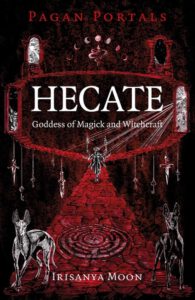
Recensie: Hecate, Goddess of Magick and Witchcraft

Hecate, Goddess of Magick and Witchcraft
Irisanya Moon
Moon Books, June 30, 2026. Paperback ISBN 9781803417059
e-Book ISBN 978-1-78535-999-6

Hecate waits for us at the crossroads, torches in each hand. The goddess of land, sea, and sky is wise and wondrous, terrifying and holy. Triple-faced Hecate does not tell us the way; she shows us what can happen when we step into our power. Witch practices, trances, spells, and immersive exercises, you can build a relationship with Hecate: light-bringer, gate-breaker, and star-walker. The Goddess of Magick and Witchcraft inspires, guides, and grants safe passage in the darkest moment.

Bovenstaande tekst staat op de achterflap van dit nieuwe boek over de Griekse Godin Hekate. Ikzelf schrijf haar naam altijd graag met een K. Ik ken Irisanya Moon van haar boek over de Nornen, waarvan ik de Nederlandse vertaling heb gelezen door A3 Boeken. Dat las erg fijn weg, haar schrijfwijze is prettig, en niet al te hoogdravend taalgebruik.
Omdat ik best veel werk met deze Godin, en mijzelf een redelijk devote mag noemen, ben ik altijd op zoek naar interessante (nieuwe) boeken over haar.

Even heel eerlijk, in ieder boek over haar vind je dezelfde verhalen over haar achtergrond, familie, epitheta en symbolen. Daar zal je in dit boek niets nieuws over vinden als je al diverse boeken hebt over haar. Maar los van dat … is dit wel een mooi compleet boek over haar. Alles wat je moet weten over Hekate kan je hierin terugvinden.
Er staan mooie gebeden in, invocaties en spreuken waarmee je aan de slag kan. Ook de kruiden en offergaven die bij haar horen worden besproken. De speciale dagen en maanfasen die gewijd zijn aan deze Godin. En een hele lijst met epitheta, dieren en symbolen die verbonden zijn met Hekate, inclusief een duidelijke uitleg. En natuurlijk hoe je haar kan vinden en kennis kan maken met haar.

Aan het einde vind je een indrukwekkende literatuurlijst met links naar websites en vele boeken. Daar staan zelfs voor deze boekenheks nog interessante tips bij.
Kortom … een leuk boek om kennis te maken met Hekate in duidelijke taal, en met werkbare informatie.

Bol.com heeft hem voor euro 12,50, en voor dat geld mag het eigenlijk niet aan jouw verzameling boeken ontbreken als deze Godin jouw interesse heeft.

Geplaatst in Boeken, Recensies | Getagged , , , , | Een reactie plaatsen

Vuur zonder rook

Hoe kun je in het droge seizoen het element ‘vuur’ symboliseren in je ritueel zonder dat je daadwerkelijk vuur, of batterijen, gebruikt?

Zoals bekend gebruikt een heks symbolen bij rituelen. De elementen worden vaak vertegenwoordigd door gebruiksvoorwerpen die we ‘wapens’ noemen: de kelk voor water, het pentakel voor aarde, de staf voor vuur en de athame voor lucht. Maar ook het wierookvat wordt gebruikt voor de combinatie van vuur en lucht, en natuurlijk zijn er kaarsen, op het altaar en op de windstreken. Dat geldt vooral bij rituelen thuis. Als een heks buiten in het bos een ritueel doet, kan ze andere symbolen gebruiken voor de elementen. ’s Winters kan het fijn zijn om in je heksenketel – of eronder – een echt vuurtje te stoken, maar in de zomer moet je oppassen met echt vuur. Ook met kaarsen en wierook. Wat kun je dan gebruiken om het element vuur aan te duiden?

Tegenwoordig kun je kaarsen in allerlei modellen vinden in een versie met batterij. Maar voor mij geeft dat toch niet de sfeer die ik ermee wil oproepen. De instrumenten van de heks zijn doorgaans een afspiegeling van voorbije tijden, en ik ervaar daarbij een vanzelfsprekende connectie met de voorouders. Kaarsen in plaats van elektrisch licht, de bezem, het zwaard, papier in plaats van computers; voel je wat ik bedoel? Iets met een batterij brengt mij direct terug in de 21e eeuw. Het detoneert. Alsof je een open haard vervangt door een beeldscherm met de afbeelding van een vuur. Geldt dat voor jou niet, gebruik dan vooral die – veilige – kaarsen op batterijen! Maar er zijn alternatieven.

In plaats van vuur, kun je kleuren gebruiken: rood, geel, goud. Eventueel in de vorm van een vlam of vuurtje. Aan de bomen vind je nu de oranje lijsterbessen. Een trosje bessen op de plek van het zuiden roept iets vurigs op, in elk geval bij (het laatste) daglicht.

Vuur staat voor energie, voor leven. Dat is waarom de staf dat element vertegenwoordigt. Een levende plant zou dus ook op het zuiden kunnen staan, zeker een plant met rode, oranje of gele bloemen. Citrusvruchten en hun schillen kunnen de combinatie van vuur en lucht verbeelden. In plaats van rond te gaan met een wierookbrander, kun je met een verse sinaasappelschil rondlopen en daar aan de rand van de cirkel nu en dan in knijpen, waardoor de geur vrijkomt. (En kleine druppeltjes olie. Reden om dit niet te doen wanneer je wel levend vuur gebruikt, zoals echte kaarsen). Etherische olie is een andere optie. Kies voor een geur die jij verbindt met vuur of energie.

Wees creatief, dat hoort ook bij het element vuur. Gebruik denneappels, een afbeelding van de phoenix, de vuurvogel, of een afbeelding die jij passend vindt. Maak die eventueel zelf, speciaal voor het ritueel dat je nu aan het plannen bent. Voor de andere elementen, aarde, water en lucht, kun je natuurlijk ook alternatieven zoeken. Transformatie is een van de associaties met vuur. Je zou daarom een stuk verkoold hout of houtskool kunnen gebruiken, of as die je hebt bewaard uit een vorig vuur. En natuurlijk kun je woorden, gebaren en dans gebruiken, of muziek.

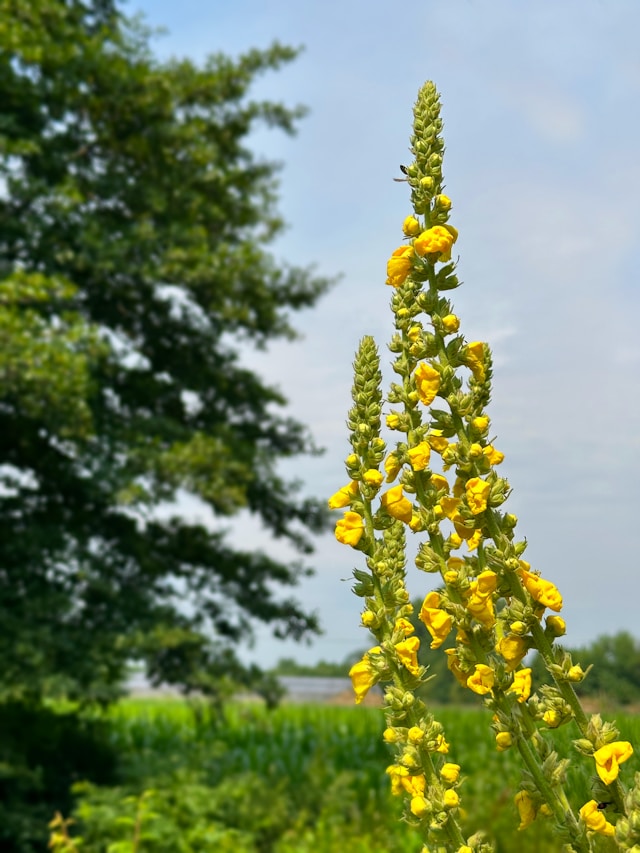
Ga bij jezelf na wat het element vuur voor jou betekent. Is dat bijvoorbeeld warmte, dan is een dekentje, een omslagdoek of een trui ook een prima symbool. Is het licht, dan kun je met zilver(papier), goud(folie) of een spiegel (gericht op het laatste licht) ook uit de voeten. Staat er toevallig een teunisbloem (de bloemen daarvan lijken licht te geven in het donker, net als de blaadjes van een ginkgoboom), een roodbloeiende stokroos of een ’toorts’ (de naam zegt het al!) op de plek waar je je ritueel wilt doen, maak daar dan gebruik van.
Je innerlijke vuur is sowieso lastig te vatten in een symbool. Of ken je jouw drijfveren wel goed genoeg om er een symbool aan te koppelen?

Verbascum, drie stengels vol met gele bloemetjes van een plant, die in het Nederlands 'toorts' heet.

Hoe dan ook: gebruik liever in het geheel geen vuur buiten als het zo droog is als nu. In een ander jaargetijde, wanneer het risico op brand kleiner is, is het ook goed om maatregelen te nemen. Zoals je kaarsen in een lantaarn zetten, waardoor ze ook minder snel uit waaien. En neem altijd de kooltjes van je wierookbrander mee naar huis, en gooi ze pas weg als ze echt koud zijn.

Zie ook het artikel ‘Het element vuur’.

Geplaatst in Artikelen | Getagged , , | Een reactie plaatsen

The Philosophy of Wicca: Reflections on Fertility

Among the many aspects explored in Wiccan practice, fertility is perhaps the one that most frequently divides opinions and gives rise to misunderstanding. This occurs because the concept is too often reduced to a purely biological or social meaning, when in Wicca — and in much of the Western magical tradition — it carries a far broader philosophical, energetic, and spiritual dimension.

Polarity Beyond Biology and Social Construct

Wiccan practice is structured, among other foundations, upon the principle of polarity — the joint work of the Goddess and the God as complementary and co-creative forces. It would, however, be a philosophical error to reduce this polarity to the social categories of “man” and “woman”, or to the biological categories of “male” and “female”.

Purely biological categories — chromosomes X and Y, reproductive anatomy — describe physical mechanisms, but fail to capture the complexity of magical and spiritual energy. The social archetypes of “man” and “woman”, as constructed in many cultures, were historically shaped by patriarchal hierarchical structures that limited the full development of women, non-binary people, and all those who did not conform to the dominant model. Neither of these systems — the biological or the conventional social — adequately reveals the nature of the Goddess and God’s energy.

Polarity in Wicca is, above all, energetic and spiritual. It encompasses qualities such as receptivity and projection, introversion and expression, depth and expansion — pairs that transcend biological or social gender. Starhawk, one of the foremost voices of the modern Wicca movement, describes this polarity as “the dance of energies that permeates all life”, emphasising that it is not bound to specific bodies or gender identities.

It is within this perspective that transsexuality, non-binary identity, and all expressions of gender find a legitimate and natural place within Wicca. When we understand that the Goddess and the God are universal energetic principles — not fixed gender identities — practice becomes genuinely inclusive, without requiring artificial adaptations or condescension.

The Role of Myth in Understanding Deities

If biological and social gender categories are insufficient to describe the energy of the Goddess and the God, it is myth that provides us with the most adequate language for this approach. We find this function of myth in virtually all of the world’s mythologies: it is not mere “story” or fantasy, but a symbolic system that contextualises the energetic presuppositions of a deity and helps us understand, as fully as possible, the nature of that divine force.

The mythologist Joseph Campbell observed that myths function as “metaphors of spiritual human experience” — inner maps that integrate history, culture, collective psychology, and spiritual dimension. Each deity, therefore, carries a complex of attributes that includes geographical origins, stories of suffering and triumph, connections to natural elements, patterns of relationship, and specific emotional qualities. This richness far exceeds anything a binary definition of gender could offer.

Thus, when we call upon a deity in ritual, we are not merely invoking an abstract “masculine principle” or “feminine principle”, but a rich, multidimensional presence rooted in millennia of sacred human experience. Myth is the vehicle that connects us to this depth.

Polarity in Ritual

This understanding has direct implications for ritual practice. The choice of deities to be invoked need not follow a fixed pattern of “female goddess + male god”. It should be guided by the magical purpose, the energies required, and the practitioner’s attunement to the forces being called.

Consider a ritual of support for a woman experiencing injustice or violence. We might invoke archetypes of war, courage, and justice — such as the Greek Artemis (goddess of the hunt, protection, and feminine autonomy), the Roman Bellona (goddess of war), the Norse Freyja (warrior and mistress of seidr magic), or the Celtic Morrigan (goddess of sovereignty, battle, and transformation). The God, in this same ritual, may be summoned not as a dominant force, but as support, balance, and shield — a principle of stability that allows the Goddess’s energy to manifest in full freedom.

This combination of energies — the warrior Goddess and the sustaining God — generates a third magical force. It is precisely this third force that, in Wiccan philosophy, represents fertility.

Fertility as a Third Force: A Philosophical Vision

Fertility, in its deepest Wiccan sense, does not refer exclusively to biological reproduction. It is the result of the harmonious union of two complementary forces — whatever their nature — and manifests as creation, expansion, and renewal across multiple planes of existence.

This vision finds parallels in several philosophical and spiritual traditions. In Taoism, the interaction between yin and yang produces not only biological life, but every manifestation of the universe — from music to ethics, from politics to art. In Hermetic alchemy, the conjunctio oppositorum (union of opposites) is the process that generates the opus magnum, the great transformative work. In Wicca, the magical result of ritual polarity is equally rich: it may take the form of protection, healing, clarity of vision, purification, intellectual creativity, emotional strength, or spiritual renewal.

It is no coincidence that Wicca celebrates the seasons of the Wheel of the Year as expressions of this multidimensional fertility: spring is not merely the blossoming of fields, but the awakening of creativity; autumn is not merely the harvest of grain, but the harvest of accumulated experience and wisdom. Fertility is therefore present throughout nature — including human nature in its intellectual, emotional, and spiritual dimensions.

Vivianne Crowley, in her seminal work Wicca: The Old Religion in the New Age, articulates this vision by affirming that the mysteries of the Goddess and the God are not dogmas, but living experiences — and that fertility, in its sacred sense, is the capacity to create, transform, and renew in any sphere of life. Margot Adler, in Drawing Down the Moon, documents how modern Wiccan practitioners have long recognised this expanded dimension of fertility, beyond any reductive interpretation.

Conclusion: A Living and Inclusive Philosophy

Wicca, understood in its philosophical depth, offers a vision of the sacred that transcends fixed binary categories — whether biological or socially constructed — without denying them. It integrates them into a broader horizon, where what matters is not the gender identity of the practitioner or the deities invoked, but the energetic quality of the connection established and the magical intention that moves it.

Fertility, understood in this way, does not divide — it unites. It is the recognition that all creation arises from encounter, that all transformation requires the interaction of complementary forces, and that the result of that encounter — whether a life, an idea, a healing, or a protection — is always, in some sense, sacred.

It is this philosophy — rooted in nature, open to human complexity, and committed to the dignity of all ways of being — that makes Wicca not only a spiritual tradition, but also a profoundly ethical and humanist one.


References

Adler, Margot. Drawing Down the Moon: Witches, Druids, Goddess-Worshippers, and Other Pagans in America Today. New York: Viking Press, 1979. Revised edition: Penguin Books, 2006.

Bolen, Jean Shinoda. Goddesses in Everywoman: A New Psychology of Women. New York: Harper & Row, 1984.

Campbell, Joseph. The Hero with a Thousand Faces. New York: Pantheon Books, 1949. Third edition: New World Library, 2008.

Campbell, Joseph. The Masks of God: Primitive Mythology. New York: Viking Press, 1959.

Crowley, Vivianne. Wicca: The Old Religion in the New Age. London: Aquarian Press, 1989. Revised edition: Thorsons, 1996.

Farrar, Janet and Stewart Farrar. The Witches’ Goddess: The Feminine Principle of Divinity. London: Robert Hale, 1987.

Farrar, Janet and Stewart Farrar. The Witches’ God: Lord of the Dance. London: Robert Hale, 1989.

Gimbutas, Marija. The Goddesses and Gods of Old Europe: Myths and Cult Images. London: Thames and Hudson, 1982.

Hutton, Ronald. The Triumph of the Moon: A History of Modern Pagan Witchcraft. Oxford: Oxford University Press, 1999.

Jung, Carl Gustav. The Archetypes and the Collective Unconscious. Collected Works, vol. 9, Part I. Princeton: Princeton University Press, 1959.

Leland, Charles Godfrey. Aradia, or the Gospel of the Witches. London: David Nutt, 1899. Reprint: Phoenix Publishing, 1990.

Starhawk [Miriam Simos]. The Spiral Dance: A Rebirth of the Ancient Religion of the Great Goddess. San Francisco: Harper & Row, 1979. 20th anniversary edition: HarperSanFrancisco, 1999.

Starhawk [Miriam Simos]. Dreaming the Dark: Magic, Sex and Politics. Boston: Beacon Press, 1982.

Stone, Merlin. When God Was a Woman. New York: Dial Press, 1976. Reprint: Harcourt Brace Jovanovich, 1978.

Valiente, Doreen. Witchcraft for Tomorrow. London: Robert Hale, 1978.

Valiente, Doreen. The Rebirth of Witchcraft. London: Robert Hale, 1989.

Geplaatst in English articles | Getagged , , , , , | Reacties uitgeschakeld voor The Philosophy of Wicca: Reflections on Fertility

Tales of the Mediterranean – the Enigma of Sardinia – Part 1

In May 2025 I travelled to Sardinia for a Spring break. My journey into Sardinia’s deep past began in Olbia, a place that feels like a threshold — between sea and land, and between the present and something far older. From there, the island gradually revealed itself not just as a landscape, but as a repository of memory, shaped by thousands of years of human presence.

What drew me most strongly was not the imposing nuraghi, though they stand everywhere as silent witnesses to the Nuragic civilisation. Instead, it was something far smaller, more intimate: the human form rendered in miniature.

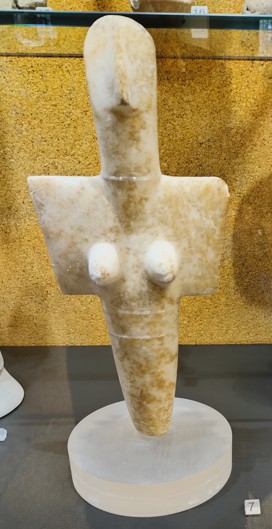
This interest deepened when I reached Cagliari and spent time in the National Archaeological Museum of Cagliari. There, behind glass yet somehow vividly present, were rows of prehistoric figurines — many of them in what is often described as a “cruciform” shape. Their forms are abstract, almost geometric: outstretched arms, simplified bodies, faces that are more suggestion than detail. And yet, they carry a striking presence.

Often referred to as “Venuses”, these figures echo a much older and widespread tradition of female figurines found across prehistoric Europe. But here in Sardinia, they feel distinctly of this place — rooted in the island’s Neolithic cultures, such as the Ozieri culture. Whether they represent fertility, divinity, ancestors, or something more elusive, they seem to hold a symbolic language that is both deeply human and ultimately unknowable.

Standing among them, I had the sense not of observing artefacts, but of encountering expressions of belief — traces of how people once understood life, death, and continuity. These were not grand monuments meant to dominate the landscape, but objects that could be held, carried, perhaps even used in ritual. Their power lies in their intimacy.

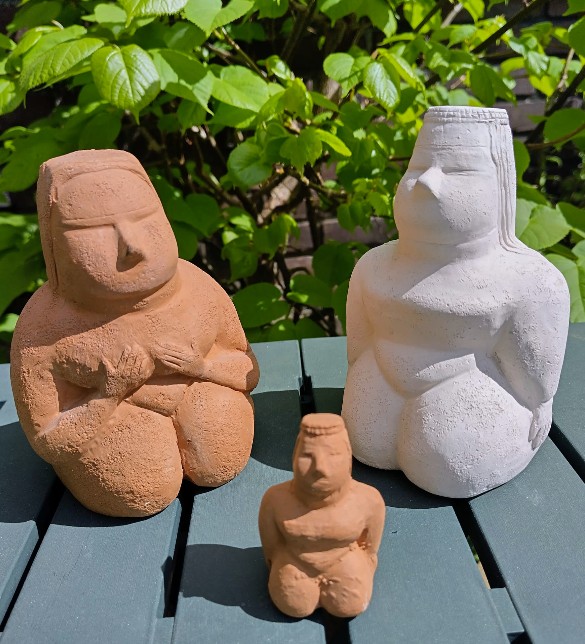
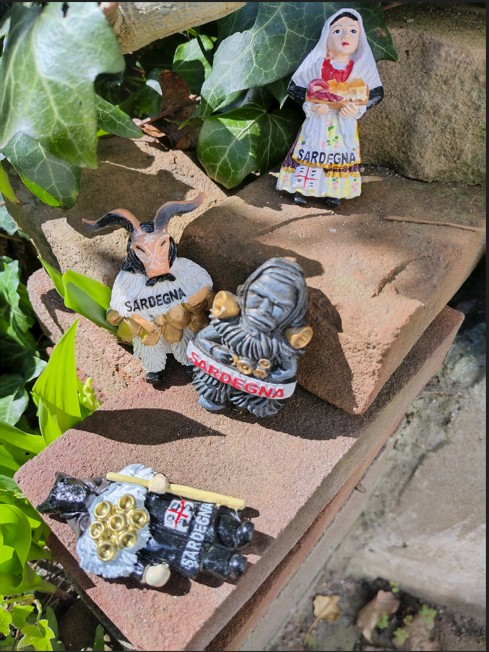
Later, I found myself drawn to bring that connection into my own hands. I bought two large and one small figurine — modern reproductions, perhaps, but still shaped by that same ancient aesthetic. Holding them, I was reminded that history is not only something we study at a distance; sometimes it is something we recognise, almost instinctively.

(Found in a souvenir shop in Cagliari – replicas of Neolithic figurines)

(An example of a cruciform figurine, now in the National Archaeological Museum of Cagliari.)

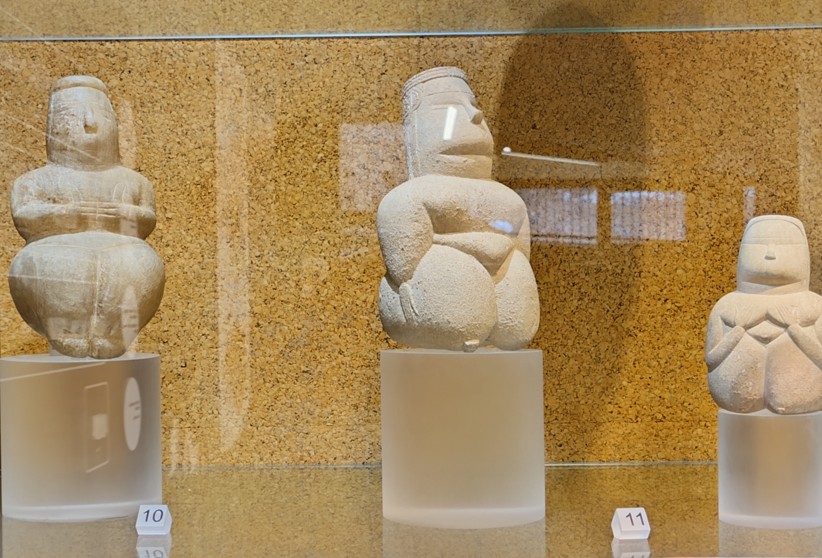
(Three ‘Venus’ figurines, now in the National Archaeological Museum of Cagliari.)

Sardinia’s past stretches back at least 20,000 years, from the earliest human presence in caves such as Grotta Corbeddu, through the agricultural transformations of the Neolithic, to the rise of the Nuragic towers and the later arrival of Phoenicians, Carthaginians, and Romans. Each layer has left its mark.

And yet, it is these relatively small figurines that remain with me most vividly. They seem to distil something essential — something about the human need to represent, to revere, to connect. In their quiet, stylised forms, they bridge an immense span of time, linking the hands that first shaped them with those that continue to hold them today. They, of course, reminded me of the figurines I had seen in Cyprus and also in the Cyclades, Greece.

Looking at the 3 figurines, they echo the visual language of the Ozieri culture and its immediate successors. Left figure (terracotta, seated, arms across chest), this is the most interesting in terms of symbolism. It features a seated, compact posture, with arms drawn inward across the torso. There is a strong emphasis on body mass (hips, thighs, torso). The stylised face with a prominent nose closely reflects Late Neolithic Ozieri-type figurines. The volumetric body and grounded seated pose are typical, whilst the inward arm position may suggest containment, gestation, or introspection. It carries the “embodied presence” typical of earlier figurines and is closest to the “living body” phase of representation. The right figure (white, more geometric, upright) shows a clear stylistic shift. The features are more upright, column-like forms, with the body simplified into geometric planes. The arms are reduced to angular shapes, and there is less emphasis on anatomy, more on structure.

This reflects the transition toward abstraction and moving away from the natural body toward a symbolic human form. It sits conceptually between Ozieri naturalism and later cruciform stylisation. This is a transitional form.

The small central figure in the photo is more simplified but still clearly anthropomorphic. The features include a compact, simplified body with minimal detail. There is more emphasis on posture rather than anatomy. This resembles reduced domestic or votive figurines, possibly inspired by Later Neolithic or Chalcolithic simplifications. Or even popular museum replicas, such as the one I found. In this sense, we can think of it as a didactic or symbolic miniature, rather than a precise archaeological type.

Taken as a group, the figurines unintentionally (or perhaps intentionally) illustrate a core developmental sequence in Sardinian prehistory. From ‘Embodied → Stylised → Abstract’ with on the left the ‘body as presence’, the Ozieri phase, to the right, ‘body as structure/symbol’, i.e. transitional. And in the centre, body as sign or token’.

One could frame these figurines not as “goddesses”, but as material expressions of presence — objects that mediate between body, identity, and continuity across life and death. This becomes powerful when especially when linked to Domus de Janas / Houses of the Fairies . Rather than literal depictions, such figures may be understood as symbolic presences mediating between the living and the ancestral realms.

From a contemporary pagan or Wiccan perspective, it is tempting to read them as early expressions of the Goddess — the creative, sustaining force present in all living things. But what struck me most was not certainty, but openness. These figures do not insist on a single meaning; they invite relationship. They ask to be held, contemplated, perhaps even listened to.

Standing among them, I was aware of a continuity that transcends doctrine. The people who shaped these forms lived thousands of years ago, yet their impulse — to honour life, to give form to the unseen — remains recognisable. In that sense, these figurines are not relics of a lost belief system, but part of an ongoing human conversation.

Though modern in origin, they echo the same cruciform simplicity, the same quiet balance between abstraction and presence. Holding them, I felt less like an observer of history and more like a participant in a long, unbroken thread.

It is there, perhaps, in these small, cruciform forms, not as answers, but as gestures, towards life, towards continuity, towards the enduring human desire to honour the mystery of being.

Figurines and Symbolism in the Ozieri Culture

The Late Neolithic Ozieri culture (c. 3200–2800 BCE) represents one of the most artistically and symbolically sophisticated phases of prehistoric Sardinia. Known especially for its finely crafted ceramics and elaborate funerary architecture, it also produced a distinctive corpus of anthropomorphic figurines that offer insight into the inner life of these early communities.

These figurines, often described in earlier literature as “Venus” types, are typically small, stylised human forms. Unlike the more exaggerated fertility figures known from other parts of prehistoric Europe, Ozieri examples tend toward a refined abstraction: the body is simplified, yet still recognisably human, with subtle emphasis on form rather than explicit anatomical detail. While frequently interpreted as female, their meaning is not fixed; current archaeological thinking resists assigning them to a single “Mother Goddess” framework. Instead, they are understood as part of a broader symbolic language concerned with life, death, regeneration, and continuity.

As I pointed out earlier, the key context for these figurines is the remarkable funerary landscape of Sardinia, particularly the rock-cut tombs known as Domus de Janas / Houses of the Fairies). These subterranean structures, carved to resemble domestic interiors, suggest a worldview in which the boundary between the living and the dead was permeable and ongoing. Within this setting, figurines likely played a ritual role — not merely as representations, but as active participants in mediating relationships between the human community, its ancestors, and the unseen world.

Over time, a striking transformation occurs. The more rounded, volumetric figurines of the Ozieri phase gradually give way to increasingly abstract, cruciform representations in the later Neolithic and Chalcolithic periods. These figures — flattened, schematic, and often cross-shaped — distil the human form into its most essential geometry. Found in similar funerary contexts, including Domus de Janas tombs, they suggest not a loss of meaning, but a concentration and codification of symbolic expression.

The cruciform shape itself invites multiple readings. It may reflect a stylised human with outstretched arms, a gesture of invocation or offering; alternatively, it may encode a more cosmological idea, linking vertical and horizontal axes — earth and sky, life and death, the human and the ancestral. Importantly, this form long predates later religious associations with the cross, and should be understood within its own prehistoric framework.

This evolution — from embodied figurine to abstract sign — marks a profound shift in how human presence was conceived and represented. Yet continuity remains. Across the Ozieri culture and into the later Nuragic Civilization, the human figure persists as a central motif, carrying meanings that are at once personal, communal, and cosmological.

Sabina Magliocci, writing about ‘Aradia in Sardinia – The Archaeology of a Folk Character’) mentions the Fairies:

“There are said to be in Sardinia beings called Janas, whose name means ‘followers of Diana’,  linking them directly to the medieval legends of roaming spirits. They are said to live in Neolithic shaft tombs, known as Domus de Janas, ‘homes of the fairies’, or in caves, both locations of prehistoric burials. They are expert spinners and weavers, and can interact with and in some cases even marry humans (Liori, 1992, 107-111). Like the Romanian iele, who are led by Irodeasa (Kligman, 1981, 54), Sardinian Janas have as their patroness Araja or Arada Turchi (2000, 78), whose name is a version of the medieval Italian Erodiade. It is, in fact, the rendering in Sardo of a hypothetical Italian word ‘Aradia’. This is a persuasive piece of evidence suggesting that at some time, a character called Aradia must have existed in Italian folklore, and that when her stories were brought to Sardinia, her name, as well as details of her legend, acquired a Sardinian flavour. In some cases, the leader of the Janas is called s’Araja dimoniu,Aradia the demon’, a reflection of the demonisation of the legend at the hands of medieval clerics. If s’Araja dimoniu is the leader of the fairies, it is not an unreasonable leap to hypothesise that at some point in Sardinian legendry, this figure split into two, acquiring a counterpart who was not demonic, but righteous, rewarding industriousness and punishing laziness in young women who were spinning and weaving. The name of this spirit was s’Araja justa, ‘the just Aradia’ – and here we have the likely antecedent of sa Rejusta (Turchi, 2001, 79).”

Sabina continues: “Legends of Herodias and Diana most likely entered Sardinia during the 12th – 13th centuries, when the city-states of Pisa and Genoa vied for control over the island. This was exactly the time during which these legends were widely diffused in continental Italy, and when clerics were writing encyclicals warning against the dangers of believing these tales.

In fact, it is not unlikely that it was through the influence of clerics themselves that the legend was imported. By the 15th century, it could be found in Sardinian confessionals (Turchi, 2001, 84).

What seems not to have happened in Sardinia is the blending of this legend complex with the emergent myth of the diabolical sabbat; medieval Sardinian witch trial records lack confessions from women who reported going out at night with Aradia (Hennigsen, 1993; Pinna, 2000). Instead, s’Araja justa seems to have hybridised, over centuries, with indigenous legendary characters like sas mamas (‘the mothers’), who may be versions of pre-Christian spirits or deities connected with the sun, moon and water. She also merged with legends about night roaming” 

From Figurine to Mask: continuity of presence in Sardinia

During my visit to Cagliari, I found a series of small prehistoric figurines — objects often described as “Venuses”, yet far more subtle than that label suggests. Their forms were simplified, poised between body and abstraction, carrying a presence that felt less representational than relational. Later, I acquired two modern ceramic pieces inspired by these ancient types. Holding them, I was struck not by what they depict, but by what they seem to do: they gather attention, centre awareness, and suggest a continuity between the human form and something beyond it.

These figurines find their origins in the Late Neolithic Ozieri culture (c. 3200–2800 BCE), one of the most artistically refined prehistoric cultures of Sardinia. Alongside intricately decorated ceramics, Ozieri communities created anthropomorphic figures that move between embodiment and abstraction. Over time, these forms undergo a striking transformation. The rounded, seated bodies of earlier figurines gradually give way to increasingly schematic, even cruciform shapes. The human figure is reduced, distilled, abstracted — yet not diminished. Instead, it becomes more concentrated, more symbolic. The body is no longer depicted; it is invoked.

This movement — from embodied form to symbolic essence — does not end in prehistory. It continues, unexpectedly, in the living ritual traditions of Sardinia.

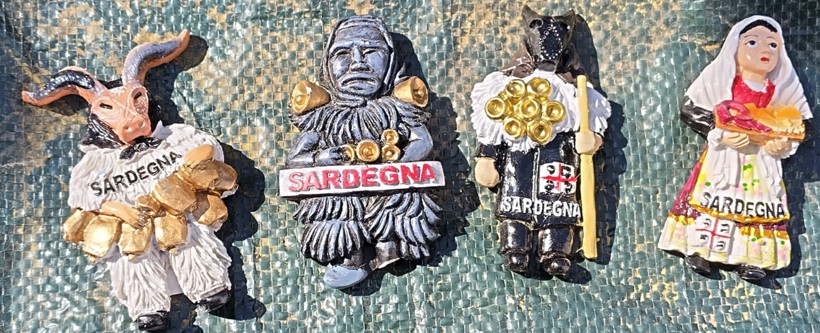
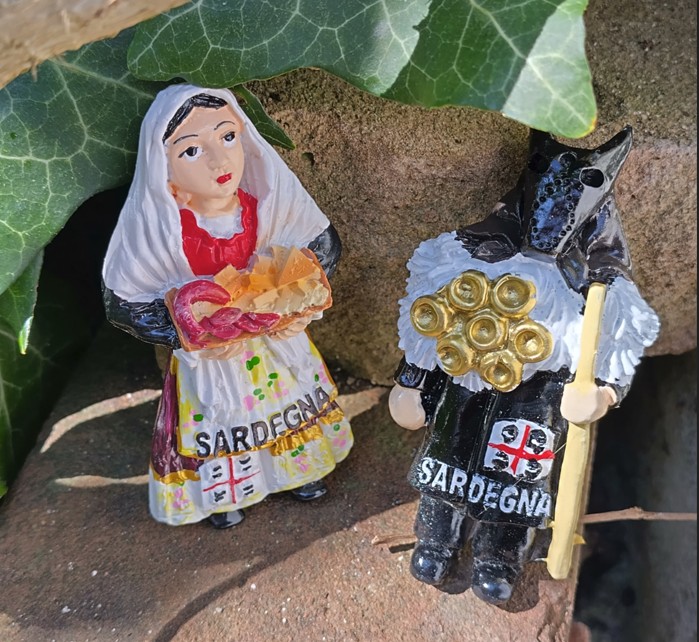
(Found in a souvenir shop in Cagliari, magnets depicting Mamuthones and the Lady carrying bread.)

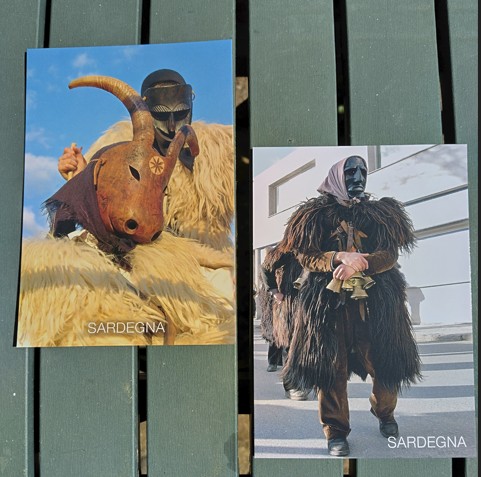
(Postcards from a souvenir shop in Cagliari depicting Mamuthones.)


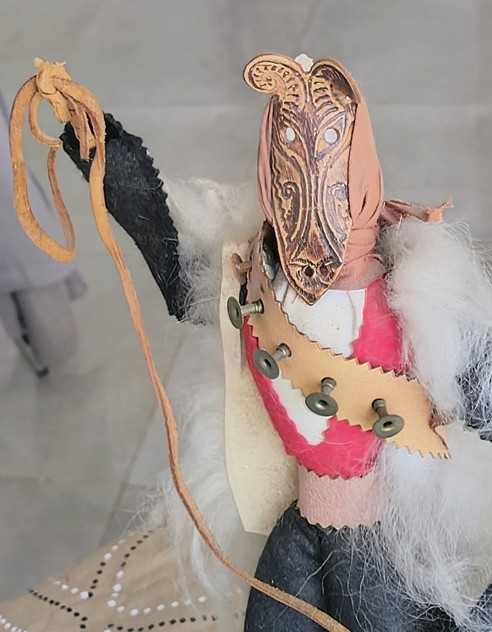
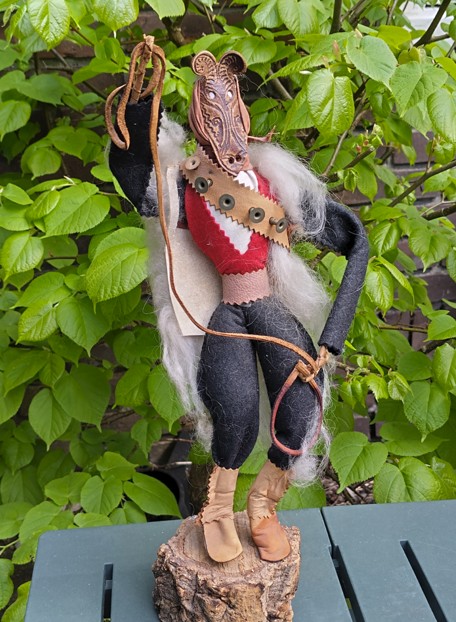
(Found in a souvenir shop in Cagliari, an Issohadores – approx 40 cms tall.)

Each year, during Carnival, the village of Mamoiada becomes the stage for one of the island’s most compelling performances: the procession of the Mamuthones and Issohadores. The Mamuthones, clad in black sheepskins and burdened with heavy bells, move in slow, synchronised steps, their dark wooden masks erasing individual identity. Beside them, the Issohadores — dressed in red and white — guide, control, and occasionally “capture” members of the crowd with a rope, drawing them into the ritual.

Here, too, the human form is transformed. Masked, weighted, and rhythmically constrained, the body becomes something other than itself. The Mamuthones do not perform as individuals; they move as a collective presence, their bells producing a deep, resonant sound that is felt as much as heard. The effect is both solemn and immersive, suggesting not spectacle but participation in a shared field of meaning.

Alongside them move the Issohadores, lighter in dress and more fluid in motion. With their white garments, red jackets, and colourful sashes, they stand in visual contrast to the dark, heavy Mamuthones. Most strikingly, they carry a rope — the soha — with which they skilfully “capture” individuals from the crowd. Those caught are not singled out for exclusion, but drawn into the ritual, becoming part of its unfolding. In this moment, the boundary between observer and participant dissolves.

If the Mamuthones embody a collective, ancestral force, the Issohadores mediate its relationship to the community. They guide the procession, regulate its rhythm, and extend its reach outward. The rope becomes a line of connection, linking performer and observer, ritual and daily life. What might otherwise remain distant or overwhelming is made accessible — translated into lived, shared experience.

Seen together, these elements form a continuity of sensibility that stretches back millennia. The figurines of the Ozieri culture, the carved interiors of the Domus de Janas, and the living ritual of Mamoiada all engage with a common question: how does the human form become a vessel for something beyond itself? Whether in clay, stone, or movement, the answer is not given through representation alone, but through presence, transformation, and relationship.

While often framed within the Christian calendar, this ritual clearly carries echoes of a far older worldview — one in which the boundaries between human, animal, and ancestral realms are fluid. The sheepskins, the masks, the repetitive movement, and the sonic weight of the bells all point toward a form of embodiment that is closer to transformation than representation.

Seen in this light, the connection to the prehistoric figurines becomes less speculative and more experiential. Both the small clay forms of the Ozieri culture and the masked figures of Mamoiada engage with a similar question: how does the human body become a vessel for something beyond itself? Whether held in the hand or encountered in procession, these forms do not simply depict — they mediate.

What emerges is not a linear history, but a continuity of sensibility. Across millennia, Sardinia preserves a way of relating to form, presence, and transformation that resists easy categorisation. The figurine, the tomb, the mask, and the ritual all participate in a shared language — one in which identity is not fixed, but negotiated between the visible and the unseen, the individual and the collective, the living and the dead.

From an interfaith perspective, this continuity resonates with traditions that recognise the sacred as immanent — present within land, body, and community rather than separate from it. The masked figure, the ancestral form, and the ritual gesture all suggest that identity is not fixed, but relational, shaped through connection with what lies beyond the visible.

From an environmental perspective, the same pattern emerges. The use of animal skins, the weight of the bells, the rhythmic engagement with the ground, and the act of drawing others into the ritual field all point toward a worldview in which human life is inseparable from the wider web of existence. To be “caught” by the rope is not merely to be included in a performance, but to be recognised as already part of a larger whole — human, animal, land, and ancestry intertwined.

What Sardinia offers, across these layers of time, is not simply a sequence of cultural expressions but a continuity of relationship. The figurine, the tomb, the mask, and the ritual all participate in a shared language — one in which the boundaries between living and dead, human and more-than-human, visible and unseen remain permeable.

In this way, the small figurine held in the hand and the masked figure moving through the village are not so distant from one another. Both serve as reminders that to be human is not only to stand apart, but to stand in relation: to the earth, to those who came before, and to those yet to come.

REFERENCES:

Sabina Magliocco: “Aradia in Sardinia – The Archaeology of a Folk Character” In Ten Years of Triumph of the Moon. (Harpenden: Hidden Publishing, 2009), pages 40-60.

Download the PDF here: https://www.academia.edu/584599/Aradia_in_Sardinia_the_Archaeology_of_a_Legend

Sabina Magliocco: “The Two Madonna’sThe Politics of Festival in a Sardinian Community”

© Sabina Magliocco 1992, 2005, 2019  Originally published by Peter Lang, Aug 1 1993. ISBN ‎ 9780820418964

Second edition published by Waveland Press, 2005. This is a typescript of the 2nd edition. All rights now belong to the author.

Download the PDF here: https://www.academia.edu/150895/The_Two_Madonnas_the_Politics_of_Festival_in_a_Sardinian_Community

Sabina Magliocco, Ph.D., Professor of Anthropology, grew up in Italy and the United States. She has published on religion, folklore, foodways, festival, witchcraft and Neo-Paganism in Europe and the United States. Her research began in Sardinia, where she studied how globalization affects traditional religious festivals. She went on to study rituals, festivals and cultural politics among contemporary Pagans and Witches in the United States. A recipient of SSHRC, Guggenheim, National Endowment for the Humanities, Fulbright and Hewlett fellowships, and an honorary Fellow of the American Folklore Society, she also served as editor of Western Folklore 2004-09 . Her current research is on traditional healers in Italy; that will, she hopes, result in another book, tentatively entitled ‘The Enchanted Worldview in Italy’.

Booklet “Religious and Secular Festivals in Sardinia” / FFI SARDEGNA Turismo: www.sardegnaturismo.it

See also: https://www.facebook.com/VisitSardinia/

Instagram: https://www.instagram.com/visit.sardinia

The photos were all taken by @Morgana Sythove.

Continue with Tales of the Mediterranean – the Enigma of Sardinia – Part 2.

Geplaatst in English articles | Getagged , , , , , | Reacties uitgeschakeld voor Tales of the Mediterranean – the Enigma of Sardinia – Part 1

Tales of the Mediterranean – the Enigma of Sardinia, Mamuthones & Issohadores – Part 2

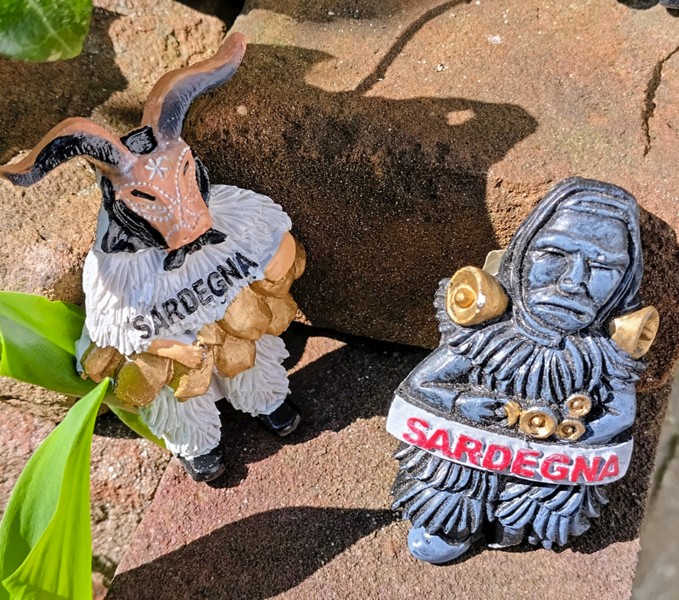
(Diverse magnets depicting Mamuthones and a Lady carrying a basket of bread.)

Continuation of Tales of the Mediterranean – the Enigma of Sardinia – Part 1

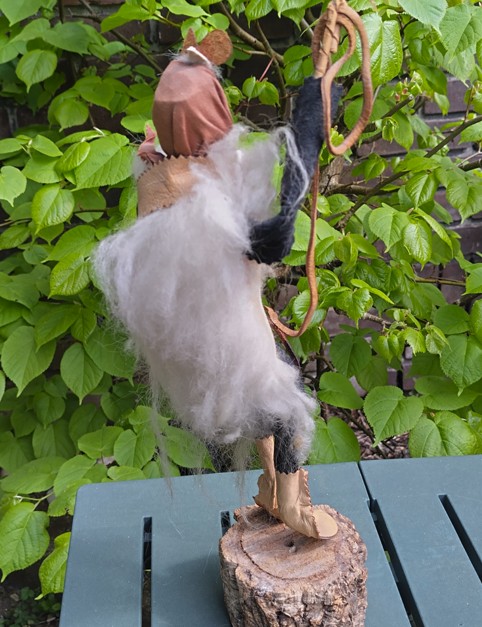
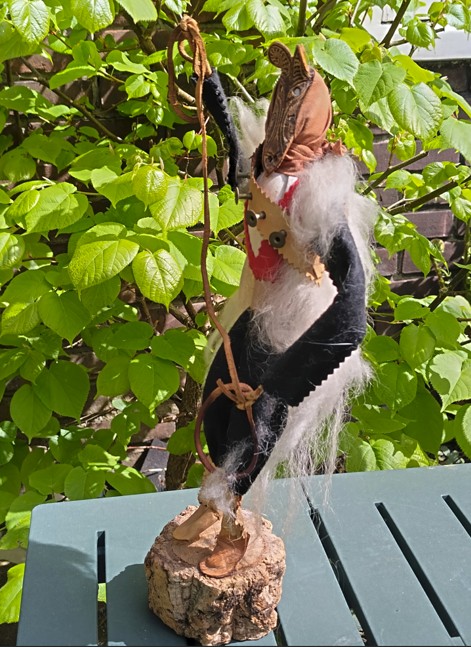
That I made a connection with what I later found out to be an Issohadores was the highlight of my visit to Sardinia. When I was in Cagliari I visited a couple of museums including the ‘Museo Archeologico Nazionale’. Afterwards I checked out the souvenir shops and found the 3 terracotta figurines I mentioned in the main article. I also found a dusty, long unnoticed figure of a masked person, dressed in red & white, with a rope, mounted on a piece of Cork. I asked how much it cost, thinking already that it would be way over budget. It wasn’t! The shopkeeper was amazed that I said yes, without hesitation, but also nodded as if it was a recognition of a fellow traveller.


I also found several magnets with Mamuthones. See the corresponding photos. I think most tourists have no idea of who and what they are. Hopefully, this article (Part 2) will shed some light on the nature of them. Read on.

Who are the Mamuthones and Issohadores?

The Mamuthones are the most visually striking figures, dressed in black sheepskins, wearing heavy wooden masks (often dark, expressionless, almost mournful). They carry 30 kg or more of bronze bells (campanacci) strapped to their backs. They move in a slow, rhythmic, almost trance-like procession, stepping in unison so the bells produce a deep, resonant, almost hypnotic sound. Their presence feels ancient, Earth-bound, more like forces than individuals.

The Issohadores accompany and guide the Mamuthones. They wear white trousers, red jackets, and colourful sashes. They have lighter, more expressive masks and carry a rope (soha), which they use to “capture” spectators. Their role is more dynamic and interactive as they control the movement of the Mamuthones. They engage with the crowd and being caught by the rope is traditionally seen as a good omen.

The main performances take place during Carnival (January–February, leading up to Lent), and key dates in Mamoiada include Feast of Saint Anthony (January 16–17) – often considered the ritual beginning of the main Carnival days before Ash Wednesday. But, and this is crucial, the ritual clearly predates Christianity and has been absorbed into it rather than created by it.

There is no single explanation which fully accounts for the tradition, but several interpretations coexist. Looking at the Prehistoric / Agro-pastoral ritual, many scholars link the Mamuthones to the Seasonal Cycles, Fertility Rites and the relationship between humans, animals, and the land.

The heavy bells and animal skins suggest a transformation into animal or ancestral beings. There is a ritual “waking” of the land at the end of winter. This resonates strongly with the symbolic world of the Ozieri culture and later Sardinian traditions — where human identity, animal presence, and the unseen world are deeply intertwined.

Another theory suggests that the Mamuthones represent captives or subjugated people, whilst Issohadores represent controllers or elites. This is sometimes linked (speculatively) to conflicts with invaders, or social hierarchies within Sardinia.

However, this explanation feels less convincing to many researchers because it doesn’t fully account for the ritual intensity and symbolic depth. A more nuanced reading sees Mamuthones as forces of nature, chaos, or the underworld whilst the Issohadores represent order, control, social structure. The interaction between them becomes a ritual balancing of energies, not unlike seasonal rites elsewhere in Europe

The importance of sound and movement. The bells are not just decoration — they are central. The synchronized movement creates a collective rhythm and the sound is felt physically, not just heard. It induces a kind of shared altered state, both for performers and observers.

This aligns with many ancient ritual traditions where repetition, plus sound and movement, equals transformation.

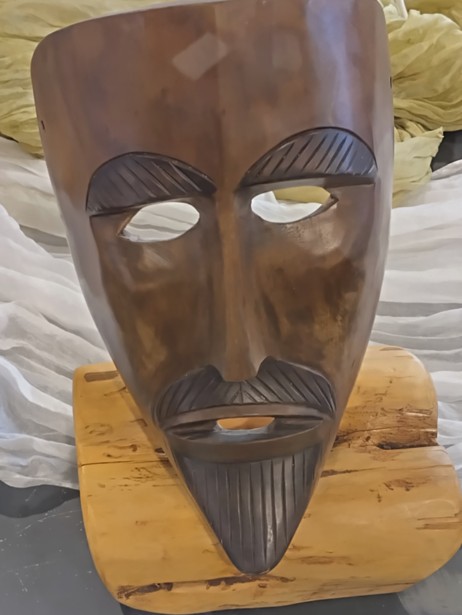
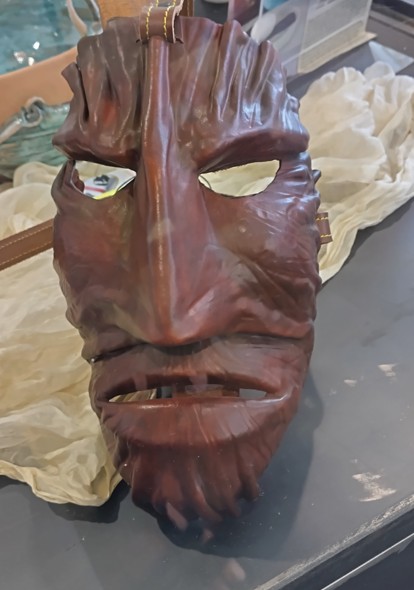
(Photos of masks seen at the airport at Olbia, promoting folklore in Sardinia – 1)

(Photos of masks seen at the airport at Olbia, promoting folklore on Sardinia – 2)

When I connected this to what I saw in the figurines and tombs (Domus Janus), the Mamuthones’ masks resemble faces without individuality. Their movement is deliberate, heavy, almost funerary. Their anonymity suggests they are not “people” but presences. They embody ancestors. They are the mediators between the living community, the land, the dead. This echoes the worldview behind the Domus de Janas, where the dead remain part of the community.

They present a living ritual in which the human form is masked, weighted, and transformed — continuing a Sardinian tradition that stretches from Neolithic figurines to Bronze Age bronzes, where identity is not fixed but negotiated between body, symbol, and presence.

Unlike many reconstructed traditions, this one is continuously practised. It is deeply rooted in local identity, still emotionally powerful. In a modern context, they raise questions about memory carried through ritual rather than text. The persistence of pre-Christian cosmologies beneath later layers and the relationship between humans, land, and unseen forces.

(Meet my Issohadores, frontview)


(My Issohadores from the back, with a sheepskin.)

(And now from the left – note the Cork on which it is mounted. Cork is sacred to Sardinia.)

The more visually imposing Mamuthones often overshadow the Issohadores, but they are in many ways the key to understanding the ritual. Without them, the performance would lose its structure, its interaction, and much of its meaning. So, who are the Issohadores?

The Issohadores come from Mamoiada and appear alongside the Mamuthones during Carnival processions. Their defining features include white shirts and trousers, red waistcoat or jacket, and a brightly coloured sash (often across the chest). They wear a lighter, more human-like mask. A rope (soha) is carried coiled in the hand. They are fewer in number than the Mamuthones and move more freely, often stepping slightly ahead or to the side of the main group.

The most distinctive action of the Issohadores is lassoing people from the crowd. They throw the rope with precision, looping it around individuals. Traditionally, those caught are often young women, historically linked to fertility symbolism and visitors, or outsiders, when being captured is considered auspicious.

But this is not random play — it’s highly controlled and intentional. Symbolically, the rope may represent connection, binding individuals into the community, selection or initiation. This is a drawing in of life force or vitality. In a deeper reading, it echoes ancient ritual gestures of claiming, blessing, or marking someone as part of a shared field. If the Mamuthones embody weight, repetition, and anonymity, the Issohadores embody control and direction, agility and awareness, mediation between performers and public. They lead the procession, regulate the rhythm and spacing of the Mamuthones, and maintain order within what might otherwise feel overwhelming or chaotic.

This pairing creates a dynamic balance, not a hierarchy. Unlike the dark, almost featureless masks of the Mamuthones, the Issohadores wear masks that are lighter in colour, more expressive and closer to human features. This matters because it suggests they are not “otherworldly beings” in the same way, but rather, intermediaries, figures who can move between the masked world of the Mamuthones and the unmasked world of the community.

Several interpretations exist as to the origin of the Mamuthones and the Issohadores sit at the centre of many of them. As far as Pastoral Symbolism, the rope may echo herding practices, the capture and control of animals. The act of capturing may represent drawing individuals into community cohesion, reinforcing bonds during a liminal time of year. Carnival, after all, is a moment when boundaries loosen, and social roles are reconfigured. From a more symbolic or anthropological perspective, the Issohadores may function as threshold figures. They cross boundaries, they connect realms, they regulate transformation.

While the Mamuthones produce the deep sonic field with their bells, the Issohadores move around that sound, intervene within it and break and redirect its rhythm. They introduce variation, surprise, and interaction. Without them, the ritual would be immersive — but closed. With them, it becomes relational. The Issohadores are the agents of connection within the ritual field — figures who do not embody the force itself, but who guide, direct, and draw others into relationship with it.

If the Mamuthones feel like ancestral presences, then the Issohadores feel like those who know how to approach them, how to work with them and how to bring that encounter back into the human community. In that sense, they are not secondary figures at all — they are essential translators between worlds.

If the prehistoric figurines of the Ozieri culture suggest a human form becoming symbol, and the Mamuthones of Mamoiada embody a collective, ancestral presence, then the Issohadores introduce a vital third element: relationship.

Moving alongside the heavy, bell-laden figures during Carnival, the Issohadores are distinct in both appearance and function. Their lighter clothing, more expressive masks, and fluid movement set them apart. Most notably, they carry a rope — the soha — with which they skilfully “capture” individuals from the surrounding crowd. Far from being a playful gesture alone, this act carries an undercurrent of meaning: those caught are symbolically drawn into the ritual, marked not as spectators but as participants.

In this moment, the boundary between observer and performer dissolves. The rope becomes more than a tool; it is a line of connection, extending the ritual field outward into the community. What is enacted is not spectacle, but inclusion — a drawing-in of life, presence, and relationship.

Within the structure of the procession, the Issohadores guide and regulate the movement of the Mamuthones, whose slow, synchronised steps and resonant bells create an atmosphere that is both solemn and immersive. If the Mamuthones evoke forces that are ancient, collective, and beyond the individual, the Issohadores operate at the threshold between those forces and the human world. They are not separate from the ritual; they are its mediators.

Seen in the wider context of Sardinian cultural continuity, this role resonates with earlier forms of symbolic practice. The figurines found in the Domus de Janas were not merely objects to be observed; they participated in a relationship between the living and the dead. Similarly, the Issohadores do not simply accompany the Mamuthones — they translate their presence into lived experience, making the encounter accessible, relational, and shared.

From an interfaith perspective, this dynamic is strikingly familiar. Many traditions recognise figures whose role is not to embody the sacred directly, but to mediate access to it, such as priests, shamans, guides, or guardians of threshold spaces. The Issohadores can be understood in this light: not as authorities, but as facilitators of encounter, ensuring that what might otherwise remain distant or overwhelming becomes integrated into the life of the community.

Environmentally, too, this carries resonance. The rope, the gesture of drawing in, the act of connection all suggest a worldview in which separation is an illusion, and relationship is primary. To be “caught” is not to be constrained, but to be recognised as already part of a wider web: human, land, ancestry, and more-than-human presence intertwined.

In this way, the Issohadores complete the ritual triad. Where the figurine holds presence, and the Mamuthones embody it, the Issohadores activate it — extending its reach, grounding it in community, and ensuring its continuity across time.

The woman carrying bread, sometimes seen alongside the Carnival processions in Mamoiada, represents a quieter but essential dimension of Sardinian ritual life. Unlike the masked Mamuthones or the mediating Issohadores, she is unmasked, grounded, and unmistakably human. Her presence anchors the spectacle in the continuity of daily life, reminding us that ritual is not separate from the community it serves. The bread she carries is not merely symbolic; it is the outcome of labour, care, and a relationship with the land. In this sense, she embodies nourishment, stability, and the return from transformation to lived reality.

Bread itself holds deep cultural significance across Sardinia. Traditional forms such as pane carasau ** and elaborately decorated ceremonial loaves are central to both everyday sustenance and festive life. Bread-making has historically been a communal and often female-led practice, involving seasonal rhythms, shared knowledge, and ritualised preparation. It expresses a profound connection between soil, grain, fire, and community, transforming raw elements into something that sustains both body and culture.

Within the broader ritual context, the woman with bread can be understood as the embodiment of continuity and integration. Where masked figures evoke transformation, ancestry, and the more-than-human, she represents the re-grounding of those forces into human life. Her role highlights an important truth: that the sacred is not only encountered in moments of intensity or spectacle, but is also carried forward through everyday acts of making, feeding, and sustaining community.

Masked Winter Rituals in Europe: A Shared Language of Transformation

The ritual traditions of Sardinia do not stand in isolation. Across Europe, particularly in rural and mountainous regions, we find strikingly similar expressions in which the human form is masked, transformed, and set into motion at key moments of the seasonal cycle. Among these are the Kukeri of Bulgaria and the Alpine figures associated with Krampusnacht in Austria and neighbouring regions.

In each case, participants don elaborate costumes incorporating animal skins, horns, and masks that obscure individual identity. Bells – large, heavy, and sonically powerful – are worn on the body, producing rhythms that resonate through both landscape and community. Movement, whether slow and processional or energetic and chaotic, becomes a central means of expression. These are not merely performances to be watched; they are immersive acts that transform space, time, and relationship.

The Kukeri, with their vigorous dances and dramatic gestures, are often explicitly associated with fertility and the driving away of harmful forces. Krampus figures, emerging in the depths of winter, occupy a more ambivalent space, blending fear, discipline, and theatrical inversion within a Christianised framework. By contrast, the Mamuthones of Mamoiada move with a measured, almost solemn rhythm, their anonymity and weight suggesting not spectacle, but presence — something older, quieter, and more inwardly focused.

Despite these differences in tone, the underlying pattern is unmistakable. Across these traditions, the human body becomes a threshold: a site where boundaries blur between human and animal, individual and collective, living and ancestral. Masking does not conceal identity so much as reconfigure it, allowing the wearer to step into a role that is at once personal and transpersonal.

Importantly, there is no clear evidence that these traditions derive directly from one another. Rather, they appear to emerge from a shared substratum of agro-pastoral life in which seasonal uncertainty, dependence on the land, and the need for communal cohesion gave rise to ritual forms that could both express and mediate these realities. Whether through the slow resonance of the Mamuthones, the exuberant energy of the Kukeri, or the disruptive force of Krampus, each tradition enacts a moment of controlled transformation, marking the passage from darkness toward renewal.

Seen alongside the prehistoric figurines of the Ozieri Culture, a deeper continuity becomes visible. The same impulse that shaped small clay bodies into symbolic forms appears, millennia later, in the transformation of living bodies into masked presences. In both cases, the human figure is not fixed or self-contained, but open, capable of holding, expressing, and negotiating forces that exceed the individual.

What emerges, then, is not a single tradition, but a shared European language of ritual: one in which sound, movement, masking, and seasonal timing converge to create spaces of encounter. These are moments when identity is loosened, relationships are reconfigured, and the boundaries between worlds become permeable once more.

Ode to the Mamuthones and Issohadores

In the shadowed hills of Mamoiada, when winter loosens its final breath,
and the earth stirs beneath stone and root, you come.                                                                  Not as men or women, but as memory.

Mamuthones – bearers of weight, keepers of the slow pulse –
You walk as if time itself were upon your shoulders.
Sheepskin and silence, faces carved into stillness,
You do not look at us – you look through us,
as though we too are passing.

The bells speak where you do not.
Deep-throated, iron-hearted, they call to the soil,
to the bones beneath, to seeds waiting in the dark.

Step…                                                                                                                                                          Sound…
Step…
Sound…

A rhythm older than speech,
older than fear – a remembering of how the world begins again.

And you, Issohadores, bright threads in the dark weaving                                                            – you move where others cannot.

White and red, breath and motion,
You circle the weight, you shape the path,
You cast your rope not to bind, but to gather.                                                                                  A loop through air – and suddenly, we are no longer watchers.                                                      Drawn inward, named without words, caught not by force but by belonging.

Between you, a world is held, the heavy and the light,                                                                    the silent and the speaking, the ancient and the awakening.                                                          You do not perform – you become.                                                                                                    And as the season turns – as green rises unseen beneath the surface,
as lambs stir in hidden fields, as the first warmth touches stone,                                                your passage opens the way.                                                                                                            Not by command, but by presence.                                                                                                  Not by spectacle, but by remembering.

O Mamuthones, who walk with the weight of earth!                                                                        O Issohadores, who cast the line between worlds!

In your steps, winter yields.                                                                                                                    In your sound, the sleeping stirs.                                                                                                          In your turning, we are called again into the great weaving of land,                                          of life, of all that was, and all that is becoming.

REFERENCES

** Pane carasau is a traditional, ultra-thin, and crispy flatbread originating from the island of Sardinia, Italy, with a history dating back to at least 1000 BCE

Booklet “Religious and Secular Festivals in Sardinia” / FFI SARDEGNA Turismo: www.sardegnaturismo.it

See also: https://www.facebook.com/VisitSardinia/

Instagram: https://www.instagram.com/visit.sardinia

The photos were all taken by @Morgana Sythove.

Continue with Tales of the Mediterranean – The Enigma of Sardinia – Nuragic Civilization – Part 3

Geplaatst in English articles | Getagged , , , , , , , | Reacties uitgeschakeld voor Tales of the Mediterranean – the Enigma of Sardinia, Mamuthones & Issohadores – Part 2

Metamorfosen

In Shakespeares toneelstuk The Tempest (De storm) zingt de luchtgeest Ariël een lied waarmee hij prins Ferdinand wijsmaakt dat zijn vader is omgekomen bij de schipbreuk ten gevolge van de storm die Ariëls opdrachtgever, de magiër Prospero, heeft opgeroepen:

Full fathom five thy father lies.
Of his bones are coral made.
Those are pearls that were his eyes.
Nothing of him that doth fade
But doth suffer a sea change
Into something rich and strange…
1

Shakespeare schreef dit toneelstuk in 1611. In de zestiende en zeventiende eeuw voeren Europeanen de wereldzeeën over en kwamen meer dan voorheen in aanraking met mensen, dieren, planten, schelpen en andere zaken die ze nog niet kenden. Er ontstond er een grote belangstelling voor verschillen in culturen en voor de variatie in de natuur. Interessante en zeldzame dingen werden verzameld in zogeheten kunst- en rariteitenkabinetten of Wunderkammer.

something rich and strange

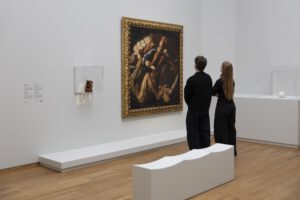
Rood koraal (bloedkoraal) was ‘something rich and strange’, dat men graag in zo’n rariteitenkabinet had. Omdat koraal onder water zacht en beweeglijk is, maar boven water hard wordt, werd het al vanaf de oudheid beschouwd als iets wonderbaarlijks, iets tussen plant en mineraal in, lees ik in de catalogus bij de tentoonstelling Metamorfosen, die momenteel te zien is in het Rijksmuseum in Amsterdam. Omdat bloedkoraal zoiets bijzonders was, werd het graag toegepast in amuletten om het kwaad af te weren, met name in zaken die met bloed te maken hebben.

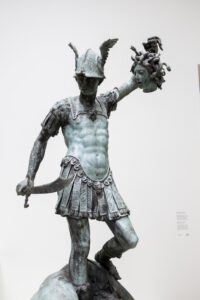
Perseus die het hoofd van Medusa heeft afgehakt (1585-1590). Bronzen beeld van Hubert Gerhard, gemaakt voor een fontein voor hertog Albrecht V van Beieren in München. Uit Medusa’s hals (op deze foto niet zichtbaar) kon water stromen. In de tuin om de fontein heen stonden beelden, alsof die zojuist door Medusa’s aanblik waren versteend. Foto © Rijksmuseum/Albertine Dijkema

Het verhaal over Perseus die met het afgehakte hoofd van Medusa over zee vloog om Andromeda te bevrijden, waarbij er druppels bloed vielen op zeewier dat daardoor rood kleurde en versteende tot bloedkoraal, is bekend uit het dichtwerk Metamorfosen van Ovidius. Hierin verwerkte de dichter een duizelingwekkende hoeveelheid Grieks-Romeinse mythen. De tentoonstelling in het Rijksmuseum laat zien hoe in de loop der eeuwen veel van deze mythen in de kunsten tot uitdrukking zijn gebracht. Verschillende werken tonen het afgehakte Medusahoofd, soms vastgehouden door Perseus en soms op zichzelf, als kwaadafwerend teken.

Een ander verhaal in de Metamorfosen gaat over de jager Actaeon, die naar de godin Diana (Artemis) gluurde toen zij naakt een bad nam. Zij veranderde hem daarop in een hert, waarna hij door zijn eigen jachthonden werd aangevallen en verscheurd. Een tak bloedkoraal vormt op de tentoonstelling het gewei van een verguld-zilveren drinkbeker uit 1640 in de vorm van een man met een hertenkop, vergezeld door twee honden. Het tentoonstellingsthema ‘metamorfosen’ komt hier meervoudig tot uitdrukking: zilver en goud zijn veranderd in een beker met de vorm van Actaeon die in een hert verandert, met een gewei van rood koraal dat volgens de mythe eerst zeewier was.

Of het koraal bij deze beker hier een kwaadwerende werking werd toegedicht, wordt niet expliciet vermeld, maar de nabijheid op de tentoonstelling van een beker die uit een ‘hoorn van een eenhoorn’ (narwaltand) was gemaakt, roept zoiets wel in gedachten. De hoorn van een eenhoorn zou immers beschermen tegen gif.

mythen

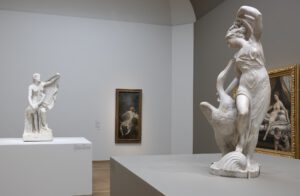
Avontuurtjes van Jupiter uitgebeeld in verf en steen op de tentoonstelling in het Rijksmuseum. Foto © Rijksmuseum/Albertine Dijkema

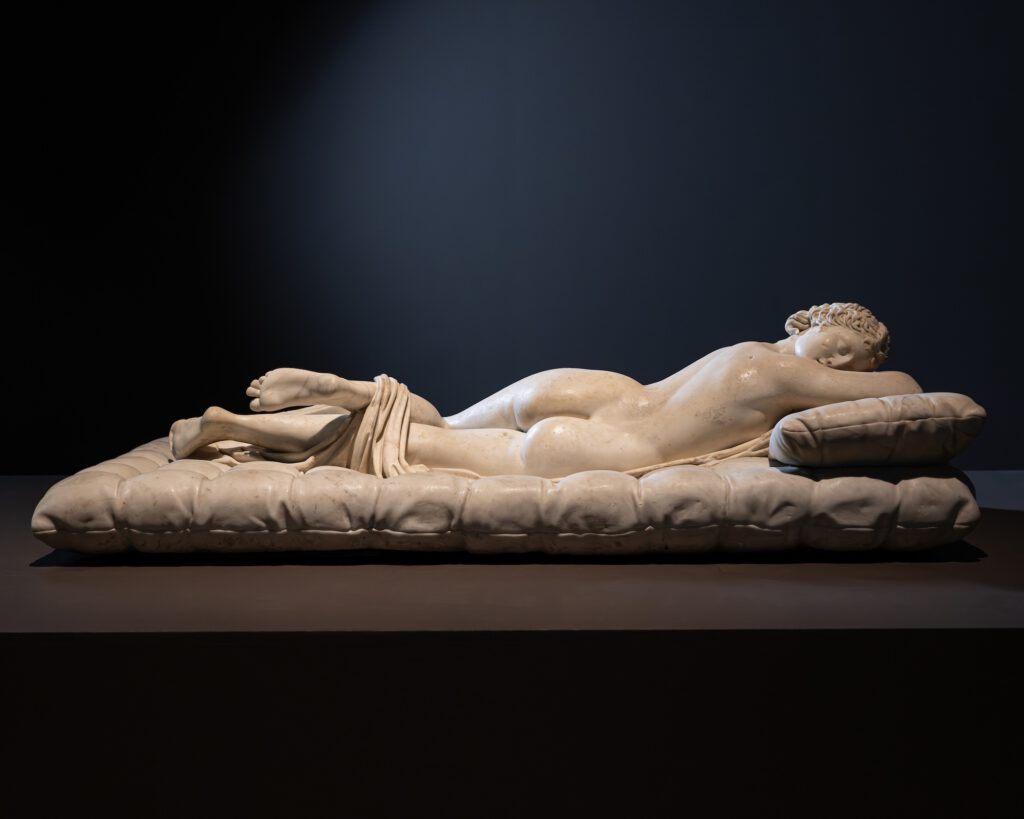
Enkele mythen waar de tentoonstelling verder aan herinnert zijn onder meer die over de seksuele escapades van Jupiter (Zeus), die zich hiertoe veranderde in bijvoorbeeld een zwaan, een stier of een gouden regen, of die zijn liefje veranderde in een koe zodra zijn echtgenote langskwam; over Arachne die in een weefwedstrijd met Minerva (Athene) een weefsel maakte waarin dergelijke goddelijke slippertjes werden getoond, waarna Minerva haar in een spin veranderde; over Narcissus die verliefd werd op zijn eigen spiegelbeeld; over de bronnimf Salamacis die verliefd werd op Hermaphroditus en van de goden gedaan kreeg dat zij één met hem werd. Speciaal voor deze tentoonstelling is het beeld van de Slapende Hermaphroditus vanuit het Louvre overgebracht.

Slapende Hermaphroditus. De liggende figuur van Hermaphroditus is Romeins, uit de tweede eeuw v.C., maar het matras en kussen zijn er in de zeventiende eeuw bij gemaakt door Gian Lorenzo Bernini. Foto © Rijksmuseum/Amie Galbraith

lauwerkrans

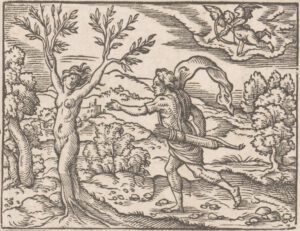
Misschien wel de bekendste metamorfose is die van Daphne, een nimf die door Apollo werd achtervolgd. Zij deed er alles aan om hem te ontlopen, terwijl hij hopeloos verliefd op haar was. Deze situatie was Apollo’s eigen schuld: hij had namelijk Venus’ (Aphrodites) zoontje Cupido (Eros) beledigd door te zeggen dat dat jochie maar beter niet met serieuze wapens als pijl en boog kon rondvliegen. Pijl en boog, had Apollo gezegd, pasten beter bij een god die daarmee een reusachtige slang had overwonnen, hijzelf dus. Liefdesgodje Cupido dacht daar anders over en had een gouden, liefde-opwekkende pijl op de boogschutter-god afgeschoten, en een loden, liefde-verdrijvende pijl op Daphne.

Virgilius Solis: Daphne verandert in een laurierboom. Illustratie bij: Johannes Posthius: Tetrasticha in Ovidii metam. Frankfurt am Main: Georg Rab en Sigmund Feyerabend en erven Weigand Han (1569). Collectie Rijksmuseum

Om aan Apollo te ontsnappen riep Daphne de hulp in van haar vader, de plaatselijke riviergod. Water kan verschillende vormen aannemen en het kan de vorm van dingen ogenschijnlijk of daadwerkelijk veranderen, dus de riviergod was deskundig op het vlak van metamorfosen. Hij zorgde ervoor dat zijn dochter in een laurierboom veranderde.

Apollo verklaarde dat zijn geliefde nu weliswaar niet meer zijn vrouw kon worden, maar dat de laurierboom voortaan zijn boom zou zijn, en hij zorgde ervoor dat de bladeren altijd groen zouden blijven. Als aandenken aan zijn eerste liefde draagt Apollo sindsdien een krans van laurierbladeren. Er zouden nog andere liefdes (vrouwen en mannen) volgen, maar de lauwerkrans bleef.

Apollo heeft veel functies. Zo is hij onder meer de leider van de Muzen, en als godheid van de kunsten was hij een geliefd onderwerp in de beeldende kunst, zoals deze tentoonstelling laat zien. Het moment waarop Daphne in een boom verandert is door de eeuwen heen een populair Apolloverhaal geweest om uit te beelden. Zo is er al een illustratie uit de eerste helft van de veertiende eeuw, bij de tekst Ovide Moralisé, een bewerking van de Metamorfosen waarin de mythen werden uitgelegd met een christelijke moraal. Daphne was in deze interpretatie het zinnebeeld van de kuisheid. Actaeon stond voor Jezus Christus, Phaëton2 voor Lucifer, en Ceres (Demeter) die Proserpina (Persephone) zoekt, was “de Kerk die afgedwaalde zielen probeert terug te vinden et cetera et cetera3.

vrouwbeeld/vrouwenbeeld

Alexander Ver Huell:  Pygmalion en Galatea (ca. 1854 – ca. 1887). Tekening in pen en penseel, in een album. Collectie Rijksmuseum

Afgaand op de tentoonstelling sprak in de negentiende eeuw vooral het verhaal over Pygmalion en Galathea tot de verbeelding. Pygmalion was een beeldhouwer op Cyprus. Hij was er ooit getuige van geweest hoe de godin Venus een groep vrouwen strafte voor het feit dat zij Venus niet als godin erkenden: zij werden veroordeeld tot een leven in de prostitutie. Hierdoor getraumatiseerd besteedde Pygmalion liever geen tijd en aandacht aan vrouwen, maar wijdde zich geheel aan zijn kunst.

Hij maakte een heel mooi beeld – van een vrouw, dat dan weer wel. Het was zelfs zo mooi, dat hij er verliefd op werd en het ging behandelen alsof het zijn vriendin was: hij gaf bloemen en sieraden, en legde haar op bed met een gerieflijk kussen. Op de feestdag van Venus ging hij zoals het hoorde offeren (vooral niet de godin boos maken!), en hij sprak het gebed uit dat hij een vrouw zou vinden zoals zijn beeld. Venus hoorde hem en begreep wel wat hij eigenlijk bedoelde met ‘zoals’. Dus toen hij thuiskwam en zijn beeld een kus gaf, voelde hij hoe het warm en zacht werd en tot leven kwam…

Een natuurgetrouwe weergave is door de eeuwen heen altijd hoog aangeslagen en het wekt geen verbazing dat een verhaal over een kunstwerk dat zo levensecht is dat het daadwerkelijk tot leven komt, tot de verbeelding sprak van met name kunstenaars. Maar waarom juist in de negentiende eeuw?

Odilon Redon: Slangenaureool (1890).  De vrouw “is een soort antichrist. (…) De prent past in de sfeer van Là-Bas, het boek dat Joris-Karl Huysmans klaar had in hetzelfde jaar. Redon correspondeerde met de schrijver”, meldt de toelichting van het Rijksmuseum

Mogelijk was de thematiek die negentiende-eeuwers uit het verhaal had oppikten die van echte, vlees-en-bloed-vrouwen als bedreiging. Pygmalion hield zich immers ver van vrouwen, niet omdat hij geen erotische verlangens kende, maar omdat hij vreesde dat vrouwen gemakkelijk vervielen in goddeloosheid en promiscuïteit. Bram Dijkstra heeft in de studie Idols of Perversity4 uitvoerig beschreven welke vrouwvijandige ideeën er aan het eind van de negentiende eeuw speelden, en hoe deze in verband kunnen worden gebracht met maatschappelijke ontwikkelingen en wetenschappelijke theorieën in die periode.

Met name de ‘ontdekking’ dat vrouwen actief geïnteresseerd konden zijn in seks, soms zelfs met andere vrouwen, was destijds blijkbaar een grote schok voor de mannelijke verbeelding en leidde tot fantasieën over allerlei soorten femmes fatales. Maar ook over diverse tegenhangsters hiervan, die als flauwgevallen fabelwezens geen eigen verlangens of daadkracht leken te kennen. Een door de man geschapen beeld dat precies voldoet aan zijn verwachtingen, een kunstvrouw die niet kan zondigen omdat ze niet over een eigen, zelfstandige wil beschikt: zo zou je Galathea ook kunnen zien. Tegenwoordig heet zoiets geloof ik een tradwife.

illustraties

Opvallend veel van de kunstwerken op de tentoonstelling zijn echter ruwweg uit de tijd van Shakespeare: de zestiende en zeventiende eeuw. Dit doet vermoeden dat juist in die tijd van grote maatschappelijke veranderingen het idee van metamorfose tot de verbeelding sprak.

Onder meer door de ontdekking van een niet in de Bijbel genoemde ‘Nieuwe Wereld’ (de Amerika’s) en door de publicaties van astronomen die leerden dat de aarde om de zon draaide in plaats van andersom, was duidelijk dat de Bijbel niet volstond als enige bron van kennis over de wereld. Meer dan voorheen ging men op zoek naar kennis en wijsheid in de natuur, en de boekdrukkunst stimuleerde de verspreiding van ideeën. Er was belangstelling voor ‘natuurlijke magie’ en alchemie: kunsten die gebruik maakten van de in de natuur aanwezige krachten (zoals luchtgeesten). Bovendien zocht men kennis en wijsheid in teksten uit de oudheid, zoals het werk van Ovidius.

In 1557 verscheen in Lyon, zowel in het Frans als in het Nederlands, een boek met belangrijke verhalen uit de Metamorfosen samengevat in versjes en voorzien van houtsneden die de verhalen illustreerden. Deze afbeeldingen zetten de toon voor latere geïllustreerde vertalingen, bewerkingen en plaatjesboeken. Uiteindelijk werden de Metamorfosen zo “een aantrekkelijk en makkelijk te raadplegen handboekje voor de mythologie.”5.

De populaire afbeeldingen beïnvloedden ook de manier waarop Bijbelse verhalen werden geïnterpreteerd en afgebeeld. In het Bijbelverhaal over David en Batseba (haar naam kan ‘dochter van overvloed’ betekenen, lees ik op Wikipedia) komt geen oude vrouw voor, maar in hun weergave plaatsten schilders er vaak wel een oude vrouw bij. Die ontleenden zij aan Ovidius’ verhaal over de oogstgod Vertumnus, die hevig verliefd was op de fruitgodin Pomona:

Pomona had geen belangstelling voor Vertumnus en liet hem niet toe in haar voor mannen afgeschermde tuin, hoe hij zich ook vermomde als leuke jonge boer, tuinman enzovoort. Tenslotte nam hij de gedaante aan van een oude vrouw, en wees haar op een wijnrank die in een boom klom. Zij/hij bepleitte de zaak van Vertumnus en merkte op dat een goede oogst mogelijk werd gemaakt doordat de boom en de wijnrank elkaar ondersteunden, en dat er in zo’n samenwerking iets ontstond dat meer was dan de som der delen. Ook vertelde zij/hij een waarschuwend verhaal over een meisje dat haar aanbidder afwees, waarop hij zelfmoord pleegde en zij in steen veranderde. Toen Vertumnus tenslotte weer in zijn eigen goddelijke zelf veranderde, gaf Pomona zich gewonnen.6

Hendrick Goltzius: Vertumnus en Pomona (1613). Collectie Rijksmuseum. “Door de stok van de oude vrouw nadrukkelijk tussen haar benen te plaatsen geeft [de schilder] op kluchtige wijze aan dat het hier eigenlijk om een handtastelijke man gaat.” (Eric Jan Sluijter)

De moraal van beide verhalen was, vond men in die tijd, dat een jonge vrouw haar ‘tuintje’ moest afschermen tot de juiste echtgenoot kwam. Maar als die zich aandiende, moest ze zonder dralen met hem het bed in duiken, want haar jeugd en vruchtbaarheid zouden snel vergaan, en als ze eenmaal een oude vrouw was, waren haar kansen verkeken.

schildersbijbel

In het Schilder-boeck uit 1604 noemde Karel van Mander de Metamorfosen zelfs een “Schilders-Bijbel”. Ovidius’ vijftien boeken7 lange gedicht begon met een scheppingsverhaal, dat weliswaar niet precies overeenkwam met dat uit de Bijbel, maar daar ook niet direct mee in tegenspraak leek:

Voor zee en aarde en de allesbedekkende hemel bestonden,
toonde de schepping in haar geheel één enkele aanblik
die men chaos genoemd heeft (…)
(…) Geen oerelement bewaarde zijn vorm,
ieder blokkeerde het andere, omdat binnen één massa
kou en warmte, vocht en droogte, zacht- en hardheid,
zwaarte en zwaarteloosheid elkaar bleven bestrijden.
Een god met een betere natuur heeft deze strijd beëindigd,
want hij scheidde de hemel en aarde en zee en aarde
en heeft de heldere hemel van de vastere lucht afgezonderd
(…)
Wie van de goden het ook is geweest, hij scheidde en verdeelde
de chaos, die hij tot zijn bestanddelen terugbracht.
8

Twee mensen kijken in het Rijksmuseum naar het schilderij Chaos, of De strijd van de Vier Elementen van Louis Finson. Links van het schilderij is in een vitrine een kleine ruimtelijke weergave van dit schilderij te zien, in 1663 gesneden uit buxushout door Jan Pietersz Beelthouwer. Het ‘ei’ met vaag menselijke trekken in de vitrine rechts op de foto is het werk Promethée van Constantin Brancusi, uit 1911 en verwijst mogelijk naar de rol van Prometheus als schepper van de eerste mensen. Foto © Rijksmuseum/Albertine Dijkema

Op de tentoonstellling is een groot schilderij van Louis Finson uit 1611 te zien waarop de oerelementen aarde, water, lucht en vuur elkaar danig in de weg zitten. De elementen zijn weergegeven als vier menselijke figuren. Mijn metgezel merkte op dat het twee paren waren: een oude man en vrouw, en een jonge man en vrouw. Ik zei dat aarde en water traditioneel als vrouwelijk werden gezien en lucht en vuur als mannelijk, en we veronderstelden dat de jonge vrouw en man bovenaan het schilderij dan water en vuur moesten zijn – de jonge vrouw had een golvende strook blauw met wit onder zich, wat het idee van water leek te bevestigen – en de oude man en vrouw onderaan lucht en aarde. Het was wel apart dat water zich boven lucht bevond, maar ja, het was de chaos uit de oertijd, toch? Wij waren erg ingenomen met onze interpretatie, maar eenmaal thuisgekomen las ik in de catalogus dat de jonge vrouw voor het element lucht stond en de oude man voor het element water. Bij nadere beschouwing ziet het blauw met wit er inderdaad meer uit als een hemel met wolken.

zielsverhuizing

In boek 15 komt Pythagoras aan het woord. Tegenwoordig denken veel mensen bij die naam aan wiskunde, maar Pythagoras was lange tijd vooral bekend als filosoof. Wiskunde was een deel van zijn filosofie en had onder meer te maken met getalsverhoudingen in de muziek. Bij Ovidius wordt Pythagoras opgevoerd als de wijze denker die in Italië de Griekse filosofie vertegenwoordigt. Hij werd namelijk geboren op Samos maar verhuisde naar Croton in Zuid-Italië, in die tijd een Griekse kolonie.

Pythagoras steekt in de Metamorfosen een lang betoog af, waarin hij de ideeën uit het begin van de Metamorfosen, over de oerchaos en de vier elementen, nog eens in herinnering brengt. Hij voert aan dat alles altijd onderhevig is aan verandering: dag verandert in nacht en nacht verandert in dag; de gestalte van de maangodin verandert van dag tot dag; zelf veranderen we ook naarmate de tijd verstrijkt; eieren veranderen in vogels; landschappen veranderen; en zelfs op elementair niveau gaat aarde over in water, water in lucht, lucht in vuur en vuur weer in lucht enzovoort. De gedaanteveranderingen uit de mythen zijn minder vergezocht dan je zou denken, lijkt de boodschap.

Maar terwijl de lichamen veranderen, doceert Pythagoras, veranderen de zielen niet: die verhuizen alleen naar andere lichamen. Hij spreekt de mensheid streng toe: waarom slachten jullie runderen, die jullie zo goed hebben geholpen op het land? Dat is het slachten van een collega! Dat jullie uit zelfverdediging gevaarlijke dieren doden, is niet erg, maar je hoeft ze dan toch niet op te eten. En wat hebben de schapen jullie misdaan? Bovendien weet je niet of in een dier niet de ziel huist van een dierbare…9

vergoddelijking

Crispijn van de Passe: Aesculapius reist in de vorm van een draak naar Rome (1602 – 1607). Collectie Rijksmuseum

Na de toespraak van Pythagoras gaan de Metamorfosen verder met onder meer een verhaal over hoe de god van de geneeskunst Aesculapius in de gedaante van een slang (of draak) vanuit Griekenland naar Rome kwam, en over de moord op Julius Caesar die de zoon van Venus was. Na Caesars dood nam zijn moeder zijn ziel en “liet deze niet in de lucht verspreiden maar bracht haar naar de hemelse sterren”10 waar hij een god werd. Vervolgens steekt Ovidius de loftrompet van de zoon van Caesar, keizer Augustus, aan wie hij zijn dichtwerk opdroeg.11 Augustus is zo mogelijk nóg goddelijker dan Caesar. Tot slot verklaart Ovidius dat dit gedicht hemzelf onsterfelijk maakt:

Nu heb ik een werk voltooid, dat door geen woede van Jupiter,
door geen vuur of zwaard, geen vraatzuchtige tijd kan worden vernietigd.
Laat de dag die slechts macht heeft over mijn lichaam,
wanneer hij dat wil, de onzekere loop van mijn leven beëindigen.
Met het beste deel van mijzelf zal ik voor eeuwig
boven de hoge sterren zweven, mijn naam zal niet sterven.
Waar over de bedwongen aarde macht van Romeinen zich uitstrekt,
zullen mensen mij lezen en als dichters enige waarheid
verkondigen: beroemd leef ik voort tot in de eeuwen der eeuwen.
12

Tussen de regels door lees ik daar het literaire motief van ‘een, twee, drie’ in,13 met drie als culminatie: één – Caesar is een god; twee – Augustus is nog beter dan Caesar; drie – maar Ovidius is het allergoddelijkst!

heilig boek

Voor veel Europeanen was lange tijd de Bijbel het heilige boek. Maar anders dan je soms hoort beweren, werden ten tijde van het christendom de oude goden niet vergeten. De teksten van Romeinse dichters als Ovidius hielden de herinnering aan ‘heidense’ goden levend. (Germaanse goden werden, net zoals in de Romeinse tijd al gebeurde, min of meer gelijk gesteld aan Romeinse.)

Hedendaagse heidenen verwijzen zelden naar de Latijnse literatuur als iemand vraagt wat hun heilige geschriften zijn. Ze zeggen dat ze geen heilig boek hebben, of dat de Natuur hun heilige boek is. Maar hoe lees je het ‘boek der natuur’ als heilig boek? Vanouds is dit gedaan aan de hand van geschreven teksten. De waarnemingen en interpretatie van wat men in de natuur tegenkwam werden gekleurd door de Bijbel, maar ook door de Naturalis Historia van Plinius de Oudere (ca. 23/24 – 79 n.C.) en het werk van diverse andere schrijvers en filosofen uit de oudheid, voor zover men daarover beschikte. Aan de hand van beschrijvingen die men in de teksten vond en die men ook dikwijls met elkaar in verband bracht, werd aan de natuur een achterliggende betekenis en bedoeling voor het menselijke bestaan toegekend.

Hendrick Goltzius: Orde in de chaos / Schepping van de vier elementen (1589). Collectie Rijksmuseum

Uiteindelijk maakte het weinig verschil of God, “een god met een betere natuur”, of een andere god het allemaal zo had bestemd, of dat het de bedoeling van de Natuur was. Een kunstenaar, een dichter, een schepper drukt zijn of haar bedoeling uit in haar of zijn scheppingen, en God of de Natuur was de opperste kunstenaar. Het idee van de scheppende natuur als een soort doelgerichte godheid van wie de bedoelingen tevens een bepaalde gedragscode voor de mensen impliceren, werkt nog altijd door. Wie iets ‘onnatuurlijk’ noemt, geeft daarmee meestal te kennen van mening te zijn dat de natuur het niet zo heeft bedoeld en dat het daarom verwerpelijk is.

Maar wàt er precies ‘onnatuurlijk’ moet worden genoemd, verschilt per periode en per persoon. In de tijd van Shakespeare bijvoorbeeld waren er mensen die het gebruik van cosmetica beschouwden als onnatuurlijk, en een belediging van de Schepper. Zo klaagt Hamlet tegen Ophelia: “Ik ken jullie schilderwerk maar al te goed. God heeft jullie een gezicht gegeven en jullie maken er een ander van.”14 In onze tijd daarentegen wordt iemands ‘metamorfose’ na een total make-over doorgaans positief gewaardeerd, en niet veroordeeld als strijdig met het kosmische plan.

bedoeling

De Metamorfosen werden in de middeleeuwen en vroegmoderne tijd gelezen als morele lessen, net als Bijbelverhalen. Ovidius, die voor het begin van onze jaartelling leefde, wilde vanzelfsprekend geen christelijke deugden bepleiten. Of hij zijn dichtwerk educatief bedoelde en er nog iets anders mee beoogde dan verhalen vertellen, de lezer amuseren, de keizer vleien, en pronken met zijn eigen kunnen, daarnaar blijft het gissen.

Wel speelt bij zijn verhalen over goden en nimfen vermoedelijk het wereldbeeld van de stoïcijnen uit zijn tijd mee op de achtergrond. De ‘god met een betere natuur’ waarvan in het begin sprake was, zou de demiurg uit de filosofie van de Stoa zijn. De vier elementen die al het bestaande vormen, zijn volgens deze filosofie onderhevig aan een eeuwige kringloop (vuur wordt lucht wordt water enzovoort), waardoor alles in de wereld voortdurend verandert.

Antonio Tempesta: Circe verandert de mannen van Odysseus in zwijnen (1606). Collectie Rijksmuseum

Nimfen die bomen worden, Jupiter die naar believen een stier, een zwaan, een wolk kan worden, boeren die in kikkers worden veranderd,15 mannen die in varkens worden omgetoverd16 – het doet allemaal heel magisch aan. Een veelgeciteerde definitie van Aleister Crowley omschrijft magie als “the Science and Art of causing Change to occur in conformity with Will”. In de Metamorfosen komen veranderingen tot stand door goddelijk ingrijpen, door natuurlijke processen of door de kunst. Is hier ook sprake van enige wil of Wil; zit er een plan of bedoeling achter alle gedaantewisselingen, of is het eerder toeval en willekeur? Met de filosofie van de Stoa in het achterhoofd valt aan te nemen dat de metamorfosen, hoe onderling verschillend ook, allemaal plaatsvinden volgens een kosmische wil, namelijk de Logos die in de natuur ligt besloten.

Of de Logos van de Stoa ook nog een doel buiten zichzelf had, weet ik niet. Het doel van een mensenleven was in elk geval te leven in overeenstemming met die natuur. Enigszins kort door de bocht gezegd hield dit in dat je moest meebewegen met de veranderlijkheden van het lot, en veranderingen eenvoudig accepteren. Veranderingen waren immers onvermijdelijk. “Alles verandert, niets gaat teloor”17, verkondigt Pythagoras in regel 165 van boek 15. De historische Pythagoras was weliswaar geen stoïcijn, maar Ovidius schreef dan ook geen geschiedenis van de filosofie. Dichterlijke vrijheid, zullen we maar denken.

boodschap

“Dat de mythen uit de oudheid nog altijd actueel kunnen zijn, danken ze aan hun kameleontische gedrag: ze passen zich moeiteloos aan andere tijden aan, ze metamorfoseren constant. (…) Mythen en de personages die ze bevolken, worden met graagte door partijen van uiteenlopende kleur en gezindte geadopteerd, toegeëigend en ingezet voor vaak volkomen tegengestelde doelen” schrijft Frits Scholten in ‘Ovidius’ Metamorfosen nu’ in de catalogus bij de tentoonstelling in het Rijksmuseum. In dat opzicht lijken mythen dus echt op heilige boeken.

Zijn constatering over het kameleontische gedrag van mythen weerhoudt Frits Scholten er niet van zelf ook enkele actuele thema’s in de Metamorfosen aan te wijzen. Zo noemt hij de mythe van Medusa een duidelijk geval van ‘me too’ en die van Hermaphroditus “een schoolvoorbeeld van genderfluïditeit”, dat ons de enorme variatie die “Moeder Natuur” voorbrengt, voor ogen houdt. Maar de “meest urgente boodschap die Ovidius ons meegeeft, is, tot slot, een pleidooi voor een zorgvuldige omgang met de aarde en de natuur”. In het verhaal over Phaëton, die de vurige paarden voor de wagen van de Zon niet in bedwang kon houden en zo hemel en aarde verschroeide, ziet hij de klimaatcrisis terug. En met het idee van de zielsverhuizing in gedachten vraagt hij zich af, wat er gebeurt “als ook de ziel van de aarde verhuist?”

Zo bieden de Metamorfosen nog altijd stof tot nadenken.

Phaëthon reed met de zonnewagen te hoog en te laag, waardoor hemel en aarde verschroeiden, en werd door Jupiter neergebliksemd om verdere rampen te voorkomen. Harten vier uit een kaartspel met voorstellingen uit Ovidius’ Metamorfosen (1620 – 1664). Collectie Rijksmuseum


Tentoonstelling ‘Metamorfosen’, t/m 25 mei in het Rijksmuseum, Amsterdam.
Met diverse extra’s op het programma en een app met audiotour, zie de persberichten, of in het Engels: press releases.
Tentoonstelling 23 juni t/m 20 september in de Galleria Borghese, Rome.
De tentoongestelde objecten zijn niet in beide musea allemaal dezelfde. Achterin de catalogus is te lezen welke werken in Amsterdam, welke in Rome, welke in beide steden en welke helemaal niet worden tentoongesteld.

Catalogus:
Francesca Cappelletti, Frits Scholten (et al.) : Metamorfosen. Ovidius en de kunsten. Rijksmuseum, Galleria Borghese, Hannibal Books, 2026. 352 p. ISBN 978 94 9341 655 0 – € 40
Engels: Metamorphoses. Ovid and the Arts. ISBN 978 94 9341 654 3 – € 40
Italiaans: te koop bij de tentoonstelling (geen bestelgegevens online gevonden)


Noten
1 Shakespeare: The tempest, Act 1, scene 2. Het hele lied:
Full fathom five thy father lies.
Of his bones are coral made.
Those are pearls that were his eyes.
Nothing of him that doth fade
But doth suffer a sea change
Into something rich and strange.
Sea nymphs hourly ring his knell
Burden, ⌜within:⌝ Ding dong.
Hark, now I hear them: ding dong bell.

In de vertaling van Martinus Nijhoff:
Vijf vaam diep ligt je vader in zee
Maar in zee gaat niets verloren:
Zijn oog wordt een parel,
zijn rib wordt koraal,
En schelpen worden zijn ooren.
Zoo wordt alles aan hem vermooid
En tot een ding van de zee voltooid.
Aanhoudend luiden de zeemeerminnen
Zijn doodsklok – Ding, dong – Hoor, ze beginnen
 –

In 1950 componeerde Frank Martin ‘Five songs of Ariel’ voor Felix de Nobel en het Nederlands Kamerkoor. ‘Full fathom five’ is het tweede van deze liederen.
2 Phoebus’ zoon, die in zijn roekeloze en wereldbedreigende rit in de zonnewagen door Jupiter werd neergebliksemd. Zijn zusters, de Heliaden (Zonnedochters) veranderden in het verdriet om hun broer in bomen, en hun tranen in barnsteen.
3 Piet Schrijvers: ‘Inleiding: Natuur als kunst – kunst als natuur’, in: Ovidius, Gedaantewisselingen (Metamorfosen). Primavera Pers. Leiden 2022. Dit is de vertaling die ik in de rest van het artikel citeer.
4 Bram Dijkstra: Idols of Perversity: Fantasies of Feminine Evil in Fin-de-Siècle Culture. Oxford University Press 1986.
5 Eric Jan Sluijter: ‘Ovidius’ Herscheppingen herschapen. Over de popularisering van mythologische thematiek in beeld en woord,’ in: J. Bloemendal en A.A. Sneller (ed.), Bronnen van inspiratie. Receptie van de klassieken in de vroegmoderne Nederlanden in muziek, literatuur en beeldende kunst, De Zeventiende Eeuw 32 (2007), pp. 45-76 – maar ik vond het artikel als pdf online. De meeste informatie over de schilderijen van David en Batseba heb ik uit dit artikel. ‘David en Batseba’ was, net als mythische verhalen over nimfen en dergelijke, geliefd als thema voor schilderijen vanwege het vrouwelijk naakt.
6 Regel 770 in de vertaling van Schrijvers: “Hij rekende op geweld, maar geweld was niet nodig (…)” (m.a.w. hij hoefde haar niet eens te verkrachten) – de seksuele moraal was bij klassieke goden en nimfen onmiskenbaar anders dan bij hedendaagse mensen.
7 In de oudheid werd geschreven op boekrollen met een bepaalde lengte, waardoor wat wij nu als één ‘boek’ kunnen lezen (bijvoorbeeld de Metamorfosen) zelden op één rol paste, maar werd verdeeld over meerdere boekrollen. Klassieke werken worden daarom nog altijd aangeduid als bestaande uit zo-en-zoveel boeken. (Dit is trouwens ook het geval bij de Bijbel.) Pas vanaf de late oudheid werden boeken in de vorm van samengebonden katernen met bladzijden gemaakt; zo’n boek heet ook wel een ‘codex’, en vanaf de vroegmoderne tijd hoefden boeken niet allemaal meer stuk voor stuk handmatig te worden overgeschreven, maar konden ze in grotere oplagen worden gedrukt, met losse zetelementen zoals letters en houtsneden. Tegenwoordig wordt om verwarring te voorkomen bij klassieke werken soms ‘delen’ gezegd in plaats van ‘boeken’. Ik houd het vooralsnog op ‘boeken’.
8 Ovidius, Gedaantewisselingen (Metamorfosen) boek 1, regels 5-33. Verderop wordt de ‘god met een betere natuur’ omschreven als de mundi fabricator: ‘bouwmeester van de wereld’ in Schrijvers’ vertaling. In een noot legt de vertaler uit dat dit idee is gebaseerd op opvattingen van de stoïcijnen over een demiurg.
9 Letterlijk en figuurlijk lijken een beetje door elkaar te lopen. De geslachte runderen waren daarvoor nog de helpers van de mens – ik ben geneigd dit niet te lezen alsof ze in hun vorige leven mensen waren. Maar misschien is dat wel bedoeld. Waarschijnlijk is het opzettelijk ambigu.
10 In de Metamorfosen worden veel verhalen verteld over mensen die zelf ook weer allerlei verhalen vertellen, en in een dergelijk raamwerk is het gemakkelijk de draad kwijt te raken. Hier is volgens mij de dichter zelf aan het woord. Kennelijk deelt hij Pythagoras’ idee van zielsverhuizing niet. Of misschien verhuizen naar zijn eigen idee sommige zielen naar nieuwe lichamen, vervluchtigen andere, en worden sommige opgenomen onder de goden.
11 Er waren geen uitkeringen of subsidies, dus kunstenaars waren gedwongen een rijke kunstliefhebber uit te zoeken om in hun onderhoud te voorzien. Als tegenprestatie werden ze geacht hun geldschieter openlijk de hemel in te prijzen. Een beetje vergelijkbaar met het huidige “deze tentoonstelling / muziekfoyer / catalogus / … is mede mogelijk gemaakt door… (en dan een lijst bedrijven, multinationals etc.)” De bekendste rijke kunstliefhebber heette Gaius Cilnius Maecenas. Naar hem wordt een financiële weldoener ook wel een mecenas genoemd.
12 Gedaanteverwisselingen (Metamorfosen), boek 15, regels 871-879
13 Er bestaat vast een deftiger literaire term voor dan ‘een, twee, drie’, maar ik geloof niet dat ik die ooit heb geleerd. Als iemand de juiste term weet, hoor ik die graag!
14 William Shakespeare: Hamlet. Vertaald door Gerrit Komrij. International Theatre Bookshop / Publiekstheater, Amsterdam 1986. In het Engels
I have heard of your paintings too, well enough; God
has given you one face, and you make yourselves
another (…)

15 Door Latona (Leto), de moeder van Apollo en Diana (Artemis). Zij was pas bevallen van haar tweeling en wilde water drinken uit een meertje, maar de boeren verhinderden het haar en sprongen in het water om het modderig te maken. Op de tentoonstelling is deze scene te zien op een groot wandtapijt.
16 Circe veranderde de mannen van Ulysses (Odysseus) in zwijnen, en maakte later de betovering weer ongedaan. Het verhaal is misschien vandaag de dag vooral bekend uit Homerus’ Odyssee, maar het wordt ook verteld in de Metamorfosen.
17 Omnia mutantur, nihil interit (…). In die passage betoogt Pythagoras dat ook de dood niet gevreesd hoeft te worden. De ziel sterft niet, maar verhuist van lichaam naar lichaam. Niets gaat verloren in het grote geheel; slechts de vormen veranderen, “zoals kneedbare was tot nieuwe gedaanten gevormd wordt”.

Geplaatst in Boeken, Heksenkronkels, Nieuws, Recensies | Getagged , , , , , , | Reacties uitgeschakeld voor Metamorfosen