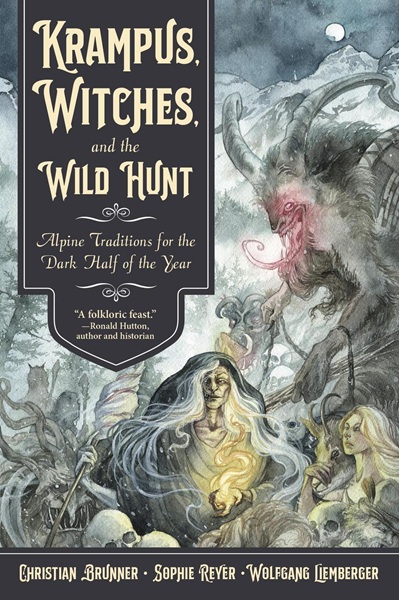
Krampus, Witches, and the Wild Hunt. Alpine traditions for the dark half of the year
Christian Brunner, Sophie Reyer, Wolfgang Liemberger
Llewellyn, 20 October 2026, 218 p. ISBN 9780738782157. $ 18.99, € 23,95.
Article by Christian Brunner
Just in time for a review in the 2026 Samhain edition of Wiccan Rede Online magazine this book was published. There is no opportunity to read it thoroughly, but this is the time of the year for a review on the subject of Krampus, associated with the 5th of December.
The authors are three Austrians: a Druid and writer; an author screenwriter and professor specialised in Alpine lore; and a filmmaker and author. When fate brought them together, they decided to create a book about the time between November 1st and April 30th, sharing “the many peculiar traditions, dark lore, rituals, and recipes that come from the folk culture of Austria”. More has been written on the light half of the year, but their interest was drawn to the ominous, to the mystery of the darkness. “What is it that compels people to see strange monsters and strange creatures in the shadows of the night or in the deep forest? Why would folk dress up as terrifying demons, tell frightening stories to their children, and visit homesteads to perform ritual?” After introducing themselves, they also present ‘Life in the Alps’.
The book continues with an introductory chapter on ‘The dark half’ and three sections with chapters: ‘From Light to Darkness’; ‘Darkness’ and ‘From Darkness to Light”, in which Darkness includes the ‘Rauhnächte’, so the period from late December until January. Following the calendar these subjects are covered: All Souls; Goddess and Saint; Krampusnacht; Luzltage; The Rauhnächte; The Wild Hunt; Mother Percht; The Perchten; Winter Spirits; In Your Practice; February 2nd Lichtmess; Fasching; Spring Equinox; Walpurgisnacht.
My first impression is that this book is a valuable source of information on the customs and beliefs and the folklore in the Alpine region in the dark half of the year. Well-researched, written in an accessible way, with 8 pages of enlightening photos in colour, and with recepies for food and drinks that belong to the special days. Interesting for anyone who wants to know more on the folklore or wants to know more about the backgrounds of these traditions, but with extras for Pagans: rituals and suggestions under the header ‘In your practice’.
The book ends with a Conclusion; a Calendar with the relevant dates from November 1 (All Saints) until April 30 (Walpurgisnacht); a Pronunciation Guide for the German as spoken in the Austrian Alps; and a biography. A title I missed in these ‘Works Cited’ is When Santa Was A Shaman: Ancient Origins of Santa Claus & the Christmas Tree by Tony van Renterghem (also by Llewellyn, 1995), but of course the authors have access to older, original, sources in German.
If you don’t buy the book, do read the article by Christian Brunner on the Llewellyn website (link on top of this page).
“Krampus is not the devil. And he has little to nothing to do with Christmas. He definitely doesn’t come to destroy it — rather the opposite.”
