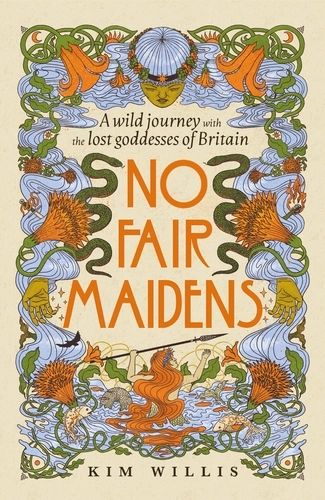
No Fair Maidens. A wild journey with the lost goddesses of Britain
Kim Willis
Penguin, 2026. 250 p. ISBN: 9781529947847 (hard cover). £20.00, € 27,95.
The Roman Pomponius Mela, around the year 43, writes about an island in the Britannic Sea. The Isle of Senna belongs to a Gallic divinity, and is famous for its oracle, whose priestesses, sanctified by perpetual virginity, are reportedly nine in number. They stir up the seas and the winds by the magic of the charms, they turn into whatever animals they want, they cure, they predict the future to the sea voyagers who consult them.
An Island of Nine Sisters. Shapeshifters, healers, fortune tellers. Goddesses.
1000 years later. Geoffrey of Monmouth writes a chronicle of the islands aroud Britain. Such as the Island of Apples, that is ruled in a benevolent rule by nine sisters. They have the power of shape-shifting, and healing, and prophecy. It is to them that the dying body of the hero Arthur is taken.
In the Mabinogion, Arianrod takes her sisters to an island. They are shapeshifters, and healers, and have the power of prophecy.
There is a pattern in the oldest stories of the British isles. “Our most powerful myths tend to echo through history.” But the stories are not told anymore. They are not part of the school curriculum. So Kim Willis told her audience in a Candlelight History Talki: ‘The Lost Mythology of Celtic Goddesses’. “We were supposed to have been told these stories”, she says in the book. “We’re supposed to have found them in the hazy realm of the ancestors, each one designed to make sense of us. But somewhere along the line the thread was cut, leaving us wondering why we struggle for a sense of belonging.”
In the book the stories are followed by explanations and many interesting details about each goddess, and how she was viewed in history. And the stories are intertwined with the larger story of how Kim Willis came to know about the goddesses and their stories. Certain events in Willis’ life found an answer in the discovery of a goddess. She uses the word ‘goddesses’ because they are formidable. “The tales in this book are here to help us remember. They help us imagine something transformative, inviting us to see just how radically our lives might change, if we were to change the stories we were raised on. In fact, once upon a time, in a moment when it seemed I was at a dead end, these stories have saved my life. And I wonder if there are ways, and moments, in which they might save yours too.”
The stories cover many aspects, if not all, of women’s lives.
The book title is explained right in the beginning of the book. This is not a story in which a lost princess waits for her rescuer, to live happily ever after. No fair maiden, at least no ‘damsel in distress’.
The eight goddesses whose stories are told are: Severn; Cerridwen; Coventina; Arianrhod; Gwendoline; Melusine; Scáthach, and Morgen. The source texts are given and also some notes on words used, like Mabinogion/Mabinogi, plus suggestions to carry these stories forward.
The book is about the lost goddesses of Britain. Pre-Roman. Pre-Anglo-Saxon. But still, interested readers on the continent will recognize some of the goddesses, and certainly their power, their connection with nature. And many of us have connections in Britain too, and maybe ancestors from the islands. Certainly each story of a powerful woman, of a goddess or heroine, will resonate inside us. The book may inspire us to search for our lost goddesses, for the stories we were not told.
i See also the Seed-Talk The Dark Origins of Christmas: Demons, witches, Twelfth Night & more and the on-demand course The History of Witchcraft, from 12 February to 22 March 2027.
