Sabbat Wine of the Witches

Drink from the cup of Witches’ wine and remember ancient rites forgotten by time. 

Witchcraft is a practical system of mysticism whose method is known as magick. At the core of my experience of Witchcraft is a direct and personal encounter of the psychic reality. I have come to understand Witchcraft as a type of gnosis or mysticism through which communion with the Divine is the principle initiation. Akin to the Mystery Cults of the ancient Pagan world, the experiences hold an occult quality that may lead you far from the usual encounters of secular religion and into the practice of magick.

I believe this is exactly what the initiates of the old Pagan Mystery Cults experienced and precisely what Gerald Gardner, the father of modern Witchcraft, had in mind with the contemporary expression of Wicca (I use the terms Wicca and Witchcraft interchangeably).
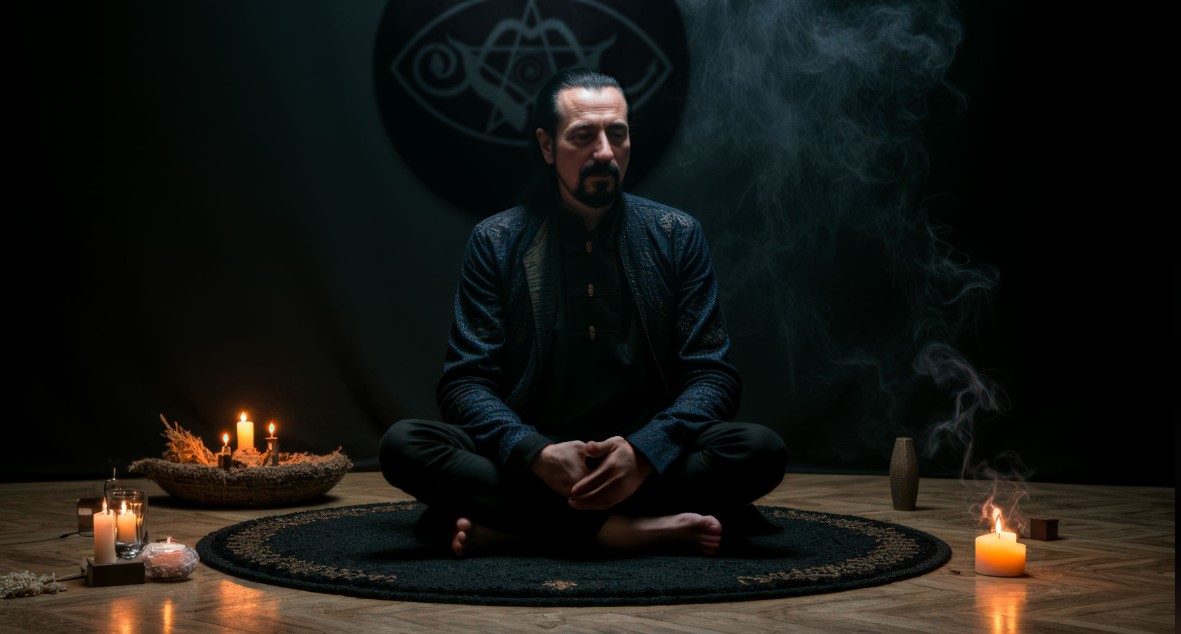
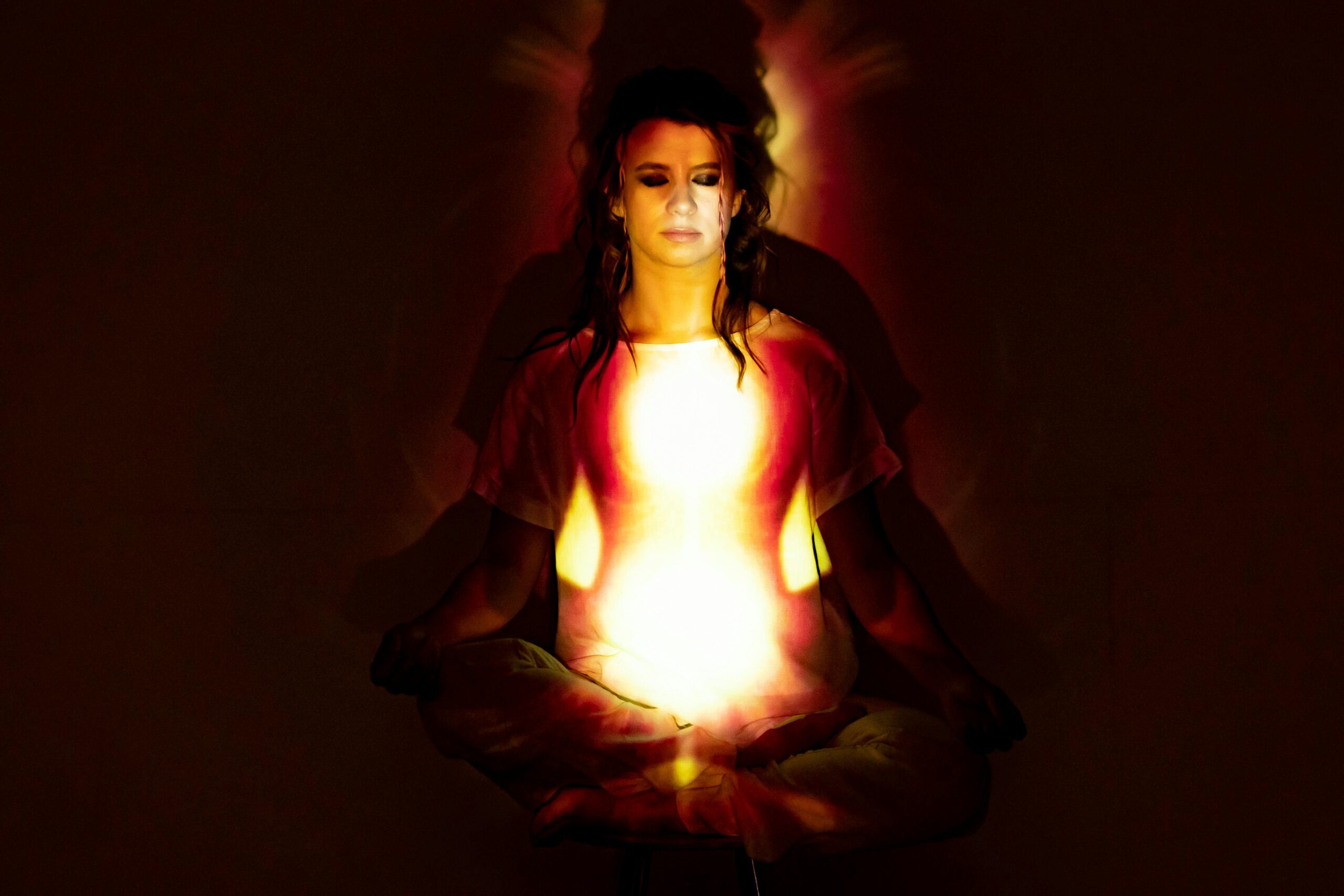
(Tim cross-legged, sitting in Circle)

My early encounter with practical magick was via the casting of spells learned from a man who had spent years living with the Spanish Gypsies. Marc de Pascale had published his collection of Gypsy sorcery under the title Book of Spells. He was a gifted psychic, a natural clairvoyant, and over an occasional exchange of tarot readings we became friends. His spellcraft worked well and it taught me to rely on my ability to wilfully cause results through visualisation. By candlelight I would enter a dreamlike state where desires took on ghostly forms, tangible and fluid-like. Later, I learned this manifestation had a name—the vinum sabbati or sabbat wine of the Witches.

The vinum sabbati is a substance not made of any ordinary fruits of the vine. Its roots draw from the rich, dark recesses of dreams. This ethereal fruit may be harvested under the light of the midnight moon, and fermented in a cauldron of dreams generated in the nocturnal trance of sleep. Whether awake or dreaming, the world of imagination is most acute in children, but some adults maintain this capacity. Although I didn’t realise it in my youth, for most of my life I have had a natural propensity to this type of imaginative impulse. In the practices of Witchcraft, I found methods to engage my psychic dreams, coupled with an overwhelming fascination to understand what was behind these twilight experiences.

I was in my first year of high school when I realised that there was something beyond the everyday reality. An incident occurred within my family home involving physical contact with an aberrant spectre, an entity which had haunted our home for years and was later identified as my paternal Grandmother. The family home faced onto the beachfront at Bondi and had been bought especially for my Grandmother. One sunny day as I stood in the room that overlooked the beach esplanade, ghostly hands gripped hold of both of my arms. I struggled to prise myself free. Her presence and power completely overshadowed me and I was forced to witness a distorted vision of a fierce storm happening outside.

The sky turned suddenly dark. From where I stood I could see something like a king tide had entirely swamped the beach. Winds acting like a vacuum sucked windows straight out of the apartments and homes along the entire esplanade. I shook with fear and somehow managed to liberate myself from my spectral grandmother’s grip. As soon as I had left the room, everything returned to normal. Later, I was to learn she had passed away in that room. As frightening as this had been, the event triggered a major turning point.

My first reaction was to approach my science teacher to find out if he could offer any logical explanation. It took me a week to summon enough courage to broach the subject with him. Although he was a high-school science teacher and a good one by my estimation, he was also a Christian Brother. They were like a separate breed, knowledgeable but unapproachable. Unfortunately, his response consisted of a clichéd, ‘Well my son, there are some things in this world we just can’t explain.’ I wasn’t sure whether he was speaking as a scientist or as a Christian, but either way I was devastated that he had no answers. The subject was never again raised at school.

This led me to my second choice, which proved much more productive. I turned to books. Reading brought a new and very hidden world gradually into the light. The occult in Sydney during the late 1960s consisted mainly of astrologers, spiritualists and incense-burning hippies, some of whom had tarot cards but didn’t know how to use them.

There was the ‘Witch of Kings Cross’, Rosaleen Norton, but she was totally reclusive. Therefore my mentor became the pages within these scarce and treasured volumes. I read Gerald Gardner’s book Witchcraft Today and a number of things struck an immediate cord. I had been instinctively practising many of the techniques used by Witches to encounter the psychic reality.

From 1973 I began to formally practise the Wiccan traditions of Gerald Gardner and Alex Sanders. (After all, what is the point of tradition unless you follow it?) Sanders did for the 1970s generation of seekers what Gardner had done in the 1950s—only on a scale that Gardner could not have imagined. Sanders’s style of the Old Religion was a fusion of Qabalah, Hermetics and Wicca. Stewart Farrar very eloquently describes his teachings and influence in his book What Witches Do.

The shift to coven-based Wicca provided the structure necessary for me to work with others. I set about in the development of the first coven in Adelaide by performing a ritual to invoke the moon Goddess with the purpose of attracting others of like mind. Up to that point, much of my Witchcraft had been focused around practical magick. Although this provided me with the basis for occult development, it was more result driven and didn’t enable me to experience the Divine of which Gardner and Sanders spoke; and which I now understood was central to a complete initiation into Witchcraft. During the first year there was a lot of exploration, circle orientation for southern hemisphere conditions, the initiatory grade structure and, in particular, experiments in trance and clairvoyant states.

By 1974 the coven consisted of a diverse group of people. There was Chris, who worked by day as a personal assistant and assumed the role of principle priestess for the coven. There was her younger sister Ros, Alex a policeman, Christine an antique dealer, and Alastair a university student and practitioner of Tantra. A few months later, Linda, a teacher of Italian, joined. Linda teamed up with me to lead the coven in the development and formal training of potential members.

We met frequently in the private covenstead of my home in Melbourne Street, North Adelaide, a street better known at the time for doctors, dentists and architects. Affectionately called the ‘Witch’s Cottage’ by the locals, my home, and I, had developed something of a reputation by challenging the Law in a landmark court case over my right to read tarot cards and do psychic consultations in a professional capacity. The ‘Witch of North Adelaide’, as I had become known, was a regular identity seen in the evenings walking down to Café Istanbul with coven members and other students of the occult in tow.
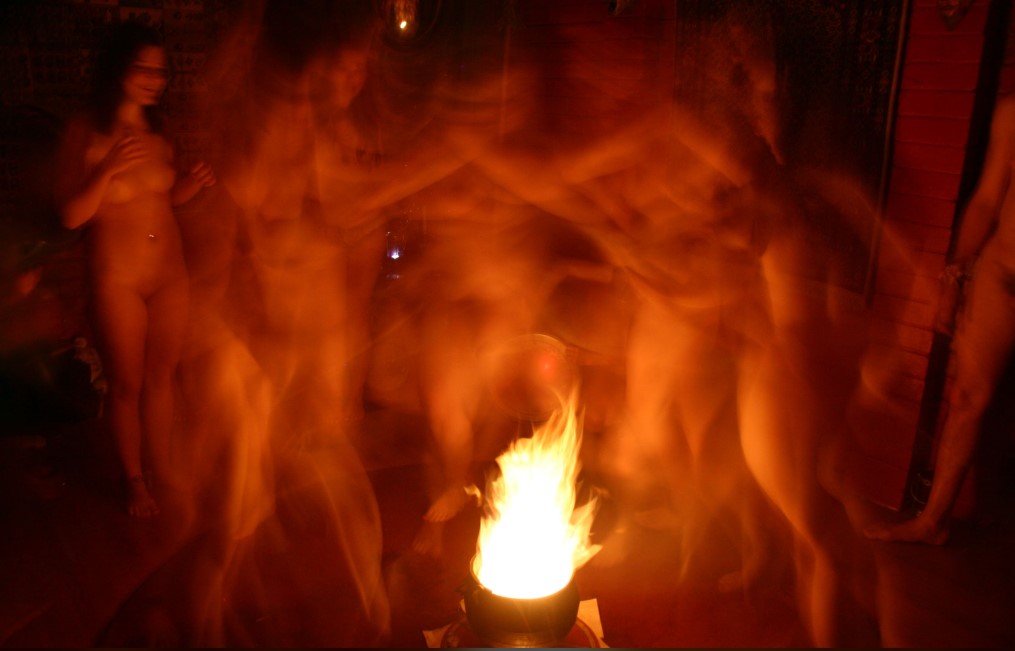
(Dancing ecstatically: Nuit’s Veil Coven photo archives )

At least once or twice a week we would cast the circle and practise some form of trance induction, and train in the ‘Black Arts’ as the neighbours liked to think. Some of our initial methods included staring into bowls of inky-water, gazing into black mirrors, or using the strange, mirrored Witch ball – a mirrored glass ball usually hung in the window to avert evil. Witch balls have been very popular from at least the eighteenth century. Using these devices for scrying induced the desired change in consciousness. At the start, these experiments helped to open our awareness of the subtle etheric field (life energy) surrounding the body, but eventually we could also see this energy field around the objects themselves. As we progressed in these methods, they led us to try other techniques that resulted in deeper visionary experiences. We were now using more active techniques including special breathing exercises and hypnotic dances.

At the same time I was exploring other occult traditions. One of the major influences in the Western Magickal Tradition is the Hermetic Order of the Golden Dawn (founded in 1887). Their initiations taught a procedure for trance via a set of astral doorways. These are a set of specially coloured symbols representative of the elements. Using them as a focal point, the practitioner begins to mentally journey through and into the astral world beyond. We used this focused projection of consciousness with our trance techniques to open the psyche into direct experiences. On occasion, spontaneous out-of-body episodes (astral projections) would occur. These encounters with the psychic reality began to trigger events in our everyday lives, frequently resulting in significant life changes. Such as on the occasion when I awoke from an afternoon nap after having had a hair-raising ‘astral joyride’ in a friend’s car, which was being stolen at that very moment. We rushed to the garage only to find my experience was more than a dream.

My perception of reality has undergone dramatic change as a consequence of these encounters. Years later I came to refer to these events as ‘occult darshan’. Darshan is a Sanskrit term for a direct and personal mystical experience. Studying Gardner, I found he was particularly interested in how Witches awakened an energy field around the body. In his book Witchcraft Today, he guardedly outlined some of the Witches’ methods and how their rituals were designed to open a space outside of the normal reality. Using a formula of ritual magick, he demonstrated how the Witch cast a magick circle as a doorway to an objective psychic reality and, more significantly, offered examples of what it was used for. He postulated that a current of energy around the body acted as a bridge between the mundane and the psychic. With the aid of ritual magick, this natural but excited energy could be amplified by using the Witches’ circle. Such rituals could move an individual’s awareness outside of time and space. Gardner explained the ultimate purpose in creating this bridge was to experience encounters with the Divine.

(Dancing ecstatically – under the Light of the Moon: Nuit’s Veil Coven photo archives )

Examples of this communion are found in the performance of such rituals as Drawing Down the Moon, a ritual designed specifically to channel the spirit of Luna, the ancient Pagan Goddess of the moon and initiation. The root words for both moon and mind are the Indo-European manas and mana; the derivative mania originally meant an ecstatic revelation. Likewise, lunacy meant possessed or chosen by the spirit of Luna. Gardner examined how a corresponding psychic reflex could be invoked. Many of the procedures used by Witches cause an altered or heightened state of consciousness as a necessary stage to facilitate initiation and direct experience of the Divine.

We mark this round and cast this rune
Upon this night in the sight of the moon
Our bare feet mark this Witches’ round
And thus it becomes hallowed ground

(Tim Hartridge, from the rite Lumen in Tenebrae)

The coven membership had expanded and with it our need for a more dedicated space. We rented a large old house in an inner suburb of Adelaide. It was perfect for our needs and, not surprisingly, had a witchy number – thirteen. We painted the whole house; the ritual room standing in stark contrast to the rest of the rooms with its deep indigo-blue walls and stained red cedar floorboards with the Witches’ circle painted on them. This became the physical heart of the coven’s ritual practice.

Hypnotic, strangely soothing, the Witches’ mantra named and called to the twilight spirit to draw down. The lithe spirit entered into the midnight-room. Weaving the magick of the sonorous spell, as ancient as humankind, the Witches called to the moon. The supreme and archaic Witch Goddess, ruler of the deep indigo night, the ethereal shape-shifter who bestows mana upon Her chosen. The voice of the Goddess’s Priestess sang the charm to the night and the moon, calling the Lunar Goddess to draw near. Other voices joined, summoning the bright Goddess into the Witches’ circle. A spirit of the night responded and I felt afloat as though on the flowing tide. The deeper the echoes chanted, the more I sank into an emotional sea mixed with currents of excited joy and engulfing sadness. Luna was with us, She who rules the oceans, lovers and lunatics. I was immersed in an atmosphere both brightly charged and darkly intoxicating. She began to appear. Gliding into the sensuous bodies of the Witches and gazing out through their eyes, She was all around me, in the faces of these wild Witches and in the rhythm of the dance, She whirled around and around me. The lunar current swarmed tangibly and surreally in the sea of incense in which we swam. In the centre was a dark iron cauldron and out of it danced a flame. The scarlet fire rose and flared with such force it wound and spiralled up into the air. It transformed into a massive leviathan, and from out of the black cauldron it bellowed a flood of flame like a firestorm. Awe, terror, thrill, intensity poured out in a powerful cone of bright fire, engulfing my body and brain.

Such encounters taught me a great deal. If the Goddess had been an ideal, something not quite real to me, then experiences like these changed all this. I instinctively knew She stalked me, occasionally leaving me hints and clues where I should look to find Her. if the Goddess had seemed more like a yearning for something far away, like lovers kept apart by the cruel circumstance of Fate, then through such initiatory experiences Her presence was felt most acutely in my life.

It was while working with others that powerful archetypal energy began manifesting in the coven. The shadow Gods like to challenge our conditioning, testing in us what is true and what is false. The amphibious Hekate was chief amongst the Gods to pique the cosy coven. She stirred things to create a divine hell-broth which brought home the words of warning of poet Robert Graves in The White Goddess: ‘. . . the Goddess whom you adore . . . she demands either whole-time service or none at all.’ The amphibious nature of Hekate would take the coven circle from the dry land of the logical intellect into the watery realms of dreams and astral experiences.

Chris, the Priestess with whom I worked, had some propensity for trance. We both instinctively knew it was time to invoke the Archeron Goddess of the Underworld so I designed a ritual in which we might take advantage of trance mediumship. The ritual would also be our induction into the archaic mysteries of the patron and Queen of Witches. The initiation was deeply emotional and I began to change. If I had been a reluctant and ignorant initiate up until then, I now felt the influence the Goddess would play in my destiny.

From that moment on, I knew we had been taken under the wing of the nightshade Goddess. Not too surprisingly, my confidence grew and the work in the coven became deeper. I realised, too, that initiation was more than simply joining the club. I gradually began to understand my relationship with Witchcraft in terms of an inner initiation and an outer connection with coven members and others of like mind. I began to question the literalism with which others understood their roles as Witches. My explorations were challenging many of the accepted protocols. The Witch in me frequently appeared more as an unexpected eruption of the unconscious. As if encountering a fascinating stranger, I didn’t recognise myself in these moments.

Although I didn’t have the language to describe the nature of these happenings, I knew one thing – in the make-up of my personality I was not a Witch 24 hours of the day. Instead, I began to recognise that at certain times this psychic function of the Witch would emerge, usually during times of emotional stress. I began to embrace the idea of Witchcraft more as a psychic phenomenon of the Self, and this opened up many new possibilities. Principally, Witchcraft was less about religion and more to do with the practice of  magick as a function of the psyche.

All my early research and spellcraft provided me with some skills to share with the members of our developing coven. Our desire to explore magick sometimes resulted in a number of amusing outcomes – as on the occasion when we decided to conjure a  rainstorm. Summer in Adelaide can be gruellingly hot. This time of year is very dry with a desert-like climate due to the northerly airstreams coming directly from Central Australia. During January and February the expectation of a naturally occurring thunderstorm is as likely as a visit from Elvis. Despite the odds, this is what we were attempting. We set about logically evoking water elementals, which we bound into knotted cords. The technique enables the Witch to simply release the knots on the desired day for rain. I did this and for good measure cracked the cords like a stock whip to stir up the winds of a storm. By five o’clock that afternoon, in the sweltering heat, an unnoticed black storm cloud had gathered directly over North Adelaide where I lived. A powerful downpour lasting several minutes ensued, followed by something like a Turkish steam bath in the street.

Several of the major TV and radio stations broadcast from North Adelaide and so the evening news weather reports spoke of a ‘freak rainstorm over North Adelaide!’. Needless to say I was elated and out I danced into the street. Before long the telephone began to ring with calls from coven members: ‘Was that us?’ However, my joy was soon diverted to problems with the plumbing, which never seemed to be permanently fixed, and an equally annoying case of genital crabs (the sexual organs are ruled astrologically by Scorpio which is the fixed water sign). While I don’t adhere to such Wiccan concepts as the Threefold Law, I was beginning to appreciate a need for balance.

After almost a decade of practising coven-based Witchcraft, changes were occurring and it was happening from the inside out. I had mastered most aspects of contemporary Witchcraft and was now more confident to rely upon my own conclusions. But the Gods were stirring the cauldron again and this time I was the medium.

Many contemporary forms of Wicca place the emphasis upon the Priestess in the coven. This is especially true in the celebration of the full moon or Witches’ esbat. At these rites the Priestess is the one who is said to actually draw down the spirit of the moon Goddess into herself, while the Priest plays little more than a support role.

The one thing I noticed was this drawing down did not always happen, and more than that, I might experience the Goddess regardless! So I began looking into what was really happening during the full moon esbats and other sacred rites. Not surprisingly, I realised that I had been too rigid and literal in my understanding of the rite, or indeed its intended purpose. I suddenly thought, what if drawing down the moon really meant manifesting Lunar consciousness, and not just in the Priestess but in anyone present at the rite? Almost immediately, I began to be subjected to an immense flood of Lunar influences. These began with an insomnia at the time of the full moon. During these periods I would sometimes hear the ethereal sound of a woman’s voice calling the names of the Goddess – Ma, Binah, Moon, Ea, Ge.

Spontaneously, I began to sing these names in a chanted melody. Like a bottled-up dam, the floodgates burst open and offered a passionate out-pouring. The soulful sounds of this Lunar mantra are a powerful spell, and one that the present coven still uses more than twenty years later. It has had an enduring quality, which has proven effective in connecting to the Lunar current of the White Goddess. The experience also produced some unexpected psychic reflexes. I was given access to glimpses of past-life memories: a more recent past life in which I was a paratrooper shot down during World War II and drowned behind enemy lines. Other even more unexpected encounters were astral visits to other Witches’ sabbats both in the past and present. This was not an entirely unfamiliar occurrence because I began to recall how, in my early teens while exploring the occult and the tarot, I had had shadow memories about unfamiliar ritual procedures. One time I even went so far as to build a stone altar based upon such a memory. I constructed it from old stone and brick in an abandoned part of an adjoining garden and used it to invoke the wild energies of the place with offerings of candles and flowers. I would feel an immense sense of solace while communing there amongst the huge Moreton Bay fig trees that overshadowed my small temenos. Unfortunately I had to abandon and dismantle my shrine because my father found it and became convinced that the neighbours were practising black magic.

These shadow memories have persisted throughout my life so that I am never surprised to learn that some ritual I have constructed has a near-identical twin with other Witches living on the other side of the world, or that it was some supposedly top-secret magickal procedure known only to the initiated. Despite having had many psychic experiences, I was for a long time in denial of these abilities. I didn’t know if I could trust these shadow memories, especially what I have come to  identify as recollections from past lives. On occasion these might occur right in the middle of a ritual and act to cause total confusion for anyone else working with me. Despite the inconvenience to my fellow coven members, I would proceed to steer the ritual in some completely new direction. Because of this ability to tap into these shadow memories, I now count amongst my achievements some of the most successful large-scale rituals conducted at Australian Pagan festivals.

On a more mundane level, Luna was making Her presence felt. For the first time, I allowed a friend to read my horoscope, revealing that I carried a permanent full moon in the water sign of Scorpio. On a positive side this may manifest as deeply-felt emotions and sensitivity; in a negative aspect it can lead to depression. The condition is triggered each time the moon returns to its natal position. A full moon will occur once a month when the sun is directly opposite. The moon is also the place of one’s soul, and at full moon is turned toward one’s spirit (sun).

Speaking in psychological terms, it is likened to the direct flow between the conscious and unconscious. The father of modern psychology, C. G. Jung, wrote in terms of the light of Consciousness bringing to bloom the flower of the Unconscious. Sound and music began playing a more significant role in my ritual work. In particular, I was exposed to the Shamanic drum trance techniques as taught by Dr Michael Harner (see ‘Further reading’). I would combine these techniques with my own instinctive and experimental methods. Some years before I had also explored the use of the resonant qualities of the Chinese gong and its effects on consciousness. The gong has some unique qualities and benefits over other percussive instruments. I found that its shimmering sound waves aid in parting the psychic reality, so the Witch may slip through the openings and gaps created. It is not unusual to hear people report, after I have taken them through this technique, that they thought either the ritual room or I had disappeared during the rite.

Around 1975 I had purchased a ritual gong through a friend, Alan, who runs an antique business in Adelaide. Alan had quite a story to tell about the ‘satanic’ gong, as he liked to call it, and was clearly pleased (or relieved) that I decided to take it.
(Tim Hartridge holding the ritual gong. Photo by T. Hartridge and V. Hall. )

The gong has attracted many unusual psychic and physical phenomena over the years. Its history is similarly curious – constructed in Europe during the eighteenth century, about a hundred years later it was procured for the practice of Haitian Voudoun ceremonies, at which time it was inscribed with the ritual vevers (symbols). I discovered that by using the gong’s reverberant qualities, and by applying a rapid, percussive technique, I could produce a sound to provoke trance.

As well as the use of sonic devices and techniques, ritual dance also helped to aid a shift in consciousness. Dance is one of the eight specific methods mentioned by Gardner for producing magickal effects. Dance is particularly useful in raising a psychic phenomenon known as the cone of power, which may occur spontaneously when the dynamic ritual dance is performed in a coven.

Examining many of the practices of Witchcraft reveals that these methods help to facilitate the emergence of the archetypal Witch from within the psyche. For example, the active participation in inspired ritual helps to transport the practitioner out of the normal routines of life. Also, methods that heighten sensuality will assist in shifting the ritualist into an altered state of consciousness. Sensuality in this context should not automatically be equated with sexual libido, but has more to do with an arousal of the senses. In other words, anything that assists the ritualist to ‘go native’ will help them to enter the mythic reality. The use of aromatic sabbat oils rubbed into the body before or during ritual, the use of ritual nudity (skyclad), or the play of frenetic dances, especially when done around a central fire, are all effective triggers. If you can step aside from the centre focus of self-consciousness (the real meaning of the word ecstasy), then an altered state of consciousness will occur. This can be encountered by any sincere person prepared to explore their wild and uninhibited nature, for it is in these neglected places of the psyche that the archetypal Witch can thrive and be directly experienced.

Many modern books fail when it comes to useful teachings in the practice of magick and Witchcraft. This is because they are more about following a tradition without having first explored personal psychic experiences. Many authors are content to let their readers simply follow the prescribed rituals, rather than developing an inner understanding. This is little better than playing at being the Witch.

Without a means of connecting to the magickal current, these types of rituals remain inert. Therefore, the first thing I emphasise to the student of Witchcraft is the importance of connecting to the chi of the ritual, meaning its life energy or spirit. Once this is done, an authentic experience will follow.

In contrast, the writings of magician Kenneth Grant are an excellent resource for any student of the occult. Grant’s background in writing began in the late 1950s. In 1989 a series of his essays was reprinted under the title Hidden Lore, including one of the more significant essays entitled ‘Vinum Sabbati’. This deals with a comparative interpretation of the alchemical symbology of Witchcraft. Grant suggests that much of the imagery of the Witches’ sabbat are symbolic motifs of astral phenomena, and that the Witch makes such phenomena manifest in the ‘latent wish’. This is a primitive urge for union with the Divine. Grant identifies the vinum sabbati as an intoxicating sabbat wine ostensibly brewed from dreams, astral essences and the trance of the ritual participants. I knew I had tasted the vinum sabbati as the product of the psychic reflex.

The arguments for and against a preference in describing oneself as either a Witch or Wiccan evidence a great deal of literalism on the part of those who practise Witchcraft. But what if becoming a Witch is more a psychic phenomena of the Self? It is less, then, about religion and more to do with the practice of magick and initiation into the Mysteries. This is the domain of the archetypal Wild-Witch, who unapologetically awakens from deep within the psyche. When being a Witch is experienced in this way, as our link to the natural, we may begin to re-animate our primitive and forgotten powers. These natural instincts may manifest in a variety of familiar and unfamiliar forms. Our intuition is one such form, while others include clairvoyance, astral and psychic projections, and even a natural ability to heal. The Witch’s Craft may be thought of as the ability to bend and enter the psychic reality at will through the many techniques of trance.

This approach in using an alternative interpretation to what it may mean to be a Witch places a greater emphasis upon the personal psychic function and the importance of personal experience. By looking for the Witch within, we may begin to think in terms of wanting to do more than simply learn from others. We are more likely to seek self-initiation into the Mysteries; to show initiative in the contribution to our own psychic study and knowledge base; and we will almost certainly find greater value in our own experiences above those of others as a basis for belief.

Currently I work within a coven based in the inner-west of Sydney. I still teach and conduct workshops that explore the wide variety of ritual techniques I’ve acquired over the years. I am just as curious and fascinated by other peoples’ experiences as I am with my own and have found the practice of Witchcraft deeply enriching.

For me it is not a spiritual practice which claims to know it all, but it certainly challenges me to ask ‘why’. Perhaps old Gerald Gardner had it right when he spoke of Witchcraft in the following terms:

‘It is the old case of: Unless you experience it yourself you will never believe. When you have experienced it, you don’t believe, you know.’
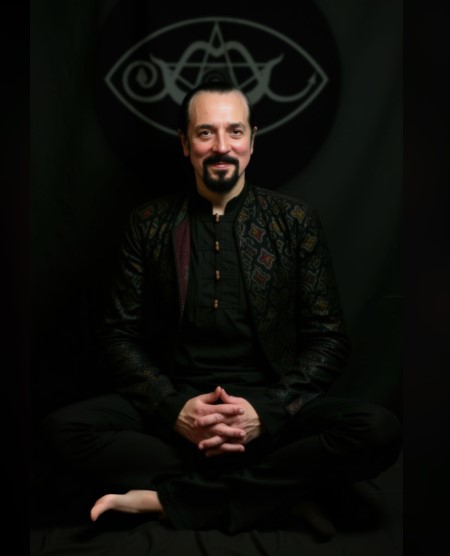
(Tim – with the NOX pentacle logo in the background)

Further reading

Stewart Farrar, 1971, What Witches Do, Phoenix Publishing, Arizona

Gerald Gardner, 1954, Witchcraft Today, Anchor Press, Essex

Kenneth Grant, 1975, Cults of the Shadow, Skoob Books, London

Kenneth and Steffi Grant, 1989, Hidden Lore, Skoob Books, London

Michael Harner, 1980, The Way of the Shaman, HarperCollins, San Francisco

Carl G. Jung, 2000, Collected Works of C G Jung, McGuire, Adler,

Fordham and Read (eds), Princeton University Press, Princeton

Marc de Pascale, 1971, Book of Spells, Thomas Nelson, Sydney

Websites:

http://www.ozpagan.com

https://www.facebook.com/WitchesWorkshop

http://www.witchesworkshop.com

https://www.witchesworkshop.com/nox

Photos reproduced with permission, from Tim Ozpagan’s private collection and Nuit’s Veil Coven photo archives.
Geplaatst in English articles | Getagged , , , , , , , | 1 reactie

Danzas Brancas, Antroido, and the Renewal of Light

Danzas Brancas, Antroido, and the Renewal of Light: Reflections for Imbolc

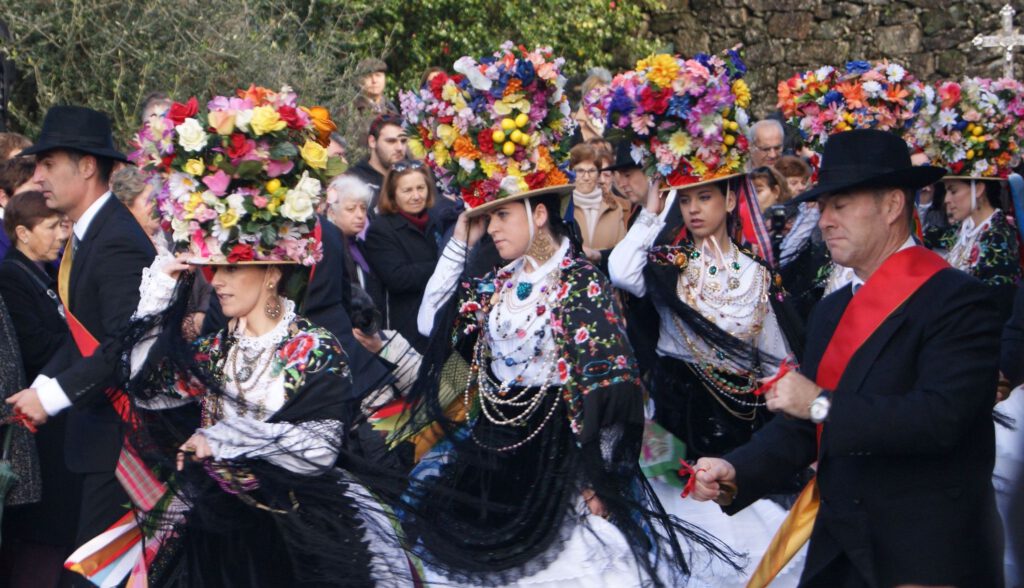
Danza de San Sebastián, bailada cada 20 de xaneiro en Aldán (Cangas, Pontevedra). Catalogada como festa de interese turístico baixo o lema “Danza ancestral de Aldán”, constitúe segundo os etnólogos e musicólogos unha danza votiva da fecundidade, cristianizada baixo a advocación do soldado romano mártir san Sebastián: música, pasos e indumentaria retrotráennos a épocas medievais e incluso anteriores.

Danza de San Sebastián, danced every January 20th in Aldán (Cangas, Pontevedra), this event has been designated as a festival of tourist interest under the slogan “Ancestral Dance of Aldán”. According to ethnologists and musicologists, it is a votive fertility dance that has been Christianized under the patronage of Saint Sebastian, the Roman soldier and martyr. Its music, steps, and attire hark back to medieval times and possibly even earlier periods. Photo by: Septem Trionis CC BY 2.0

Framing the Context of Imbolc and Local Folklore

Between the cold marking the end of winter and the first rays of spring sunlight, candles are lit in honor of the reborn flame. The season of Imbolc brings an atmosphere of renewal: the purification of the earth, the beginning of a new agricultural cycle, and the promise of fertility. For Wicca practitioners, this is the time to honor the Goddess in her Maiden aspect, luminous and full of hope, while the God, hidden in the earth, begins his rebirth toward spring.

In Galicia and northern Portugal, this transition is also manifested through ancient folkloric traditions that, as echoes of a pre-Christian past, celebrate the same principles of purification, fertility, and renewal. These lands, culturally united since pre-Roman times and consolidated as part of the ancient Kingdom of Galicia, share a heritage reflected in their dances, masks, and festivities. This article explores how “Danzas Brancas” (White Dances) and the Antroido encapsulate the spiritual essence of Imbolc, connecting the universal values of Wicca with a rich Galician-Portuguese tradition.

In Imbolc, Wicca practitioners honor the sacred dynamic between the God and the Goddess, reflecting the natural cycles of purification, balance, and fertility. This Sabbat marks the transition between winter and spring, a time when light begins to be reborn and the earth prepares to receive new life. Through rituals of purification, sacred lights, and symbolic offerings, we recognize the Goddess in her Maiden aspect and the growth of the God within the earth, anticipating his vital force in spring.

Historical and Geographical Connection: Galicia and Portugal as Cultural Bridges

Since pre-Roman times, Galicia and northern Portugal have shared a common cultural identity marked by the rhythms of nature and spiritual cycles. This deep connection was strengthened over the centuries, especially during the Kingdom of Galicia, when these lands formed a political and cultural unit. This historical legacy has left traces that still resonate in the popular traditions of both regions.

Celtic and Roman influences left a lasting mark on these lands. Rural masquerades, originating as rituals linked to fertility and purification, adapted to Roman calendar celebrations such as the Saturnales, Lupercales, and Kalendas. These festivities represented seasonal transitions and renewal, integrating customs that survived over time and blended with local spirituality.

The “Danzas Brancas”, performed with white garments and precise rhythmic movements, serve as rituals of purification and harmony, reminding us of the importance of balance between the community and nature. These dances are common during local festivities, and in the Terra de Miranda, we find a fascinating example in the “Pauliteiros de Miranda”, where the use of sticks represents both protection and fertility.

Similarly, the Antroido and its variants, such as the “peliqueiros”, “caretos”, “cigarróns”, and “volantes”, symbolize social inversion and liberation before the new spring cycle. Masks and costumes not only symbolize purification and the abandonment of the old but also reflect the archetype of the Trickster. In Wicca, this figure can be associated with the Horned God in his role as protector and renewer, embodying liberation and ritual chaos before the spring rebirth.

These traditions not only celebrate the balance between the human and the Divine but also serve as a living reflection of the spiritual principles connecting local communities with universal cycles. Costumes and masks, beyond representing an archetype, act as tools of transformation and liberation, purifying the old to make way for the new.

Wicca and Folklore as Mirrors of the Divine

Wicca transcends cultural boundaries by connecting with universal principles of the cycle of life, death, and rebirth. As highlighted by the works of Carlo Ginzburg, Maxine Sanders, and Janet and Stewart Farrar, these practices draw from a common source that unites the spiritual and the cultural. The figure of the God and the Goddess, central to Wicca, finds a living reflection in these folkloric manifestations, such as the Antroido and “Danzas Brancas”, which symbolize purification, fertility, and cosmic balance. These traditions demonstrate that local celebrations are not merely echoes of the past but living expressions of spiritual principles resonating on a universal level.

From a Kabbalistic and Hermetic perspective, “as above, so below”. Folkloric traditions, particularly the Antroido and “Danzas Brancas”, represent the processes of chaos and order defining the sphere of Malkuth, the physical realm in the Tree of Life. These rituals, such as the burning of effigies in the Antroido or the solemn rhythms of the “Danzas Brancas”, symbolically reflect the dynamics of purification and renewal necessary to harmonize with higher spiritual levels.

By connecting these local practices with the universal values of Imbolc, we recognize that Roman traditions such as the Saturnales, Lupercales, or Kalendas influenced the evolution of these customs, creating a bridge between the ancient world and contemporary spirituality. This principle underlines the importance of recognizing folklore not just as a cultural legacy but as a spiritual cartography reflecting the interaction between the human and the Divine.

Celebrating the Harmony Between the Local and the Universal

By lighting a candle or performing a traditional dance, we acknowledge our belonging to an eternal cycle of life, death, and rebirth. Imbolc practices, both in Wicca and Galician-Portuguese folklore, offer us the opportunity to connect with the earth, our ancestors, and the energies sustaining the world’s balance.

These cultural and spiritual manifestations not only honor the past but also invite us to take an active role as guardians of a legacy transcending temporal and geographical boundaries. By celebrating these connections, we reaffirm the essential unity between the local and the universal, recognizing that every symbolic action we perform has a reflection in the greater cycles of the cosmos.

Exploring the Danzas Brancas 

Danza de Paus. Fozara. Ponteareas. Galicia

A Shared Legacy: Galicia and Northern Portugal

The Danzas Brancas of Galicia and Portugal are unique manifestations of a shared cultural and spiritual tradition, deeply rooted in natural cycles and pre-Christian symbolism. Though they vary locally, these dances share fundamental elements that connect them, highlighting their common origin and ritual nature.

The white costumes, symbols of purity and renewal, are often complemented by colorful sashes crossed over the body. These elements, in addition to evoking fertility, reflect the symbolic connection to seasonal renewal and agricultural cycles, linking communities to the land. In many of these traditions, dancers wear decorated hats adorned with colorful ribbons, and in earlier times, natural elements like corn cobs or dried plants reinforced the link with the earth and its cycles.

The traditional music accompanying these dances, featuring the gaita de fol (bagpipe) as the main instrument and drums marking a distinctive rhythm, is another shared characteristic. This rhythm, particular and distinct from other Atlantic Galician-Portuguese dances, underscores the solemn and ritualistic character of the Danzas Brancas. These ceremonial rhythms, beyond structuring the dances, represent cosmic order and serve as a means of spiritual purification.

The Ritual Nature: Past and Present

Historically, these dances served as ritual offerings during seasonal transitions, marking moments of purification and communal renewal. Although today many are associated with Christian figures, such as saints or the Virgin Mary, it is evident that their original meaning transcends these interpretations. These offerings symbolize the act of seeking protection and fertility, preserving a connection with the pre-Christian past.

For instance, the Danzas de Arcos and the Pauliteiros de Miranda feature coordinated choreographies that integrate elements like sticks and arches, reflecting collective collaboration and the balance between creation and destruction. These symbols, beyond their aesthetic function, represent the balance essential for the continuous cycle of life and rebirth. These ritualized actions connect directly to the symbolism of Imbolc, where light and fire represent both purification and the beginning of a new cycle.

A Spiritual Connection with Wicca

From a Wiccan perspective, these dances share essential principles with Imbolc: purification, fertility, and connection to the earth. Their communal dimension transforms them into collective magical acts that unite participants with the divine. As Maxine Sanders highlights in Firechild, and Nigel Jackson in Masks of Misrule, pre-Christian rituals and dances emphasize the importance of cosmic balance and the cyclical continuity of life, death, and rebirth.

The rhythms and ritual movements of these dances can be interpreted as manifestations of cosmic order, reflecting harmony between the human and the divine. In the Wiccan context, these folk traditions serve as spiritual bridges, connecting the physical world, represented by Malkuth in the Tree of Life, with the divine in higher levels.

The Wealth of a Shared Heritage

By integrating these cultural manifestations, we can appreciate how the Danzas Brancas of Galicia and Portugal, along with their local variations, represent a shared treasure. They not only celebrate fertility and purification but also reinforce the idea that spiritual and cultural traditions transcend borders. These dances reflect the deep connection between people and the land and their capacity to harmonize with the eternal cycle of nature.

Antroido and Spiritual Transformation

Video recorded before the parade of the tourist Entroidos of Galicia through the streets of Santiago de Compostela in January 2015.

Pre-Christian Roots: Antroido as a Gateway to Rebirth

The Antroido of Galicia and northern Portugal has its roots in pre-Christian festivities that celebrated seasonal transitions and agricultural renewal. These festivals not only marked the end of winter but were also key moments for communal purification and ritual chaos, preparing the way for a new cycle of fertility. Among its manifestations, notable figures include the Peliqueiros, Cigarróns, and Merdeiros, whose costumes and masks represent a symbolic inversion of social order. Through mockery and disguise, the collective desire to release the old and purify oneself for what is to come is expressed.

Nigel Jackson emphasizes in his work on the Rite of Misrule how social inversion and ritual chaos are universal expressions linked to the Horned God, who presides over liminal moments between chaos and order. The concept of “Rough Musick” in England or masked rituals in Central Europe resonates with our Antroido, where participants take on subversive roles to exorcize collective evils.

The significance of masks in Antroido is not merely decorative but invokes the power of transformation. Masks, as Jackson describes, symbolize both a connection to the spiritual world and the ability to transcend personal identity. In this context, the masks of the Peliqueiros and Cigarróns become a bridge to the cyclical forces of nature and fertility.

Comparison with Imbolc Rituals

In Wicca, Imbolc represents purification and spiritual preparation through fire and rituals honoring the transformation of the Goddess into the Maiden. This idea finds echoes in the Antroido of Galicia and Portugal, where costumes and social chaos serve as rituals of purification and farewell to winter. Through symbolic actions like burning effigies or using masks, the old is bid farewell to make way for renewal, reflecting principles similar to Imbolc’s fire rituals.

Jackson’s texts also highlight the importance of the “great in-between time” as a moment of magical transition between the old and the new. The Antroido fits into this logic, where ritual chaos releases the past and allows the community to be reborn, as observed in the cycles of the Wheel of the Year.

In Antroido, burning effigies or symbols of the old cycle mirrors Imbolc’s fire rituals, where reborn light purifies and prepares the way for the new. Additionally, the masks of figures like the Peliqueiros evoke the Trickster archetype, who in Wicca represents the Horned God in his role as protector and renewer, presiding over moments of chaos and order.

Antroido as a Manifestation of Cultural Unity

The connection between Galicia and northern Portugal becomes evident not only in geographic continuity but also in shared cultural heritage. Drum and bagpipe rhythms, costumes adorned with colorful sashes, and the use of natural elements like plants or cabbages decorating outfits reflect a common pre-Christian substratum. This unity is recognized in traditions such as the Caretos de Podence, which share symbols of fertility and purification with the Cigarróns de Verín. 

Parade of Bombos and Caretos of Lazarim, Salsas and Grijó (Bragança), as well as the masks of La Visparra (Vigo de Sanabria).

Nigel Jackson underscores in his study of masks and rituals the universality of these symbols as tools for crossing spiritual and social boundaries, becoming elements of connection between the individual and the cosmos. The unity between Galicia and Portugal resides not only in language or territory but also in a shared spirituality expressed in Antroido as a rite of collective renewal.

A Connection with My Experience at Antroido Ribeirao 

Entroido Ribeirao. Santiago de Arriba. Chantada (Lugo, Galicia)

I had the unique opportunity to attend, by invitation, the Antroido Ribeirao in Santiago de Arriba, Lugo—one of the oldest and most authentic manifestations of these festivities in the northwestern Iberian Peninsula. This experience allowed me to connect directly with the ritual and spiritual essence of Antroido, observing how the elements described throughout this text manifest in a real-world context.

One of the most striking aspects of this celebration was the presence of the Volantes, central figures of the Antroido Ribeirao. Their costumes, which combine symbolic whiteness and vibrant color, include the characteristic pucho, a tall hat adorned with long, colorful ribbons that flutter in the wind and move rhythmically with their dance. This element, along with their exuberant energy as they run through the fields, conveys a sense of renewal and vitality, as if channeling the forces of the earth to purify and revitalize the community. These ribbons, which seem to harness the energy of wind and earth, symbolize the renewing strength of spring, connecting the community to the natural cycles. My experience watching the Volantes running through the fields was not just a moment of cultural admiration but a direct spiritual connection with the principles of purification and rebirth that we also celebrate during Imbolc.

The connection between Antroido Ribeirao and the symbolism of Imbolc became evident through the dynamics I observed. For example, the liminal character of the Volantes and their masks not only breaks with the usual order but also acts as a catalyst for the spiritual transformation of the community. This idea directly aligns with the Wiccan concept of Imbolc as a moment of transition, purification, and preparation for a new cycle.

The origins of the masked rituals of Antroido Ribeirao can be linked to ancient winter festivals, connecting them to the temporal continuum spanning from the Winter Solstice to the beginning of spring. This connection not only resonates with Wiccan spirituality but also reinforces the idea that these practices are cultural and spiritual expressions that survive as echoes of our pre-Christian roots.

For me, participating in such an event was not simply about witnessing a folkloric tradition but experiencing a profound connection with the spiritual and cultural heritage shared by Galicia and northern Portugal. The rhythms of the gaita and drum, the symbolism of the ribbons and costumes, and the communal fervor that permeates the Antroido Ribeirao remind us that these traditions, beyond temporal or geographical boundaries, represent a universal call to renewal, the celebration of life, and harmony with nature. Watching the Volantes run through the fields, I felt the ancestral strength of these lands manifesting in each colorful ribbon and every note of the gaita. This experience was not merely a folkloric celebration but a deeply spiritual journey that reinforced my connection with the cyclical energies of nature.

Universal Connections

Folklore as a Mirror of Universal Spirituality

Folklore acts as a spiritual cartography that reflects the connections between the human microcosm and the universal macrocosm. Traditions such as Danzas Brancas or the Antroido of Galicia and northern Portugal encapsulate universal principles of renewal, purification, and transformation through local rituals.

Carlo Ginzburg, in Night Battles, explores how agrarian rituals and beliefs in the transitions between life and death act as “echoes of a universal spiritual substratum”. These ritual and folkloric practices of rural European communities preserve pre-Christian symbolisms that connect humanity with the divine. Ronald Hutton, in The Triumph of the Moon, highlights how contemporary Wicca draws upon European folkloric traditions, adapting elements of pre-Christian festivals and rituals to create spiritual practices that celebrate natural cycles.

From a Kabbalistic and Hermetic perspective, Dion Fortune, in The Mystical Qabalah, explains that “as above, so below”, emphasizing that cultural manifestations in Malkuth (the Kingdom, the earthly sphere) reflect cosmic processes occurring in the higher spheres. The Antroido, with its masks and rituals of social inversion, can be seen as a terrestrial representation of moments of transition and chaos that precede the creation of a new order—a principle resonating with the Kabbalistic concept of Tikkun, or the repair of the universe. These connections show how folklore can guide spiritual work by uniting the earthly and the divine.

Danzas Brancas and Antroido can be interpreted as expressions of Malkuth, the earthly sphere where processes of chaos and order manifest to prepare the path toward higher harmony. Dion Fortune, in her Kabbalistic vision, describes Malkuth as the earthly reflection of cosmic balance. Folkloric traditions like Danzas Brancas and Antroido symbolize the necessary chaos and order for renewal, emphasizing the principle of releasing the old to make way for the new.

The Unity of the Cosmos: Reflections by Alex and Maxine Sanders

Maxine Sanders, in Firechild, and Alex Sanders, in his legacy as the founder of Alexandrian Wicca, stress the importance of recognizing universal connections that transcend cultures and traditions. For them, Wiccan rituals, such as those of Imbolc, are not merely spiritual practices but “cosmic attunement rites”, harmonizing individuals with the eternal cycle of death and rebirth.

The figure of the Horned God, central in Wicca, presides over moments of chaos and order. His representation as a trickster and a renewer is also reflected in the masks of peliqueiros, cigarróns, or volantes, whose ritual roles symbolize the release of the old and the fertilization of the new. This connection reinforces the idea that Galician-Portuguese folklore is not merely a local cultural expression but a microcosm of a universal spiritual principle.

Preserving Cultural Heritage: A Spiritual Duty

Preserving traditions like Danzas Brancas or the Antroido enriches local culture and serves as a tool to understand the spiritual interconnections among human communities. As Ronald Hutton notes, the continuity of these practices allows individuals and communities to explore their ties to the sacred and the cyclical.

Maxine Sanders highlights that the true purpose of Wicca is “to recognize and honor the forces that connect humanity with nature and the cosmos”. By keeping these traditions alive, we not only preserve our cultural history but also strengthen the spiritual foundations that unite us with the world. Through these practices, we ensure that our cultural heritage remains a guiding light for future generations.

Conclusion: Resonating with Natural Cycles

The folklore of Galicia and northern Portugal and the rituals of Imbolc share a common thread: both celebrate life as an eternal cycle, where death and renewal are necessary phases for spiritual evolution. These practices transcend cultural, linguistic, and spiritual boundaries, showing that humanity, in its diversity, is united by the same fundamental principles.

Dion Fortune once stated that “all traditions are reflections of the same cosmic mystery, adapted to the culture observing it”. This thought inspires a broader reflection: by recognizing the connections between local traditions and universal principles, we can find a common path toward harmony—both among humans and with the earth.

Local traditions, such as the Antroido and Danzas Brancas, not only preserve our cultural legacy but also serve as mirrors of universal principles that unite humanity with natural cycles. By celebrating these connections, we reaffirm our role as guardians of spiritual balance and the earth.

As a Witch and Priest of the Alexandrian Tradition, participating in and observing these traditions has deepened my connection with the cyclical forces of nature. Through Danzas Brancas and Antroido, I recognize spiritual principles that transcend cultures and traditions, reminding me that every local ritual, however small it may seem, is part of a universal balance that connects humanity with the divine. This legacy, expressed in the land we inhabit, is a bridge to transcendence. Preserving these traditions is an affirmation of our role as guardians of spiritual equilibrium, strengthening our connection with natural and cosmic cycles.

Below is the video for “Alentejo” by Baiuca, a Galician musician known for blending traditional Galician music with electronic elements. Despite its title, the video features masked figures from traditional Antroidos of northern Portugal and Galicia, such as the Caretos of Lazarim and Arcas, the Follateiros of Lobios, the Merdeiros of Vigo, and the Troteiros of Bande.

References

• Diego, X. (n.d.). Antroido Ribeirao: Unha tradición enraizada na Terra de Santiago de Arriba.

Farrar, J., & Farrar, S. (1981). Eight Sabbats for Witches. London: Robert Hale.

• Farrar, J. (1971). What Witches Do: A Modern Coven Revealed. London: David & Charles.

• Fortune, D. (2000). The Mystical Qabalah. York Beach, ME: Weiser Books.

• Ginzburg, C. (1990). Ecstasies: Deciphering the Witches’ Sabbath (R. Rosenthal, Trans.). London: Hutchinson Radius. (Original work published 1989)

• Hutton, R. (1999). The Triumph of the Moon: A History of Modern Pagan Witchcraft. Oxford: Oxford University Press.

• Hutton, R. (2022). Queens of the Wild: Pagan Goddesses in Christian Europe: An Investigation. New Haven, CT: Yale University Press.

• Jackson, N. (1996). Masks of Misrule: The Horned God & His Cult in Europe. London: Capall Bann Publishing.

• Martínez San Martín, A. (2000). Historia da danza en Galicia. Santiago de Compostela: Edicións do Castro.

• Rodríguez Cruz, J. (1995). Danzas gremiais e procesionais da provincia de Ourense. Ourense: Deputación Provincial de Ourense.

• Sanders, M. (2008). Firechild: The Life & Magic of Maxine Sanders ‘Witch Queen’. Oxford: Mandrake.

• Sanders, A. (2003). The Alex Sanders Lectures. Oxford: Mandrake.

• Turismo de Galicia. (n.d.). Entroido en Galicia: Historia, tradición e máscaras. Xunta de Galicia.

Geplaatst in English articles | Getagged , , , , , , , , , , , , , , , , , , , | Reacties uitgeschakeld voor Danzas Brancas, Antroido, and the Renewal of Light

Figuurlijke vlinders en magische moraal

Terloops – want het gesprek ging feitelijk over iets anders – vroeg ik aan een bevriende heks of zij goed was in weermagie. Ze fronste en antwoordde dat zij het weer niet wilde beïnvloeden, omdat alles in dat systeem met elkaar samenhangt, “en je weet: de vleugelslag van een vlinder…”

Een vlinder in Brazilië…

Dat wist ik inderdaad, dat wil zeggen: ik had in de loop der jaren wel eens iets opgevangen over ‘het vlindereffect’. Dat was toch de gedachte dat een beweging zo teer en minimaal als het gefladder van een vlinder in Brazilië de aanzet kon vormen tot een tornado in Texas? Waarbij ik me altijd afvroeg: waarom een vlinder in Brazilië? Het was uiteraard bij wijze van spreken. Het was een theorie uit de Verenigde Staten, vandaar ongetwijfeld die tornado’s. Maar waarom juist een vlinder in Brazilië? Stond dat land bekend om zijn vlinders, of zo? En hoe liepen die luchtstromingen van Brazilië naar de VS eigenlijk? Had het iets met de vlindertrek van de monarchvlinder te maken? Ik had me die dingen afgevraagd, maar me er verder nooit in verdiept. Nu ik er weer aan werd herinnerd, werd het toch eens tijd om uit te zoeken hoe het precies zat met die stormverwekkende vlinder.

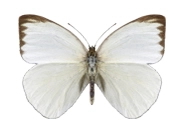
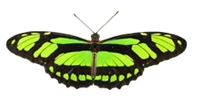
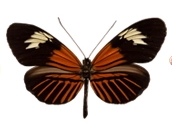
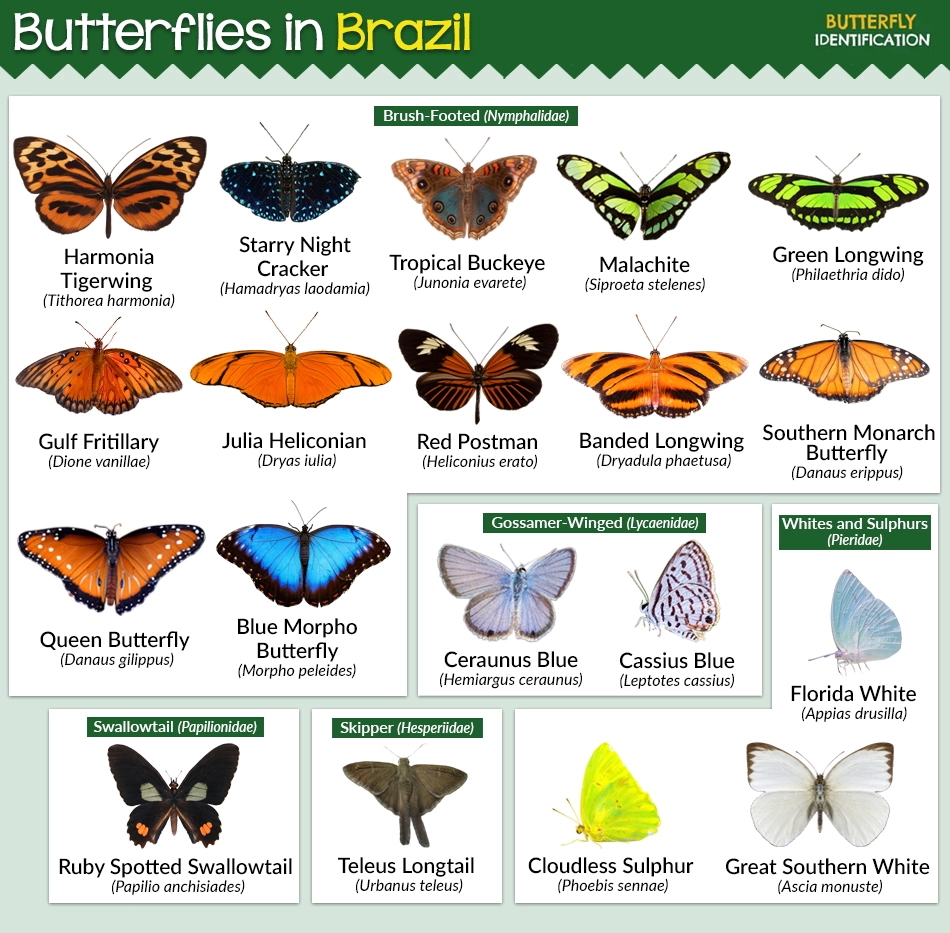
Vlinders in Brazilië. Afbeelding van de website Butterfly Identification. Alle losvliegende vlinders bij dit artikel komen uit dit overzicht.

De wiskundige en meteoroloog Edward N. Lorenz ontdekte in 1961 dat iets ogenschijnlijk onbeduidends in een geheel van op elkaar inwerkende krachten na verloop van tijd een aanmerkelijk verschil zou kunnen maken. Hij werkte toen aan een computersimulatie op basis van statistische gegevens, om het weer over een periode van twee maanden te kunnen voorspellen. Op een dag herhaalde hij een eerdere simulatie, en ging even een kop koffie halen terwijl de computer doorrekende. Toen Lorenz terugkwam, zag hij dat er iets heel anders uitkwam dan de eerste keer. Hij ontdekte dat het verschil vermoedelijk viel terug te voeren op het feit dat hij, toen hij voor de tweede keer de gegevens van de gehanteerde twaalf variabelen (temperatuur, windsnelheid e.d.) had ingevoerd, één getal had afgerond, van .506127 naar .506.

Begin 1963 publiceerde Lorenz een artikel over zijn ontdekking, met de titel ‘Deterministic Nonperiodic Flow’. Hij beschreef hierin hoe hij, om zijn veronderstelling te testen, niet de aardatmosfeer als uitgangspunt had genomen maar een container gevuld met gas, met slechts drie variabelen. Zelfs in dit sterk vereenvoudigde model bleken processen gevoelig voor kleine verschillen aan het begin. Dat zo’n miniem verschil kon uitgroeien tot een groot verschil in het vervolg, betekende dat de tot dan toe gangbare natuurwetenschappelijke opvatting, dat verschillende gebeurtenissen noodzakelijkerwijs en met de precisie van een mechanisch uurwerk1 voortvloeiden uit de opbouw van de kosmos, waarin een bepaald dit altijd en eeuwig tot een bepaald dat moest leiden, op losse schroeven kwam te staan.

Het was niet zo dat er ineens niks meer voorspelbaar was of dat in het weer van alles en nog wat tot willekeurig wat zou kunnen leiden. Maar het besef begon door te dringen dat er in de natuur processen zijn die weliswaar geheel en al verlopen volgens bekende natuurwetten, maar toch op de lange duur onvoorspelbaar zijn. De nieuwe zienswijze die voortkwam uit Lorenz’ onderzoekingen, zou bekend worden als ‘chaostheorie’ en kreeg vooral vanaf de jaren ’80 van de vorige eeuw bekendheid. De vergelijking van de natuur met een mechanische, voorspelbare klok werd vervangen door die met een levend wezen.

Zeemeeuw wordt vlinder

Buiten de meteorologie werd aanvankelijk weinig aandacht geschonken aan ‘Deterministic Nonperiodic Flow’, of aan een ander artikel van Lorenz uit 1963, ‘The predictability of hydrodynamic flow’. In dat laatste reageerde hij op een mede-meteoroloog die had gesteld dat als Lorenz’ theorie juist was, één enkele vleugelslag van een zeemeeuw genoeg zou zijn om het weer definitief een andere loop te laten nemen. Lorenz schreef dat de meningen daarover nog altijd verdeeld waren, maar dat er recente aanwijzingen waren ten gunste van de meeuw.2

Pas toen hij eind 1972 een lezing zou geven voor de American Associaton for the Advancement of Science (AAAS), kwam de vlinder in beeld. De organisatoren wilden een pakkende titel voor de lezing. Lorenz was tijdelijk het land uit en onbereikbaar, dus ze moesten zelf iets verzinnen. Ze dachten dat iets met alliteratie het altijd wel goed deed en bedachten: ‘Does the flap of a butterfly’s wings in Brazil set off a tornado in Texas?’ Robert C. Hilborn zocht de ontstaansgeschiedenis van deze metafoor uit.

Een van de organisatoren zei dat een vlinder hem aantrekkelijker leek dan een zeemeeuw, maar dat het ook best een “sea gull in Senegal” had kunnen zijn. Hij kon zich niet herinneren of er iets speciaals was waarom voor een vlinder werd gekozen. Een ander noemde alleen Storm van George R. Stewart (een boek uit 1941) als mogelijke invloed. Daarin komt geen vlinder voor, maar wel de zin: “He thought of his old professor’s saying: A Chinaman sneezing in Shen-si may set men to shoveling snow in New York City.”3

Hilborn wist te achterhalen dat het idee van de sterke gevoeligheid voor beginvoorwaarden bij weersvoorspellingen al was genoemd in een recensie uit 1898 van een Frans boek over thermodynamica. De recensent merkte daarin op dat de vlucht van een sprinkhaan in Montana het pad van een storm kon doen afwijken van Philadelphia naar New York. Maar uiteindelijk bleek dat er in een AAAS-artikel van Joseph Smagorinsky uit 1969 sprake was geweest van een vlinder. Waarschijnlijk was dat de vlinder die onbewust meespeelde bij het bedenken van een de titel voor Lorenz’ lezing in 1972.

Nog een vlinder

Niemand van degenen bij wie Robert C. Hilborn hiernaar informeerde, zei zich te herinneren dat de vlinder was gekozen met het verhaal ‘A Sound of Thunder’ van de science-fictionschrijver Ray Bradbury in gedachten. Toch is dat een associatie die veel mensen hebben. Ook mijn gedachten fladderen van de vlinder in Brazilië steevast naar de vlinder in ‘A Sound of Thunder’, dat ik (in vertaling) had gelezen lang voordat ik over de chaostheorie hoorde.

In dit verhaal, dat voor het eerst werd gepubliceerd in 1952, reist een rijke man voor een wel heel bijzondere jachtsafari met een tijdmachine naar de tijd van de dinosauriërs. De tijdreisorganisatie heeft diverse veiligheidsmaatregelen getroffen om te voorkomen dat de loop van de geschiedenis wordt veranderd. Tijdreizigers worden vooraf gedesinfecteerd, en in het verleden gaan zij over een speciaal aangelegd pad dat boven de grond zweeft. Voor deze safari heeft een verkenner tevoren uitgezocht welke dinosaurus op het punt zal hebben gestaan dood te gaan, zodat het niet uitmaakt als die, in plaats van op natuurlijke wijze te sterven, wordt neergeschoten. Voor lezers die het verhaal (of de gelijknamige film uit 2005, die overigens afwijkt van het verhaal) nog niet kennen, zal ik proberen geen spoilers te geven, maar ik denk dat ik niet meer verklap dan ik al heb gedaan door dit verhaal in verband met het ‘vlindereffect’ te noemen, als ik zeg dat een minieme gebeurtenis miljoenen jaren later dramatisch zal blijken uit te pakken…

“A little error here would multiply in sixty million years, all out of proportion. Of course maybe our theory is wrong. Maybe Time can’t be changed by us. Or maybe it can be changed only in little subtle ways. A dead mouse here makes an insect imbalance there, a population disproportion later, a bad harvest further on, a depression, mass starvation, and finally, a change in social temperament in far­flung countries. Something much more subtle, like that. Perhaps only a soft breath, a whisper, a hair, pollen on the air, such a slight, slight change that unless you looked close you wouldn’t see it. Who knows? Who really can say he knows? We don’t know. We’re guessing. But until we do know for certain whether our messing around in Time can make a big roar or a little rustle in history, we’re being careful. This Machine, this Path, your clothing and bodies, were sterilized, as you know, before the journey. We wear these oxygen helmets so we can’t introduce our bacteria into an ancient atmosphere.”
– uit: Ray Bradbury: ‘A Sound of Thunder’

Heksen en het weer

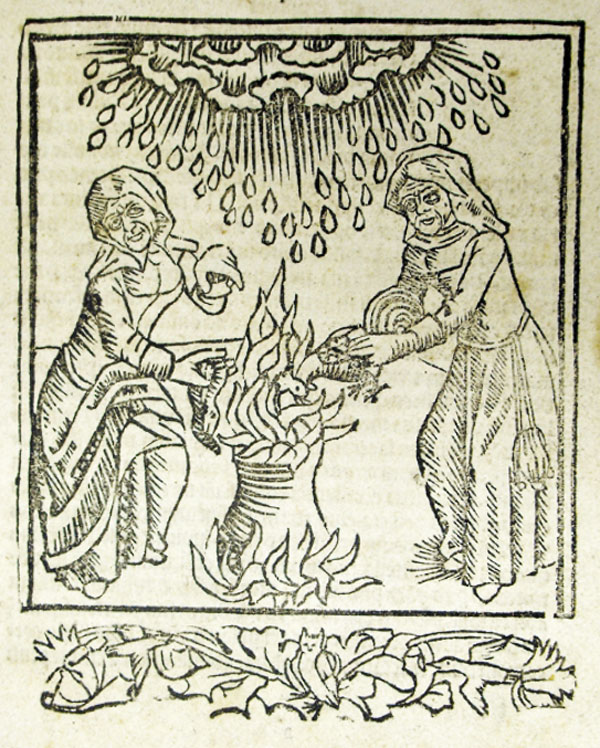
Hekserij om het weer te beïnvloeden. Afbeelding uit het boek ‘De Lamiis et Pythonicis Mulieribus’ van Ulrich Molitor (1489)

Heksen hebben altijd de reputatie gehad, het weer te kunnen beïnvloeden. In veel gevallen was dat een negatieve reputatie: volgens de Britse koning James (1566 – 1625)4 die het boek Daemonologie schreef om weerwoord te bieden aan mensen die twijfelden aan het bestaan of de macht van heksen, hadden heksen geprobeerd hem te vermoorden door stormen af te sturen op het schip waarop hij, pasgetrouwd met Anna van Denemarken, met zijn bruid terugvoer naar Schotland. Ten tijde van de grote heksenvervolgingen was er in Europa een kleine ijstijd, en velen waren ervan overtuigd dat het slechte weer in die periode door heksen werd veroorzaakt.

De reputatie was echter niet louter negatief, want wie zoveel macht heeft dat ze slecht weer kan oproepen, kan vast en zeker ook goed weer oproepen. Schippers en zeelieden gingen graag naar een toveres of tovenaar die ze een goede wind mee kon geven of die een ongewenste wind kon vangen en vastzetten, ongeveer zoals koning Æolus in de Grieks-Romeinse mythen ervoor zorgde dat helden zoals Odysseus of Jason met een gunstige wind naar huis konden varen.5 Er zijn altijd mensen geweest tot wie men zich wendde voor magische beïnvloeding van het weer, of die zich daar zelf op toelegden.

Was het slechte weer in de tijd van de heksenvervolgingen dan werkelijk een bedoeld of onbedoeld gevolg van getover? Dat zal geen verstandig mens willen beweren. Men weet niet precies hoe de kleine ijstijd ontstond, maar mogelijk hield het verband met stof in de atmosfeer door vulkaanuitbarstingen elders op aarde – overigens een goed voorbeeld van hoe op het oog ongerelateerde gebeurtenissen met elkaar kunnen samenhangen. En de huidige klimaatverandering, zou die dan deels zijn veroorzaakt door magische onzorgvuldigheid? Het is onwaarschijnlijk dat mijn gesprekspartner zoiets wilde suggereren. Maar ik denk wel dat ze weermagie juist met het oog op die klimaatverandering een erg groot risico vond.

De vervelende buurman

Maar als ‘een vlinder een storm kan veroorzaken’, en als het daarom beter is om het weer op zijn beloop te laten, zonder magische inmenging waarvan je de implicaties niet kunt overzien, geldt dat dan niet voor alle magie? Als een wiccaheks een vervelende buurman heeft, zo leerde ik ooit, zal zij hem als het even kan niet vervloeken. “Doe wat je wilt, als het niemand schaadt” is immers het advies, en vervloeken geldt als schaden. Wat ze wèl kan doen, zei men, is haar magie erop richten dat hij ergens anders een fantastisch mooi huis ontdekt en snel daarheen verhuist, waardoor de heks geen last meer van hem heeft.

Maar stel je voor dat hij in dat mooie huis naast iemand komt te wonen die net zo’n rotzak is als hijzelf, en die nog meer ellendelingen kent, en dat ze allemaal goeie maatjes worden en een criminele bende oprichten. Waar blijf je dan met je “als het niemand schaadt”? Misschien zou de buurman, als hij niet verhuisde, op zeker moment wel een vriendin krijgen waardoor hij geleidelijk aan steeds aardiger en socialer zou worden, maar vervalt die mogelijkheid als hij verhuist, omdat hij haar dan nooit zal tegenkomen.

Of stel je voor dat er in plaats van de vervelende vent een leuk jong stel met kinderen naast je komt te wonen. En dan blijkt de buurman voor zijn wietplantage op zolder eigenhandig allerlei ondeugdelijke elektriciteitsleidingen te hebben aangelegd, waardoor er op een nacht brand uitbreekt waarbij beide ouders, die inmiddels op zolder hun slaapkamer hebben ingericht, omkomen. Terwijl de vervelende buurman, dronken en stoned in slaap gevallen met harde muziek aan, zèlf in de brand zou zijn omgekomen als hij daar was blijven wonen.

Maar in dit scenario is er magie gebruikt en is hij verhuisd. Omdat de ouders er niet meer zijn, de grootouders al enige tijd niet meer leven, en er niemand te vinden is die drie kinderen tegelijk wil opnemen, worden de kinderen in verschillende pleeggezinnen geplaatst, waar ze getraumatiseerd opgroeien. In de puberteit sluit de een zich aan bij een knokploeg en belandt tenslotte in de gevangenis; een ander gaat drugs dealen en wordt op den duur doodgeschoten; en de derde blijft weliswaar op het rechte pad en krijgt een goede baan, vindt een lieve partner en krijgt schatten van kinderen, maar is zijn hele leven zo diepongelukkig dat hij uiteindelijk te veel gaat drinken, zelfmoord pleegt en partner en kinderen getraumatiseerd en in armoede achterlaat… Wat een ellende!

Het toverboek

Toen ik klein was, zocht ik eens overal in huis naar het toverboek. Het leek me namelijk heel aannemelijk dat ergens in ons huis een oud toverboek verstopt moest zijn. Een groot dik boek met een bobbelige zwarte buitenkant zag er veelbelovend uit, maar dat bleek een oud fotoalbum. Een kleiner boek met vergeeld papier en een verschoten rode rug met sporen van gouden opdruk zag er minder spannend, maar in elk geval passend oud uit. Eenmaal geopend bleek dat echter een sprookjesboek, dat mijn vader als kind voor zijn verjaardag had gekregen. Het toverboek bleef onvindbaar, dus ging ik maar in het sprookjesboek lezen.

Ik las een verhaal over een jongeman die ergens in het geheimzinnige Oosten een reusachtige lepel had gekocht, die echter uit een klooster blijkt te zijn gestolen. De monniken beloven hem goud of edelstenen of wat hij maar wil, als hij de lepel aan ze teruggeeft. Hij heeft gehoord dat die monniken de toverkunst beheersen, en wil dat ze hem als beloning leren toveren.

Zij raden hem dat sterk af, maar hij houdt voet bij stuk: beloofd is beloofd! Dan giet een monnik een vloeistof in de lepel, “die op gewoon water leek. ‘Als gij toveren wilt leren, zo sprak hij, moet gij uw gezicht hierin dopen.’ De jongen gehoorzaamde en toen gaf de monnik hem een lange vreemde les in het toveren. Dank zij de wonderbare vloeistof kon de jongen alles direct begrijpen en onthouden.” Hij krijgt een toverstaf, stapt weer op zijn kameel en tovert zichzelf in een oogwenk naar zijn vriend, waar het toevallig juist hard sneeuwt. Omdat hij daar niet op gekleed is en het koud heeft, tovert hij wat sneeuw in brand. Om extra indruk te maken op zijn vriend, wekt hij vervolgens een sneeuwpop tot leven.

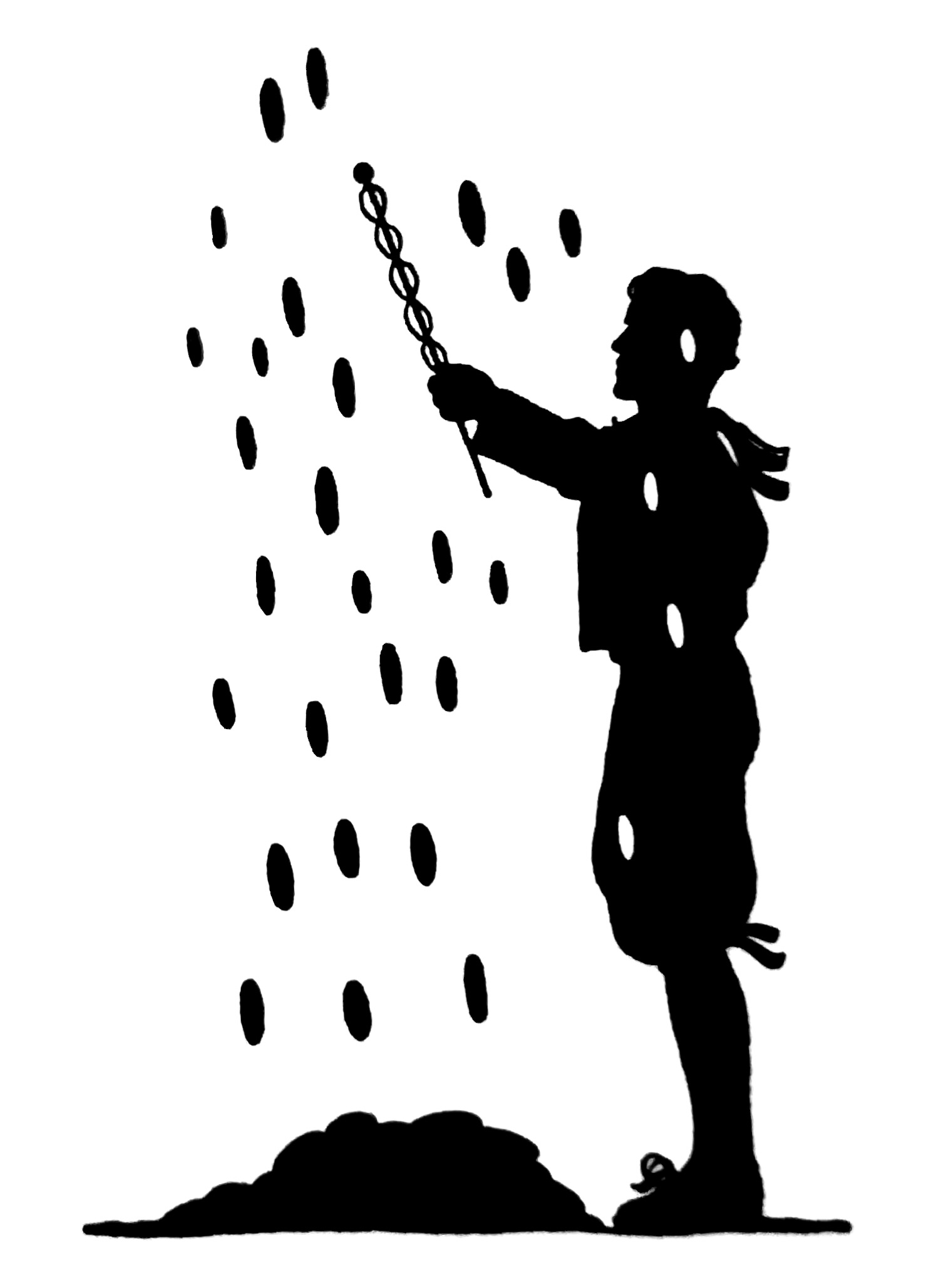
De jonge tovenaar laat het geld regenen. Illustratie bij het verhaal ‘De wonderlepel’ in: Piet Marée: Uit grootmoeders sprookjeskast – Vierde bundel

Hij bezoekt een goochelvoorstelling en brengt die in de war met zijn echte toverkunsten. Als slotstuk van de show laat hij het goudstukken regenen. Alle aanwezigen proberen zoveel mogelijk voor zichzelf te verzamelen, en er ontstaan nare vechtpartijen. Dan komt iemand in paniek de zaal inrennen: overal in de stad is brand uitgebroken doordat er een brandende sneeuwpop rondzwerft! De mensen keren zich tegen de tovenaar en breken zijn staf, waardoor hij niets meer in orde kan toveren…

En dan is hij ineens weer in het klooster en tilt hij zijn gezicht uit de vloeistof. Het blijkt dat hij alleen maar een visioen heeft gezien van wat er kon gebeuren als hij zou leren toveren. “Hij begreep nu wat de monnik bedoeld had, toen hij toveren voor hem even gevaarlijk noemde als vergif of vuur.” En bij nader inzien ziet hij er toch maar vanaf. Als kind vond ik dat besluit behoorlijk teleurstellend. Al vond ik die sneeuwpop die letterlijk als een lopend vuurtje door de stad ging, grappig gevonden.

En dan was er nog iets over degene die van alles schijnbaar uit het niets tevoorschijn kon toveren. In mijn herinnering maakte dit deel uit van het sprookje over de wonderlepel, maar bij nalezing bleek dat niet het geval. Mogelijk heb ik het in diezelfde periode ergens anders gelezen,6 en de verhalen in mijn herinnering samengevoegd. Of zou ik dat gedeelte er zelf bij hebben gedroomd?

Daarin kwamen de tovenaar en zijn vrienden er na een tijdje achter dat alle zomaar tevoorschijn getoverde dingen niet werkelijk vanuit het niets in het bestaan werden geroepen, maar slechts door magische verplaatsing ergens anders vandaan werden gehaald. Voor de grap een groot rotsblok op het marktplein toveren, betekende dat verderop in de bergen een deel van een rots plotseling verdween, waardoor andere stukken rots losraakten en een steenlawine veroorzaakten. Gelukkig was daar toevallig niemand in de buurt, maar het had anders kunnen lopen! En lekker eten tevoorschijn toveren kwam erop neer dat mensen ergens anders ineens aan een lege tafel zaten, wat natuurlijk niet erg eerlijk was.

Dat leverde mijn jeugdige zoektocht naar een toverboek mij op: de waarschuwing dat toveren geen onschuldig amusement of vrijblijvende wensvervulling kon zijn, omdat het altijd plaatsvond in een groter verband waar het consequenties had. En net als die jongen met die lepel begreep ik de les: opgepast! Maar anders dan hij, dacht ik dat het mogelijk moest zijn om op een goede manier te toveren. Net zoals vuur – waar die monnik magie mee vergeleek – onder bepaalde omstandigheden zeker gevaarlijk was, maar dat nog geen reden vormde om er absoluut nooit ook maar iets mee te maken te willen hebben. Zelfs mijn overbezorgde oma liet mij tenslotte zelf een lucifer afstrijken om een kaars aan te steken. Als ik maar voorzichtig was.

Vragen of dwingen

Het bezwaar tegen weermagie van mijn recente gesprekspartner bleek trouwens voornamelijk te gelden voor magie die het weer wil dwingen af te wijken van het natuurlijke verloop. Een vriendelijk verzoek om het verlangde weer vond zij nog wel acceptabel. De definitieve beslissing over het wel of niet uitkomen van de wens, en daarmee de verantwoordelijkheid voor eventuele globale gevolgen, wordt daarmee overgelaten aan hogere machten, die (hopelijk) een beter zicht hebben op eventuele consequenties. Dat is wel zo bescheiden. Maar toen ik hier later nog eens over nadacht, vroeg ik me af of het daarmee ook per se de beste benadering is; mijn indruk is dat hogere machten niet altijd oog hebben voor wat wij mensen voor goed en wenselijk houden. Wat nu als er een stormgod is die wel voelt voor flink veel extreem weer?

En is het verschil tussen afdwingen en verzoeken in de praktijk niet vooral een kwestie van bewoordingen? Als je je verbaal richt tot goden, voorouders, elementalen, of wie of wat dan ook, maakt het vaak wel uit wat voor woorden je kiest. Het maakt verschil of je een bevelende toon aanslaat en met sancties dreigt, of beleefd te kennen geeft wat je graag zou zien gebeuren. Als echter het zwaartepunt van iemands magie niet zozeer is gelegen in de spreuk (het gesprokene), maar vooral in uitbeelding, visualisatie, of het overbrengen van een bepaald gevoel via ‘afstemming’, of iets in die trant – hoe maak je dan verschil tussen bijvoorbeeld “regen, houd op! Nu!” en “geachte regen, zou u zo vriendelijk willen zijn nu eventjes op te houden” of “verheven goden, als het geen problemen veroorzaakt in het grote geheel, mag deze regenbui dan ophouden”? Er zijn genoeg magische rituelen (of ritueeltjes) die zonder tekst werken. Is op hout kloppen om onheil af te weren, vragen of dwingen? Als een tante gaat ‘duimen’ om haar neefje te doen slagen voor zijn rij-examen, is dat dan afdwingen of vragen?

Return of the butterfly

Terug naar die vlinder die een orkaan veroorzaakt. Werkt een kleine, onschuldige handeling op den duur beslist grootschalig negatief uit? Vaak wordt de vlindermetafoor juist aangehaald om je moed in te spreken en te vertellen dat wat jij doet ertoe doet, hoe klein en onbeduidend je jezelf misschien ook vindt: “Alles verandert door een enkele vlinder.” De gedachte is dat zelfs de kleinste goede daad uiteindelijk bijdraagt aan een betere wereld. Niet dat zoiets als je stem verheffen tegen een kleine misstand wel eens kan uitmonden in burgeroorlog, gevolgd door een staatsgreep “onder leiding van een energieke kolonel.”7 Terwijl dat laatste beeld toch meer overeen komt met het drama van de lieflijke vlindervleugel die aan het begin staat van een vreselijke storm!

Stiekem wordt in de bemoedigende redenering ook nog eens het verschil tussen ‘kan gebeuren’ en ‘zal gebeuren’ weggemoffeld. “Wil je jouw invloed op de toekomst gebruiken om de wereld mooier te maken? Gebruik dan het vlindereffect in je voordeel, zet de juiste veranderingen in gang. Jij kunt de wereld van je dromen vormgeven door in de wereld te stoppen wat je er zelf graag uit zou halen”, valt te lezen op de hierboven aangehaalde wereldverbeterwebsite. Succes gegarandeerd? Het staat er niet met zoveel woorden, maar de suggestie is dat jouw daden zeker succes zullen hebben, al is het misschien minder spectaculair dan je hoopt en zul je er zelf misschien nooit iets van merken.

Gaat dit nog wel over de vlinder van Lorenz? De titel van de lezing in 1972 was een vraag: Kan de vleugelslag van een vlinder in Brazilië een tornado teweegbrengen in Texas? Het pleit lijkt inmiddels, ruim een halve eeuw later, wel zo’n beetje beslecht ten gunste van de vlinder. Maar het gaat in die theorie nu juist over de moeilijkheid dingen op de lange termijn te voorzien, omdat een kleinigheid aan het begin al zoveel verschil blijkt te kunnen maken voor het vervolg. Je weet niet of die vlinder aan het begin staat van ontwikkelingen die uitmonden in een orkaan. Het zou kunnen. Maar het zou ook kunnen dat de vlindervleugelslag verhindert dat er een orkaan ontstaat. Het op elkaar ingrijpen van ketens van oorzaak en gevolg is zo gecompliceerd dat de uitkomst nooit volledig voorspeld kan worden. Kan een vlinder een orkaan veroorzaken? “Zelfs nu nog weet ik niet wat het antwoord is”, zei Lorenz in 2008.

Patience

Patience met fysieke kaarten

Dat één handeling aan het begin van een reeks gebeurtenissen ingrijpende invloed kan hebben op het verloop, blijkt trouwens al uit het spelletje patience. Regelmatig speel ik dat op een iPad (het heet daar Solitaire) en het aardige is dat ik daar, anders dan met een echt spel kaarten, eenvoudig een paar stappen terug kan gaan als ik niet uitkom. Het is zelfs mogelijk om hetzelfde partijtje van begin af aan opnieuw te spelen. Wat daar dan ‘hetzelfde’ aan is, is hoe de kaarten in het stapeltje zitten als ik begin. Het verloopt namelijk volstrekt verschillend wanneer ik, kort nadat ik ben begonnen, bijvoorbeeld niet hartenboer op klavervrouw leg, maar ruitenboer. Het vervolg is dan zo anders dat het de tweede keer niet langer een variant op de eerste keer lijkt, maar een heel ander partijtje. Of het verschil altijd zo groot is, of vaak of soms, weet ik niet want ik speel patience om te ontspannen, niet om statistieken bij te houden. Meestal begin ik gewoon een heel nieuw partijtje, met de kaarten opnieuw geschud.

In het echte leven is het niet mogelijk om ‘de kaarten opnieuw te schudden’ en als het ware een heel nieuw partijtje te beginnen. In plaats van te kiezen tussen hartenboer en ruitenboer om daar eventeel later op terug te komen, moet je besluiten of je in een bepaalde situatie magie wilt gebruiken of niet. Als de zaken vervolgens anders lopen dan je had gehoopt, kun je niet een paar stappen teruggaan of helemaal overnieuw beginnen. Je kunt hooguit, wanneer zich later een vergelijkbare situatie voordoet, een andere keus maken. Op grond waarvan kies je er in de praktijk voor dit te doen en niet dat? Waarom laat je een bepaalde mogelijkheid op het ene moment voorbij gaan, maar op een ander moment niet? Laat je je leiden door een bepaalde theorie, of hangt het van het moment af?

Beeldspraak

Wat betekent de chaostheorie voor de heksenpraktijk, en in het bijzonder voor magie met betrekking tot het weer? Zodra een nieuwe wetenschappelijke ontwikkeling bekend raakt bij het grote publiek, zijn er mensen die daarin de lang gezochte verklaring vinden van hoe magie werkt, of die uitroepen dat die lui van de wetenschap nou eindelijk ook eens door krijgen wat ‘wij’ al eeuwen wisten. Zelf voel ik nooit zo’n dringende behoefte om magie – of liefde, of schoonheid, of zulke zaken – natuurwetenschappelijk verklaard of gelegitimeerd te hebben. Als ik een liedje zing om een dierbare te beschermen, interesseert het me niet bijster of en nog minder hoe zoiets dan precies zou moeten werken; waar het mij om gaat, is dat die persoon veilig is.

In ruim een halve eeuw is Lorenz’ vlinder uitgegroeid van een meteorologische theorie tot een morele les. Om te waarschuwen of te inspireren, naar believen. Maar het blijft een metafoor. Dat wil zeggen: beeldspraak om iets anders, meestal een abstract idee dat als zodanig lastig te bevatten is, te verduidelijken. De moeilijkheid is dat de beelden in zo’n geval toegankelijker zijn dan het idee.

Je ziet het helemaal voor je, en gaat vanuit dat beeld, en vanuit bepaalde details of aspecten ervan, verder redeneren en gevolgtrekkingen maken die voor je het weet al niet meer van toepassing zijn op het eigenlijke idee. Zo gingen mijn gedachten, toen ik voor het eerst over het vlindereffect hoorde, onmiddellijk aan de haal met de Braziliaanse herkomst van de vlinder. Terwijl die later alleen maar gekozen bleek omdat de woorden butterfly en Brazil zo leuk allitereren. Ook de vlinder zelf was kennelijk vrij willekeurig gekozen, en niet bedoeld om poëtisch aan te duiden dat het ging om een voorval dat zich ‘ontpopt’ tot iets anders.

Het beeld van de vlinder die het ontstaan van een storm in gang zet of voorkomt, toont niets aan, maar illustreert iets. Je kunt er best aan refereren om te verduidelijken dat magische (en niet-magische) handelingen zich niet in een vacuüm afspelen, maar deel uitmaken van een complex van op elkaar inwerkende gebeurtenissen. En om te zeggen dat het daarom belangrijk is om goed na te denken over wat je wilt doen, om ongewenste ontwikkelingen zo veel mogelijk te voorkomen. Maar een science-fictionverhaal of een sprookje kan diezelfde boodschap overbrengen. En de chaostheorie houdt, naar ik begrijp, ook in dat je hooguit op korte termijn kunt voorzien hoe iets zich – waarschijnlijk – zal ontwikkelen. Of het verstandiger is om iets wel of om het juist niet te doen, valt niet wiskundig te berekenen. Kennis van het vlindereffect biedt geen praktisch of moreel houvast.

Maar als beeldspraak is die vlinder prachtig, of het nou de vlinder van Lorenz is of die van Bradbury, of voor mijn part de vlinder als symbool voor de ziel – de ziel van de mens, die “tot vrijheid veroordeeld” (Sartre) zelf keuzes moet maken.

Een goede keuze gemaakt

Noten

1 Net zoals de verschillende aantallen slagen die een ouderwetse klok laat horen: één slag voor één uur, één slag voor half twee, twee slagen voor twee uur, één slag voor half drie, drie slagen voor drie uur… voortkomen uit de bouw en de werking van de klok en niets anders. De klok hoeft niet voor elk uur of halfuur apart telkens weer van een god, mens of ander wezen een nieuwe opdracht of een zetje te krijgen. Evenmin hoeft de klok zelf te beschikken over een denkend bewustzijn dat hem eraan herinnert dat een half uur na vijf slagen één slag moet klinken, en weer een half uur later zes slagen. Alle verschillende gebeurtenissen (klokslagen) zitten al ingebouwd in het mechaniek.
Als je weet hoe de klok werkt, kun je voorspellen dat er vier slagen aankomen, wanneer er iets minder dan een uur daarvoor drie klonken, en je weet ook dat acht uur na die vier slagen een hele serie van maar liefst twaalf slagen ten gehore zal worden gebracht.
De kosmos als klok vormde een belangrijke metafoor in het mechanische wereldbeeld dat in zwang raakte tijdens de Wetenschappelijke Revolutie van de zestiende tot achttiende eeuw. In de filosofie van het deïsme werd God vergeleken met een horlogemaker.

2  “The controversy has not yet been settled, but the most recent evidence seems to favor the gull.” Geciteerd in: Robert C. Hilborn: ‘Sea gulls, butterflies, and grasshoppers: A brief history of the butterfly effect in nonlinear dynamics’.

3 “Hij herinnerde zich dat zijn professor altijd zei: Een niezende Chinees in Shaanxi kan mensen in New York City aan het sneeuwscheppen zetten.” Vooral de Engelse zin zit vol hatsjie-ige alliteratie.

4 Hij was James VI in Schotland en James I in Engeland en Ierland, om het eenvoudig te houden… Hij is met name bekend van een Bijbelvertaling die voor het Engelse taalgebied ongeveer de positie inneemt als in het Nederlandse de Statenbijbel, en die dan ook wordt aangeduid als de King James Version.

5 Bij Odysseus mislukte dat, omdat zijn bemanning de zak waarin alle ongunstige winden tijdelijk waren opgesloten, voor een zak met kostbaarheden hield, en hem stiekem openmaakte terwijl Odysseus sliep. Uiteraard vlogen alle winden er onmiddellijk uit. In een vliegende storm werd het schip teruggeblazen naar het eiland van Æolus, maar die voelde er niets voor om hem nog eens te helpen. – Odyssee, boek 10 (κ)

6 Als iemand het verhaal herkent en weet waar ik het kan hebben gelezen, hoor ik het graag!

7 In het lied van Drs. P. gaat het vanzelfsprekend niet om een echte misstand, maar om een overdreven letterlijke interpretatie van de toenmalige radioreclameslogan “op de markt is uw gulden een daalder waard”.

Geplaatst in Heksenkronkels | Getagged , , , , | Reacties uitgeschakeld voor Figuurlijke vlinders en magische moraal

De Weg van Yggdrasil, deel 3

Vervolg van de Weg van Yggdrasil, deel 1 en deel 2

De Weg van Yggdrasil

een Paganistische filosofie

Flierefluiter
© 2024

INLEIDING

“It is only through mystery and madness
that the soul is revealed”
Thomas Moore

Het leven is een mysterie, een knettergek en mooi mysterie. Ik leef nu zo’n 53 jaar en ik blijf me verbazen over alles wat ik meemaak, hoor, zie, ruik, voel en ervaar.

Ik bewandel ook al ruim 30 jaar een paganistisch pad, als Gardnerian Wicca, als heks en als druïde en ik probeer het leven vanuit paganistisch perspectief te beleven, te beschouwen en enigszins te begrijpen. Hiernaast ben ik ooit gegrepen door het Daoïsme en ook deze filosofie vormt een belangrijk denkraam waardoor ik naar het leven kijk.

En hoewel ik inmiddels pretendeer enige wijsheid te hebben opgedaan, blijft het leven een mysterie. Grote gebeurtenissen als geboorte en dood, de wonderbaarlijke veelvormigheid van de Aarde, haar kringlopen en bewoners en het wezen van de Kosmos blijven ongrijpbaar voor me. De daoïstische filosoof Zhuang Zi schreef al: “Met een kikker in een put kan men niet over de zee praten; hij is beperkt tot zijn put. Met een zomerinsect kan men niet over ijs praten, want hij is gelimiteerd wat de tijd betreft.” Het is duidelijk, ik ben een kikker in een put.

En toch wil ik het in dit essay hebben over dit soort grote onderwerpen en vragen. Want ondanks dat we deze mysteriën onmogelijk kunnen bevatten, kunnen we er wel een kleine glimp van opvangen. De kikker in de put snapt de zee niet, maar kent wel het water dat zowel in zijn put als in de zee aanwezig is. Het zomerinsect zal nooit ijs ervaren, maar wel het verschil in temperatuur tussen een plekje in de zon en een plekje in de schaduw.

Ik wil in dit essay delen hoe ik tegen de mysteriën aankijk, welke glimpen ik heb opgevangen en wat dat betekent voor mijn leven, mijn in de wereld staan, mijn handelen en mijn spiritualiteit. Want in mijn ervaring zijn de kleine glimpen van het mysterie die we opvangen, de kleine openbaringen en inzichten die we ontvangen vaak heel betekenisvol en soms zelfs ‘life-changing’.

Ten overvloede wil ik nog benadrukken dat de inzichten die ik hier beschrijf mijn inzichten zijn. Ik ben er van overtuigd dat ze op dit moment voor mij waar zijn en dat het voor iedereen waardevol kan zijn om er hier kennis van te nemen. Ik ben er ook van overtuigd dat ze geen universele geldigheid bezitten maar voor verschillende mensen anders kunnen zijn. Mysteries zijn immers net als olifanten, als je er van de ene kant naar kijkt zie je een slurf die gras eet en als je van de andere kant kijkt een groot gat waar poep uit komt. En beide visies zijn even waar.

Ik wens iedereen veel leesplezier en inspiratie met dit essay!

Blessed Be & /I\
Flierefluiter

Afb. Oberon Zell (naar Flammarion)

ANDERSLAND

De jaarfeesten en de esbats vieren de kringlopen in de natuur en helpen zo om me af te stemmen op de Weg van Gaea zoals die in haar fysieke lichaam, de planeet Aarde, tot uitdrukking komt. Het land en de zeeën, de natuur, de seizoenen en het klimaat zijn allemaal onderdeel van het materiële, fysieke lichaam van Gaea.
Maar net zoals alle andere levensvormen, mensen, dieren en planten, heeft ook Gaea een aura, een energetisch lichaam dat zich in en om haar fysieke lichaam bevindt. Deze aura is net als haar fysieke lichaam een wereld op zich, een andere, energetische wereld die de materiële Aarde omvat en overstijgt. Ik noem deze ‘andere wereld’ Andersland. Voor het bestaan van Andersland is geen wetenschappelijk bewijs, maar vrijwel alle religies en spirituele stromingen van over de hele wereld en van alle tijden kennen het bestaan van een ‘andere wereld’. Ook zijn er van over de hele wereld en van alle tijden verhalen bekend van mensen die deze ‘andere wereld’ gezien en bezocht hebben, van sjamanen tot mystici en van mensen die met fairy’s zijn meegereisd tot aan mensen die door UFO’s zijn ontvoerd.
Andersland is een energetische wereld die de fysieke wereld omvat en overstijgt. In deze wereld bevinden zich allerlei verschillende landschappen en gebieden en wonen allerlei uiteenlopende wezens zoals goden en godinnen, voorouders, geestelijke meesters en gidsen, krachtdieren, engelen en demonen. Ook wezens die sterk verbonden zijn met de Aarde en de natuur zoals boomnimfen, witte wieven, aardmannetjes en elfen of fairy’s wonen in Andersland, maar omdat Andersland de materiële Aarde omvat kun je ze toch ook ‘gewoon’ in het bos tegenkomen.

Omdat wij mensen, net als andere levende wezens, een integraal onderdeel zijn van de Aarde, van Gaea, zijn we dat ook van haar aura, Andersland. Het is daarom voor mensen relatief gemakkelijk om Andersland te bezoeken. Onbewust doen we dat elke nacht in onze dromen, maar dankzij allerlei methoden en technieken die sjamanen en mystici in de loop der tijd hebben ontwikkeld, is Andersland ook bewust te bezoeken. Meditatie, sjamanistische trance, ascese, ritueel of het nemen van middelen als alcohol, paddo’s en drugs zijn veelgebruikte manieren om contact te leggen met Andersland.

Het reizen naar Andersland is niet heel moeilijk, maar kan wel gevaarlijk zijn. Mensen die psychisch niet stabiel zijn kunnen er beter niet aan beginnen. Voor andere mensen kan het echter een heel bijzondere, inspirerende, verrijkende en mooie ervaring zijn.
Het bezoeken van Andersland is heel nuttig. Ik raadpleeg geregeld de wezens die daar leven over allerlei zaken en krijg meestal goede informatie en adviezen van hen. Bovendien verbind ik door naar Andersland te reizen mezelf, en vooral mijn aura, met Andersland en daarmee met de aura van Gaea.
Zo versterk ik de Nwyfre, de levenskracht, in mezelf èn stem ik mijn Weg nog beter af op de Weg van Gaea.

Sami drum, Wikipedia

Loa: Godinnen, Goden & Geesten

Andersland kent, net als de fysieke Aarde, een enorme diversiteit aan levensvormen. Sommige hiervan zijn enorm groot en machtig en andere zijn juist heel klein en fragiel, sommige zijn oud en wijs en andere juist jong en speels, de meeste zijn anderen goed gezind terwijl sommige onverschillig of zelfs kwaadaardig kunnen zijn. Het gaat in iedere geval om geestelijke wezens, bezielde manifestaties van Nwyfre, een bont gezelschap van goden en godinnen tot aan boomgeesten en krachtdieren en zowat alles daartussen die in Andersland een wereld vormen die ‘de onze’ als een aura omvat en overstijgt. En net zoals onze aura in wisselwerking staat met ons fysieke lichaam, zo staat Andersland in wisselwerking met de fysieke Aarde en haar bewoners. Deze wisselwerking is van wezenlijk belang voor de gezondheid van Gaea en daarmee voor de gezondheid van haar kinderen, menselijk, dierlijk en plantaardig.
Een goed contact met Andersland en haar bewoners is daarmee dus belangrijk voor zowel de Aarde als geheel als voor mensen individueel. Ik wil hieronder dan ook wat meer vertellen over hoe ik, als wicca/heks en druïde, mijn contact met de bewoners van Andersland vormgeef.

Het paganisme, de wicca/hekserij en het druïdisme zijn voor mij religies en bij religies horen over het algemeen goden. Godinnen en goden zijn in mijn ervaring individuele geestelijke wezens met een grote wijsheid, kennis en kracht die werkzaam zijn op een of meerdere ‘vakgebieden’. In mijn ervaring zijn er veel, heel veel, godinnen en goden en met een klein aantal hiervan heb ik een band, een connectie, met hen ‘werk’ ik.
Dit kennen van en werken met meerdere goden wordt in de godsdienstwetenschap, de theologie, polytheïsme genoemd. Niet alle paganisten zijn net als ik polytheïst, er zijn ook paganisten die ervaren dat alle godinnen en goden in werkelijkheid manifestatie van één enkele godheid zijn (monotheïsten) of die ervaren dat de godinnen en goden slechts archetypen zijn, symbolen die verwijzen naar psychologische rollen en functies in het wezen van de mens. Zij zijn atheïstisch. Weer andere paganisten zijn animistisch en ervaren dat in feite alles in de wereld bezield en daarmee goddelijk is, niet alleen mensen, dieren en planten, maar ook rotsen, natuurverschijnselen als wolken en bronnen en voorwerpen als sieraden, zwaarden en computers. Hoewel ik vooral polytheïstisch ben en met meerdere individuele godinnen en goden werk, herken ik ook wel vaak archetypen in hen en ervaar ik ook dat ook voorwerpen bezield, levend en zelfs goddelijk kunnen zijn. Het een sluit het ander niet uit, in het paganisme is de theologie ondergeschikt aan de persoonlijke beleving en ervaring.
De godinnen en goden waarmee ik werk komen uit verschillende pantheons, uit verschillende culturen en tijden. De meeste zijn Keltisch, maar ik werk soms ook met Germaanse, Grieks-Romeinse en hindoeïstische/boeddhistische godheden.
Ik zeg bewust dat ik ‘werk’ met bepaalde godheden omdat dat is wat ik doe. Ik ‘vereer’ of ‘aanbid’ geen godinnen of goden, maar ik werk met hen samen om mijn en hun doelen te realiseren. En daarbij ‘eer’ ik ze wel, maar dan net zoals ik respect zou tonen aan een menselijke helper of leraar en niet zoals fans tegen hun idool opkijken en of zoals volgelingen van sommige andere religies hun godheden, of vaak hun God, ‘aanbidden’ en ‘vereren’.
Tenslotte ervaar ik de godinnen en goden als transcendent én immanent, dus zowel als buiten mezelf staand als in mezelf aanwezig. Door mezelf af te stemmen op de godheden buiten me, stem ik mezelf ook meteen af op het goddelijke in mezelf en tevens op zowel de Weg van het goddelijke als op mijn persoonlijke Weg. In de paganistische Church of All Worlds spreken leden elkaar tijdens rituelen dan ook aan met “Jij bent Godin” en ‘”Jij bent God”. En zo is het.

Foto Mikhael Nilov, Pexels

In het paganisme vieren we het leven en om dat te benadrukken werken we binnen de wicca/hekserij altijd met een godin èn een god. Wicca is een vruchtbaarheidsreligie en leven komt voort uit het samengaan van het vrouwelijke en het mannelijke, van godin en god. Letterlijk bij het verwekken van kinderen, middels seks of IVF, maar ook voor spirituele of persoonlijke ontwikkeling, voor creativiteit, en voor het gaan van de Weg is het belangrijk dat vrouwelijk en mannelijk en/of andere tegenpolen (positief-negatief, water-vuur, yin-yang, et cetera) in mezelf in harmonie samenkomen en samen iets nieuws voortbrengen.

Zelf werk ik in mijn rituelen meestal met Cerridwen, een Welshe moedergodin van inspiratie, transformatie en hekserij en met Cernunnos, een Gallische hertengod van overvloed, levenskracht en sjamanisme.

Dit duo vertegenwoordigt goed wat ik in het paganisme en de wereld tegenkom en nodig heb. Door me ritueel op hen af te stemmen en met hen samen te werken, kan ik hun krachten gebruiken om beter in mijn Weg door het leven te gaan.

Maar ik werk niet alleen met Cerridwen en Cernunnos. Voor specifieke doelen werk ik vaak samen met godheden van wie dit doel bij hun ‘beleidsterrein’ hoort. Toen ik een dichtbundel schreef met oude Keltische versvormen was het eerste gedicht een gebed aan Cerridwen waarin ik inspiratie/Awen aan haar vroeg. Die heb ik ook gekregen en het schrijven van de Welshe versvormen ging prima, maar toen ik later aan het hoofdstuk over Oud-Ierse versvormen begon liep ik helemaal vast. Pas toen ik dit hoofdstuk begon met een gedicht ter ere van Brigid, de Ierse godin van (onder meer) inspiratie en dichtkunst, kon ik ook dit hoofdstuk schrijven. Deze anekdote is een leuk voorbeeld van hoe ik samenwerk met de goden, zij geven mij inspiratie en ik eer hen met een gedicht.
Een ander voorbeeld is hoe ik eens de godin Fortuna heb aangeroepen in een magisch ritueel om werk te vinden en hierbij ook een afbeelding van haar op mijn altaar had gezet. Op deze afbeelding had ze een set kaarten in haar hand. Een tijdje later kreeg ik inderdaad werk, namelijk de opdracht om een cursusboek over de tarot te schrijven. Daar heb ik toen als dank de afbeelding van Fortuna in opgenomen, gaarne en met reden.

Bij de voorbeelden hierboven is de keuze van de godinnen een heel bewuste geweest. Ik heb gekeken welke godinnen passen bij het doel dat ik nastreefde, Keltische verzen schrijven of werk zoeken, en daarna in meditatie en ritueel contact gelegd met deze godinnen. Soms (vaak) komt het initiatief echter uit Andersland en zoekt een godheid zelf contact.

Zo kwam ik bij een wandeling eens langs een straatbieb met een boek over ‘De Oude Belgen’ er in en op de eerste pagina die ik zag toen ik het boek willekeurig opensloeg stond een afbeelding van de Gallische godheid Iverix. Deze afbeelding en de summiere beschrijving fascineerden me en ik ben meer informatie over hem gaan zoeken, heb een artikel over hem geschreven en contact gelegd in meditatie en ritueel en nu is hij mijn innerlijke gids bij de druïdencursus van de OBOD.
Een ander voorbeeld is de berggeest Krakonoš, de Heer van het Reuzengebergte tussen Polen en Tsjechië. Toen ik daar op vakantie was zag ik zijn afbeeldingen overal en die trokken mijn aandacht. Ik heb een boekje gekocht met een aantal sagen en legenden over deze berggeest en die spraken me enorm aan. Ik leerde hierdoor zijn karakter een beetje kennen en zag verschillende afbeeldingen die Krakonoš zowel aan Cernunnos als Odin verbinden. Inmiddels heb ik meerdere boekjes met sagen en legenden over hem verzameld en deze vormen een vast onderdeel van mijn repertoire als verteller. Ik ben er zeker van dat Krakonoš mijn aandacht getrokken heeft omdat hij wil dat zijn verhalen weer meer verteld worden.

Het voorbeeld van Krakonoš is interessant omdat hij strikt genomen geen ‘god’ is maar ‘slechts’ een berggeest. Persoonlijk vind ik dit soort onderscheiden tussen de verschillende bewoners van Andersland nogal onzinnig. Voor mij zijn de verschillen in grootte, kracht, macht, wijsheid, beleidsterrein, verschijningsvorm, enzovoorts niet zo belangrijk. Of het ene wezen nu een god is, Cernunnos, en het andere een berggeest, Krakonoš, dat vind ik van dezelfde orde als dat de ene persoon postbode en de andere premier is. Het zijn allebei mensen en de wezens van Andersland zijn allemaal geestelijke wezens, manifestaties van Nwyfre, waar ik eventueel contact mee kan leggen en kan samenwerken. Binnen de Vodou religie op Haïti worden al deze wezens ‘Loa’ genoemd ongeacht of het machtige heersers over storm en onweer zijn, voorouders van een bepaalde familie of de geest van een klein stukje bos. Loa betekent overigens, heel toepasselijk, ‘mysterie’.

Het samenwerken met deze wezens, deze Loa, kan op heel veel verschillende manieren en een daarvan wil ik nog wel noemen, het samenwerken tijdens visualisaties of pathworkings. Dit is een meditatietechniek waarbij ik mezelf eerst diep ontspan en me daarna voorstel dat ik een open plek in het bos bezoek. Dit bezoek probeer ik zo helder en realistisch mogelijk te beleven door me de beelden, geluiden, geuren en andere sensaties die zich bij zo’n bezoek voordoen zo levendig mogelijk voor te stellen. Eenmaal aangekomen op de open plek ontmoet ik meestal iemand, vaak Iverix of Vos, mijn krachtdier, en dan stel ik hen een vraag. Als antwoord nemen ze me dan vaak mee het bos in en laten me daar iets zien of meemaken. Zo ben ik bijvoorbeeld een keer in een put gegooid als antwoord op de vraag hoe ik het beste kon stoppen met roken. Het heeft me heel veel pogingen gekost om met veel moeite weer uit die put te klimmen, en dat was bij stoppen met roken net zo.

De meditatietechniek Pathworking is een krachtige en relatief eenvoudige manier om Andersland te bezoeken en contact te leggen en samen te werken met de wezens, de Loa, die daar wonen. Maar ook als ik niet direct met hen samenwerk is het goed om aan de Loa te denken. Ze leven immers weliswaar in Andersland, maar Andersland omvat ook de fysieke wereld.
Loa’s als dryades, bronnimfen en fairy’s kan ik zomaar in de natuur, in het wild, tegenkomen. Als ik buiten in de natuur mediteer of een ritueel doe, dan vraag ik altijd de Loa, de ‘Wezens van deze Plek’, om toestemming en bedank hen ook na afloop. En als er zwerfvuil ligt, dan ruim ik dat meestal op als tegenprestatie voor het gebruik van de plek.

HEKSENKUNSTEN

Het beoefenen van de heksenkunsten healing, divinatie en magie zijn een belangrijk onderdeel van mijn spirituele pad. Enerzijds omdat deze kunsten een praktisch nut hebben dat mij persoonlijk verder helpt in deze wereld en het leven èn waarmee ik ook anderen verder kan helpen, en anderzijds omdat het beoefenen van deze kunsten mij beter afstemt of Andersland en Nwyfre en daardoor op mijn Weg. Het beoefenen van de heksenkunsten is een integraal onderdeel van wicca en hekserij en hoort binnen het druïdisme bij het takenpakket van de ovaat.

Healing
Healing is de kunst van het genezen, van het herstellen van de lichamelijke en geestelijke balans, het weer vrij laten stromen van de levenskracht Nwyfre, het in standhouden van het leven. En omdat het paganisme het leven viert, is healing een heel belangrijke kunst om te beoefenen. Er zijn veel verschillende manieren om aan healing te doen, zowel regulier als alternatief, die variëren van coaching tot acupunctuur en van kruidengeneeskunde tot massage.

Het werken met magie is een belangrijke kunst omdat hij veel praktisch nut kan hebben en kan helpen bij alle hobbels en problemen in het dagelijks leven. Magie is hiernaast ook spiritueel belangrijk omdat ik door het werken met allerlei verschillende energieën en het samenwerken met godheden en andere Loa ook meer op deze energieën en Loa word afgestemd. En aangezien deze energieën en Loa zowel transcendent als immanent zijn, word ik dus ook beter op mezelf en op mijn Weg afgestemd.

Ik gebruik magie met mate en voornamelijk voor mezelf. Dit omdat het doel van magie niet altijd bereikt wordt op de manier waarop ik het van te voren bedacht had en dat kan soms vervelend zijn. Bovendien raak ik door het werken met magie, en healing en divinatie, steeds beter op mijn Weg afgestemd waardoor mijn leven steeds meer zijn natuurlijke loop gaat en ik ook minder vaak magie hoef te gebruiken om hobbels en problemen te overwinnen.
Magie werkt het beste als zij meegaat met de stroom van Nwyfre en de Weg volgt. Magie die tegen de Weg ingaat is ‘zwarte’ magie, dom, onethisch en, gelukkig, meestal niet echt effectief.

ZOMERLAND

Paganisten vieren het Leven in al haar aspecten, en een van die aspecten is de dood. Alles wat leeft ontstaat, bestaat en vergaat immers. Dit gegeven jaagt veel mensen angst aan en veel religies verzachten deze angst met uitgebreide theorieën over het leven na de dood in Walhalla, de Hemel, de Hel, de Onderwereld, op de een of andere vorm weer hier op Aarde of in Nirvana. Sommige religies vinden dit leven na de dood zelfs belangrijker dan het leven hier op Aarde.

De paganistische spirituele tradities zijn leven-omarmend en richten zich vooral op het Aardse leven in het hier en nu. Ze vieren de kringlopen van de seizoenen en belangrijke momenten in het leven van de mens, ze zijn zich terdege bewust van het feit dat alles eens moet sterven, aanvaarden dit gegeven, maar hebben vaak geen uitgesproken visie op wat er daarna gebeurt. Zo geloven veel wicca’s en druïden in een vorm van reïncarnatie, maar meestal ook in het bestaan van voorouders en vaak ook in een hiernamaals, binnen wicca ‘Zomerland’ genoemd.
Zoals vaak in het paganisme kunnen dit soort schijnbaar tegenstrijdige ideeën gewoon naast elkaar en tegelijkertijd bestaan. Want wie weet, misschien gaat iemand na de dood wel eerst naar Zomerland om na een tijdje te reïncarneren en misschien wordt iemand na een grote hoeveelheid incarnaties gedaan te hebben een wijze voorouder. Of misschien lossen we wel helemaal op na onze dood, wordt ons lichaam weer integraal deel van Gaea en onze ziel een ‘stukje’ Nwyfre.

Ik weet het niet en niemand weet het. Ik weet alleen dat alle Leven ontstaat, bestaat en vergaat, en als ik om me heen kijk zie ik dat dit altijd gebeurt in kringlopen en dat na elke winter weer een lente komt. Ik kan alleen maar in vertrouwen mijn Weg gaan, de Weg van Gaea, de Weg van Yggdrasil,
de Weg van het Leven.

Geraadpleegde en/of aanbevolen literatuur

Miranda & Stephen Aldhouse-Green (2005) The quest for the shaman.
Frigga Asraaf (2010) Asatru, een naslagwerk.
Barefoor Doctor (2003) Handboek voor stadskrijgers.
Samuel Bercholz & Sherab Chödzin Kohn (1993) De stroom ingaan: Boeddha’s leven en leer.
Nimue Brown (2013) Spirituality without structure; the power of finding your own path.
Philip Carr-Gomm (2002)
Druid Mysteries; ancient wisdom for the 21st century.
Philip Carr-Gomm & Richard Heygate (2009)
The Book of English Magic.
Woei-Li Chong (2016) Filosofie met de vlinderslag; de daoïstische levenskunst van Zhuangzi.
Vivianne Crowley (2022) Wild Once.
Vivianne & Christopher Crowley (2001)
Free your creative spirit.
Paul Davies & Caitlin Matthews (eds) (2015)
This ancient heart; landscape, ancestor, self.
David Dewulf (2008) Mindfulness Werkboek; krachtig en mild leven in het nu.
Danu Forest (2020) Wild Magic; celtic folk traditions for the solitary practitioner.
Joseph Goldstein (1993) Vipassana; inzichtmeditatie als pad tot bevrijding.
Marian Green (1991)
A Witch Alone; thirteen moons to master natural magic.
Hermann Hesse (1971)
Tussen Oost en West; wat ik geloof.
Christine Hoff Kraemer (2012) Seeking the mystery; an introduction to Pagan theologies.
Paul & Neeltje Hoftijzer (2003)
Het eeuwenoude lied van de bomen.
Ronald Hutton (1996)
Stations of the Sun; a history of the ritual year in Brittain.
Catrin James (1998 & 1999) Celtic Faery Shamanism part 1 & 2
Anodea Judith (1989)
Chacra Werkboek; het chacrasysteem als sleutel tot kennis en geestelijke groei.
Daan van Kampenhout (1995)
Handboek Sjamanisme.
Ko Lankester (1994)
De Keltische maankalender in het zonnejaar.
Joke & Ko Lankester (1996)
De Kringloop van het leven; wicca, de oude religie.
Joke & Ko Lankester (1998) De acht jaarfeesten.
Frederic Lamond (1997)
Religion without beliefs; essays in pantheist theology, comparative religion and ethics.
Lau-Tze (± 370 vjt) Tau Teh Tsjing (=Daodejing) (vert. J.A. Blok)
James Lovelock (1979) Gaia; A New Look at Life on Earth
Marcia Zina Mager (1999) De Magie van Elfen; intens ervaren.
Alfred Metraux (1972) Voodoo in Haiti.
Deng Ming-Dao (1996)
Iedere dag Tao; leven in harmonie en balans.
James Nichol (2014) Contemplative Druidry; people, practice and potential.
Emma Restall Orr (2004) Living Druidry; magical spirituality for the wild soul.
Aidan Rankin (2010) Shinto; a celebration of life.
Rene Ransdorp (2007)
Zwervend met Zhuang Zi; wegwijs in de taoïstische filosofie
Andrei Ridgeway (1999) Psychic Living; tap into your psychic potential.
Bertrand Russel (1946) Geschiedenis van de Westerse filosofie.
Maxime Sanders (2008)
Firechild; the life and magic of Maxime Sanders ‘witch queen’.
Jack Stoop (2014)
Heidense hekserij; het pad van de heks binnen het modern Paganisme.
John C. Sulak (2014) The wizard and the witch; an oral history of Oberon Zell & Morning Glory.
Doreen Valiente (1975)
Natural Magic.
Larissa A. White (2021)
World Druidry; a globalizing path of nature spirituality.
Linda Wormhoudt (2010) Seidr; het Noordse pad.
Oberon Zell-Ravenheart (ed.)
(2008) Green Egg Ommelette.
Zhuang Zi (± 240 vjt) De volledige geschriften. (vert. K. Schipper)

Met dank aan Wendy en Serge voor de feedback!

De Weg van Yggdrasil is opgedragen aan al mijn cirkel- en grovegenoten,
het is me een eer en genoegen samen met jullie deze Weg te bewandelen!

www.jackstoop.eu

Geplaatst in Artikelen | Getagged , , , , | Reacties uitgeschakeld voor De Weg van Yggdrasil, deel 3

Volle maan overdenkingen

12 februari is het volle maan. Volle maan van de Overstroming, ook wel Wolfmaan genoemd. Het thema van deze maan is kijken naar jezelf… welk oud patroon is zo gewoon geworden dat je het niet meer ziet? Het patroon is een deel van jezelf geworden, je bent je patroon. Deze maan mag je dit verhaal aan je biechtmoeder vertellen.

Afgelopen winterperiode heb je je heerlijk op jezelf kunnen richten. Wat reflecteren en mijmeren. Wat is de herfst/winter toch een fijne tijd. Jammer is dat de maatschappij zo weinig mee beweegt met de seizoenen. We zouden eigenlijk qua werk en verantwoordelijkheden een stapje terug moeten doen in deze tijd van het jaar. Wat langer slapen en wat rustiger werk… maar helaas, zo werkt het niet in onze 24/7-maatschappij.

In deze tijd van het jaar mag er langzaamaan weer van alles geboren worden. De eerste plantjes steken hun kopjes weer boven de grond, de knoppen aan de struiken en bomen staan op barsten. Wat dood leek, blijkt vol met leven! Het is een kwetsbaar punt in de cyclus, een punt tussen dood en leven. Dit punt is verbonden met het element water… de basis voor het leven, maar je kan er ook in verdrinken.

En dat is precies waar je mee mag werken deze maan. Wat ben je tegengekomen in de afgelopen maanden? Oude patronen die je belemmeren te groeien? Oude patronen die je eerder achteruit helpen in plaats van vooruit? Die eerder voor afsterven zorgen dan voor groei?

Het dier dat deze queeste begeleidt is de kraanvogel. De vogel die vol geduld op één been kan staan voor het voedsel dat hij nodig heeft voor zijn groei. In veel culturen wordt de sjamanistische kraanvogeldans uitgevoerd, een ritueel voor het zoeken naar balans en je eigen centrum.

Als ik zo met deze kennis naar mezelf kijk dan zie ik een belangrijk patroon dat deze afgelopen maanden een flinke knauw heeft gekregen. Mijn vaste patroon om alles netjes te bewaren. Alles op de computer en externe harde schijf is netjes in mappen opgeborgen en snel terug te vinden. Foto’s, facturen, contracten, vollemaanwandelingen, alles! Heerlijk om een zo overzichtelijk geheel te hebben. Ook op zolder ligt het oude archief, alles netjes in mappen. En dan is er een crash, van zowel mijn computer als mijn externe harde schijf. Alles WEG!

Van Greenthingz heb ik gelukkig grote fotoboeken gemaakt tot en met 2018. Daarna moest ik nog doen, corona kwam er tussen en ik had nog niet genoeg foto’s voor een volgend boek. Dat had ik afgelopen jaar echt wel kunnen doen… maar het ontbrak me aan tijd en energie daarvoor. Zestig uur werk voor één boek… al die tijd geplakt achter mijn laptop 😛

Heel jammer van de foto’s. Veel erger vond ik mijn vollemaanverslagen!! Die liggen ook niet bij een ander zoals veel foto’s van fotografen en Greenthingzleden. Mijn verhalen, mijn overdenkingen … weg! Gelukkig heeft een lieve vriend een rescue op mijn harde schijf uitgevoerd en zijn veel foto’s nog gered, helaas veel op thumbnailgrootte 🙁 dat is niet geschikt voor fotoboeken. En er zijn vollemaan-verslagen teruggevonden! Van 2007 tot en met 2012 is er een hoop gered. Maar die zaten in een andere map dan die van erna denk ik… ik moet nog verder zoeken achter talloze naamloze icoontjes 🙁 Alles openen en hernoemen. Ik merk dat ik nu veel weg gooi. Veel hoeft van mij niet bewaard te worden. Ik was al helemaal gewend aan het niet meer hebben. Heel veel is ballast.

Zo ook mijn oude archief op zolder. Gister met het opruimen van de kerstspullen, achter ‘het schot’, de hele boel eruit getrokken. Het houten huis met beertjes, dat ik bewaarde voor eventuele kleinkinderen, gaat weg. De kleinkinderen zie ik niet komen de eerstvolgende jaren 🙂 Dus daar mogen andere kinderen mee spelen… elders. En dan al die mappen en dozen met facturen, bonnen en belastingen van Greenthingz. Alles ouder dan 10 jaar… weg ermee! Een vuilniszak vol, weg! Alle mappen weg, twee vuilniszakken vol. Mappen zijn afval, hoe mooi ze ook zijn. De kringloop neemt ze niet meer aan, kinderen hebben een tablet… net als ik een laptop/harde schijf. Eén crash en je hebt niets meer! Geen jeugdherinneringen, geen overpeinzingen op papier, niets.

Een kofferbak vol met spullen en ‘afval’ weg kunnen brengen… en het houten huis? Ik ga het even op de foto zetten voor Marktplaats en anders naar een vriendin, voor haar kleinkinderen 🙂

Het is best lekker om op te ruimen… ook als dat niet gepland is, als het je overkomt. Van de week las ik een artikel in de krant van iemand die door brand alles verloren had en dat dat een positieve wending aan zijn leven had gegeven. Het kan ook bevrijdend zijn om alles op te ruimen.

Mijn zoon trekt door Australië en heeft een rugzak. Zijn kamer in Berlijn opgezegd en voor minimaal een jaar leven uit zijn rugzak. Ik vind het maar wat… met mijn huis en spulletjes om me heen 😛

De laatste keer dat ik bij B8, mijn bomenvriend, was, kreeg ik het woord ‘Afscheid’. Ik kon er niets mee. Ik dacht eigenlijk alleen aan de mensen om me heen. Maar ook het verlies van mijn vollemaanverslagen voelt als verlies, iets waar ik afscheid van heb moeten nemen. Ik denk dat ik ze vanaf nu lekker uitprint 😛 En natuurlijk weer netjes opberg in mappen op de externe harde schijf. Maar vooral fysiek, gewoon een A4’tje.

Bewaren, het is een patroon van me. Vooral bewaren van informatiedragers! Boeken (heb ik nu mijn mini-bieb voor aan huis), DVD’s (hup in de mini-bieb als ik denk ‘m niet nog eens te bekijken). Afgelopen zaterdag nog een tas vol tijdschriften meegenomen naar de sauna, zijn ze blij mee! En zo zoek ik wegen om het afscheid van mijn ‘patroon-heiligen’ 😛 dragelijk te maken 🙂 Patroonheiligen zorgen voor bescherming, net als mijn patroon. Het voelt veilig als ik alles op orde heb en bij me: zonder voelt naakt en onbeschermd. Zo zit dat met patronen… zonder je patronen mis je iets wat je houvast geeft, wat je veiligheid geeft. Voor mij zijn mijn verslagen en foto’s mijn externe geheugen. Ik ben niet zo best in onthouden… eigenlijk gewoon heel slecht 🙁 En deze zaken waren/zijn mijn houvast.

Gelukkig ben ik weer een archief aan het opbouwen, er zal alleen een behoorlijk gat in zitten. Het is wat het is. Gelukkig is er de Wiccan Rede Online die al heel wat jaren vier verslagen per jaar heeft uitgegeven 🙂 Hopelijk blijven die nog heel wat jaren staan en kan ik ze af en toe eens terug lezen als ik oud en versleten ben: mooie herinneringen aan een bewogen leven 🙂

Het is goed om op te schonen, weg wat weg kan en mag. Geen zaken bewaren waar verwachtingen aan kleven… houten huis en de laatste kinderkleertjes, hup de deur uit. De Pokémon-verzameling van zoonlief die mag achter het schot blijven… zijn herinneringen en natuurlijk ook de mijne, mooie kindertijd. En zolang hij geen vaste woon- en verblijfplaats heeft kan zijn verzameling hier staan.

Patronen, mooi om naar te kijken en ze zijn best heilig! Alleen patronen moeten geen blokkade worden. Teveel bewaren kan echt een blokkade worden. Jaren geleden, toen we nog met z’n vieren in dit huis woonden, waren we ingebouwd in huis. Het voelde als een schuifpuzzle waar niet meer te schuiven viel. Ik heb toen ook zoveel naar de kringloop, marktplaats en weggeefhoek geloosd! Dat nooit meer! Ik weet dat er grenzen zijn aan bewaren… loslaten en ruimte creëren is fijn!

Ken je oude Keltische het verhaal van de bron van Segais?

Het gaat over een geheime bron. De bron mocht alleen bezocht worden door de eigenaar Nechtan en de door hem gekozen graaldragers. Nechtan is verbonden met de naam Neptunus, van oorsprong was hij God van de bron en wateren. Rond deze geheime oerbron groeiden negen hazelaars. De hazelnoten van deze bomen werden als magisch gezien. En op uitnodiging van Nechtan mochten verhalenvertellers (barden) de bron bezoeken. Door het water en de noten konden zij inspiratie opdoen.

De landgodin Boann kreeg geen uitnodiging maar wilde maar wat graag de magische krachten leren kennen. In de gedaante van een witte koe is zij ‘s nachts naar de bron getogen. Op het moment dat zij van het water dronk explodeerde de bron en het water liep richting zee en zette het land onder water. Wat een ramp leek bleek het begin van rivieren, het land werd geïrrigeerd. De zaden in de grond werden gewekt en konden groeien dankzij het water! De ‘volle maan van de overstroming’ staat symbool voor dit principe. De overvloed van het water… de ramp blijkt uiteindelijk een levensgroot geschenk te zijn!

Ik ga nog zoeken naar mijn levensgrote geschenk :-/ Voorlopig ben ik nog bezig met afscheid nemen van mijn verhalen… misschien dat ik de bron eens mag bezoeken. Ik wacht op een uitnodiging!

Ik trek nog wel even een kaartje om te kijken wie mijn patroonheilige mag zijn deze Imbolc, wat er geboren mag worden.

Grappig, bovenop mijn godinnendeck ligt ‘Sulis’, Bodies of water. “Spend time near water, such as a lake, river or the ocean, to recharge your batteries”. Deze kaart trok ik de laatste keer… dan leg ik ‘m altijd open bovenop het deck. Ik heb de uitnodiging al gehad… alleen kon ik ‘m toen niet plaatsen, en nu wel.

Het trekt mij behoorlijk om eens te gaan zwemmen in open natuurwater… al een tijdje, moet ik eens gaan doen. Misschien is er wel een medestander of clubje in de buurt 🙂

Het gaat jullie goed in het nieuwe jaar! Zorg goed voor je patroonheiligen! Zie ze <3
Liefs, Loes


Geplaatst in Volle Maan Wandelingen | Getagged , , | Reacties uitgeschakeld voor Volle maan overdenkingen

Recensie: De tweede helft van je leven

De tweede helft van je leven. De kracht en wijsheid van de vrouw
Susan Smit
Amsterdam, Lebowski, 2024. 287 p. ISBN 9789048873845. € 23,99
E-book, 352 p. ISBN 9789048873852. € 9,99
Audio download, 610 min. ISBN 9789048873869. € 5,99

Het thema van dit boek lijkt op het eerste gezicht niet voor de hand liggend voor een bespreking in een heksenmagazine, ook al is het geschreven door (zelfverklaard, zeggen sommige interviewers en redacties er dan bij) heks Susan Smit. Maar vrouwen in de tweede helft van hun leven zijn het archetypische beeld van de heks, en juist schrijfster Susan Smit, tevens heks, maakt dit tot een boek dat uitstekend past in Wiccan Rede Online. In een wereld waarin jeugd wordt verheerlijkt, en waarin (sommige) mannen het liefst oudere vrouwen afserveren als ‘niet (meer) belangrijk’, is elk ander geluid welkom. En zeker zo’n doordacht pleidooi als dit om je weerstand tegen ouder worden te laten varen. Om de nieuwe fase te aanvaarden en te omarmen, om wat die allemaal te bieden heeft. Ja, er gaan dingen verloren, en daar mag je om rouwen. Maar de tweede levenshelft kan vreugde, vervulling en verdieping brengen. Een bestaan “waarin je loslaat wat niet meer voor je werkt en de wereld brengt wat je ten diepste te bieden hebt”. Samenvallen met jezelf.

Susan Smit is 50 en weet waar ze het over heeft. Als fotomodel hoorde ze al allerlei aanmerkingen op haar lichaam, doorgaans tegenstrijdige opmerkingen. Naarmate vrouwen ouder worden, neemt de kritiek van buiten op hun lichaam alleen maar toe. Er zijn mannen die oudere vrouwen volstrekt negeren, alsof die geen waarde meer hebben. En om te beginnen alleen maar een aan vruchtbaarheid, of dienstbaarheid aan mannen, gekoppelde waarde hadden in hun jeugd. Mannen die zelf op geen enkele wijze te hoeven voldoen aan een schoonheidsideaal en hun baan niet verliezen als ze grijze haren, rimpels of een bierbuik krijgen. De maatschappij is niet toegesneden op (ouder wordende) vrouwen; de maatschappij is ingericht op mannen. Maar het probleem ligt niet bij (ruim) de helft van de spelers, maar bij hoe het spel georganiseerd is. Het vrouwenlichaam werkt anders, maar het is wijs en eerlijk. Leer er maar naar luisteren. De perimenopauze (waarin de hormonen beginnen te schommelen en afnemen) en de menopauze (een jaar na de laatste menstruatie) “zijn niet voor watjes”. Het is een periode van chaos tussen verschillende levensfasen. Maar die chaos is ook vol leven en levensvatbare mogelijkheden en leidt tot herbezinning.

Het boek is opgedeeld in tien hoofdstukken die verschillende thema’s aansnijden, waaronder schoonheidsnormen, ‘een lastige vrouw zijn’, de romantische liefde (en het eigen pad van Smit op dat gebied), ‘je ware vorm aannemen’, creativiteit, seksualiteit, de natuur (“de aarde zit ook in de menopauze, denk ik weleens”), veranderlijkheid en ‘dichter bij het mysterie’. Dat laatste hoofdstuk raakt het meest aan de spiritualiteit, de sluier tussen de werelden en magie, dus aan hekserij. Maar ‘de oude religie’ wordt ook in andere hoofdstukken regelmatig aangehaald als bron van hoe het daar werkt, hoe het ook kan. Net als trouwens mystica Hildegard van Bingen een door het hele boek heen terugkomende bron van wijsheid is. Ik vond de verwijzingen naar vrienden en vriendinnen en naar beroemde mensen (geïnterviewd voor eerder boeken over ‘Wijze vrouwen’ en ‘Wijze mannen’) en naar de romans van Smit niet hinderlijk. Ik vind dit zelfs het beste boek van Susan Smit dat ik gelezen heb, en ik was er al jaren van overtuigd dat ze goed kan schrijven. ‘De tweede helft van je leven’ is absoluut een aanrader voor vrouwen die dat stadium binnenkort bereiken of al bereikt hebben, maar ook voor jongere vrouwen en voor mannen.

Vanwege het thema van dit Imbolcnummer wil ik graag een citaat opnemen uit het zesde hoofdstuk (p. 188):

Elke keer als er boosheid in me opwelt over besluiten van machthebbers, houd ik mezelf dit voor: laat me mijn aandacht niet richten op het oude en negatieve, maar op het nieuwe en hoopvolle. Laat me mijn energie besteden aan verbinding maken mét, niet aan afzetten tégen. Laat me niet teveel meedeinen op oude energie, die me wegtrekt van mijn eigen bewustzijn. Laat me bakens verzetten door onverstoorbaar te geloven in de mogelijkheid van iets beters en onverstoorbaar het goede te dienen. Laat me onderdeel zijn van iets beters.

Geplaatst in Boeken | Getagged , , , | Reacties uitgeschakeld voor Recensie: De tweede helft van je leven

Introducing Tim Ozpagan Hartridge

With great pleasure we introduce Tim Ozpagan Hartridge.

Tim is joining the ‘WiccanRedeOnline team’ as a columnist. In a recent conversation, we discovered that we have a similar background as pioneers in creating and building a Wiccan/Pagan Community & Network. Tim in Australia and Merlin & Morgana in the Netherlands. Our paths crossed on several occasions, for example when Tim as an author contributed to books such as Practising the Witch’s Craft by Douglas Ezzy.

Founder of Nuit’s Veil Coven and WitchesWorkshop based in Sydney, NSW, Australia meet Tim Ozpagan Hartridge, a seasoned Witch and revered teacher with decades of experience in coven-based Witchcraft, Magick, and Pagan practices. Tim’s journey began in his early teens, and his passion for the Craft has since transformed him into a prominent advocate for modern Paganism. He has shared his insights on TV, film, radio, podcasts, and print media, becoming a respected voice in the magickal community. In the early 1980s, Tim hosted Broomstick Corner, a pioneering Adelaide radio program that explored alternative spiritual practices through interviews with leading practitioners.

As a founding member of the Dark Circle Collective and creator of Nuit’s Veil Coven, Tim has played a pivotal role in building vibrant Witchcraft communities worldwide. Tim’s commitment to education is evident in his workshops and lectures, which cover a wide range of esoteric topics. In 1999, he founded WitchesWorkshop, an influential online community that has brought Witches from across the globe together to learn, share, and grow. Through his courses and meetups, Tim has guided countless students in deepening their practice, creating Witch Circles, and unlocking their full potential as practitioners.

Tim’s mission is simple: to help others transform Witchcraft from an interest into a meaningful, authentic practice. His workshops and resources empower students to embrace their unique magickal path and awaken the Witch-within.

We will be joining Tim and exploring the profound mysteries of the Craft, gaining the skills and confidence to create our own Witch Circle, delve into transformative rituals, and uncover the limitless possibilities of magick.

For starters, check out the article he wrote “Sabbat Wine of the Witches” 

For more information check out WitchesWorkshop.


Geplaatst in English articles | Getagged , | Reacties uitgeschakeld voor Introducing Tim Ozpagan Hartridge

Recensie: Germaans Heidendom, handboek voor blot en ritueel

Germaans Heidendom, handboek voor blot en ritueel
Frigga Asraaf
Het Rad, 328 p., 2024. ISBN 9789403765242. €29,-

‘Germaans Heidendom’ is, zoals de ondertitel al zegt, een ‘handboek voor blot en ritueel’ en dan met name voor offers en rituelen binnen stromingen als Asatru, Vanatru, de Noordse Traditie en, uiteraard, het Germaans heidendom.
Het boek begint dan ook met een uitleg van het Germaanse wereldbeeld, de boom Yggdrasil, de negen werelden en alle dwergen, alven, reuzen, godinnen, goden en andere geesten die daar wonen. Hierna worden de betekenis en het belang van rituelen uitgelegd en komt de vorm en uitvoering van rituelen uitgebreid aan bod. Hierna bestaat het grootste deel van het boek uit tientallen voorbeelden van rituelen voor verschillende gelegenheden zoals het eren van goden en geesten, het vieren van jaarfeesten en overgangsrituelen voor onder meer geboorte, huwelijk en overlijden.

Frigga Asraaf is al dertig jaar actief als priesteres binnen het Germaanse heidendom en een van de drijvende krachten achter de blotgroep ‘Het Rad’. Tevens is Frigga oprichtster van de internationale gebedskring ‘Vlam voor Vrede’ (Flame of Frith). Met al deze ervaring is het logisch dat ‘Germaans Heidendom’ een goed geschreven boek is met gedegen en bruikbare informatie over het schrijven, uitvoeren en begeleiden van rituelen. De meeste rituelen zijn geschreven als groepsritueel, maar eenvoudig aan te passen voor solitaire heidenen. Een boek dat weliswaar gericht is op het werken binnen de Germaanse traditie, maar dat ook nuttige informatie, bruikbare tips en veel inspiratie bevat voor rituelen in andere tradities zoals wicca en druïdisme. Dit alleen al maakt ‘Germaans Heidendom’ tot een aanrader.

Maar er is meer. Frigga is tevens een van de makers van de podcast ‘The Wyrd Thing’ over inclusiviteit en diversiteit binnen het heidendom. ‘Germaans Heidendom’ wil dan ook expliciet handreikingen bieden voor inclusievere rituelen waar rekening gehouden wordt met alle aspecten van de mensen die er aan deelnemen. Er wordt in het boek goed nagedacht over hoe ook heidenen met een beperking deel kunnen nemen en wat er nodig is om ook heidenen van kleur en/of uit de LHBTQIA+ gemeenschap zich welkom te laten voelen. Deze overdenkingen en tips voor inclusievere rituelen zijn uiteraard ook heel bruikbaar voor wicca’s, druïden en andere pagans. Dit is wat ‘Germaans Heidendom’ onderscheidt van andere boeken over rituelen en heel relevant maakt voor deze tijd.
Zo staan er voorbeelden in van rituelen die je in de meeste andere boeken tevergeefs zult zoeken maar die voor een groeiende groep pagans zeer waardevol zijn. Bijvoorbeeld een ritueel voor de LHBTQIA+ voorouders en een ritueel voor transmensen die in transitie gaan. Ook bij de ‘traditionele’ overgangsrituelen is veel aandacht voor de diversiteit die tegenwoordig (gelukkig) mogelijk is. Zo is het huwelijksritueel niet alleen geschikt voor een verbintenis tussen een man en een vrouw, maar ook tussen twee mannen, twee vrouwen en non-binaire mensen. En ook voor een verbintenis tussen meer dan twee personen. Uiteraard is er een ritueel voor het welkom heten en benamen van een pasgeboren kind, maar ook voor een adoptief kind. Er zijn afscheidsrituelen voor een overleden persoon, maar ook voor het einde van een zwangerschap door een miskraam of abortus. Allemaal zaken die ook binnen andere tradities dan het Germaans Heidendom voorkomen.

Binnen wicca en andere vormen van hekserij is polariteit tussen godin-god en vrouw-man erg belangrijk, maar een groeiende groep mensen ervaart deze polariteit in zichzelf niet, minder of anders. Voor non-binaire personen en transmensen kunnen rituelen waarin man-vrouw-polariteit een sterk element is niet goed aanvoelen. En de nadruk op vruchtbaarheid in de klassieke zin speelt voor LHBTQIA+ wellicht ook wat minder. ‘Germaans Heidendom’ biedt relevante stof om over dit soort onderwerpen na te denken en ze bespreekbaar te maken in covens en rituele groepen. Hiervoor hoeft niet het hele Boek der Schaduwen herschreven te worden want zoals Frigga laat zien zijn kleine aanpassingen vaak al voldoende om een ritueel inclusiever te maken.

Kortom, er zijn meerdere boeken over rituelen in verschillende paganistische tradities, maar de nadrukkelijke aandacht voor inclusiviteit en diversiteit maakt ‘Germaans Heidendom’ tot een onmisbaar boek voor elke heiden of pagan die zijn/haar/hen rituelen wil laten aansluiten bij de 21e eeuw.

Geplaatst in Boeken | Getagged , , , , | Reacties uitgeschakeld voor Recensie: Germaans Heidendom, handboek voor blot en ritueel

Review: A Year of Sacred Trees

A Year of Sacred Trees: Working With the Wisdom of Tree Spirits Throughout the Year
Ariadne Rainbird
Independently published (November 22, 2024)

Paperback, 168 pages. ISBN ‎ 979-8339302223
Available via Amazon: Kindle $9,99 or paperback $29.80 or hardback $35.18
Beschikbaar ook via bol.com (voor de Nederlandse markt): € 25,74

Hot on the heels of Ariadne’s book To all the blessed gods (see the link to the review below) comes her newest book, A Year of Sacred Trees. She describes it as: “A practical guide on how to tune in with the sacred energies of trees and work with tree spirits each month of the year”.

Yes… it is just that… however, attention is also given to The Tree Calendar and Lunar Months. Ariadne describes the system she has utilised to calculate the extra, or intercalary, month every 3 years or so. Interestingly she “first came across the Tree Calendar in the early 1980’s through the work of Kentish wandmaker and Master Elfin Craftsman Dusty Miller XIII”.  She notes too that he “also followed a lunar calendar using the country folklore names of the full moons”. Merlin also knew Dusty Miller in the same period and had similar experiences of finding the names of the full moons. In the overview of the ‘English Folk Names of Full Moon’ she mentions – in the same order – all the full moon names Merlin designated to the ‘Silver Circle Moon Calendar’ – the only one ‘missing’ is Tree Moon which occurs usually in November, which is ironic in a system which connects to Trees. (Ariadne references the SC Moon Calendar, see below).

The other influence Ariadne drew heavily on at first was the ‘Tree Calendar’ invented by poet Robert Graves. However to get back to the Sacred Trees… Ariadne writes:

Trees are vital to life on Earth, providing many benefits to the environment, wildlife and humans. Trees clean the air and allow us to breathe, keeping the atmosphere rich in oxygen and filtering pollutants from the air and improving our immunity. Trees protect against floods and water pollution and are essential for the water cycle and combating climate change. Some trees fix nitrogen into the soil making the soil fertile for other plants to grow, or protect riverbanks from collapse. Many trees live to a great age and have witnessed much in their long lives. Trees give us food, shelter, warmth, tools, furniture and many practical objects, cool our streets and cities, and give ease of mind during stressful times and are beneficial to our mental health. Yet we often take trees for granted, making use of them but not stopping to thank them or to ask their permission to use their gifts.

This is a book about Working With the Wisdom of Tree Spirits Throughout the Year. Chapters 2 to 18 are devoted to various trees – most of them also found in the Tree Calendar. The Rose, Apple, Bramble and Blackthorn are not included in the Graves Calendar but are important in other traditions. Prayers and meditations are given for each tree, and practical exercises for working with tree spirits and developing relationship with trees are given.

(Bramble/Blackberry Spirit Prayer Card)


(Hawthorn Tree Spirit Prayer Card)

Each chapter is accompanied by full-colour illustrations of paintings or photographs made by Ariadne. Some of the paintings have been made into ‘Spirit Prayer Cards’. The front cover is the painting of IVY.

Chapter 19 is concerned with ‘Working with Tree Spirits’ honouring them and cooperating with them ‘so that we may develop a relationship of cooperation rather than exploitation’.

In Appendix One & Two attention is given to Divinatory Key Words with an extensive overview. In Making Flower Essences Ariadne gives a general overview of how to make them.

This is a workbook intended to be used throughout the year. It can help us to write our own full moon rituals using the folklore mainly of The British Isles and Western Europe. Ariadne lives in Wales and is proud of her Welsh heritage. She has included a number of Welsh names of trees and full moons too. 😊

This book is highly recommended especially for people working and performing rituals outside.

References:

See also the review: All the blessed gods-an anthology of the living orphic tradition

Ariadne also references the SC Moon Calendar, see the article The Silver Circle Moon Calendar by Merlin

See Ariadnes Web Creations with a number of the ‘Tree -paintings-as cards’
See the Bramble/Blackberry Spirit Prayer Card, and (Hawthorn Tree Spirit Prayer Card) for example.

Geplaatst in Boeken, English articles, Recensies | Getagged , , , , , | Reacties uitgeschakeld voor Review: A Year of Sacred Trees

Review: Witchcraft: A Graphic History

Witchcraft, a Graphic History: Stories of Wise Women, Healers and Magic
Lindsay Squire (text) and Lisa Salsi (illustrations)
Leaping Hare Press,
Quarto Publishing PLC, 2024.
128 p. ISBN 9780711295254. € 23.99 £ 14.99 (e-book ISBN 9780711295261).

Looking for a specific title in the ‘fantasy’ section of the local bookshop, next to the ‘young adult’ section, I happened to find this book on Witchcraft. I liked the cover picture but somehow missed the word ‘graphic’ in the title. In stead of a text book, with stories, this turned out to be mainly a ‘comic book’. Not in the sense of ‘comic / comical’, but a graphic novel. That was a surprise, but still the content looked very interesting.

The word ‘stories’, plural, seems out of place, since the book mainly tells the history of Biddy Early. She was a traditional Irish witch, wise woman, herbalist et cetera in the nineteenth century in Ireland. She was accused of witchcraft and brought to trial, but was released, due to insufficient evidence. She kept practising until her death in 1874 (she was born in 1798).

Lindsay Squire first tells the history of Biddy Early and how it inspired her. The story of Biddy’s life is a little dramatized, but it is in essence true. The only fictional part is the introduction of an apprentice, based on a younger version of Lindsay Squire herself. She asks questions so that Biddy can explain it not only to the pupil, but also to the reader. Inserted are also extra pages in between and at the end of each chapter, adding what probably counts as the other stories. On these pages you’ll find types of witches; an brief explanation of modern day witchcraft and magic throughout history; famous figures in the history of witchcraft; myhical creatures; herbs and potions; magical techniques and tools; the history and background of the witch hunts; et cetera. Also illustrated, but in a style that differs from the ‘comic’ (with panels and speech balloons) that is the main story.

I’ve been wondering who the targeted audience is for this graphic history. Probably people much younger than I, and the sweet depiction of the characters, plus the introduction of the apprentice, suggest young women, or maybe even girls in the age of the pupil. The clue is clearly written on the back cover of the book: “With expert insights from iconic Instagram witch ‘The Witch of the Forest’…” (Lindsay). So Lindsay Squire is famous on / from Instagram, a platform for photo and video sharing – so visual content, which explains the graphic form – and Tumblr. And her bestselling books may be the source followers of her get their knowledge of witchcraft and magick from. Well, as such it is certainly not a bad book. Maybe not 100% correct on all accounts, but which book ever is? It does explain how witch hunts can develop, and how hearsay can grow into a story over which you do not have control anymore. And how, in this case, the story ends well.

I would hope that the Instagram audience finds their way to Wiccan sources, if that is the path that suits them best, in the same way I found this book: browsing for something else. It would be a shame when separate worlds exist next to each other, and ‘never the twain shall meet’. Or maybe I’m just an old dinosaur, and other Wiccans do use Instagram, and I need not worry.

Geplaatst in Boeken, English articles | Getagged , , | Reacties uitgeschakeld voor Review: Witchcraft: A Graphic History