Recensie: Aardevrouwen spreken

Voorkant van het boek Aardevrouwen spreken

Manon Tromp (redacteur en samensteller)
Aardevrouwen spreken 
A3boeken. ISBN: 978 90 77408 99 5. € 17,50

‘Aardevrouwen spreken’ gaat over 13 vrouwen die op hun manier verbonden zijn met de Aarde, en hun visie delen op deze tijd en de toekomst.

Allereerst vond ik het heel leuk om bij de presentatie van dit boek op ‘een Aardige dag’ aanwezig te zijn en een aantal van de schrijfsters van dit boek vol enthousiasme te horen over hun passie, hun doel.
Manon Tromp heeft in samenwerking met de uitgever twaalf vrouwen verzameld met totaal verschillende invalshoeken. Een aantal van die vrouwen kende ik al van hun eigen boeken. De andere vrouwen waren mij tot nu toe geheel onbekend.
Ik stel ze allemaal even kort voor. Ik heb uit hun teksten datgene gehaald wat mij erg aantrok in hun verhalen. Maar uiteraard hebben hun verhalen meer te vertellen dan mijn korte samenvattingen.

Manon Tromp, natuurmagiër. Ze gaat voor een natuurlijke manier van leven, het verbinden, samenwerken en creëren vanuit vrijheid en acceptatie. Niet elkaar bestrijden en beconcurreren. Creëer een omgeving die goed bij jou past en bevorderlijk is voor een prettiger leven. Een goede raad, die ik ook eens ter harte zou moeten nemen. “Zijn er mensen in je directe omgeving die de energie uit je trekken? Probeer deze mensen dan te vermijden of ga er een goed gesprek mee aan of je een betere manier kunt vinden om met elkaar om te gaan”.

Elvira van Rijn, levenspadvinder. Elvira kende ik van haar boek Maya wijsheid voor je levenspad. “Doe waar je goed in bent, lever jouw unieke bijdrage aan de wereld door volledig jezelf te zijn. En er valt nog veel los te laten uit het verleden. Iedere keer als je de pijn, het verdriet, de paniek die in je opkomt als je een stap vooruit maakt, liefdevol omarmt, kan het oplossen in liefde.” Mooie wijze woorden, gevolgd door vier tips om onbevreesd je hart te volgen.

Betty de Keizer, duurzaam onderneemster. Van sportdocent tot strategisch milieumanagement waar ze aan de slag ging met beleidsontwikkeling voor duurzaam ondernemen en het begeleiden van studenten. “Vrouwen over de hele wereld verstaan elkaar zonder woorden.” “Wat een puinhoop hebben we er met z’n allen van gemaakt, wat een aanslag op de wortels van ons bestaan!” “Delen en verbinden, dat wordt het nieuwe ondernemen.” Duidelijke taal en mooie adviezen om het anders te gaan doen, vrouwen moeten de handen ineen slaan.

Karin Haanappel, kunsthistorica. Karin brengt ons terug naar de egalitaire culturen, daar kunnen we van leren. “De tijd dat er nog geen stammenstrijd was, dat vrouwen en mannen in balans waren met elkaar en hun omgeving. Het is voor de geschiedenis zo belangrijk dat we starten in de prehistorie, waar aangetoond wordt dat er tijden geweest zijn van balans en gelijkwaardigheid, en dat juist die kennis ons de weg kan wijzen naar een toekomst in balans.” Inderdaad is de geschiedenis zoals we hem voorgeschoteld krijgen erg dominant en vanuit het mannelijke benaderd: His Story…

Christine Pannebakker, vrouweninsprirator. “Ons leven en de wereld om ons heen zijn een optelsom van keuzen. En als we om ons heen kijken, kunnen we vaststellen dat er soms beroerde beslissingen zijn genomen. Het negeren van leed is net zozeer een vorm van geweld als het veroorzaken ervan.” Haar raad: “Vrouwen leggen zich tegenwoordig wel dertig verschillende levenstaken op, reduceer dat eens tot vijf. Vijf zorgt in de natuur voor harmonie, en doe die vijf taken met volle overgave. Dat maakt dat jouw talent, kracht en passie ook echt de wereld in komen.”

Carin Biegnolé, filosofe. Durf weer echt vrouw te zijn. “Zijn we in staat om het vrouwelijke meer ruimte te geven en tegelijkertijd de aard van het mannelijke hoog te houden? Zijn we in staat om dicht bij onszelf te blijven en te voorkomen dat we ons aan de ander aanpassen?” Carin vertelt hoe je dingen kunt veranderen door dingen anders te doen en te bekijken.

Linda Wormhoudt, sjamaniste. Linda heeft het over de kracht van Moeder Aarde, maar ook over balans. “We kunnen niet steeds nemen, je zult ook moeten geven. Uitwisseling in plaats van roofbouw. Maar vooral, kijk naar je eigen grond. Sjamanisme is verbonden met het land onder je voeten, het land waarop je leeft.” Voor haar is het heel belangrijk om kennis over te dragen, het stokje door te geven, het vuur aan te reiken. Ik heb veel bewondering voor haar manier van in de wereld staan en haar boeken zijn het waard om te lezen.

Agnes Meijs, oervrouw. Zorgen voor jezelf is zorgen voor de Aarde. Wat me vooral opvalt aan haar bijdrage is de manier hoe zij met kinderen omgaat. Ga naar buiten, leer ze dingen zien en maak ze enthousiast. Ze geeft praktische tips om de natuur in te gaan en hoe je die in alle glorie kunt beleven en waarderen.

Fransje de Waard, groenverspreider en permanaut. “Wanneer we de onderstroom blijven versterken, ons aansluiten bij wat groter en al in beweging is, zien we vermoedelijk vooral een nieuwe economie ontstaan.”

Gerwine Wuring; ecologe en druïda. Aan de hand van een aantal vragen zoals ‘Wat voedt jouw ziel, waar word jij wezenlijk blij en gelukkig van?’ geeft ze antwoord voor zichzelf, maar laat ook de lezer nadenken over al deze toch wel belangrijke vraagstukken van het leven.

Monique Janssens, communicatieadviseur ethiek en MVO. Monique kende ik maar al te goed van haar boek: Dieren en wij – hun welzijn, onze ethiek. Voor mijzelf een belangrijk boek, ze heeft duidelijke standpunten omtrent dierenwelzijn en ethiek. Ook hier vertelt ze in het kort wat haar bezighoudt, en hoe het zou moeten, dat omgaan met dieren. Ik kan er alleen maar compleet achterstaan.

Margreet Kattestaart, natuurgeneeskundige. Ze heeft een praktijk voor voeding en gezondheid. Begonnen uit onvrede met de reguliere geneeskunde die zich volgens haar alleen bezig houdt met een fysieke benadering. Een ziekte komt langs om je iets te vertellen. De toekomst van de geneeskunde, en de vaccinaties, het helen van de mens. Als herborist herken ik veel van haar benadering en visie.

Lea Manders, politica en astrologe. Ze stamt uit de tijd van de laatste babyboomers zegt ze. Hobbelde mee in de laatste dagen van de hippiebeweging en met love en peace raakte je voor eeuwig besmet door het virus van de liefde. Ze probeert via haar Partij voor Mens en Spirit een bijdrage te leveren aan een gezonde samenleving, eentje waarbij het onderbuikgevoel niet wordt genegeerd.

Toen ik het boek aan het lezen was, maakte ik een vergelijking met een ander boek dat ik jaren geleden heb gelezen, namelijk Wijze vrouwen van Susan Smit. Ook daar komen allerlei vrouwen aan het woord met hun visie en kijk op de wereld, inspirerende en intelligente vrouwen net zoals in dit boek Aardevrouwen spreken. Maar in Wijze vrouwen zijn de vrouwen geïnterviewd en doet Susan hun verhaal. In Aardevrouwen spreken zijn het de vrouwen zelf die aan het woord komen en hun visie op de wereld en de Aarde delen. Ik herkende in de, voor mij bekende, auteurs hun verhaal, hun eigen manier van schrijven en praten. En dat maakt dit boek net iets leuker om te lezen, vind ik. Verder kan ik me zo voorstellen dat als je de auteurs niet kent, dat je heel nieuwsgierig wordt naar hun werk. Ik ben dat in ieder geval wel geworden naar de tot nu toe voor mij onbekende dames. Wat een boel inspirerende vrouwen van eigen bodem!!

2012-10-02
Serotia.

Geplaatst in Boeken, Recensies | Getagged , | Reacties uitgeschakeld voor Recensie: Aardevrouwen spreken

Recensie: En de drummers waren vrouwen

Voorkant van het boek En de drummers waren vrouwen Layne Redmond En de drummers waren vrouwen; een spirituele geschiedenis van het ritme vertaling: Isabella Verbruggen A3 boeken 192 p. geïllustreerd. ISBN: 9789077408971. € 25,00 ‘En de drummers waren vrouwen’ gaat over een begraven en vergeten aspect van het spirituele erfgoed van vrouwen. Layne Redmond neemt ons mee naar de oorsprong en de geschiedenis van de framedrum. Deze werd als ritueel instrument gebruikt in grotten en later in de tempels van de eerste nederzettingen van onder meer het Oude Europa. In die tijd werd de aarde als Godin vereerd en het waren de vrouwen die de rituelen en ceremoniën leidden. Het ritme van hun drum hielp hen als sjamanen en priesteressen de trancestaat te bereiken. Tot de val van het Romeinse Rijk bleef het drummen een krachtig middel voor versterking van de gemeenschapsband en voor individuele transformatie. Aan de hand van onder meer mythen, archeologische vondsten en geschiedschrijving laat Layne Redmond de kracht van de godinnenculturen zien en de plaats van de muziek daarin. Ze legt de oude vrouwelijke ritmetradities bloot en daarnaast beschrijft ze de inmiddels wetenschappelijk bewezen effecten van het ritme op ziel, geest en lichaam. Al decennia helpt Layne Redmond vrouwen zich bewust te worden van de spirituele geschiedenis van het ritme en hoe zij door drummen individuele en culturele heling en transformatie kunnen bewerkstelligen. Mede dankzij haar claimen steeds meer vrouwen hun oorspronkelijke geboorterecht. Recensie Serotia: Begin mei ben ik aan dit boek begonnen, eindelijk een vertaling in het Nederlands, dat laat zich wel zo prettig lezen, een goede vertaling ook. Maar niet een boek dat ik in één teug heb uitgelezen, daar was het té informatief en diepzinning voor, het boek komt binnen. Wat mooi ook toch, dat als je een boek pakt een heleboel andere dingen synchroon gaan lopen. Een ander boek liet mij ook kennismaken met de vrouw en de framedrum, het gebruik in rituelen, de taal van het ritme. Layne diept dat gegeven nog eens flink uit in haar boek. En zo kwamen er tijdens het lezen van dit boek een heleboel dingen samen met eenzelfde onderwerp: vrouwen en ritme. Layne vertelt over de oorsprong van het vrouwelijke, hoe belangrijk de Oergodin is, in welke gedaantes ze verschijnt. Wat de Oergodin voor de religie betekent, hoe daar in vroegere tijden mee werd omgegaan. Kortom een stuk geschiedenis dat we over de hele wereld tegenkomen in allerlei culturen, maar in de vroege oudheid vooral terugvinden in beelden en afbeeldingen. Ik vond het fijn om te lezen over al deze culturen, een tijd waarin het vrouwelijke en de vrouw nog belangrijk was, waarin er nog respect was voor de rol van de vrouw, schepster van het leven. Maar ze schrijft ook over de tijd waarin dit verdween, een tijd waarin vrouwen stil moesten zijn, en de drum eigenlijk afgepakt werd als instrument tussen hen en de Goden. Een tijd waarin zij niet mochten spreken, laat staan zingen, waarin het mannelijke de overhand kreeg, en het vrouwelijk ondergeschikt werd. Layne neemt je mee vanuit de prehistorie door de geschiedenis naar het heden. Beelden en afbeeldingen in rotsen, hun vorm, wat ze bij zich hebben, alles wordt toegelicht en besproken en voorzien van prachtige foto’s en tekeningen met duidelijke omschrijvingen en uitleg. De illustraties nemen je echt mee naar vervlogen tijden, en die je ook in nu weer kunt terugvinden en herbeleven. Voor mij persoonlijk voegt dit boek weer een hoop toe aan de kennis die ik had over vrouwen en Godinnen en hun rol in het verleden en heden. Het is niet alleen prettig te lezen, maar geeft ook veel achtergrondinformatie. Centraal staat de vrouw en haar drum en het ritme. Ik ben anders aan gaan kijken tegen de framedrum als muziekinstrument, ik zie het nu niet meer alleen als een muziekinstrument, maar als instrument binnen rituelen, om te communiceren met de Goden; een ritueel voorwerp. Ik begrijp nog meer hoe belangrijk de rol van het vrouwelijke is en was, hoe belangrijk het ritme van muziek is, hoe mooi een instrument als een framedrum. Het boek inspireert je enorm om met een framedrum en ritme zelf aan de slag te gaan, en het goddelijke in jezelf en de wereld te herontdekken. Nogmaals, complimenten voor de vertaling en voor de prachtige illustraties.

Geplaatst in Boeken, Recensies | Getagged , , | Reacties uitgeschakeld voor Recensie: En de drummers waren vrouwen

‘Witchcraft in Holland’ – a report of the symposium, Leiden

This is the English translation of the account Marije Verkerk wrote after the Symposium ‘Hekserij in Holland’ at the University of Leiden on April 12, 2012.

Witchcraft in Holland

Last April, the Leiden Institute for Religious Studies organized a symposium about ‘Hekserij in Holland’ (Witchcraft in Holland). Originally, the idea was that two guest speakers would answer questions from students who attended the course about New Religious Movements and New Age. However, more people showed interest in the subject of modern witchcraft and it was decided to organize a public symposium. A good decision; the turn up was impressive and the two speakers were entertaining, interesting and complemented each other very well.

The speakers

The two speakers who would enlighten us about modern witchcraft were Morgana and Miranda. Those of you who are familiar with Wicca might recognize the first name; Morgana is a high-priestess and prominent figure in Gardnerian Wicca, the organization Pagan Federation International (PFI), and magazine Wiccan Rede. The main theme of her presentation was the development of modern witchcraft from the 1970′s onwards, on a personal level as well as on a global scale.

Miranda graduated in 2005 as one of the first students in World Religions at Leiden University. She is currently working on a PhD on the Neo-Germanic movement Asatrú. Her connection with witchcraft started when she was a teenager, and at 16 she ‘officially’ (more on this later) became a witch. Her talk at the symposium focused on this period of personal transition, the journey from evangelical Christianity to Wicca, the early years of being a witch, and the search for the divine and kindred spirits. She also touched on questions about building your own altar and the pros and cons of having a pentagram tattooed on your arm.

Morgana

The main subject of Morgana’s speech was to give an overview of the history of modern witchcraft. In 1951, Britain’s law was updated and witchcraft was no longer illegal. Gerald Gardner assembled what he called old knowledge and initiated the birth of modern witchcraft (or, as he saw it, reconstructed centuries-old traditional witchcraft). Opinions differ as to the origin of the ideas and rituals that Gardner presented. The theory that they can be traced back to pre-christened European paganism is popular, although scientifically speaking there is little evidence for this underground continuity.

What we do know is that occult groups – which started to pop up from the Renaissance onwards and which flourished during the nineteenth century – have contributed considerably to modern witchcraft. Morgana sees witchcraft as a ‘scavenger religion’: it absorbs wisdom and rituals from various movements, such as shamanism, animism, anthroposophy and occult groups as The Golden Dawn and the enigmatic Aleister Crowley. She also pointed out that there are many similarities between Wiccan rituals and Catholic liturgy; many pagan rituals and gods were assimilated into Christianity when it ‘replaced’ Europe’s folk religions. One example is the name day of Saint John (24 June), originally the celebration of Mid-Summer (pupils from Waldorf schools will probably recognize this).

It was 1979 when Morgana was first introduced to witchcraft, when she was on holiday in England and noticed an appeal from a coven looking for new members. This is, by the way, quite unusual; covens are normally more reserved when it comes to new witches joining the group. Nonetheless, Morgana received her initiation into priesthood that same year. It would take another five years before she and her partner (who was with her through the whole process) felt adequately prepared to initiate others. They were both convinced of the importance of Wicca and they made an effort to help the movement grow. Morgana emphasized that initiation is not necessary to honour and worship the gods. ‘As a witch, you are constantly travelling, searching for messages from gods and nature spirits’. Initiation is no prerequisite for this, but dedication and diligence are a must.

The ’80′s: Growth and misunderstanding

During the 1980′s and 1990′s, witchcraft slowly became part of the public conscience. Popular culture did a lot to make witchcraft known by and attractive for (especially) teenagers. Some modern witches eyed this process with suspicion (wouldn’t it cheapen the tradition as just another hype?), but Morgana thinks it was a wonderful thing to happen to modern witchcraft. Yes, it caused misunderstandings and superficial interest, but it also made itself known to people who were serious about it and who felt they belonged to this new movement.

In the 21st century, Internet claimed a prominent role. The upside: a bigger audience. The downside: little control on the information that is spread and consequently a lot of half-truths and mistakes on the plethora of websites that sprung up. One example of this is the consistent but false overestimation of the number of people who were burned as witches during this black time in European history. Exact figures are unknown, but it certainly isn’t millions. An educated guess is approximately 40.000 people were killed (and not all by the churches and mostly by hanging, not the stake).
On this point, Morgana was firmer than I had expected. It stressed her love for truth-finding, which she earlier had claimed to be one of the pillars of being a witch. Exaggerating the numbers and playing the victim does nothing for the credibility of modern witchcraft. Of course, I completely agree.

Men and Women

In the final part of her talk, Morgana spoke about men and women in witchcraft. People often think that women, the Goddess, and female energy are dominant in Wicca. This is partly correct, but Morgana rejects this hierarchy; she thinks men and women complement each other and they can work in harmony. ‘I’m not a feminist, I believe in specific roles for men and women,’ but one is not better than the other, and both types of energy are present in every person. Probing from the audience could not change her position on this.

However, there are some movements in modern witchcraft that aim to reverse the patriarchal model and that only admit women. Mostly these groups belong to ‘Dianic Wicca’, a Wiccan movement originated in the USA that emphasizes the Goddess en proclaims to be feminist Wicca.

Miranda

After a short break, the microphone was passed to Miranda.
She grew up in a small evangelical community, which fell apart when the minister died. At first, she did not mind this, but after some years passed she felt something was missing in her life, a connection with the divine she had experienced in her childhood. With a self-conscious and apologetic smile, Miranda told us that the movie The Craft first sparked her interest in witchcraft. The audience did not mind this at all and greeted the mention of the television series with affectionate nostalgia (I myself have very fond memories of Charmed). After this fleeting first impression of witchcraft, what followed was a time of searching, especially for information and like-minded people.

Becoming a Witch: read, read, talk, and read

Miranda found her confessional home in Vivianne Crowley’s Witchcraft. To get in touch with people who knew more about it, she contacted people she found in an obscure magazine and met them in the park. She wrote to the Pagan Federation, only to hear that with sixteen years she was too young to join. So she kept reading.

Young people on their first steps to becoming a witch are still told to read, a lot, before they make any decisions or join a coven. This is a vision that Morgana voiced earlier that evening: being a witch is not something you choose lightly; it requires dedication and hard work. This stimulates serious witches-to-be to inform themselves, but it also leaves them to themselves, which can be hard when you are young and trying to figure out where you belong.

Coming out

After reading and learning about witchcraft, Miranda’s next step was to tell the world and her parents that she was a witch. She told how much this prospect frightened her, how she nervously approached her parents in the garden and dropped the news on them. She did not expect her mother, who is an evangelical Christian, to take it well and neither did the audience. But it turned out her worries were ungrounded.
After her coming out, Miranda decided to dedicate herself to the gods. From then on, she called herself a witch. She built an altar in her room, which she guarded with maternal ferocity (‘don’t touch that! My energy is around that, I don’t want to have to cleanse it again!’). I found the way she portrayed her younger self with equal measures of spirit and reflectivity very entertaining.

Casually, she told us about her tattoo, a pentagram. It elicits all kinds of responses: witches wondering if that’s really necessary, Satanists telling her that she, unfortunately, has it upside down, and in Egypt people confuse it with the star of David and she has to explain that no, she is not walking around with the symbol of Judaism on her arm.

Miranda had her first contact with fellow witches at a meeting organized by the Pagan Federation at Oudewater. She felt nervous and excited; finally she would meet people who were the same as she was! Later, she visited a ‘Witches café’ at The Hague and met people who practiced and thought about witchcraft as she did. This friendship developed and together with three or four others she practiced her witchcraft for some years. The group was not always the same, sometimes someone left or joined, but it was a constant factor that enabled her to incorporate Wiccan practices into her life.
Currently Miranda practices her witchcraft alone, a statement she immediately follows up with an invitation: if anyone is interested in forming a new group they should e-mail.

No, it’s not like in Charmed

With witchcraft comes magic. It was interesting that both Morgana and Miranda did not associate themselves with magic of the flashing and smoking kind. Popular culture of course loves this stereotype and the notion that people do practice magic raises some extraordinary expectations. But being a witch is, according to Morgana, all about ethics and responsibility. Magic is mostly just hard work, self-reflection, and taking responsibility for the consequences of your actions on the world around you. For her, Wicca is the way to act on these convictions, but the same could be true for Buddhists, Christians or Atheists. This may be a bit disappointing for those of you who were expecting a smouldering cauldron, but it is in fact closer to the core of what it means to be a modern witch.

Miranda’s witchcraft has not much to do with sparkly magic either. For her, it is about the connection with the divine. Seasonal festivals, rituals and magical objects are the manifestations of this, but the form of her religion is f secondary importance to the core: contact with and honouring of the divine energy.
I asked how it was for her to study her own religion scientifically. Maybe, she said, this experience had given her a less romantic and more realistic view of Wicca. She also felt she did not care as much as others did about getting the rituals and rules exactly right, because the different traditions and ideas seem more a question of preference than of wrong or right. What matters is her relationship with the divine and this did not suffer from the scientific approach.

Modern witchcraft is individualistic. Not always in the literal sense, because although many witches practice their religion in solitude, covens are tight and intimate communities. However, personal responsibility and the freedom to shape the religion to your preferences are important aspects of witchcraft. When asked how she sees the Divine, Miranda gave her own vision but added that this might be different for other witches.
Of course, this personal touch has a place in most religions; because religiosity is by definition a personal business. Individual stories, like those of Morgana and Miranda, give depth to what otherwise may be just theory and impersonal facts.

With thanks to Marije!

http://marijeverkerk.wordpress.com/2012/08/20/witchcraft-in-holland/#more-263

Geplaatst in English articles | Getagged , , , , , | Reacties uitgeschakeld voor ‘Witchcraft in Holland’ – a report of the symposium, Leiden

Geest, Lichaam en een Petrischaaltje


Al heel lang ben ik ervan overtuigd dat geheime kennis niet bestaat. En dat er verschillende wegen naar dezelfde waarheid leiden. Het mooie is voor mij als dat bevestigd wordt uit onverwachte hoek. Een tijdje geleden liep ik via Twitter tegen deze meneer aan http://www.brucelipton.com. Een celbioloog die via zijn vakgebied op spiritualiteit uitgekomen is.

Op dit moment zijn genen een hot item als het gaat over ons mensen, met name op gezondheidsgebied. Genen worden gezien als bijna allesbepalend. Een visie waarbij je als mens onderworpen bent aan het materiaal dat je toevallig hebt meegekregen en waar je zelf geen invloed op hebt. Heb je slechte genen, dan heb je een slechte gezondheid. En er is niks wat je er tegen kunt doen. Een materialistische visie van onderworpen zijn aan het lot. Een visie die machteloosheid propageert. Want als mens, als bewust individu, heb je in deze visie geen invloed op wat je genen voor je in petto hebben. (En als je er anders over denkt, dan ben je lid van de orenmaffia).

Lipton ontdekte echter dat genen niet reageren op de omgeving. Maar cellen doen dat wel. In een petrischaaltje bijvoorbeeld. Harde wetenschap. Verander de omgeving en de cellen zullen reageren.

Bruce Lipton propageert een nieuwe biologie waarbij energie meegenomen wordt. Een veld waarbij inzichten uit de quantumfysica en biologie samenkomen.

“At the very leading edge of biophysics today, scientists are also recognizing that the body’s molecules are actually controlled by vibrational energy frequencies, so that light, sound and other electromagnetic energies profoundly influence all the functions of life.”
http://www.brucelipton.com/interviews/interview-with-bruce-in-planeta-magazine-part-one/

En een van de belangrijkste invloeden op die energiefrequenties is: onze menselijk geest.

Lipton legt dat als volgt uit: wat we geloven, bepaalt hoe we reageren op onze omgeving. Als we onze omgeving zien als voedend en we vertrouwen hebben in onszelf, zullen we op heel basaal niveau ontspannen zijn. En daarmee creëren we een ontspannende, voedende staat voor elke cel in ons lichaam. Op het moment dat we het tegenovergestelde geloven, zullen we spanning in ons lichaam creëren. En als er iets ongezond is voor ons is het wel om onder spanning te staan.

Maar het gaat verder dan dat. Genen zijn een blauwdruk. Maar het is wat we meemaken in het leven, en hoe we daarop reageren, dat bepaalt of genen actief worden of niet. Lipton vertelt dat tweelingonderzoek heeft aangetoond dat identieke blauwdrukken heel verschillende actieve genen kunnen hebben. We zijn dus niet willoos gebonden aan wat onze genen voor ons in petto hebben, maar precies omgekeerd. Wij, onze emoties, overtuigingen en ervaringen, beïnvloeden onze genen.

Klinkt New Age, nietwaar? Maar klinkt ook als magie… Want wat willen we met magie? De werkelijkheid beïnvloeden. Om gezondheid te creëren, om geluk af te dwingen. Om bewustzijn te verkrijgen. Zo boven, zo beneden, zo binnen, zo buiten. Als je dat werkelijk gelooft dan is het niet vreemd dat zich dat in alle facetten van de materie precies zo afspeelt. En dat de sleutel tot verandering niet (alleen) te vinden is in geheime boeken van beschavingen van lang geleden. Maar net zo goed in het hier en nu, een een laboratorium in een petrischaaltje. En op tal van andere plekken. Want het Universum houdt haar wezen niet geheim, maar schreeuwt het van de daken. Misschien toch zo af en toe eens naar boven kijken?

Geplaatst in Artikelen | Getagged , | Reacties uitgeschakeld voor Geest, Lichaam en een Petrischaaltje

Review: The Temple of Hekate

The Temple of Hekate
Tara Sanchez

Cover of the book The Temple of Hekate

(The Cover art for the Temple of Hekate is by Georgi Mishev, Bulgaria)

http://avaloniabooks.co.uk/catalogue/hellenismos/the-temple-of-hekate

ISBN 978-1-905297-49-8.  Price UK  RRP £12.99

This is an excellent follow-up book to Sorita & David’s book ‘Hekate, Liminal Rites’ in that it is a collection of modern rituals. Tara has used her own experiences and presented in book form a working modern day Temple of Hekate.

From the basic introduction to Hekate and general magical practice (the necessity of keeping a magical journal for example) Tara discusses many aspects of temple practice. This in itself is important. However I was extremely interested in the description of the ‘Oracle of Her Sacred Fires’.

Using three six-sided dices she has gleaned the book ‘Her Sacred Fires’ for appropriate texts. She has given a table with the various correspondences.

For example she used one of my quotes for 5-5-5 “Ten rows of steps ..leading to the stone-paved road. The temple, encircled with five rows of steps…”  (Morgana Sythove, Sacrifices will be made, from Hekate, Her Sacred Fires 2010) 🙂

Of course Tara encourages everyone to create their own form of divinationary system but this is a wonderful way of creating a link with modern priests and priestesses of Hekate.

Filled with many other insights and personal experiences Tara has presented us with a book not only honouring the past but pointing the way to new ways of working with Hekate.

From: http://avaloniabooks.co.uk/about/authors

Tara Sanchez
Tara is the author of The Temple of Hekate. She is a Torchbearer of the Covenant of Hekate, and previously contributed to the anthology Hekate: Her Sacred Fires (2010).  She was also one of the key facilitators of the Rite of Her Sacred Fires (2010) with Sorita d’Este, a worldwide ceremony which was held for the first time during the Full Moon of May 2010. Tara currently resides on the Cheshire/Derbyshire border with her long suffering husband, beautiful and precocious daughter and a gaggle of cats.  For more information visit her website: www.templeofhekate.net.


Geplaatst in Boeken, English articles, Recensies | Getagged , | Reacties uitgeschakeld voor Review: The Temple of Hekate

Review: Hekate Liminal Rites

Cover of the book Hekate liminal rites

Hekate Liminal Rites (Rituals Magic & Symbols)
by
 Sorita d’Este & David Rankine
http://avaloniabooks.co.uk/catalogue/hellenismos/hekate-liminal-rites
2009. Paperback, 196 p. ISBN 978-1905297238. RRP £12.99.

For devotees of the Goddess Hekate this is a *must have* book. In an easy to read style Sorita and David have  included many sources and references to Hekate spanning 3000 years. From the Odyssey (Homer) to the famous Theogony (Hesiod), from Greek drama to Macbeth (Shakespeare) we come to see how Hekate has influenced magical en spiritual thought.

We can read how Hekate was slowly demonised and came to be feared. However in this book we can see how Hekate has been fused, syncretised and adapted to become an influential and modern day Goddess.

Perhaps it is Hekate who more than most ancient goddesses has come back into our lives. My own encounter with her is one of many. I feel that it is however important that we look to original sources when working with ancient deities.

David & Sorita have done an excellent job  with this book by giving us a few signposts. An important section of the book is the closer look at the Greek Magical Papyri (PGM) and the charms and spells. Not only is Hekate mentioned (and her symbols… the key, blackdog/bitch etc.) but also other gods and goddesses closely associated with her. Hermes/Hermekate, Ereschigal, Zeus, Aphrodite, Artemis and Selene. In the chapter ‘Fusions’ they look at these connections in more detail.

Hekate in her liminal nature, standing on the threshold, with her two torches was also known by many names: from Chthonia “earthly one” to Phosphorus “light-bearer” to Soteira “saviour”. Gradually we begin to see why Zeus also exhalted her… “she is honoured amongst all the deathless gods…”


Geplaatst in Boeken, English articles, Recensies | Getagged , | Reacties uitgeschakeld voor Review: Hekate Liminal Rites

Tales from Anatolia: Hekatesia 2005

 NB This is the report I wrote after the first visit to Lagina in 2005.

In June 2012 I finally returned to Bodrum and whilst some things had changed … the road to Labranda for example is a complete mess due to lorries constantly transporting stones from the quarries … the tranquility of the temple is still there.

For my follow-up article elsewhere in WR-online, see here.

Hail and welcome!

***

“PFI Turkey – Hekatesia 2005”

Once upon a time… well this really does sound like a fairytale come true. In September 2004 I met a Turkish dance student at one of our Witches cafes. One thing lead to another and at Yule I met a girlfriend of his who lives in Istanbul. We chatted and ended up having this wonderful idea of setting up PFI Turkey. Many hours of Instant Messaging and emailing ensued but by February we had a website in Turkish, www.tr.paganfederation.org.

During our conversation I had expressed an interest in visiting Turkey and  Atheneris just happened to mention some festivals, which are still celebrated in Turkey that are not particularly Islamic. Now I should mention immediately that Turkey is secular and there is complete separation between state and religion. At least this is their vision and in many respects Turkey is far more secular than most western so-called democracies, but that is another story!

To hear of pagan festivals still being celebrated was new to me and of course I wanted to hear more. Atheneris mentioned one very small village festival being held near to the site of the Temple of Hekate, Lagina. Lagina is not well known, partly because excavations have only been restarted recently – in 1999. The first excavations were made in the later 1800’s.

Lagina 5

(Lagina)


lagina 6

I expressed interest and so she started making inquiries. After many months of meetings with local archaeologists, the mayor of the village, tour guides and historians, plus booking flights and arranging accommodation Flora and I met in Bodrum, Western Turkey.

Our first few days were spent in visiting the local attractions in Bodrum or Halicarnassus (Bodrum’s ancient name), including the Castle of St. Peter. This was built on the ruins of an older castle, now known to have been built by the Dorians around 1100 BC.

Perhaps the most famous ancient monument in Bodrum however is the Mausoleum, one of the Seven Wonders of the World.

Mausoleum


Overlooking the Mausoleum are the ruins of an ancient theatre, which offers a marvellous view over Bodrum and the Castle.

Bodrum 1


Temple of Zeus

On another occasion we had a private tour to Euromos where we saw the Temple of Zeus, followed by a visit to Didyma and the Temple of Apollo. Not far from Didyma is the ancient city of Miletos, where we saw a marvellous example of a theatre.


We were later joined by our guests from the UK and made a return journey to visit the wonderful Temple complex at Ephesus.  Semih our tour guide on this particular occasion told us much about Turkish and Anatolian history. He also told us about the ‘Hellenisation of Turkey’ and the settlement of Greeks in this area, which explains why many of the best examples of Greek architecture are in fact in modern Turkey. One begins to understand how important Anatolia is to European history – it is veritable open-air museum here. But so far we had visited the more touristy areas. And I could also spend much more time writing about these wonders.

Ephesus too is another one of the ‘Seven Wonders of the World’…

Ephesus 1

(Ephesus) 


Ephesus 2

However the aim of this visit was about to unfold. We picked up our last guests – three pagan friends from  the US – at Bodrum Airport and journeyed to Turgut, via Milas, north-east of Bodrum.

Fred Lamond, who had also joined us, continues the story:

“(I was)… just in time to join the main party in the minibus to Turgut Village on 16 September, with a visit to an opencast coal mine on the way, where many archaeological artefacts are frequently found.

Turgut dancers 2

(Turgut dancers) 


Turgut dancers

The Hekatesia festival, that has been taking place since 2000, is mostly a video show for the benefit of the inhabitants of neighbouring Turgut village of who Hekate was in Ancient Anatolia and of the progress of the excavations, but included this year for our benefit a splendid procession by the students of an Istanbul drama school. This was unfortunately spoiled by a swarm of press photographs that accompanied the procession taking constant photographs from all angles as it proceeded.

The day after the official festival, on the evening of 17 September, our group was allowed to hold a private ceremony in the temple ruins, which in the bright moonlight had a remarkable atmosphere.

Lagina 1

(Sanctuary of Hekate, Lagina) 


Lagina 4

The place was full of power despite not having been used as a place of Pagan worship for 1600 years. The 1000 previous years of continuous worship must have left their mark, or else it is a natural power spot and was chosen for that reason as the location of a temple to Hekate. After linking in a circle we each of us went individually to address our own personal prayers to Hekate, and I felt a very strong personal contact with the Goddess.”

Turgut hekate

(Statue of Hekate) 

Indeed the Carian Hekate is quite different to the Hellenic or Shakespearian image of Hekate many of us are used to. However the image we saw was quite different. Pictured as a young maiden carrying one and sometimes two torches, she is the one who lights the way.

From Albert Henrichs:

“Hectare was a popular and ubiquitous goddess from the time of Hasid until late antiquity… she emerges by the 5th cent. As a more sinister divine figure associated with magic and witchcraft, lunar lore and creatures of the night, dog sacrifices and illuminated caves, as well as doorways and crossroads.”

From Hekate’s History:

“Hekate probably originated in the mythology of the Karians in southwest Asia Minor, and was integrated into Greek religion around the sixth century BCE. However, there is evidence that Hekate evolved from the Egyptian midwife goddess Heqit, (alternatively spelt ‘Heket’ or ‘Hekat’.) The frog headed goddess Heqit assisted with the daily birth of the Sun and was associated with the apparently magical germination of the seemingly lifeless corn seed. In pre-dynastic Egypt the matriarch and wise woman of the tribe was called the ‘heq’. It’s interesting to note that Hekate is associated with childbirth.”

See also the article ‘Triads and Trinities – The origin of the Modern Pagan Goddess’ by Prudence Jones, updated and published in Wiccan Rede Lammas 2005.

She writes of the early Hekate:

“Inscriptions from the 3rd–2nd century BCE in the adjoining city, Stratonikeia, describe her as ‘Greatest Goddess’; she is paired with the local Zeus, himself called ‘Greatest God’; and like Cybele in Phyrgia she was served in her temple by sacred eunuchs.  Images there show her as a single figure, seated on a throne, or sometimes with lions, often standing, her veil inflated in a crescent-shaped nimbus above her head.  We may suspect that a goddess so richly honoured by the all-powerful Olympian Zeus was a local ruling goddess who was being ‘bought off’ by a newly-dominant priesthood, and so it appears to be.  Hesiod’s father came from the neighbouring province, Lycia in Asia Minor, which had been colonised by Greek-speaking peoples as recently as the ninth and eighth centuries BCE, and so the importance of the ancestral deities was no doubt vivid in the memory of his son the poet.

Hekate’s original name, Akta, is Carian, its meaning unknown, but to the average Ancient Greek its naturalised form would recall hekaton, one hundred, and thus with her abundant riches she was, so to speak, the goddess of millionaires, invoked by everyone for prosperity and good fortune in all areas of life (Theogony 416 ff.).  As the goddess at home in all worlds (the three levels of heaven into which the sun and planets moved throughout their cycles, called the Three Ways in Babylonian astro-cosmology), she was goddess of the roads, guardian of the gates and guarantor of safe conduct.  She was called ‘Protectress’ and Lady of the Ways, and sometimes shown holding a key.”

Her Temple at Lagina was a thriving centre and was linked by a processional way to Stratoniceia

“The city was named after Stratonice, the wife of Seleucus Nicator who forced the old king to divorce in order to marry his son Antiochus I Soter who founded the city in honour of his erstwhile step-mother and present wife. The most significant HellenisticoRoman vestiges are the Entrance Gate, the Gymnasium, the Bouleuterion located at the centre of the city, the Theatre.

The 11 km/ 7 miles long Sacred Road, lined with tombs and starting from the entrance gate, connected Stratoniceia, which was the political centre, to Lagina Sanctuary, the prominent religious centre of Caria dedicated to Hecate. This Anatolian goddess was Leto’s  twin sister. She reigned over the air, earth and sea, and she was present at funerals to take care of the deads’ spirits. Oracles and witches were her priests. During religious festivals, a splendid ritual procession carried the key of the Temple of Hecate from Lagina to Stratoniceia.”

The Lagina Sanctuary, which was a prominent cult centre of the Carians is still famous today and is also known by the name of Leyne. Recent research has revealed that this region was inhabited from the Antique Bronze Age (3000 B.C.) on to the present. The Kings of Selecucid dynasty by virtue of great constructional efforts, built the Lagina sanctuary as a religious centre and the city of Stratoniceia, 11 km. away, was the political centre. At the Lagina sanctuary there are propylon (monumental gateway), the interconnecting Sacred Road, an altar (sacrificial and dipping place), peribolos (wall encircling the sanctuary), Doric stoa and the Temple of Hecate.

The sanctuary is surrounded by walls of about two meters in height, which also form the back wall of the stoa. The monumental entrance building, with three entrances and an apsis at the western end supported by four Ionian columns, is connected to the stoa with a door. From the monumental entrance gate to the altar, there are ten rows of steps leading to the stone-paved road.

The temple, encircled with five rows of steps, located on an Attic Ionian pedestal, with a single row of columns with Corinthian capital, is at the centre of the sanctuary. The temple is pseudo-dipteral with 8×11 columns, and is built in the Corinthian style.

The inscriptions at Lagina and on the walls of the Bouleterion at Stratoniceia reveal that those two cities were connected by a Sacred Road and during festivities a splendid ritual procession carried the key of the temple from Lagina to Stratoniceia

And on the website http://www.mugla-turizm.gov.tr/en/14120.asp we read:

On the remaining gate there is an inscription, which mentions Augustus having restored it in 27 BC. The temple was built according to Hellenistic fashion of the time in the Corinthian style, though interpreted in a modernist manner by the founders of Stratonikea, the Seleucids, who especially used it in the building of this temple. The father of Turkish museums, Osman Hamdi Bey, carried out excavations at Lagina between 1891-1893. The inscriptions found were taken to the Istanbul Museums of Archaeology. Today excavations are being carried out under the direction of Professor Dr Ahmet A. Tırpan. During recent excavations the architectural portions of the temple were put in an orderly fashion, the propylon was dug up and totally unearthed and a so far undefined sacred structure was discovered.

We were very fortunate to meet Dr. Tirpan and his archaeological team. He has been at the Lagina site since 1999. The video and presentation he gave on the Friday evening was interesting to watch. They are the first Turkish scientists to have excavated a sacred site. Usually it has been the British, German, Swedish who have excavated in Turkey … and taken prize findings to the respective museums. Famous examples are the Gate of Miletos and the Pergamon Altar in Berlin. It is important to the Turkish people that their own scientists are now in charge and that artefacts are kept in Turkey. But this does not prevent cultural exchanges of course.

After leaving Turgut we visited the Museum at Milas, a small but lovely museum opened in 1987. There are many statues found for example at Stratonikea, in the 1500 m2 garden.

Milas 1

(Milas Museum) 

milas gladiator

(Gladiators, Milas Museum) 

In the afternoon another ‘wonder’ was waiting for us at Labranda. Again joined by a processional way – this time 20 kms from Milas – the climb up the mountain path must have been strenuous for the ancient pilgrims. The view from this ‘honey country’ was breathtaking. I have been amazed at how green this area of Turkey is. With a Mediterranean climate one would have expected everything to have been brown and burnt by now – in late summer. But no, the greenness of the countryside was unbelievable.

I should mention one other eye-opener. I had always thought that the sacred double-axe, the labrys was a Minoan symbol. However it appears that THE ancient symbol for Karia is the labrys. It was no surprise then to find out that Zeus of Labranda carried a double axe.

Milas labyrs

 (Labrys, Milas Museum) 

“Labranda, which is the holy area of Zeus Labraundos, is in ancient Karia (South western Anatolia), 14 km north eastern of Mylasa city to which it is affiliated. The most ancient findings belong to the year 600 BC. The area that has been used as holy area in 6th and 5th centuries and then as temple terrace consisted of a single, small, artificial terrace. A war took place in the holy area in 497 and Karia army has been defeated by the Persian army with its alliances.

4th century BC is the most important period of the temple. At the times of the satraps named Mausolos (377 – 352 BC) and Idrieus (351 – 344 BC), this place gained a new appearance. In 355, during the sacrifice festival in Labranda, Mausolos escaped from an assassination towards him at the last moment.

Labranda 1

(Labranda)

Buildings such as a series of artificial terraces here, one or two entrance buildings, a small Dor building (probably a fountain building), monumental stairs, two large feast halls (androns), shed building (named as oikoi), Stoa and Zeus Temple surrounded with columns must be constructed after this event. With the death of Idrieus in 344, such works have been stopped. Because of the big fire disaster that took place in 4th century BC, the holy area has lost its feature of being a cult place.

The excavation works here have been started in 1948 by A.W.Persson and are continuing with intervals since that time. The current excavations are being executed by P. Hellström.

The access from Mylasa to the holy area had been provided via the holy road having a width of 8 m. The laying traces on this road can be seen even today. Access to the area had been provided with one of the two entrance buildings (propylon). These were impressive passage doors made of Milas marble, having two columns and Ionian frontons on each side.

The building called as ‘Dor building’ was located at just east of the southern propylon building with its irregular formation close to a rectangle. It is a building that is turned towards north, has four columns, a front courtyard, a marble side and is in Dor style. It absolutely had the function of a fountain building. This small building has been included in the bath complex.

Labranda 2


200 m west of the holy building lies the stadium whose back side is reinforced with a retaining wall. The starting and end stones of the competitions are still existing at both ends. It is supposed that some competitions have been made here during the feast of 5 days made in the holy area.” (http://www.kultur.gov.tr/EN,39740/labranda.html)

However the most interesting spot for me was at the sacred spring, which still exists today, flowing under a huge rock that has spilt down the centre. As Genghis, our minibus driver noted, “here the sacred water springs form the earth. The sacred bee drinks the sacred water to make the sacred honey…” and indeed the honey was delicious.

Labranda spring

(Sacred well at Labranda)

After Labranda we made our way back to Bodrum where we spent the last couple of days ‘recovering’ from our pilgrimage. No one wanted to leave, nor say good-bye to our Turkish friends. And now looking at my Artemis statue and blue and yellow evil-eye armband and other souvenirs of Karia, I am sure we will be back.

Fred added in his report:

“Turkish official interest in their pagan past, and tolerance for contemporary neo-Paganism contrasts very favourably with attitudes in France, where Paganism like all new religions is viewed with suspicion as a ‘sect’ and can be libelled with impunity, or Greece where Orthodox Christianity is regarded as so much part of the Greek national identity that any alternatives are implicitly if not always explicitly actively discouraged.

Turgut village, where we stayed, gave me a sense of déjà vu although this was my first visit to Turkey. And then I remembered Marcel Pagnol’s films of the 1930s describing life in the Southern French villages of the Midi. People generally assume that Turkish secularism is limited to the sophisticated elites of Istanbul and Ankara, and that the countryside must be still strongly Islamic.

But with 1600 inhabitants and no hotel Turgut fulfilled most of the requirements of a backwoods village. Yet the only women wearing traditional Islamic dress with a scarf around the head were a few older women. Younger people of both sexes wore European style jeans and skirts. The only young women wearing Islamic dress I saw later in Istanbul and was assured by  that they were Arab tourists.

All this removed any doubts that I had about Turkey’s claim to be part of European culture. Of course the picture may be different in Eastern and South-Eastern Anatolia, but then so were Sardinia and Sicily equally different from the Northern Italian mainland 50 years ago and still are.

After we all said our goodbyes on 20 September I spent two days as a tourist in Istanbul, where I had also never been before.”

It is hoped that we will repeat this visit and arrangements are already being made for a return visit in 2006. Many thanks to Atheneris, Boran and Semih and all the PFI delegates who helped in making this a memorable visit.

Morgana.

For more information about future visits to Turkey/Lagina, please email us at morgana@paganfederation.org
General information about Pagan Federation International see www.paganfederation.org and PFI Turkey www.tr.paganfederation.org

Notes

Hekate’s history:     http://hekate.timerift.net/history.htm

“Triads and Trinities – The origin of the Modern Pagan Goddess” by Prudence Jones, updated and published in Wiccan Rede Lammas 2005.

http://www.muglakulturturizm.gov.tr/belge/1-95819/bodrum.html

http://www.muglakulturturizm.gov.tr/belge/1-95829/yatagan.html

Photos of Lagina: http://www.fotografcilar.com/classic/Lagina/

Stratoniceia: http://www.guide-martine.com/aegean10.asp

Labranda: http://www.kultur.gov.tr/EN,39502/archeology.html

http://www.kultur.gov.tr/EN,39740/labranda.html

Photos by Alan & John and published with permission and thanks!!

NB Lagina is the ancient city, Northwest of Yatagan, which belongs to the Yatagan District. This district is part of Mugla, the province on the Aegean Coast of Turkey.

Geplaatst in English articles | Getagged , , , , | 1 reactie

Tales of Anatolia: From Hekatesia to Aphrodisias, Part 1 – July 2012

June 2012 – I finally went back to Bodrum, Turkey after nearly 7 years . Before I left the Sanctuary to Hekate in Lagina in 2005 I uttered the immortal Arnold Schwarzenegger words “I will be back…” and there I was.

But before I write about my latest journey a little update since ‘Hekatesia 2005’.

To say it has been a time of great change in my life would be an enormous understatement and I could no doubt write a book about those 7 years. 7 years in itself is a magical number when concerned with Rites of Passage. Was this indeed the very period of my Second Saturn Return… or as I discovered later also my Third Moon Return? A Saturn return is about 28 years and Moon return is about19 years – so the chronological years of 56-57.

The pages have been written and are archived in my soul. I can’t even begin to share the moments of intense sorrow and joy I have experienced in those years but perhaps I can give you a tiny reflection, an image which may help you on your path.

One thing I have learnt on the path is that if you don’t listen to the insights and lessons given to you, the underlying patterns and discomfort will return with even greater intensity. We are given chances and possibilities to change but only we can change ourselves and our perspective. As healers we know that … and how easy it is to see where other people are making ‘bad’ choices and perpetuating certains patterns. When it comes down to ourselves we often haven’t got a clue.

My awareness of Hekate and the ancient cultures of Anatolia have helped me to understand my own history, my own biography … and perhaps more importantly why I was born in the West and the red thread in this life. That journey has definitely not ended but this visit has been a rounding off if you like. And perhaps like any other 7 year period concluding it also heralds a new phase?

This Tale of Anatolia is not only one of meeting Hekate but one of many other strands from sacred springs, to sacred bees and to the sound of the Labrys as it resonates throughout my journey. The Carian call of Apollo, Zeus and Hermes – of Hekate, Artemis and Aphrodisias – of Cibeles/Kybele and the song of Pudahepa from Hattusa all have found a place.

As I journeyed on the physical road to Mugla… and later to Labranda…  I was overwhelmed by the beauty of the mountains and felt as though I was transported back in time or was I in timeless time? Last time I was here I was with a group … and now alone, but not alone in spirit. I was back where my soul felt at home. I remembered fainting at a mountain restaurant where we had chosen for lunch. I was so sick  that I welcomed this “La petite mort”… if I was to die what better place than this paradise? But no, Hekate wasn’t going to let me die… not yet. That evening we held a private ritual at Lagina. The effects of that ritual would be immense and long lasting.

June 2012: Before visiting Lagina I stopped off at Stratonicea. This was my first visit since after the fainting episode in 2005 I decided to leave the group for the remainder of the afternoon and rest in Turgut. The group excursion for that afternoon was to Stratonicea.

STRATONICEA, EskihisarMuğla Province,  It is about 15 kms by modern roads from the village of Turgut and the Sanctuary of Lagina. The processional way to Lagina was about 11 kms.

Dr. Murat AYDAŞ, Classic Philologist and Epigraph, has been doing some recent research into the area round Stratonicea and Lagina. He wrote the following article:

Murat Aydaş, New Inscriptions from Stratonikeia and its Territory, which gives detailed information about recent finds (up to 2009)


06062012403

Stratonicea: Remains of the old City Hall. (Morgana June 2012)

Of particular interest was this reference of the connection between Stratonicea and Lagina and other religious sites in the surrounding area.

http://asiaminor.ehw.gr/Forms/fLemma.aspx?lemmaid=10061&contlang=58

7. Religion and sanctuaries

In the territory of Stratonicea there were three important sanctuaries: Zeus Chrysaoreus, Hecate at Lagina, to the north of the city and Zeus at Panamara.

According to Strabo the Temple of Zeus Chrysaoreus was found near the city.32 The location of the temple has been identified by some scholars with a place called ‘Leukai Stelai’ (White Pillars), which is mentioned by Herodotus as a meeting place of the Carians.33 The problem of the temple’s location remains a subject for discussion, as well as the topographic confirmation of the place mentioned by Herodotus.34

The sanctuary of Hecate was located 11km to the north-east of the city. A Sacred Way led to the sanctuary, beginning from the northern gate of Stratonicea’s walls through the necropolis. The rules of the religious celebrations of Hecate were written in an inscription found on the north exterior wall of the Bouleuterion of Stratonicea. The region of Lagina had been inhabited since the Bronze Age, which means well before the establishment of the sanctuary at Lagina as a religious centre by the Seleucids. During the cult festivals a procession delivered the key of the temple from Lagina to Stratonicea, as reveal the inscriptions from Lagina.35

The sanctuary of Hecate was surrounded by a wall 2m. high. The entrance was a monumental propylon with three gates. To the west of the propylon there was a stoa with an entrance of an arch supported by four Ionian columns. A stairway with ten steps led from the propylon to a paved way and then to the altar. The temple dominated in the centre of the temenos on a crepidoma. Its architectural type was pseudodipteral with pronaos. The columns, 8 by 11 in number, are in Corinthian order. The sculptural decoration of the temple is exhibited in the archaeological museum of Constantinople, after the excavations and restoration works in the1990’s. The frieze bears representations from the Greek and Carian mythology: on the east episodes from Zeus life circle, on the west the Gigantomachy, on the north the Amazonomachy and on the south the gods of Caria.

The remains of the sanctuary of Zeus Panamareus are scanty. It is located 5 km. to the South of Stratonicea. Nowadays, its location coincides with the centre of the village Bagyaka, thus the archaeological research is impossible. The important festivals Komyria, in honour of Zeus Komyros, were celebrated at Panamara. Komyros was a pre-existing Carian deity that was later identified with Zeus.”

06062012404

Stratonicea: Bouleuterion, (Morgana June 2012)

06062012406

Stratonicea: the theatre, information board, on site, (Morgana June 2012)

As I was walking through the remains of Stratonicea along the path to the theatre it made me realise how important this whole area – Caria –  must have been in antiquity. I caught myself holding my small silver labrys and remembered how important the Labrys was to Caria. After a few words at the Temple of Serapis I continued my journey… to Lagina and Labranda.

LAGINA, Turgut, Mugla, Turkey

It was with a joyful and yet melancholic heart that I approached the Sanctuary of Hekate, or Akta, her Carian name. I was fulfilling my promise made in 2005 and indeed I was back. What was waiting for me? I was struck by the beauty of the trees and wild poppies. It was so fresh and lush, the air so clear and the sky so blue. I stepped and paused … and a kind guide offered to take my photo as if to already acknowledge my return. Later we had a talk and he did indeed remember me from 2005.

I felt as if I was truly coming home. As I walked those last few steps before the Propylon, the gateway, I cast my mind back over nearly seven years since my last visit. Each step bringing back a memory, those moments of elation as Priestess but also those moments of grief we all experience when we have to say farewell to loved ones. Hekate had helped me on more than one occasion in those intevening years. Her strength to help us face the inevitable and also to show us how, and guide us, through even the darkest of nights had helped me to also see her radiance.

And now I stood before the Propylon, without crutches, with two feet firmly on the ground. Who would have thought that I would ever walk again with legs of equal length?

06062012410
Lagina.. approaching the propylon, (Morgana, June 2012)

06062012415
Standing before the Propylon (Morgana, June 2012)

I suddenly remembered Sorita telling me that she had noticed that of about 50 contributors to the book ‘Hekate, Her Sacred Fires’ at least three of us were born with dislocated hips! (Congenital Hip Dislocation/ Displasia).

Were Priestesses of Hekate like shamans… walking between the worlds, often knowing and going beyond physical pain?

Standing firm I called out my name and the intention of my visit. The entrance open I was welcomed. I walked down the steps alone, unaided, and breathed in the fresh and yet what felt like intoxicating air. Or did I feel the drunkenness of the ambrosia pouring into my very being? In any event my feet didn’t touch the ground any more.

I then sat for some time just absorbing the serenity and beauty of the sanctuary.

More memories arise and I can hear a voice, the voice I had heard before. “It’s good, you are doing well.” Those simple words of reassurance and so comforting. Each time when I heard her voice I would be back here in my mind.

And now I was here… contemplating and walking along the temple paths to the Altar and Inner Sanctum. So much I recognised and remembered from the ritual we did at the full moon in September 2005. John found a key here, a real key, and he gave it to me. It played a significant role in our ritual.

After the ritual I left it in the Inner Sanctum. I wondered if I would remember the spot I left it? I walked to the paved area before the high steps of the Inner Sanctum and climbed up slowly. The view was just as I remembered.

06062012425

Looking from on high.. from the Inner Sanctum towards the Altar (Morgana, June 2012)

I knew exactly where I had returned the key. It wasn’t there any more but I was not disappointed. I knew that it had opened other doors… as it had done for me.

I continued my walk around the sanctuary and noticed several additions. The archaeologists had obviously continued their excavations. I wondered what they had found.

These are some of the photographs I took including what I believe are new finds:

06062012418

Lagina: the Temple looking along the colonnade (Morgana, June 2012)

06062012424
Lagina, part of the Temple frieze (Morgana, June 2012)

06062012429
Lagina, general view (Morgana June 2012)

Before I left I had a lovely talk with Abdullah, one of the security guards. He remembered our visit in 2005 and noted that “you did a ritual with torches..”. He told me that afterwards he made an effort to find out more about Hekate and was delighted that I had come back. He asked me when I was coming back to do a ritual again J

Lagina and the Labrys

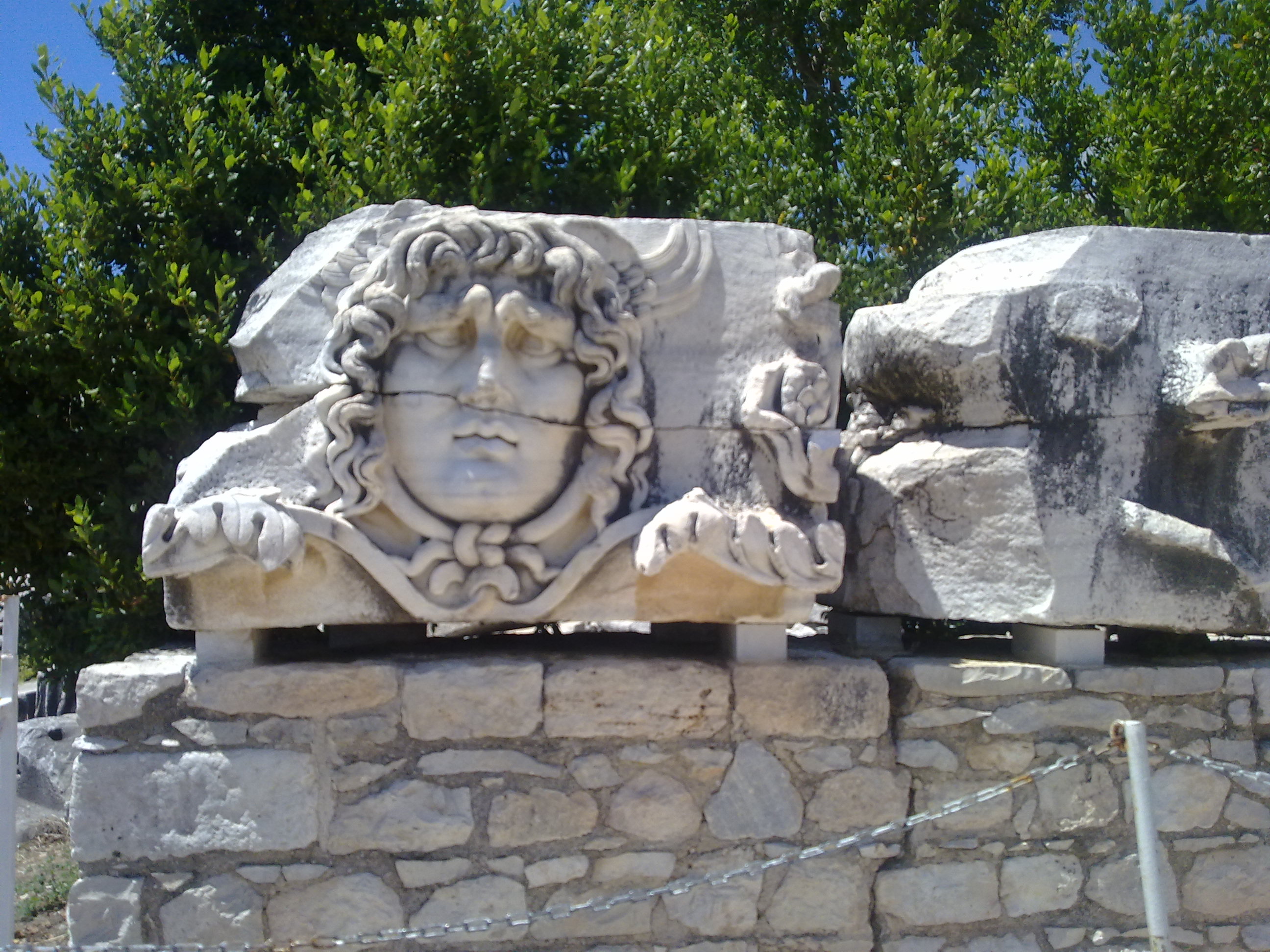
He noticed my labrys and became excited. I should add that in 2005 a number of people had commented on my labrys… and kept say “you are one of us …”. Later I found out that the symbol of Caria was… the labrys. The interesting thing though was his insistence at showing me a stone (probably from the temple roof) which had a labrys on both sides. It was difficult to see but he assured me it was there.

“The friezes of the Hekate Sanctuary are currently being displayed in the Istanbul Archaeology Museums. Four different themes are depicted in these friezes. These are, on the eastern frieze, scenes from the life of Zeus; on the western frieze, a battle between gods and giants; on the southern frieze, a gathering of Carian gods; and on the northern frieze, a battle of Amazons.”

(http://en.wikipedia.org/wiki/Lagina)

When one considers that only a few kilometers away  is the Temple of Zeus … Labranda … one begins to see the further connection between Hekate and Zeus.

06062012413
Lagina, looking towards the Propylon from the temple area (Morgana, June 2012)

old lagina sign Leyne 2

Lagina, An old information board.. notice the name LEYNE


06062012411

The information board June 2012 (Morgana) I think I prefer the old information board 🙂

LABRANDA, 13 kms northeast of Milas (Mylasa), Muğla, Turkey

The road from Lagina to Labranda was a nightmare. The quarrying had continued since 2005 and the lorries going back and forth had done a huge amount of damage to the roads. Amidst the dust we navigated slowly to the site. We did stop a couple of times though. The general views from the mountains are wonderful and the rock formations quite spectacular. It is not difficult to see how these lands inspire poets.

Take a look at Dick Osseman’s photo report of March 2007 here: http://www.pbase.com/dosseman/labranda&page=all  He has included in the captions some of the site information too.

What do we know of Labranda? See my notes in ‘Hekatesia 2005’ (elsewhere in this edition of WR-Online) where I gave a details of the origin of the Temple of Zeus.

And here too:

Labranda, information board on site (Dick Osseman, March 2007)

It was good to be back and note the connection between Lagina and Labranda. Hekate & Zeus. Zeus who had in the Theogony praised Hekate:

“Then the goddess through the love of the god conceived and brought forth dark-gowned Leto, always mild, kind to men and to the deathless gods, mild from the beginning, gentlest in all Olympus. Also she bare Asteria of happy name, whom Perses once led to his great house to be called his dear wife.

And she conceived and bare Hecate whom Zeus the son of Cronos honoured above all. He gave her splendid gifts, to have a share of the earth and the unfruitful sea. She received honour also in starry heaven, and is honoured exceedingly by the deathless gods. For to this day, whenever any one of men on earth offers rich sacrifices and prays for favour according to custom, he calls upon Hecate.

Great honour comes full easily to him whose prayers the goddess receives favourably, and she bestows wealth upon him; for the power surely is with her. For as many as were born of Earth and Ocean amongst all these she has her due portion. The son of Cronos did her no wrong nor took anything away of all that was her portion among the former Titan gods: but she holds, as the division was at the first from the beginning, privilege both in earth, and in heaven, and in sea.”

(The Theogony of Hesiod)

The view from Labranda, Caria 1 (photo by Dick Osseman) (The view from Labranda, Caria 1 (Dick Osseman)[/caption]


And there is the connection with the Labrys.. as I was reminded earlier that day when I saw it at Lagina.

labrys vase

The Labrys used to decorate a vase (Greek)

Etymology

“The word, labrys first appears in Plutarch as the Lydian word for axe

Herakles, having slain Hippolyte and taken her axe away from her with the rest of her arms, gave it to Omphale. The kings of Lydia who succeeded her carried this as one of their sacred insignia of office, and passed it down from father to son until it was passed to Candaules, who disdained it and gave it to one of his companions to carry. When Gyges rebelled and was making war upon Candaules, Arselis came with a force from Mylasa to assist Gyges; Arselis then slew Candaules and his companion and took the axe to Caria with the other spoils of war. And, having set up a statue of Zeus, Arselis put the axe in his hand and invoked the god, “Labrandeus”.

Archeology suggests that the veneration of Zeus Labraundeos at Labraunda was far older than Plutarch imagined. As with its apparent cognate, ‘labyrinth‘, the word entered the Greek languageas a loanword, so that without Plutarch’s specific reference its etymology, and even its original language, would not be positively known. The loanword labyrinth was used in Greek, but the designation “The house of the Double Axe” for the palace at Knossos is doubted because the same symbols were discovered elsewhere.

In England, ‘labrys’ was introduced by Sir Arthur Evans in the Journal of Hellenic Studies XXI. 108 (1901): “It seems natural to interpret names of Carian sanctuaries like Labranda in the most literal sense as the place of the sacred labrys, which was the Lydian (or Carian) name for the Greek πέλεκυς [pelekys], or double-edged axe.” And, p. 109, “On Carian coins, indeed of quite late date, the labrys, set up on its long pillar-like handle, with two dependent fillets, has much the appearance of a cult image.” It should be noted that the priests at Delphi were called Labryades (the men of the double axe). Evans’ article induced the word’s inclusion in the Oxford English Dictionary (OED).”

My own feelings on the origin of the labrys differ from the above in that I have never felt comfortable with the assumption that it is an axe.  Shortly before my visit to Lagina in 2005 I had attended a conference in Uppsala, Sweden. One of the local archaeologists took us out to see the Kings Mounds the day after the conference. These are magnificient tombs but he was more interested in showing us what he called Cultus Houses, which were very reminiscent of the Dutch Hunebedden.

We talked about the funerary rites and he explained that the body was first burned and then the bones were smashed by pouring cold water over the burning embers. The larger bones were then put into a funerary urn and buried.

He also showed us a rather strange stone. He held a small round rock and hit it against the shaft of a standing stone. It gave a dull sound. He then hit the other end of the stone and it rang like a bell.

My immediate repsonse was … the body is burned (fire) drenched with (water) the remains buried in urns (earth) … and the spirits are called by means of a stone bell (air). Later when I was in Lagina (and in other temples) I noticed that if you walk along paved paths of marble… your steps actually ring. I remembered both in Lagina and Labranda there were also processional ways. Would the people coming to the temples see the Labrys as they walked the path?

At Bodrum Castle, in 2005, Atheneris had been shown a stone with a Labrys flanked by two life sized ears. This is one I also found at Bodrum Castle in 2012. There was also information at the Castle about Labranda making the obvious link with Mausolus, the Satrap of Caria, who made it the family sanctuary. Of course the Mausoleum was built in Bodrum / Halicarnassus.

It suddenly dawned on me that the Labrys was not an axe but human lungs with the windpipe down the middle. What better way to illustrate sound and air  than ears and and lungs!

10062012545

Labrys, Bodrum Castle (Morgana June 2012)

In the intervening years I had made another discovery. I had become more then aware of the presence of bees. Not only the actual abundance of honey in the area I was traveling but also the names of the places directly connected to Melissa… the Greek word for honey-bee. Miletos, Milas all ancient places…  as indeed Halicarnassus is too.

Since 2005 my interest and admiration for bees has grown and they would play a significant role in my journeys both physical and spiritual. Imagine my delight when I came across this image of a bee goddess. It is a gold plaque from the 7th century BC and comes from Rhodes, which is not very far from Caria.

I was struck by the similarity it has with the Labrys.

bee brooch

Cretan Bee pendant, from Chryssolkkos, the Necropolis at Malia c. 1700 BC

And even more striking is the exquisite bee pendant:

This is a Cretan Bee pendant, image of the ‘Double goddess’ (Demeter & Persephone), from Chryssolkkos, the Necropolis at Malia c. 1700 BC (Museum of Herakleion, CRETE). Here you see Demeter and Persephone are both equated with the Bee.

And which Goddess, who Zeus praised above all others, helped Demeter to find Persephone? Yes indeed …  Hekate! She who had “privilege both in earth, and in heaven, and in sea.” Of earth, water, fire and air. She who would guard the Labrys and answer the call of those preparing for the journey to the otherside, the underworld, the place and time all men and women fear. She who held the key.

(To be continued.. the journey goes on to Didyma and the Temple of Apollo and to Aphrodisias.)

****

References:

STRATONICEA: http://asiaminor.ehw.gr/forms/fLemmaBodyExtended.aspx?lemmaID=10061

http://independent.academia.edu/MuratAyda%C5%9F/Papers/1235241/New_Inscriptions_from_Stratonikeia_and_its_Territory

http://www.bodrumpages.com/English/stratoniceia.html

LAGINA and HEKATE:

This is an extensive  article about Hekate by Yukiko Ito : http://www.albany.edu/faculty/lr618/51to.htm

“Hekate, Her Sacred Fires” Edited by Sorita d’Este: http://avaloniabooks.co.uk/catalogue/hellenismos/hekate-her-sacred-fires

and also:  http://hekatecovenant.com/

http://www.fotografcilar.com/classic/Lagina/previewpages/previewpage4.htm

http://en.wikipedia.org/wiki/Hecate

NB “The archaeological research conducted in Lagina is historically significant in that it was the first to have been done by a Turkish scientific team, under the direction of Osman Hamdi Bey and Halit Ethem Bey. In 1993, excavation and restoration work was resumed under the guidance of Muğla Museum, by an international team advised by Professor Ahmet Tırpan.”

LABRANDA & LABRYS:

http://www.pbase.com/dosseman/labranda&page=all

The Theogony of Hesiod, translated by Hugh G. Evelyn-White:

http://www.sacred-texts.com/cla/hesiod/theogony.htm

http://jvpoll.home.xs4all.nl/wdo/GRIEKEN/GEWOON/LABRYS.HTM

http://www.angelfire.com/in3/pukibee/beegoddess3.html

http://womenandmythology.files.wordpress.com/2008/10/big-bee-goddess_bm_gr18604-1234.jpg?w=299&h=300


Geplaatst in English articles | Getagged , , , , , , , | 2 reacties

Review: The Druid Plant Oracle

Cover of the Druid Plant Oracle deck
Philip and Stephanie Carr-Gomm. Illustrated by Will Worthington.

The Druid Plant Oracle. Working with the magical flora of the Druid tradition.
New York, St. Martin’s Press, 2007. 36 cards. Book 144 p. € 24,95.$ 24,95
ISBN 978-0-312-36977-4
http://philipcarrgomm.wordpress.com/2007/11/20/the-druid-plant-oracle/
http://philipcarrgomm.druidry.org/The-Druid-Plant-Oracle.html

Many of our readers will be familiar with the other decks illustrated by Will (Bill) Worthington. The Wild Wood Tarot (nu ook in het Nederlands als Tarot van het Wilde Woud) is reviewed by Morgana a year ago – see http://www.silvercircle.org/wiccanrede/wordpress/?p=1637 – and The Druid Craft Tarot by Morgana in the Imbolc 2010 edition of Wiccan Rede. In 1994 the Druid Animal Oracle (in 1998 als Het dierenorakel der druïden) was published. Text by Philip and Stephanie Carr-Gomm, drawings by Bill Worthington.

This Plant Oracle deck is a companion to the Animal Oracle. The cards are even the same size, so that you can combine the two decks to give readings inspired by both the animal and plant realms.
“Druids today use plants to bring health and inspiration. They cultivate plants for their beauty and their properties, they use them to decorate their homes and sanctuaries, and to make incenses, elixirs and magical baths – and they turn to them for the healing of both body and soul.”
The plants in this deck have been chosen for five reasons. Remains were found at archeological sites, the plants are indigenous – with the exception of mandrake, which can be seen as representative for imported species in this oracle. Or they were selected because they are mentioned in old herbals or have been used by herbalists. And “if the modern science of botanical pharmacology affirmed the reputation of a particular plant’s virtues, it felt as if its inclusion was not only historically valid, but of practical value too.”

The beautiful cards depict the plants in ‘Celtic’ surroundings and often with other symbology included in the picture. The book adds the Gaelic and Latin or botanical name of each plant (the cards give the English name) and a description of the characteristics of the plant and its meaning in divination.

The section ‘How to use the cards’ gives several spreads of cards – the Awen spread is familiar for the users of the Animal Oracle – but of course you can meditate on the cards as well. The plants are ordered alphabetically in the book, from Agrimony, via Fern, Mistletoe and Puffballs, to Yarrow, and the last three illustrated cards are dedicated to a series of three plants each: the Banes (Wolfsbane, Henbane and Hemlock), the Guardians (Elder, Hawthorn and Birch) and the Restorers (Roseroot, St. Johns Wort and Valerian).

Since many of the plants also grow in our low lands near the sea, the oracle can be used by Dutch and Belgian people as well. And when you miss your favourite plants: there are three blank cards to fill in the gap.

Geplaatst in Boeken, English articles | Getagged , , , , | Reacties uitgeschakeld voor Review: The Druid Plant Oracle

Volle maan van de speer – ‘Mijn speerpunt’ – 13 augustus 2011

20 juni 2012 vandaag is de condoleance voor de moeder van mijn ‘oudste’ vriendin. We zijn al bevriend vanaf ons vierde jaar. Ik rij zo naar Dordrecht, mijn geboortestad, en zal daar voor de laatste keer in het huis zijn waar ik als klein meisje héél veel uren heb doorgebracht. Ik zal ‘ma’ daar aan het aanrecht bezig ‘zien’ en altijd ‘zien’ zorgen… dat was haar goed toevertrouwd 🙂

En dan lees ik me even in voor het stuk in de WR… dat gaat over de dood. Vorig jaar kwam die rond Lughnassad op mijn pad en nu weer. Ik ben nu op een leeftijd dat ik steeds vaker met deze overgang te maken krijg. Mensen gaan mij voor en zullen mij opwachten als ik dit pad ook betreed.

Ik ga me zo klaar maken voor de reis, morgen is de begrafenis.
De vraag die in deze tijd, rond de Volle maan van De Speer, centraal staat is :”Wat is jouw hoogste ideaal in je leven?” en richt je daar op. Vol vuur richten we ons op ons ideaal, beginnen we ergens aan… maar idealen zijn vaker een zaak van lange adem. Lucht zal ons vuur aan moeten houden!

En vuur kan snel omslaan in een ongecontroleerd gebeuren, zaak dus om het een juiste bedding te geven. Voorheen had ik altijd het gevoel dat ik een vuurplaats had, diep in de grond uitgegraven en met keien omringd… nu voel ik veel meer dat mijn vuur op het water ligt 🙂 als een prachtige drijfkaars, drijvend op de stroming van mijn leven.

Maar nu met deze maan zal ik mijn Speer aansteken met mijn vlam en zal ik haar richten… voor het komende jaar.

Ik heb nog even tijd om die intentie te overdenken… juli een drukke maand. Vol met festivals en vrienden… voorlopig ga ik voor ‘het leven vieren!’


Volle maan van de speer “Mijn speerpunt” 13 augustus 2011

Vandaag, de 14e augustus, is de laatste dag met veel regen. De buienradar liet gisteren zien dat het hierna voorlopig droog is 🙂 Deze zomer is, na een heel hete en droge lente, erg nat. De natuur is er blij mee… het is ook niet echt koud. Het voorjaar was droog en deze nattigheid was dan ook erg nodig. Tussen de buien door hebben we heel wat festivals gehad, het een meer verzopen dan het andere. Toch hebben we gigantisch genoten van elkaar en de bezoekers die in ieder geval wel kwamen. Het is een prachtige zomer geweest tot nu toe… ik ga voor een heerlijke na-zomer 🙂

Volgende week gaan we richting Soest (D) waar we deel gaan uitmaken van een groot Middeleeuws festival in verband met de bevrijding van Soest rond 1500 of zo, waar Kampen aan meegewerkt heeft. Kampen is net als Soest een Hanzestad, dus vandaar dat we uitgenodigd zijn als groep ‘Ridders van de IJssel’, waar we ons dan weer bij aansluiten. Twee jaar geleden was het 35 graden, nu hopelijk wat minder. De jurken zijn klaar en de tenten droog 🙂

Vanuit Duitsland reizen via huis door naar Dorset (GB) waar we een driedaags festival wat gaan opvrolijken in de avond… en daarna heerlijk doorreizen door Zuid-West Engeland. We zien wel waar we aanwaaien 🙂

Een heel druk programma voor de boeg… en mijn intentie staat daar ietwat haaks op 🙂

Rust houden met mijn knie, grenzen bewaken (we gaan er straks vaak overheen :-)) en lief zijn voor mezelf. Sinds acht weken loop ik met, waarschijnlijk, een ontsteking in de linkerknie. Pijn en een gevoel van disbalans; tijdens Castlefest was het zelfs zo bizar dat mijn onderbeen twee á drie centimeter (thuis opgemeten) opgezwollen was na een dag festivalterrein. Dat zag er echt eng uit. Gelukkig was het ’s ochtends weer weg maar in de loop van de dag liep ik weer vol.

De dinsdag na CF had ik al een afspraak staan met de arts. Direct foto’s laten maken, doch meer dan een normale slijtage voor een vrouw van 50 konden ze er niet van maken. We houden het dus maar op een ontsteking van het kraakbeen. Ontstekingsremmers en pijnstilling mee… ben zo blij dat dit aanslaat, de bruisjes van de afgelopen weken deden niets. Dus ik kan weer wandelen!

Gisteravond 22.00 – ik laat het bezoek achter bij man- en dochterlief…”Ik ben zo weer terug, ik kan toch niet ver”. Met de auto rij ik tot vlakbij het bos. Ik parkeer de auto nooit ín het bos, als ik alleen in de nacht ga wandelen… dat zou een punt kunnen zijn waar ik ongewenst opgewacht zou kunnen worden 😛 Dus de auto bij het grote water en lopend het buitengebied in… wat is het aardedonker!

Het heeft net weer geplensd en de donkere wolken zijn nog niet voorbij. Ik realiseer me dat ik, met mijn flutknie, behoorlijk kwetsbaar ben. Ook heb ik voor het eerst mijn mobiel thuis laten liggen. Ik ben echt alleen en afgesloten van thuis. Alles ademt vocht, donkerte… en stilte. Af en toe een piepje in de nacht… er zitten hier toch héél veel ganzen. Het is muisstil, niets van de drukte van afgelopen maanden. Ik voel me niet erg op m’n gemak. Als ik de hoek omsla en het hek doorloop naar het bos, laat ik de enige lantaarnpaal achter me die ik tegenkom op deze wandeling.

En dan is ze er… achter een donkere wolkenflard komt de maan tevoorschijn 🙂 Ik voel me direct beter, niet meer zo afgesloten en alleen. Verbonden met al mijn maanvrienden en -vriendinnen die ook bij deze maan stil staan. Dat is het fijne van het fysiek aanschouwen van de maan. Als ze achter de wolken blijft voel ik altijd een soort van afwijzing / niet aankomen van mijn aandacht 🙂

Ik vervolg mijn weg een stuk opener, blijer. In het weiland richting ‘Boompje’ staan twee reeën. Ze staan dichtbij want ondanks de duisternis zie ik ze staan. En dan op het hek bij de weg naar ‘Boompje’, zit Luca… mijn staartloze metgezel en baas van het Westerveldse bos. Ik praat tegen hem, hij blijft zitten… ik twijfel. Het is donker, toch zit er duidelijk iets zwart/wits op die paal. Maar het reageert niet??? Dan, als ik erop af stap… staat het op en verdwijnt in het weiland waar de reeën staan. Dat kan Luca niet zijn… een vermeende vriend blijkt geen vriend te zijn. Weer alleen… de reeën vinden dat ik nu dan toch te dichtbij kom. Als ik het bospad naar ‘Boompje’ op kom, verdwijnen zij over de weg die ik net gelopen heb… het open veld in. Wat is het bos donker! De maan is weer achter de wolken. Alleen, echt alleen… geen geluid. Dan loop ik op ‘Boompje’ toe. Het is dat ik weet waar hij staat… wat is tie klein en onbenullig in vergelijk met zijn stevige knotwilg-buren. ‘Boompje’ was een iel knotwilgje dat netjes in een rij stevige wilgen stond. Hij had een half gebarst stammetje en bleef achter in de groei en rotte in op zijn oude wond. Anderhalf jaar geleden is hij onderaan afgeknapt en nu loopt hij weer uit… en is weer zijn barst voor de helft kwijt.

Met dit boompje heb ik al jaren contact en iedere keer (tijdens zijn afwezigheid heeft zijn buurboom mij van contact voorzien… op aanwijzing van Luca…) krijg ik iets van hem… meestal een woord.

Deze keer hoopte ik iets van “Liefde”, te krijgen… dat is het woord dat ik in mijn hoofd had, vlak voor ik hem aanraakte en contact maakte. Dan krijg ik “Schok!!”… dat is héél wat anders. Daar sta ik dan in the middle of nowhere… shocked.

Dan realiseer ik me de wijsheid van ‘Boompje’… vrijdag de 12e ben ik bij Tineke langs geweest. Zij heeft de zaterdag van Castlefest haar man, (die ik ook goed kende… heerlijke man!) begraven. Ik kon er dus niet bij zijn. Wel heb ik hem donderdags voor CF nog gezien, hij lag thuis opgebaard, en ik heb een lavendelbloempje van hem (op zijn lichaam lag een bosje lavendel) meegenomen en in ons offer gedaan… voor een goede reis.

De 12e was ik dus bij Tineke en we hadden het over het gevoel van gemis, afgesneden zijn van…

er alleen voor staan, er alleen dóór moeten… ondanks alle liefde en zorgen van kinderen en vrienden. Dit is een proces van absolute eenzaamheid… een periode die haar man ook door is gegaan de maanden/weken voor zijn dood. Kanker! Wat een kloteziekte!

Maar ook blij zijn met het geschenk van deze ziekte. De periode van samen zijn, nabijheid, zorg voor elkaar, spreken, realiseren en liefde… oeverloze liefde! Het huis rook al tijden naar de dood… en het stroomde over van liefde. Samen hebben ze de dag van de begrafenis en alles er omheen, kunnen regelen… het is waanzinnig geweest! Vierhonderd mensen en ruim een uur uitgelopen, omdat heel veel mensen iets wilden vertellen. Gelukkig kwam er geen crematie na hen 🙂 anders waren ze eruit gezet.

Ik realiseer me daar staand bij ‘Boompje’… dat deze eenzaamheid deze overgangsrite de ‘Schok’ is die ik ook eens zal ervaren. Dat vrienden… opeens geen vrienden blijken te zijn… anderen op de loop gaan… net als de zwart/witte kat en reeën. Dan sta je alleen… geen mobieltje om even te bellen, contact is niet meer mogelijk. Alhoewel Tineke aangeeft hem te voelen in iedere vezel van haar lijf.

Ik bedank ‘Boompje’ voor deze pas op de plaats… dit diepe realiseren. Dan, als ik me omdraai om terug te lopen, kraakt het wolkendek… en craquelé laat het maanlicht door. Alsof er iemand een deuk in de hemel heeft geslagen. Dan neem ik mijn hazelaarstaf ter hand, zegen haar en neem de Artemishouding aan. Met haar onderkant op de doorbrekende maan gericht… richt ik mij op gezondheid en liefde! De intentie van ons offer dit jaar op CF, gebracht aan het Wickerbeast, een zwijn dit jaar. Daarna vraag ik aan de elementen wijsheid en zorgvuldigheid in spreken, voelen, eigenen en mijn passies.

Zo mijmerend loop ik mijn weg terug, weer onder de lantaarn door, het duistere pad af. Bij het weiland aangekomen roep ik tussen de hekken door… die altijd open staan, Luca! Viermaal roep ik hem… ik zie wel of hij er is. Ik draai me om naar de weg… en daar komt mijn vriend! Luca 🙂

Hij heeft me gehoord! En is gekomen… weer een les, realiseer ik me. Je echte vrienden zullen er altijd zijn als je ze roept! We knuffelen heerlijk, midden op de weg die verder donker en verlaten is… twee vrienden in de duisternis. Gistermiddag heb ik hem ook gezien… en eindelijk een mooie foto van hem gemaakt… zal eens kijken of ik hem kan laten zien 🙂

Ik laat hem alleen achter op de weg… hij loopt nog een stukje mee op en verdwijnt dan in het weiland.

Opgetogen van zo’n mooie wandeling ga ik naar de auto en naar mijn bezoek. De mede staat al klaar en dochterlief heeft heerlijke bladerdeeg-kaaskoekjes gebakken… wat heerlijk om nu nog zo samen te mogen zijn! Me omgeven te weten door gezondheid en liefde…

Liefs, Loes.

Geplaatst in Artikelen, Volle Maan Wandelingen | Getagged | 2 reacties