Alizon the Witch – an extract from ‘A history of the Pendle Witches & their magic’ by Joyce Froome.
416 p. ISBN 978-1874181-62-0. GBP 16,99
See: www.carnegiepublishing.com,
Reproduced with permission
CHAPTER ONE
ALIZON THE WITCH
The evidence of John Law… About the eighteenth of March last past, he being a peddler, went with his pack of wares at his back through Colne-field: where unluckily he met with Alizon Device… who was very earnest with him for pins, but he would give her none: whereupon she seemed to be very angry; and when he was past her, he fell down lame in great extremity.
(The Wonderful Discovery of Witches in the County of Lancaster by Thomas Potts.[1])
“Unluckily he met with Alizon Device….” Eleven people died because John Law was at Colne-field that day. His argument with a teenage girl triggered one of the most dramatic and horrifying witchcraft cases in English history. The trials caused such controversy that a pamphlet, The Wonderful Discovery of Witches in the County of Lancaster, was written “by commandment of his Majesty’s Justices of Assize in the North Parts” to give the official version of what had happened.[2] It’s a blatantly biased account; but in spite of all its distortions it still can’t hide the fact that the defendants suffered an appalling miscarriage of justice.
At the heart of the case was the conflict between the local Justice of the Peace, Roger Nowell, and Alizon Device’s family. The Wonderful Discovery includes the statements Roger Nowell took from them – from Alizon herself, her older brother James, her sister Jennet (about nine years old), her mother Elizabeth, and her grandmother Elizabeth Sothernes.[3] It’s a disturbing record of a battle of wills fought out through a series of grim interrogations. Roger Nowell ruthlessly falsified evidence, but for a simple reason. He was convinced of his suspects’ guilt.
Alizon and her family openly practised magic. Their lives and values were shaped by a complex magical culture – a strange fusion of Christian and pre-Christian elements. Magic gave them practical ways to deal with everyday problems – illness, bad luck and unhappiness in love. But it also had a profound effect on their spiritual beliefs. There was very little evidence that they had committed any of the crimes they were accused of. But their magic called on the help of supernatural forces that Roger Nowell sincerely believed were evil.
The case of the Pendle witches raises questions that are still important today. Questions about guilt and truth; about the relationship between the material world and the realm of the spirit; about good and evil; and about the nature of magic and the nature of power.
*
John Law, the peddler, encounteed Alizon just outside the small town of Colne in Lancashire, on the edge of the spectacular moorland around Pendle Hill. Just 400 metres away was an inn, where no doubt he hoped to find some buyers for the goods in his pack. Mostly he sold small items such as ribbons and buttons. This was a rural community, and many people were paid not in cash but in farm produce. Money was scarce.
John travelled this route regularly, and for the local people he was also an important source of news and gossip. He may even have sold pamphlets and ballads about some of the more sensational recent news stories. The growth of printing and literacy meant that even in country districts people were well aware of current events and the latest controversies.[4]
The year was 1612, and one of the subjects most hotly discussed in early 17th century England was witchcraft. This was the mid-point of the English witch-trials period. It had begun fifty years before, and the last execution of an alleged witch would be in seventy years’ time.[5] And on this particular March day it was especially topical. A local woman had just been tried for murdering a child by witchcraft (and found not guilty) at the Lent Assizes at York.[6] In fact, there was so much suspicion of witchcraft in the area that at the August Assizes at Lancaster there would be three unrelated witchcraft cases.
John probably felt uneasy as soon as he saw Alizon. He seems to have recognised her immediately[7], and he would have known she was a ‘wise woman’ – someone who practised magic. Alizon would never have referred to herself as a witch. In the 17th century the word ‘witch’ had a very narrow meaning – someone who used magic to do harm. In fact many people regarded wise women and cunning men (as male practitioners were often called[8]) as their main defence against witches. Much of Alizon’s magical power came from a healing charm that was handed down in the family from generation to generation, and which they claimed “would cure one bewitched”.[9]
In fact one book written at the time accused wise women of stirring up the fear of witchcraft and encouraging the persecution of innocent people:
He sent to the [wise] woman at R.H. and she said he was plagued by a witch, adding moreover, that there were three women witches in that town, and one man witch: willing him to look whom he most suspected: he suspected one old woman, and caused her to be carried before a Justice of the Peace… She was committed to the prison, and there she died before the Assizes.
(A Dialogue Concerning Witches and Witchcrafts by George Gifford[10] )
But wise women and cunning men could themselves be witches. When the cunning man John Walsh was arrested in 1566, his interrogators specifically asked “whether they that do good to such as are bewitched, cannot also do hurt if they list [want to].” He replied that “he which hath the gift of healing, may do hurt if he list, but his gift of healing can never return again.”[11]
Also, of course, injuring someone physically was not the only way to harm them. It could be argued – and was – that all magic was essentially evil, even magic used for healing. It seduced both the practitioners themselves and their clients away from God, because it could only be performed with the help of the Devil and evil spirits:
He [the Devil] worketh by his other sort of witches, whom the people call cunning men and wise women… and by them teacheth many remedies, that so he may be sought unto and honoured as God.
(A Dialogue Concerning Witches and Witchcrafts[12])
By witches we understand not those only which kill and torment, but all diviners, charmers, jugglers, all wizards commonly called wise men and wise women…; and in the same number we reckon all good witches, which do no hurt but good, which do not spoil and destroy, but save and deliver… These are the right hand of the Devil, by which he taketh and destroyeth the souls of men.
(A Discourse of the Damned Art of Witchcraft by William Perkins[13])
This was not a new idea. It had been the official view of the Church throughout the Middle Ages:
Magic is… a teacher of every kind of wickedness and evil-doing, [it] lies about the truth and in actual fact does harm to people’s minds, it leads them astray from God’s religion, persuades them to worship evil spirits, lets loose a degeneration of virtuous behaviour, and drives the minds of those who pursue it towards every type of crime and forbidden wickedness.
(Didascalion by Hugh of St Victor[14])
Indeed, John Law, on his travels through Pendle, had heard many sinister rumours about Alizon and her family. There were stories that her grandmother’s exceptional powers were the result of a visit from a spirit that had left her insane for weeks. It was said that Alizon’s brother James – who was probably not yet twenty – had already murdered at least one person by witchcraft. And apparently Alizon herself, who was only about seventeen, had bewitched a child, although the child had recovered after a confrontation between Alizon and the father.[15]
But anyone in John’s line of business must have been a tough character used to dealing with all kinds of strange people. Why didn’t he just sell Alizon the pins and get rid of her?
Perhaps he didn’t want to take off his pack at the roadside, when there was an inn so close. But he could easily have explained that politely, and got Alizon to go with him to the inn. Instead, things quickly became tense. According to John, Alizon became “very earnest”. Alizon’s own statement adds more details:
This examinate [Alizon] demanded of the said peddler to buy some pins of him; but the said peddler sturdily answered this examinate that he would not loose his pack.[16]
‘Sturdily’ means more than just ‘obstinately’. In the 17th century it meant ‘harshly’, or even ‘violently’.[17] In Alizon’s version, it seems clear that John didn’t want to sell her the pins.[18]
Buying pins would also have been quite an extravagance for a young girl like Alizon. It would have been unusual for her to be paid in cash, so she would have had very little actual money. Making pins by hand was labour intensive, so 17th century pins were far from cheap. In fact it’s likely that many country people normally used blackthorn points – pins made from the thorns of blackthorn trees. They were light, slender and sharp, and could be snapped off the tree for nothing.[19]
It’s clear that Alizon was very determined to get hold of some metal pins, and John was equally determined she shouldn’t have them. It may seem strange that such a serious argument – which had such terrible consequences – should have started over something so trivial. But in fact pins were far less trivial then than they are now.
Today when we think of the tools of magic we think of wands, crystal balls and rings of power – glamorous and mysterious things. But in practice the object most often used for magic was the pin. It was used in spells for protection, for healing, for divination, to bring good luck, to curse, to reverse a curse, and for love magic. Its significance is recorded in a rhyme still often said today:
See a pin and pick it up,
All the day you’ll have good luck.
See a pin and let it lie,
Sure to rue it by and by.[20]
It was love magic, of course, that was of particular interest to teenage girls:
The women have several magical secrets handed down to them by
tradition… as, on St. Agnes’ night, 21st day of January, take a row of pins, and pull out every one, one after another, saying a Pater Noster, or Our Father, sticking a pin in your sleeve, and you will dream of him, or her, you shall marry.
(Miscellanies by John Aubrey[21])
Another 17th century spell was a little more complicated:
Yet I have another pretty way for a maid to know her sweetheart, which is as followeth. Take a summer apple, of the best fruit you can get, and take three of the best pins you can get, and stick them into the apple close to the head, and as you stick them in, take notice which of them is in the middle, and what name thou fancies best give that middle pin and put it into thy left-handed glove, and lay it under thy pillow on Saturday at night but thou must be in bed before thou lays it under thy head, and when thou hast done, clasp thy hands together speaking these words:
If thou be he that must have me
To be thy wedded bride,
Make no delay but come away
This night to my bedside.
(Mother Bunch’s Closet Newly Broke Open by T.R.)[22]
A very similar version recorded in the early 20th century used an onion instead of an apple. The account is clearer about how the pins should be positioned. Nine pins were used, with eight forming a circle and the ninth “given the name of the ‘true love’” and stuck in the centre. In this case, the spell had to be performed on St Thomas’s Eve, and the saint was invoked in the charm:
Good St. Thomas, do me right,
Send me my true love this night,
In his clothes and his array
Which he weareth every day.
(Pins & Pincushions by E.D. Longman and S. Loch[23])
As well as spells to summon a vision – or perhaps it would be truer to say the spirit – of her lover, a girl could also use magic to bring him to her in person:
If a lover did not visit his sweetheart as often as she wished, she roasted an onion stuck full of an ounce of pins. The pins must have never been through paper, and were supposed to prick his wandering heart and bring him to his lady’s feet.
(Pins & Pincushions[24])
Again, this is a spell recorded in the early 20th century, but it’s based on the same principles as one recorded five hundred years earlier, used by Matteuccia di Francesco, an Italian wise woman. A client wanted to regain the affection of her lover, who was ill-treating her. Matteuccia and her client worked a spell that involved melting a wax image over a heated tile, while the client recited a charm linking the image to her lover’s heart and binding him to her will. Apparently the spell was a great success.[25] Wax images could be heart-shaped as well as in the shape of a human figure. One is mentioned in the 17th century play The Witch by Thomas Middleton – “Is the heart of wax stuck full of magic needles?”[26] In the play the image is used for a curse, but images were used just as often for love-magic as for cursing. The methods were the same: it was the intent that was different.
In many ways, though, an apple or onion was a better representation of a lover’s heart than a wax image. An apple would remind whoever worked the spell of the apple Eve gave Adam, which robbed them of their sexual innocence. An onion ‘bleeds’ when it’s cut, and, as a root, contains the energy the plant needs to survive, just as the energy of the heart is essential to the survival of the human body.
So did John Law suspect that Alizon was about to use her evil powers to seduce some unfortunate young man? Or perhaps Alizon was not alone. She was, after all, either leaving or heading into town. Perhaps she’d met up with a group of friends.[27] Perhaps John was confronted by a whole gang of teenage girls joking about the magical havoc they were about to wreak on Pendle’s male population.
There was nothing noble or exalted about the aims of wise women and cunning men. They and their clients were very ordinary people. They wanted magic to get them out of difficulties, and bring them a little pleasure in life. And that was one of the things that made magic so abhorrent to the authorities – the God-fearing men of Church and State. What if it was true that a girl like Alizon could know a spell to turn a young man’s heart? How could someone like her – an unruly, disrespectful, bad-tempered teenage girl – have some kind of strange power? Only if she was a tool of the Devil.
[1] Thomas Potts,
The Wonderful Discovery of Witches in the County of Lancaster, “Published and set forth by commandment of his Majesty’s Justices of Assize in the North Parts”, “Printed by W. Stansby for John Barnes, and are to be sold at his shop near Holborne Conduit”, London, 1613, p.R4v. There was also a first edition published in November 1612 (see Marion Gibson’s preface in her invaluable edition of witchcraft case pamphlets,
Early Modern Witches, Routledge, Abingdon, 2000, p.173ff.). There are a number of versions currently in print – see Bibliography. From now on this will be referred to in the notes as
WD. Page numbers in 17
th century works are often a combination of letters and numbers. Pages are also often only numbered on one side. By convention, the back of the page is designated by adding the letter v. When I quote any original source written in English, I have modernised the spelling and capitalisation, but left the grammar and punctuation unchanged. I have left place names and proper names as spelt in the original.
[2] WD title page. WD in fact covers four witchcraft cases – the trial of Jennet Preston at the York Assizes in July, and three cases tried at the Lancaster Assizes in August: the Pendle witches, the Salmesbury witches, and Isabel Robey. The Pendle case was the most complex – nine trials involving twelve people. It was also linked to the case of Jennet Preston, as part of the evidence against her was a statement from James Device claiming she was involved with the Pendle witches.
[3] I have opted to spell proper names as they are spelt in the original sources. Often names are spelt in a number of different ways; if one spelling seems generally preferred to the others I have used that one, otherwise I have used the spelling that appears easiest to read. For a number of reasons, I have opted to use first names when discussing people who feature prominently in the account. I sometimes use a combination of first name and surname, but to do that on a regular basis would quickly become tedious for the reader. It’s obviously impossible to use surnames alone when so many of the people are related and have the same surname. Also, today we generally refer to people by their first names, and although this would have seemed over-familiar in the 17th century, to do anything else would, in my opinion, distance these people from the modern reader – something I am anxious to avoid. In this (as in much else) I am following the example of Emma Wilby in her ground-breaking book Cunning Folk and Familiar Spirits, Sussex Academic Press, Brighton, 2005. Elizabeth Sothernes is also referred to as “alias Demdike”. This was a legal formality – Justices of the Peace were obliged to note other names that suspects might be known by (Michael Dalton, The Country Justice, London, 1618, p.266). As today, these various names were usually the result of people marrying more than once, with women’s maiden names also being given. Elizabeth is also referred to as “old Demdike”, a nameThomas Potts takes up with relish in his commentary (Bv, F2v), no doubt because of its ugly and vaguely insulting sound; but the epithet ‘old’ may have been purely descriptive – she certainly was elderly (around eighty (Bv)) – or even respectful. In Cornwall until very recently ‘old’ was used of someone particularly clever, regardless of their age (personal communication from Paul Tonkin).
[4] See Joad Raymond, Pamphlets and Pamphleteering in Early Modern Britain, Cambridge University Press, Cambridge, 2006.
[5] Agnes Waterhouse was executed in 1566, and Alice Molland in 1684. Incidentally, 18th March was technically still in 1611, as in early 17th century England the legal year began on 25th March.
[6] Jennet Preston – more of her later. She lived at Gisburne, just over the border in Yorkshire. Although she wasn’t released until early April, her trial was probably around the middle of March. The week Alizon and John Law had their confrontation was probably the last week the York Assizes could have been held. The Lent Assizes were generally held in March, and York always came before Lancaster. Also, Roger Nowell would almost certainly have gone to the Lancaster Assizes, and as he was at home for the week beginning 30th March, the Lancaster Assizes must have been held before then. WD p.Y.
[7] He was a middle-aged man who’d no doubt travelled the same routes all his working life, and probably knew almost everyone in Pendle. There’s no reference in his statement to making any inquiries about Alizon’s identity.
[8] The terms wise man and cunning woman were also used. The word witch was used for both men and women – although, of course, statistically women were far more likely to be accused of being witches.
[9] WD p.Kv.
[10] George Gifford, A Dialogue Concerning Witches and Witchcrafts, “Printed by John Windet for Tobie Cooke and Mihil Hart, and are to be sold in Paul’s Churchyard, at the Tiger’s head”, London, 1593, p.C. (George Gifford’s surname is actually spelt Giffard on the title page of the pamphlet, but seems to have been usually spelt Gifford.) A discussion of witchcraft and magic by fictional characters. Gifford uses different characters to put forward a range of views and beliefs commonly held at the time, so that his protagonist can demolish them and demonstrate the evils of magic with a mixture of dubious logic and highly selective Biblical quotations.
[11] The Examination of John Walsh, “Imprinted at London by John Awdely, dwelling in Little Britain Street without Aldersgate”, 1566, p.A6v. In fact the pamphlet has “he which hath but the gift of healing”; however, the word “but” does not occur in the original record of the examination, Chanter MS 855B ff.310-12, Devon Record Office.
[12] George Gifford, A Dialogue Concerning Witches and Witchcrafts, p.A3.
[13] William Perkins, A Discourse of the Damned Art of Witchcraft, Printed by Cantrell Legge, Printer to the University of Cambridge, 1618 (first published in 1608), Chapter 7, Section 5. Where sources have numbered chapters and/or sections, I give these instead of page numbers, since they are, in practice, more use to modern readers.
[14] Hugh of St Victor, Didascalion, early 12th century. Translated by P.G. Maxwell-Stuart in his fascinating anthology, The Occult in Mediaeval Europe, Palgrave, Basingstoke, 2005, p.71.
[15] WD pp.B3, H3v, S2v, discussed in more detail later. The question of how old Alizon and James were is a tricky but important one. WD links them together and says of both of them that they were “in the beginning of their time” (p.F2), suggesting that they were similar in age and both quite young. It then later says of James, “He were but young, and in the beginning of his time” (p.I). In fact we don’t even know for sure that James was older than Alizon, but he was charged with more serious crimes going back over a longer period, so it is a reasonable assumption. Rossell Hope Robbins, in The Encyclopedia of Witchcraft and Demonology (Spring Books, Feltham, 1968), confidently asserts that Alizon was only eleven (p.298), but that seems unlikely. Alizon is described in her indictment as a “spinster”, so she must at least have been approaching marriageable age. Life expectancy was of course lower in the early 17th century (although average life expectancy was slewed by high childhood mortality rates), which must have made a difference to people’s perception of what would have been “the beginning” of someone’s life. Even two hundred years later, in Sense and Sensibility Jane Austen portrays Colonel Brandon (admittedly humorously) as “an old bachelor” and of “advanced years” at thirty-five. That makes it unlikely you would be considered “at the beginning of your time” at, say, twenty-five. On the other hand, Thomas Aikenhead, the Edinburgh University student sentenced to death for blasphemy in 1696, pleaded for mercy on the grounds of youth because he was only twenty when he committed the offence (see A Complete Collection of State Trials, compiled by T.B. Howell (T.C. Hansard, London, 1812) (aka Cobbett’s Complete Collection of State Trials), Vol.XIII, pp.918-939, Proceedings against Thomas Aikenhead). As for internal evidence within WD, it’s clear that Alizon was angry enough about the pins to frighten John Law – someone probably not easily scared – which suggests the kind of uncontrollable rage not unknown in teenagers. And it’s clear that from very early in the case Roger Nowell based his strategy on the assumption that James would be vulnerable to interrogation. Taking these considerations into account, I would estimate a minimum age for Alizon of sixteen and a maximum for James of twenty-two, with their most likely ages being around seventeen and nineteen.
[16] WD p.R3v.
[17] The Compact Edition of the Oxford English Dictionary, Oxford University Press, 1971.
[18] Later John’s son Abraham made a statement claiming that Alizon didn’t have the money to pay for the pins. But he wasn’t there, and his statement is suspect for a number of reasons, which will be discussed in more detail later.
[19] See E.D. Longman and S. Loch, Pins and Pincushions, Longmans, Green & Co., London, 1911, pp. 2, 20ff, 148, 153, 187, and Plate II Illustration 1. For the use of the term ‘blackthorn point’ see Francis Jones, The Holy Wells of Wales, University of Wales Press, Cardiff, 1954, p.111.
[20] There are, of course, several versions of this rhyme, including a more modern one that begins, “See a penny, pick it up….” This is the version my mother taught me when I was a child. She told me that if I let the pin lie I would rue it because a witch would stick it in an image of me.
[21] John Aubrey, Miscellanies Upon the Following Subjects, Second Edition, Printed for A. Bettesworth , J. Battley, J. Pemberton and E. Curll, London, 1721, “Magic”. First published in 1696.
[22] T.R., Mother Bunch’s Closet Newly Broke Open, printed by AM for P. Brooksby, London, 1685 (also quoted by C.J.S. Thompson, The Hand of Destiny, Rider & Co., London, 1932, p.44).
[23] E.D. Longman and S. Loch, Pins and Pincushions, pp.46-47.
[24] E.D. Longman and S. Loch, Pins and Pincushions, pp.40-41.
[25] The original trial document, edited by Domenico Mammoli, and including an introduction and English translation, was published in Rome in 1972 as one of a series of papers about the history of Todi, Res Tudertinae – 14, entitled The Record of the Trial and Condemnation of a Witch, Matteuccia di Francesco, at Todi, 20 March 1428. Richard Kieckhefer discusses it in his book Magic in the Middle Ages, Cambridge University Press, Cambridge, 1990, citing Candida Peruzzi, “Un processo di stregoneria a Todi nel 400”, Lares: Organo della Società di Etnografia Italiana-Roma, 21 (1955), fasc. I-II, 1-17. He mentions this particular spell on p.60.
[26] Thomas Middleton, The Witch, Act 1, Scene 2, written around 1615 (see the Introduction by Elizabeth Schafer to the edition published by A & C Black, London, 1994).
[27] It’s only common sense that Alizon had a social life, and we shouldn’t abandon common sense just because we’re dealing with a witchcraft case. And as we shall see in Chapter Two, love divination was (and still is) often a social activity, and the line between love divination and more aggressive love magic was a thin one. It’s also important to resist the propaganda in WD and other witchcraft accounts that portrays practitioners of magic as social outcasts. We know this wasn’t true of Alizon because one of her statements describes her laughing and joking with a friend (WD p.E4v). The belief that Alizon had magical powers might have made some people avoid her, but it would have made other people cultivate her friendship. If there were other girls involved, that would explain why John doesn’t mention his suspicions about the pins in his statement; but there are plenty of other reasons why that might not have been included: Roger Nowell might have told John that his son had said Alizon couldn’t pay for the pins, and John might not have wanted to contradict him; John might have been reluctant to admit to knowing anything at all about magic; he might have thought Alizon wanted the pins to make a witch bottle – counter-magic to remove a curse, which would have put Alizon in too good a light to be mentioned; and even in the 17th century, pure speculation by a witness was generally not considered good evidence.







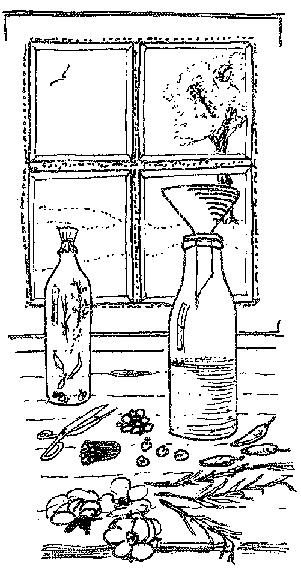
 Dit artikeltje gaat over het bewaren van geuren, zowel van kruiden als van bloemen, om te gebruiken als parfum, als olie voor ritueel werk of voor massage; in het koken of bij de sla, enzovoorts. Het proces heet ‘maceratie’. Door de bloemen of kruiden enige tijd in olie te leggen wordt de geur op de olie overgedragen.