
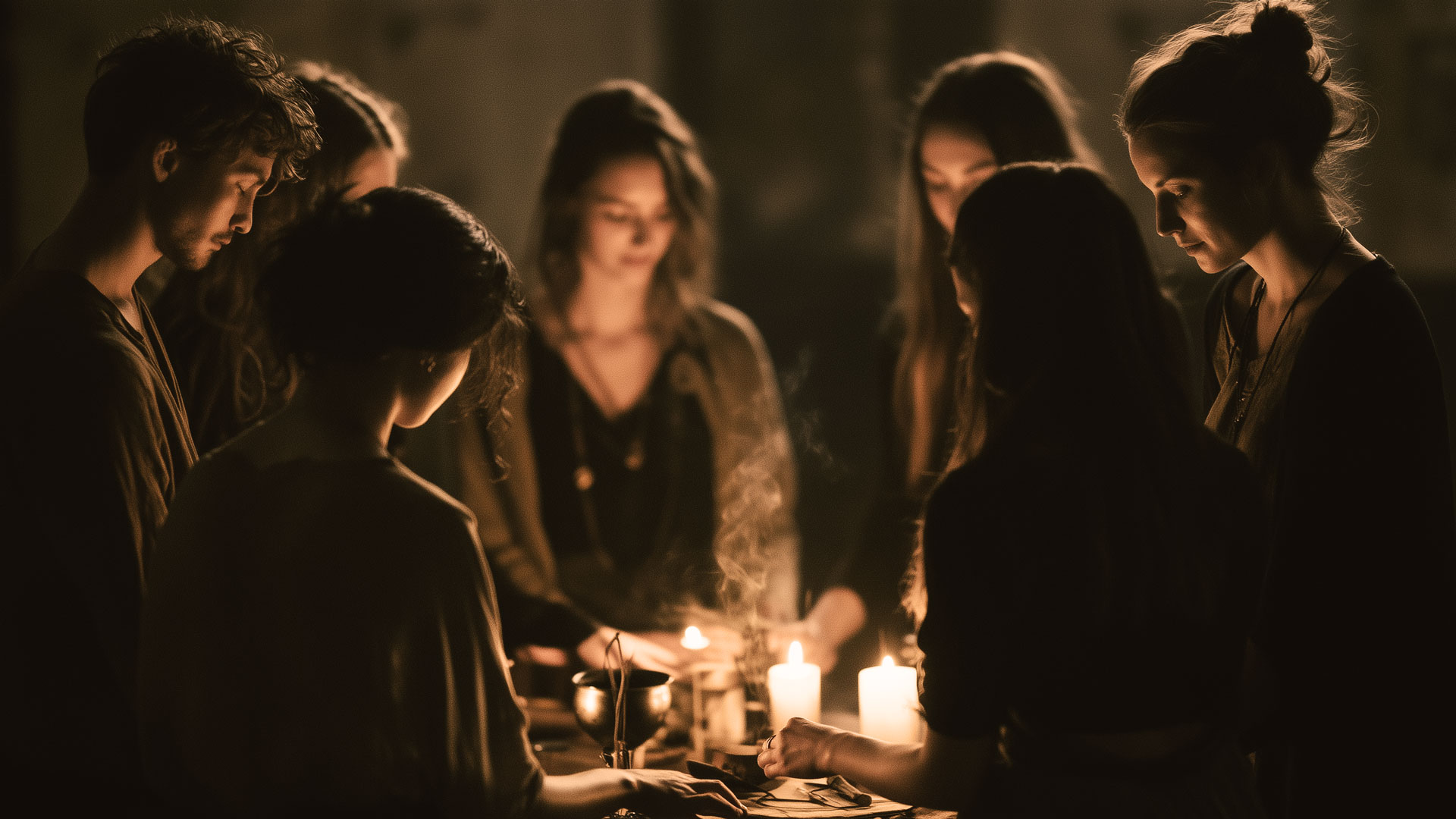
 Why Witches Work Together – The case for collective practice
In the first essay, we watched a Circle begin to form — six strangers becoming, by the end of an evening, something more than six people in a room. I called that the living container: a boundary that becomes a vessel through the attention, conduct and commitment of everyone present.
But to say that a coven is more than a gathering of solitary practitioners is to raise a question rather than answer one. Why gather at all? What does working together make possible that solitary practice cannot — and what does it ask of us in return? That is the question this essay takes up.
From Audience to Circle
Before I could teach people how to cast a Witch Circle, I discovered that I first had to teach them its language.
The people drawn to the idea of a coven were often enthusiastic. They had read a book or two, encountered the image of the Witch in mythology and popular culture, or felt the unmistakable pull of something they could not yet name. They wanted ritual, initiation, companionship and contact with others who understood that the world was not as ordinary as it appeared.
Yet enthusiasm did not necessarily bring practical knowledge.
Many had little experience of formal ritual. They did not know how the elemental tools were used, how a Circle was established or why the ritual moved from one action to the next. Terms such as invocation, consecration, grounding and raising power might be familiar, but familiarity with a word is not the same as knowing what to do when the censer of incense, chalice or sword is placed in your hands.
If we were going to meet regularly and develop meaningful coven practice, someone had to establish a common ritual vocabulary.
That task fell naturally to me.
From my early teens, I had read whatever I could find about Witchcraft, magick and the Western esoteric traditions. Books were harder to locate then, and there was no internet through which a curious adolescent could instantly disappear into a thousand conflicting sources. What I found is that I studied closely. I performed solitary rituals, experimented with spells and gradually learned what certain actions did to consciousness, imagination and atmosphere.
My Catholic upbringing had also given me a sense of ceremony.
I understood that a ritual began before its formal words were spoken. The arrangement of the room mattered. Light mattered. Silence mattered. Clothing, gesture, scent and the measured movement of people through sacred space could change the quality of attention. Whatever theological differences I later developed with Catholicism, its ceremonies had taught my body that the sacred could be approached through the senses.
Incense became part of that education.
As a teenager, I once approached my parish priest and asked him for some frankincense. I do not now remember what he made of the request, but the fragrance had already become inseparable from my sense of ritual. To this day, my students and coven members know that I am generous with incense. My instruction has often been to put on enough to “fill a cathedral”.
There is humour in that, but also a serious ritual principle. The senses help announce that we have entered a different order of experience. Frankincense does not create the sacred by itself, but its aromatic density alters the room. The familiar becomes strange enough that another form of attention may awaken.
What I had not inherited from the Church was a model for collective magical participation.
From Congregation to Participation
Many forms of modern Wicca and Witchcraft relied heavily upon the High Priestess and High Priest. They directed the ceremony, approached the altar, handled the principal tools and performed the most significant ritual actions. Other members participated through responses, songs or prescribed movements, but the centre of ritual authority remained concentrated in the priesthood.
The structure often resembled the Catholic Mass more closely than Wiccan practitioners might have wished to admit. The congregation watched while authorised figures conducted the mysteries. Members approached the altar at particular moments but generally remained at a respectful distance from its power.
I understood the attraction of this model. Skilled ritual leadership can provide coherence, beauty and confidence. An experienced priest or priestess may carry a group through a rite that inexperienced participants could not yet sustain alone. Ceremony requires structure, and someone must usually understand where the ritual is going.
The problem begins when leadership becomes permanent centrality.
When one or two people continually perform the important work, everyone else learns how to follow rather than how to practice. Members may become familiar with the appearance of ritual without developing ritual competence. They know when to respond and chant and when to move, but they do not necessarily understand how the Circle is built or what they would do if the leader were absent.
Very early in my own coven work, I began turning this model on its head.
Rather than gathering people around a High Priestess or High Priest who performed the rite on their behalf, I distributed the ritual among them. One person carried the pantacle of Earth. Another held the chalice of Water. Others took responsibility for the censer of Air and the brazier of Fire. The sword passed from hand to hand as each participant helped establish the boundary.
The Circle was not performed for them. It was created by them.
This became one of the hallmarks of my practice and coven training. The elements were not stage properties controlled by the priesthood. They were responsibilities entrusted to members of the Circle. Each person had to understand something of the tool, the element and the action they were undertaking. They had to watch one another, maintain the sequence and contribute to the shared rhythm.
The method was simple, but its implications were considerable.
A person who carries the chalice is no longer merely observing Water being invoked. They must feel its weight, move with care and offer it to another person. Someone carrying the censer must attend to the charcoal, the incense and the movement of smoke through the Circle. The person holding Fire must become particularly conscious of responsibility. The ritual is no longer an idea. It has entered the hands.
Through participation, each member begins to understand that the Circle depends upon them.
A Shared Ritual Language
When Witches work together, they require more than shared beliefs. They need a shared language of action.
This does not mean everyone must hold identical theological opinions or interpret every symbol in the same way. A coven can contain considerable diversity of thought. What it cannot sustain indefinitely is confusion about its basic practices.Members need to know how the Circle is opened and closed. They need to recognise the ritual tools, understand the sequence of the work and respond to agreed signals. They must learn the chants, invocations or elemental names used by that particular group. They should know what is expected of them before, during and after the rite.
This knowledge creates ritual fluency.
When the vocabulary is unfamiliar, attention is consumed by uncertainty. The newcomer worries about standing in the wrong place, saying the wrong words or mishandling a tool. Some degree of nervousness is unavoidable and may even heighten awareness, but excessive uncertainty prevents people from surrendering to the rite.
Repetition gradually frees them.
The words become familiar. The body remembers when to stand, turn, receive and pass the ritual objects and energy. A person no longer needs to think through every step because the ritual has entered procedural memory. Attention can then move beneath the choreography towards the imaginal and psychic dimensions of the work.
This is one of the principal reasons Witches practice together repeatedly. A single ceremony may be moving, but repeated ritual develops depth. The group learns the form well enough that the form begins to carry them.
Researchers Rather Than Experts
My approach to coven training was not to announce that I possessed every answer. I invited suitable people to undertake the work with me.
We were closer to a group of researchers than a gathering of experts.
This attitude was especially important because much of our interest lay in psychic reality. We were not simply reproducing ceremonial forms for historical appreciation. We wanted to discover what happened when those forms were enacted with attention, imagination and commitment.
What changed in the room when the Circle was cast? How did participants experience the elemental forces? What images arose during trance? Did a chant alter bodily sensation or perception? What appeared in dreams afterwards? Did several participants report related impressions, or did each person encounter a markedly different psychic landscape?
These were questions for experience rather than doctrine.
The researcher’s attitude does not require emotional distance from the work. On the contrary, the ritualist must participate fully. But afterwards, they should become capable of reflecting upon what happened without rushing to impose certainty upon it.
This meant that the experience of the beginner mattered.
A newcomer may not possess a vocabulary for what they encounter, but the absence of vocabulary does not make the encounter unreal. Indeed, beginners are sometimes less burdened by expectations. They may not know what they are “supposed” to feel and therefore notice something the experienced practitioner has learned to overlook.
Experience can create discernment, but it can also create habits.
The experienced ritualist may unconsciously compare each new working with earlier successes. They may decide too quickly that a ritual has worked or failed because it does not resemble what happened before. They may become attached to particular signs of power — a bodily tremor, a change of temperature, an image, a sudden cathartic emotional release — and overlook subtler developments.
The beginner has no such benchmark.
This does not make every novice interpretation correct. Psychic experience requires discernment. A vision may be meaningful without being literal. A powerful feeling may arise from the ritual, personal memory, group atmosphere or several things at once. The task is not to dismiss the experience, but neither is it to inflate it.
Every psychic experience deserves attention. Its meaning remains open to enquiry.
That principle created a greater equality within the Circle. Experience was not valid only when it resembled the leader’s experience. The coven leader could offer context, ask questions and help participants integrate what had occurred, but should not colonise another person’s encounter by announcing what it must mean.
A teacher’s role is to help people become better witnesses of their own psychic lives.
What the Group Makes Possible
Solitary Witchcraft taught me a great deal. It developed concentration, self-reliance and the ability to proceed without external encouragement. A Witch who cannot practice alone may become overly dependent upon the energy and approval of a group.
Yet solitary work cannot teach everything.
When we practice alone, the ritual conforms easily to our habits. We choose the timing, music, pace, language and atmosphere. We can stop when we become uncomfortable or change the procedure without needing to explain ourselves. This freedom is valuable, but it also protects us from certain forms of learning.
Other people interrupt our preferred rhythm.
They move faster or slower than we do. They understand symbols differently. Their voices may strengthen a chant or throw it temporarily out of balance. They forget lines, ask awkward questions and sometimes perceive what we have missed. They require us to communicate knowledge that we may previously have possessed only intuitively.
Teaching another person exposes the gaps in our understanding.
It is easy to believe we know how to cast a Circle until someone asks why a particular action is performed. It is easy to speak about raising power until we must guide six inexperienced people through it without creating confusion. It is easy to value freedom until our freedom must exist alongside the needs and boundaries of others.
The group makes the relational dimension of Witchcraft unavoidable.
It teaches coordination, patience and responsibility. It asks us to contribute without dominating, receive guidance without becoming passive, and recognise that our conduct affects the quality of the entire working.
The group also makes possible forms of power that are difficult to generate alone.
Several voices chanting together create a physical and psychic resonance beyond the volume of the sound. Shared movement produces rhythm. Attention becomes mutually reinforced. One person’s concentration supports another when their focus falters. The Circle becomes a field in which each participant contributes and from which each may also receive.
This is sometimes described as the ‘group mind’.
The term should not imply that individuality disappears. A healthy magical group does not erase its members or demand that they think as one. The group mind is better understood as a temporary field of shared purpose. Distinct people coordinate attention towards a common Work while retaining their own perceptions and judgement.
The strength of the Circle comes from relationship, not uniformity.
The Group Also Magnifies
Witches do not automatically become wiser by gathering together.
A group magnifies what is brought into it. Attention may deepen, but so may distraction. Trust may grow, but so may dependency. A strong personality may inspire others or gradually become the centre around which everyone else revolves. Shared emotion may support transformation or become contagion.
This is why “Witches are stronger together” cannot be treated as an uncomplicated slogan.
Witches may become stronger together when the group develops practices capable of carrying that strength. The members need a common language, clear expectations and a culture in which questions are permitted. Responsibility must circulate. Experience should be respected without becoming beyond examination. Leadership must support participation rather than replacing it.
A crowd may generate excitement. A Circle must generate capacity.
The measure of a working group is not simply whether its rituals feel powerful. We should also ask whether members are becoming more competent. Can they take on roles they could not manage before? Can they explain the ritual rather than merely repeat it? Are they developing judgement, initiative and the ability to support one another?
A group that produces continual intensity but no development may be creating dependency rather than initiation.
From Lectures to Workshops
During my years in Adelaide, I wanted to meet more people of like mind. Yet because so few had access to reliable teaching about Witchcraft, it became clear that some form of public education was necessary.
I began holding open lectures.
By then, I had already been invited by Dr Norman Habel, a respected biblical scholar and educator then teaching at the Adelaide College of the Arts and Education, which later that year became part of the University of Adelaide. He had invited me as guest speaker on Witchcraft to students. I was thrown into the deep end. The audience included not only younger students but mature-age students who were themselves ministers of religion and Catholic and Anglican nuns.
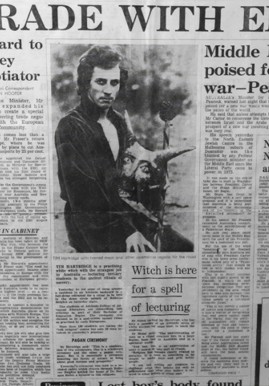
“The Australian” newspaper: my guest lecturer gig hits the headlines, 18 July 1977.
It might have been intimidating, particularly for a young Witch speaking about a subject so frequently misunderstood. Instead, I found myself surprisingly relaxed. Once I had spoken openly about Witchcraft before a room containing experienced religious practitioners, opening my own home for a public lecture series no longer seemed quite so daunting.
The lectures allowed people to encounter ideas, ask questions and gain some orientation. They were also a way of finding one another. In a period when Witches were less visible, an open lecture could become a point of contact for people who had been exploring alone.
But lectures had their limits.
A person could listen attentively, take notes and leave with their assumptions largely intact. They might understand more about the history, theory or symbolism of Witchcraft while remaining uncertain about practice. The distance between speaker and audience could reproduce the same problem I had noticed in priest-centred ritual: one person performed knowledge while everyone else received it.
Eventually, the teaching had to move from the chair into the Circle.
The lectures became more practical. Practical teaching became workshops. Repeated workshops revealed which material newcomers most needed, where confusion tended to arise, what could be taught in one evening and what required several sessions.
Over time, this work developed into my signature workshop Casting the Witch’s Circle.
The workshop series gave students an ordered entry into group ritual. It taught a common language, placed ritual responsibilities in their hands and allowed them to explore the psychic consequences of the work. It was not a coven initiation, but it gave participants an authentic experience of working collectively and allowed both teacher and students to discover whether further work together might be appropriate.
The workshop was therefore both training and threshold.
It offered enough structure to support beginners without requiring them to pretend to a commitment they had not yet made. It allowed people to move from curiosity towards practice and from practice towards a more informed understanding of what coven involvement might require.
This series grows from that same intention.
More Than Companionship
People often seek a coven because they want companionship. There is nothing trivial about that desire. Witchcraft can be lonely, particularly when family, friends or colleagues do not understand its place in one’s life.
Finding others with whom one can speak openly may be deeply relieving.
Yet companionship alone does not explain why Witches work together. A social gathering can provide friendship without becoming a coven. A discussion group can exchange ideas without developing ritual fluency. An online community can offer information and encouragement without creating the embodied field of a Circle.
The coven exists for the Work.
Friendship may grow around that Work and often becomes one of its greatest blessings. But the central relationship is not merely between members. It is also between each member and the purpose that has brought them together.
They gather to practice, learn, observe, celebrate, invoke, create and be changed.
This shared purpose gives the group a centre that does not belong exclusively to any individual leader. The leader may hold responsibility for the structure, but the Work remains larger than the leader.
When that is understood, participation becomes an offering to the Circle rather than a performance for recognition.
What Working Together Requires
Working with others requires us to move beyond the question, “What will I receive from this coven?” We must also ask, “What am I prepared to contribute?”
At first, the contribution may be modest: arriving on time, learning a response, carrying a tool or helping restore the room after ritual. These small actions matter because they establish reliability. A person who cannot yet lead a trance may still make the trance possible by tending the lighting, maintaining the rhythm or ensuring that participants have water afterwards.
Competence grows through involvement.
The newcomer watches, participates and reflects. Gradually, they take on more complex responsibilities. They may call a quarter, lead a chant, prepare a consecration or facilitate part of a discussion. Eventually, they may teach the practice to someone else.
This progression is not simply a pathway towards rank. It is how a group becomes resilient.
When knowledge and responsibility are shared, the absence of one person does not collapse the Circle. Members understand enough of the whole to support one another. Leadership can move according to competence and circumstance.
The Circle becomes something everyone helps to hold.
That is why Witches work together: not because the solitary Witch is incomplete, and not because collective practice is automatically superior, but because some dimensions of the Craft only emerge through relationship.
Others become our mirrors, witnesses, collaborators and occasional irritants. They reveal what we know, what we only imagine we know, and what remains to be learned. They lend their voices to ours, place tools into our hands and ask us to become answerable for the power we raise together.
A solitary Witch may cast a powerful Circle.
A working coven must learn how to become one.
NB: This essay is adapted from material being developed by Tim Ozpagan Hartridge for his next book, Into the Witch Circle: Belonging, Practice and the Living Tradition of Coven Witchcraft. The next article in the Coven Life series will explore Learning Through Participation — how ritual, observation and shared experience become the real teachers.
