
Entering the Witch Circle — When Strangers Become a Magical Group
This is the first in a seven-part series exploring the lived reality of coven-based Witchcraft: what seekers imagine a coven to be, what participation actually asks of us, and how a gathering of individual practitioners may gradually become a living magical group.
The series grows from material I am developing for my next book, Into the Witch Circle, itself an expansion of my long-running workshop, Casting the Witch’s Circle. Although these essays are concerned with coven life, they are not intended only for Witches who belong to covens. Solitary practitioners also work within inherited ritual forms, learn through relationships and participate in a tradition extending beyond the individual self.
Across the series, I will consider the Circle as a living container; learning through ritual and participation; trust and intimacy within the magical group; authority and responsibility in coven leadership; conflict, departure and the broken Circle; and the ways covens preserve, adapt and transmit a living tradition.
We begin, however, with the threshold itself: the moment when Witchcraft ceases to be something we have only read about and becomes something we must enter.
The First Circle
In the centre of the room stood my circular 1920’s Tasmanian oak peg-leg table. I had laid out a grazing platter of dips, olives and cheeses, with wine glasses beside a couple of bottles of red, and juice for anyone who did not drink. I must admit that the wine was partly for my benefit. It helped to settle my nerves.
It is a strange thing that, even after years of teaching people how to cast a Witch Circle, I still feel nervous before a workshop begins. Perhaps that is appropriate. Ritual should never become so familiar that we cease to care about what may happen inside it.
This group presented a particular uncertainty. They were complete strangers to me and, apart from a little emailing back and forth, strangers to one another.
It is not until people enter the room that you begin to sense whether they may be capable of working together. You notice how they listen, whether they interrupt, how much they have read and, more importantly, whether they can set aside what they think they know long enough to experience something directly.
I also wonder how they will respond to my stories of coven life and Witchcraft practice, including the psychic experiences that accompany them. Will they dismiss such things before considering them? Will they accept them too readily and attempt to imitate what cannot be manufactured? Or will they become careful researchers of their own experience?
My motivation has always been an irrepressible enthusiasm for the Craft. Once I begin speaking, I usually forget myself. The nervousness falls away as we work through the theory, but the teaching is only preparatory. The real work begins when we leave the ordinary room and enter the temple.
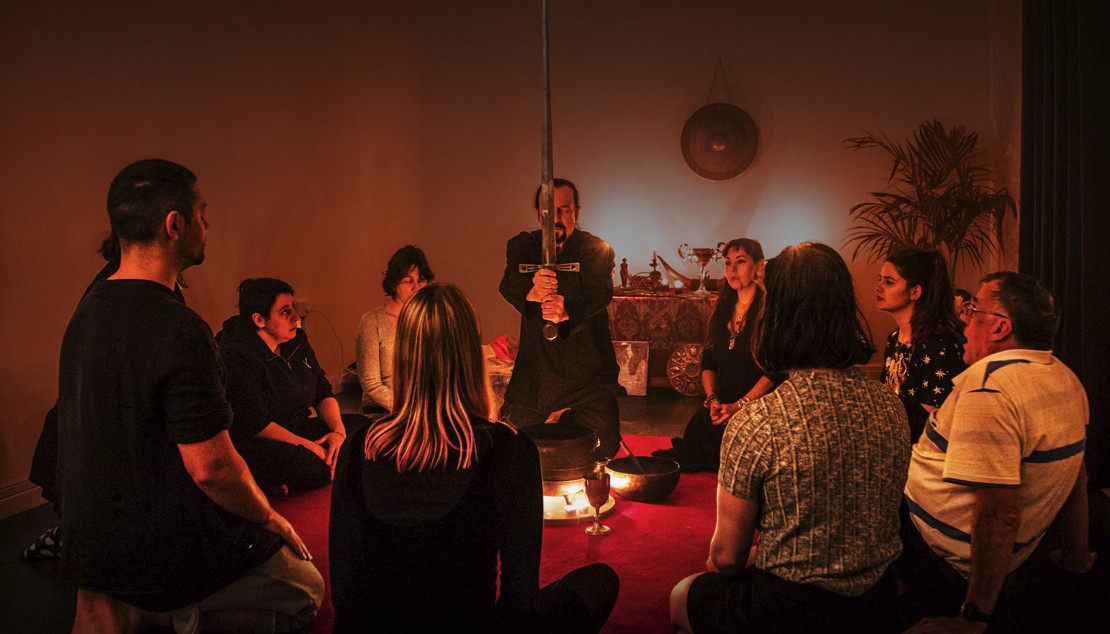
I watched the participants’ faces as they crossed its threshold. The walls were painted a deep russet, and the room held ritual objects gathered across many years: masks, a large painted pantacle, a convex moon mirror and a collection of Arabic lamps brought home from Egypt. I lit aromatic frankincense and the candle lanterns. One shaded lantern rested in the deep belly of the Witches’ cauldron, which stood at the centre of a rich red circular mat painted with a black pentagram.
The six ritual newcomers sat rather sheepishly around the Circle. Most had read something about Witchcraft, but few had participated in a formal working, let alone entered a purpose-built temple room. There is always a moment when theory must be abandoned. I plunged them into the Circle-casting rite, teaching each part as we went.
We began with the ritual sword, an object much heavier than it appears. There is usually a small look of surprise when I pass it to the first student seated beside me and they feel its actual weight in their hands.
I held the sword towards the centre, declared our intention for the night and began the casting: “The sword cuts the Circle round about.” As I passed it onwards, I prompted the response: “Power stay in, world stay out.”
The sword travelled from hand to hand. Each person repeated the words before passing it to the next, and the group began to find its first shared rhythm.
I had already entrusted the elemental tools to different participants: the Earth pantacle, the chalice of Water, the censer of incense and the burning brazier of Fire. The brazier contained a small flame of methylated spirit and was passed slowly, carefully and under close direction. Even after years of using it, that moment makes me attentive. Fire brings the rite alive, but it demands respect.
As each elemental vessel moved around the Circle, the students resonated the Enochian names: Nanta for Earth, Hcoma for Water, Exarp for Air and Bitom for Fire.
At first their voices were tentative. Then something shifted. The names became fuller and more sonorous, emerging from parts of their bodies they may not have known how to use before that night.
Finally, we brought the grail of wine into the centre. Everyone reached towards it, joining through touch as I spoke words they were hearing together for the first time:
“Drink from the cup of Witches’ wine and remember ancient rites forgotten by time. Sup from the crimson chalice and be free of those who wish you malice.”
We drank several rounds from the grail, passing the chalice with the customary greeting, “Blessed be”, and a kiss upon the cheek.
By then, the six strangers who had arrived separately were no longer simply six individuals seated in a room. A Circle had begun to form between them. Only then were we ready to undertake the deeper work of the night.
From Information to Participation
By the end of the evening, people who had previously known ritual mainly through books were speaking with the astonishment of direct experience. The difference mattered. They had not merely learned what a Witch Circle was supposed to be. They had handled its tools, spoken its words, carried its elemental powers and felt themselves becoming part of its living structure.
One participant, Lannie, later wrote: “My first ever ritual—what an experience! I loved how welcoming everyone was and have made many friendships from this.”
Another participant, Clare, described something altogether more intense: “The ritual was a truly transformational and healing experience. I experienced energy so powerful that it rocked my body back and forth like a serpent. Drum rhythms I’ve never played before — and then I turned into a cat! I feel like I’ve been to voodoo land and back!”
Such accounts should not be treated as standards against which every ritual is measured. Not everyone experiences dramatic trance, bodily movement or vivid psychic imagery. Quietness may be as significant as intensity. A change may emerge days later in a dream, a decision or a subtle alteration of perception. Powerful experience is not, by itself, proof of wisdom.
What matters is that the participants had crossed from information into participation. They had allowed the ritual to act upon them, and they now had something of their own to observe, question and integrate.
As the Circle drew to its close, everyone wanted to talk. They shared impressions, bodily sensations, images and encounters with what I call psychic reality. I knew from experience that the immersion in ritual, dance and trance would probably continue into their dreams that night. The rite had ended, but its movement through the psyche had not.
Later, as I stood at the doorway waving goodbye to the last participant, I recognised an enthusiasm I have never tired of witnessing. They would return the following week for the second part of the workshop. They had crossed the first threshold, and the work had begun.
What Actually Entered the Circle?
A Witch Circle is easy enough to describe.
People join hands. Ritual tools are used to establish the boundary. Candlelight and incense help mark the transition from ordinary awareness into sacred space. Names are chanted, bodies move, power is raised and the participants may enter trance. At the end, the powers are thanked, the boundary is released and the room returns — apparently — to what it was before.
That is the visible form. What cannot be so easily described is what happens to the people who enter it. A Circle may be drawn in a few minutes, but learning to inhabit it can take years. The body must learn when to move and when to become still. The voice must learn to speak with conviction without becoming theatrical. The imagination must become disciplined enough to give form to what cannot be seen. The Witch must learn how to raise power without becoming overwhelmed by it and how to receive an experience without immediately inflating it into revelation.
When other people enter the Circle, the apprenticeship deepens. The Witch must learn to listen, coordinate, participate and contribute. Personal preference encounters shared purpose. Individual experience enters relationship with the experiences of others. Trust must be developed, responsibility accepted and difference negotiated.
The Circle becomes more than a ritual boundary. It becomes a living container formed through the attention, conduct and commitment of everyone present.
The Ritual Circle
The first Circle is the one most Witches recognise: the sacred boundary established for ritual and magick. Within it, ordinary activity is interrupted. The elements are called, the altar arranged, ritual tools placed into service and attention directed towards the work. The Circle contains power and gives visible form to an invisible structure.
Learning to cast this Circle teaches preparation, concentration, imagination and closure. It provides a repeatable form through which spellcraft, devotion, invocation, trance, divination and transformation may be approached.
Yet correct technique does not automatically create a living rite. A ceremony may be technically flawless and still remain empty. The words may be accurate, the tools beautiful and every movement performed according to tradition, yet the deeper current never arrives.
Conversely, a modest gathering with imperfect choreography may become powerful because the people are attentive, trustworthy and willing to participate fully.
Technique matters, but technique is not the whole mystery.
The Human Circle
The second Circle is made of people.
A coven is not simply a gathering of solitary Witches performing their separate practices in the same room. It develops rhythms, expectations, relationships and memories of its own. Over time, it may begin to function as a distinct magical presence: not a mindless collective, but a field of shared attention in which individual capacities are strengthened through participation.
This cannot be created by declaration. Calling a group a coven does not make it one. Robes, degrees, titles and claims of lineage do not automatically produce depth. A living magical group is made through repeated acts of presence: arriving when one has promised to arrive, preparing the work, learning the material, carrying one’s share, respecting confidence, accepting guidance and becoming capable of supporting others.
The ordinary acts are not separate from the magick.
Someone prepares the room. Someone brings food. Another remembers the words when the ritual leader loses their place. A more experienced person helps a newcomer without humiliating them. Someone notices that another participant is distressed and quietly checks on them after the rite. The altar is cleared, the floor swept and the cups washed.
These acts may appear mundane beside invocation and trance, but they create the reliability within which people can safely risk entering deeper states of consciousness. The human Circle therefore asks more of us than enthusiasm. It asks for participation.
The Circle of Tradition
A third Circle extends beyond those presently gathered.
Every established practice carries the presence of teachers, ritualists, writers and covens whose work shaped what we have received. Some are known to us by name. Others have disappeared into the stream of transmission, while their gestures, phrases, discoveries and mistakes remain embedded in the rituals we inherit.
Tradition is not simply old material preserved without change. Neither is it whatever an individual chooses to improvise in the moment. A living tradition is a conversation between inheritance and experience. It preserves what continues to work, adapts where circumstances require it, and allows new forms to emerge through sustained practice rather than novelty alone.
The Witch entering a Circle therefore enters something already in motion.
At first, we receive. We learn words, tools, symbols and rhythms developed by others. We repeat them long enough to discover what they do. Experience gradually teaches us which elements are essential, which are local customs and which may need to change. Eventually, some practitioners accept responsibility for teaching, adapting and carrying the work forward.
What This Means for the Solitary Witch
Not every reader will seek membership in a coven. Solitary Witchcraft is a complete and legitimate path, and periods of solitude remain necessary even for those of us with decades of group experience.
The solitary Circle develops self-reliance, inner listening and a direct relationship with the powers of the Craft. Yet solitary practice is rarely created in total isolation. We learn through books, teachers, conversations, friendships and rituals preserved by other practitioners. We inherit language and techniques that travelled through human relationships before reaching us.
A solitary Witch therefore also participates in a larger Circle of influence and transmission.
The important question is not only whether we practise alone or with others. It is whether we recognise what has made our practice possible, whether we examine what we receive, and whether our work makes us more capable of relationship, discernment and responsibility.
The inner work of Witchcraft is not proved by withdrawal from others. Nor is it proved by belonging to a group. It is revealed through what our practice gradually enables us to hold: experience without inflation, difference without immediate rejection, mystery without credulity and relationship without loss of self.
Crossing the Threshold
Coven life is often approached through fantasy. Some seekers imagine immediate belonging, secret knowledge, dramatic initiation and the discovery of spiritual family. Others expect authoritarian leadership, rigid hierarchy, emotional entanglement or the loss of personal freedom.
Both images contain fragments of truth, but neither describes the whole.
A coven may become a place of friendship, powerful ritual and profound transformation. It may also become confused, dependent or harmful. It can pass through periods of vitality and exhaustion. People may grow together and later move apart. A group can carry tradition beautifully while still needing to reconsider its understanding of authority, consent and responsibility.
The first threshold is therefore not crossed when someone calls themselves a Witch, buys ritual tools or gains entry to a coven. It is crossed when the practitioner becomes willing to move from imagination into experience — and then to reflect honestly upon what the experience asks of them.
The Circle begins as something we cast. In time, it becomes something we help to hold. Eventually, it may become something we are trusted to carry forward.
Tim Ozpagan: Entering the Witch Circle — When Strangers Become a Magical Group.
This essay is adapted from material being developed for Tim Ozpagan Hartridge’s next book, Into the Witch Circle. The next article in the Coven Life series will explore The Circle as a Living Container — why a coven is more than a gathering of solitary practitioners.
