
 When Practice Becomes Apprenticeship
In the previous essay, Why Witches Work Together, I argued that a working coven must learn how to become one.
That learning does not happen simply because people meet regularly, agree upon a ritual form or call themselves a coven. Nor does it happen because someone at the centre of the Circle knows what everyone else should do.
The deeper learning begins when responsibility starts to move around the Circle: someone watches, someone tries, someone gets it wrong, and someone tries again.
Eventually — often without noticing exactly when — the person who once waited to be told what to do becomes capable of helping to carry the Work for others. That is apprenticeship, and some of its most important lessons arrive through failure.
A Ritual Before Its Time
Rachel was part of my evolving Nuit’s Veil coven during the early-2000s. At that stage, the coven functioned deliberately as a training circle. My hope was never that its initiates would remain gathered around me indefinitely. They were learning the Craft so that, in time, some might establish circles and covens of their own.
Rachel was the first among her particular group to say that she wanted to create an entirely new Full Moon rite rather than use our familiar Luna ritual.
Something had caught hold of her imagination. She had become fascinated by the great Near Eastern and Mediterranean images of the divine feminine, particularly Isis and Inanna-Ishtar. These goddesses belong to different cultures and should not simply be collapsed into one another, but Rachel was responding less to historical theology than to an archetypal pattern she perceived between them: the powerful divine woman who gives life, commands, protects, loves, loses, initiates with magick, descends and returns.
The descent of Inanna especially had taken hold of her.
In the ancient story, the Goddess descends through seven gates into the Underworld. At each gate, something belonging to her position and power is removed until she stands stripped before the mystery below. The story had an immediate resonance with the Descent of the Goddess myth used within modern Wiccan initiation rites and, for us, this was the central work of Nuit’s Veil and the Dark Circle Collective.
Later cultures would turn the image of successive unveiling into the much more theatrical “dance of the seven veils”. Whatever the historical distance between those images, the psychological idea is potent: something is removed, then something else, until the persona can no longer hide what stands beneath it.
That was the imaginative territory from which Rachel’s ritual emerged.
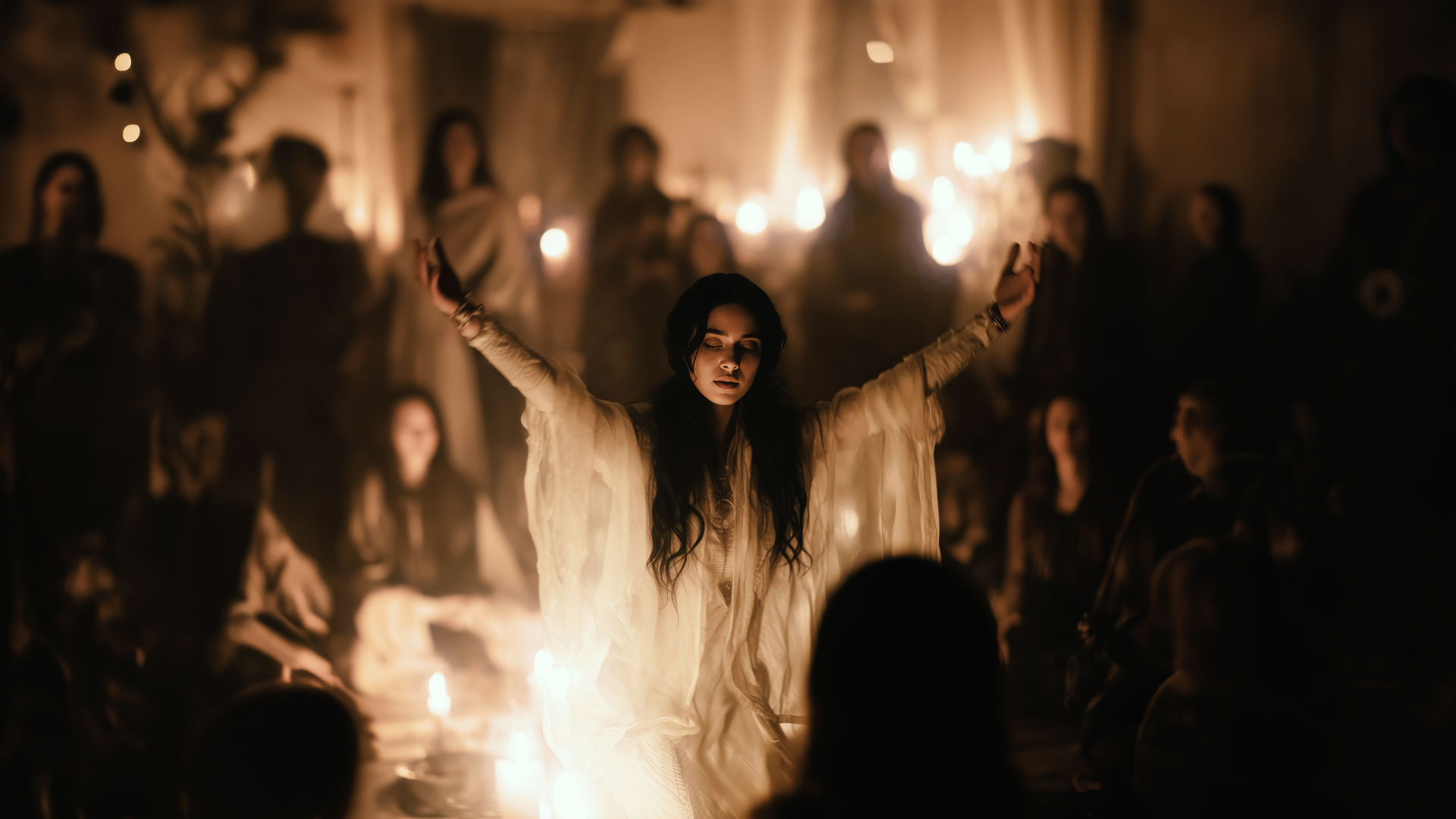
She assembled several musical pieces drawn from Raqs Sharqi, contemporary Egyptian-style belly dance, and began constructing her Full Moon rite around movement and unveiling. Nuit’s Veil worked skyclad, so the body itself was already familiar to us as part of ritual language. Movement, nakedness, voice and touch could all become instruments through which a rite was expressed. Rachel was nevertheless terribly nervous.
I encouraged her and offered assistance, but I also understood that she wanted to hold this space herself. It was her inspiration, and part of apprenticeship is eventually being trusted with something that belongs to you.
From my own experience of creating ritual, I knew something she had yet to discover: new rites almost never arrive fully formed.
They may arrive in inspiration as though complete. You suddenly see them—the movements, the words, the music, the mood. But the vision and the performed ritual are not the same thing. Between them lies rehearsal, revision, trance, failure, listening and sometimes months or years of returning to the same material. It is rather like learning a dance. Once mastered, the movements appear inevitable. You no longer see the awkwardness through which each step was learned. Rachel did not yet have that luxury of time.
The night arrived. What I hoped to see was the coven drawn into her vision. That had always been fundamental to the way we worked. Ritual responsibility circulated. Someone carried Earth, another Water, another Fire or Air. Voices joined. Bodies moved. The rite belonged to everyone who helped bring it into being. But almost immediately I realised that Rachel’s ritual had become something different. We had become an audience.
She was dancing for the Circle rather than drawing the Circle into the dance.
Her nervousness seemed to be short-circuiting the magick into performance. She knew what she wanted the rite to become and was willing it towards that image, but the harder she tried to make it happen, the further away the deeper current appeared to move.
There is a point in ritual when technique must give way to participation.
You may prepare meticulously, memorise the words, choose beautiful music and know every movement. Yet when the rite begins, something else is required. The ritualist has to listen. The body has to become receptive to what is actually happening rather than continually comparing it with what was supposed to happen.
That night, the rite never quite made that transition.
At the end there were tears. Rachel felt she had failed. Worse, she seemed to conclude that she simply could not weave the magick she had imagined. I could see something different.
The ritual contained the beginnings of something potentially beautiful. The imagery was strong. The inspiration was genuine. The problem was not that she lacked magical ability. The rite simply needed more time than she had given it — and perhaps more importantly, she needed permission to discover it rather than prove it.
But by then she was hurting. And this is the part I remember with some sadness. I wanted to help her deconstruct the working: to look at what had opened, what had closed, where the energy changed and how we might rebuild the rite so that the whole coven could enter it with her. But I could not find a way through to her.
At the time I thought she was assuming criticism before I had offered any. Looking back, I think that is too easy an explanation. Her confidence had been bruised in front of people whose respect mattered to her. Whatever I said as teacher or coven leader was therefore being heard through the much louder voice within her saying, I failed.
Perhaps what she needed first was not analysis. Perhaps she needed someone to say, Leave it alone for tonight. The rite is not ruined. We will look at it again when it no longer hurts. I wish I had understood that more clearly then.
Remembering Rachel
Rachel died several years later from a brain tumour. I have chosen to use her name here because I remember her with great affection, and because I do not want this story to reduce her to a lesson about a ritual that did not work as she had hoped. She was a young Witch trying something new. That matters.
It is easy, with decades of hindsight, to identify the places where the rite needed more time, where the coven could have been more deeply involved, and where trance and dreamwork might have allowed the original inspiration to mature. What I see less comfortably is the moment afterwards, when Rachel was hurting and I still wanted to teach.
I wish now that I had understood more clearly that sometimes teaching has to wait.
Perhaps what she needed from me that night was simply reassurance:
This was your first attempt. Nothing has been lost. The rite is still there. You are still learning. We can return to it. There would have been time for analysis later. Or so we always imagine.
Rachel never developed that particular ritual into the form I thought it might become, but I have remembered it — and her — for all these years. In that sense, the rite continued to teach me long after the Circle was opened.
So I offer this story in her memory, not because Rachel failed to create a ritual, but because she had the courage to attempt one. Blessed be, Rachel.
Knowing Is Not Knowing How
Rachel’s rite has remained with me because it contains almost everything I now understand about learning through participation. She knew the mythology. She had found the music. She understood the intention of the rite and possessed enough experience to attempt something of her own. What she encountered was the difficult distance between inspiration and embodiment.
Knowing is not yet knowing how.
A Witch may know the elemental correspondences, identify an athamé, explain the quarters and describe what is meant by raising power. They may have read dozens of books on ritual and be able to discuss the difference between invocation and evocation.
None of this necessarily tells us whether they can stand inside a working Circle and respond to what is happening. Can they carry a burning censer without becoming distracted by it, speak with enough strength for the words to acquire ritual presence, or recognise when a chant is gathering energy and resist the temptation to hurry it?
Can they remain present when another participant begins to cry; know when the Circle needs grounding rather than greater intensity; recover when somebody forgets a line; and close well? Knowledge tells you what a ritual is supposed to do. Participation teaches you what it actually requires.
This is one reason I have always resisted approaches to Witchcraft that place excessive value on accumulated information. Reading is indispensable. Study gives us context, vocabulary, comparison and the ability to recognise the structures we have inherited. But there comes a moment when the book must be put down. The tool has to enter the hand.
Watching Like an Apprentice
Participation does not begin with being placed in charge of something; it begins with learning how to watch. There is a considerable difference between watching ritual as an audience member and watching it as an apprentice: the audience asks whether the ceremony was impressive, while the apprentice asks what made it work.
They notice how the altar was prepared before anyone entered. They observe who checked the candles, who tended the charcoal and who quietly dealt with something that had been forgotten.
They notice when the person leading the ritual begins to slow their speech; they see two experienced members exchange a glance before changing the rhythm of a chant; and they recognise that someone who entered the Circle anxious is now breathing differently. They watch how a mistake is handled and pay attention to the closing. Perhaps most importantly, they observe what happens after everyone believes the ritual is over: does the group become scattered, do people remain unusually quiet, does everyone begin talking at once, does someone need support — and who notices?
This kind of observation is already a form of participation because attention is being trained.
The apprentice is learning to perceive the architecture beneath the performance.
In my workshops I have often told students that there are no questions too basic to ask. But learning does not consist only of asking the teacher what everything means. Sometimes the better question is directed inward: What did I actually notice? That is the beginning of the researcher’s attitude.
When the Tool Enters the Hand
Eventually, observation must become action. This is why the ritual tools in my Circle are distributed rather than kept exclusively at the altar: someone takes Earth, someone takes Air, someone carries Fire, and another carries Water, while the Sword itself moves through the Circle. From a distance, a pantacle is a symbol; in the hands, it becomes responsibility. The same is true of every ritual object.
Earth teaches steadiness because the person carrying the pantacle must become part of the grounding of the rite. The symbol is no longer merely something to understand intellectually. It has weight and orientation. It must be held, carried and presented.
Air demands awareness. Smoke moves independently of intention. Incense may flare. Ash falls. The person carrying the censer learns to attend simultaneously to physical movement and psychic meaning.
Fire very quickly teaches that magical symbolism never releases us from practical responsibility. A burning brazier is not metaphorical Fire. It can burn someone. The person entrusted with it must become calm, attentive and reliable.
Water asks to be received and passed. A chalice immediately establishes relationship because somebody offers it and somebody accepts it.
And the Sword teaches boundary differently when you feel its weight.
In the first article of this series I described the small surprise newcomers experience when the ritual sword is first placed into their hands. It is heavier than it looks. So is responsibility.
At first, the student worries about performing the action correctly. Later, they begin to understand what the action is doing; eventually, they stop being preoccupied with themselves altogether as their attention shifts towards the Circle. That is development.
The Body Learns the Rite
Some ritual knowledge lives in the mind, but much of it must eventually live somewhere else. The body learns when to stand and turn, the reach needed to receive a vessel from another person, and how to move around a Circle without colliding with anyone. It learns the difference between speaking ritual words and merely reading aloud, where breath belongs in a chant, and how long silence truly feels when nobody rushes to fill it.
This kind of learning is difficult to acquire from instructions because it becomes procedural: the body remembers what the conscious mind once had to supervise. At first, the newcomer thinks, Now I turn. Now I speak. Now I hold this up. Now I pass it. After sufficient repetition, the sequence begins to unfold without that constant internal narration. This is not empty rote; repetition can create freedom.
A musician practises scales not because the scale is the final purpose of music, but because the fingers eventually need to move without conscious calculation. A dancer repeats a sequence until technique no longer prevents expression. Ritual works in much the same way.
When the Witch is no longer consumed by remembering the choreography, attention becomes available for something deeper: image, sensation, atmosphere, relationship and psychic experience. The form begins to carry the practitioner. And that is when ritual can cease looking like ritual and begin becoming one.
The Gift of Getting It Wrong
Of course, the body does not learn without mistakes. People forget words, turn in the wrong direction, light the wrong candle, enter too early, or miss a response. A chant collapses; someone laughs at precisely the moment they are desperately trying to appear solemn; occasionally, something catches fire that was not meant to. These moments can feel mortifying to a beginner, but they can also be among the best teachers available.
A healthy training Circle must be capable of surviving imperfection. If every mistake is treated as a failure of spiritual seriousness, students become frightened of experimenting. They wait for instruction rather than developing judgement, and watch the leader for approval instead of watching the Circle for information. Yet the opposite is no better: if nothing is corrected because the leader/teacher fears appearing critical, poor practice simply becomes habitual.
The art is correction without humiliation.
Sometimes that means stopping and explaining; sometimes it means allowing the rite to continue and discussing the mistake afterwards. At other times, an experienced ritualist quietly compensates so that the person involved does not realise until later that anything went wrong. And sometimes the mistake itself reveals something useful: perhaps the ritual structure is clumsy, the instructions were unclear, or the leader assumed knowledge that was never actually taught. A student’s mistake can therefore expose a weakness in the teacher’s method. Rachel taught me that.
Her difficulty was not solely hers. I had encouraged her to take responsibility, but I had not necessarily taught her enough about the long process through which inspiration becomes ritual. I had taught participation extremely well. Perhaps I had not yet learned how to teach creative failure with the same care.
In a living Circle, nobody is only the teacher and nobody is only the student.
Three Things Rachel’s Rite Taught Me
Looking back, three things might have changed Rachel’s experience. The first was something she already knew from coven practice: share the ritual.
Nuit’s Veil did not work with an audience. We did not gather around a High Priestess or High Priest who performed the sacred action while everyone else waited for access to it. The Circle was created through distributed responsibility.
Rachel’s rite might therefore have begun with a different question: What can the others carry?
One person might become a gatekeeper, and another might remove a veil. Someone could speak the words of descent, while others could hold the rhythm, call the names, witness each stripping-away or help construct the return.
The moment the coven became necessary to the rite, Rachel would no longer have had to carry the entire magical burden herself. The second lesson was to return to the source of inspiration through trance and dream. The rite had first arisen within psychic imagination. Before attempting to reproduce it externally, she might have rehearsed it inwardly: walking through the seven gates, meeting the Goddess, asking what must be surrendered at each threshold, and dreaming with the music. She might also have noticed whether the imagined dance wanted witnesses, companions, gatekeepers, or silence, allowing the ritual to reveal some of its own structure before imposing one upon it.
I have learned repeatedly that rituals can arrive this way. A phrase comes first, then an image; a dream alters the choreography, or someone else enters the work and reveals a possibility I had not considered.
One of my own rites came through dreamwork with such clarity that I wrote down the details immediately upon waking. The psychic rehearsal had already organised much of the outer ceremony before it was physically performed. We do not always compose ritual. Sometimes we listen until the ritual teaches us how it wishes to be composed.
The third lesson was perhaps the simplest and hardest: give it time. A first ritual is a first ritual. It does not need to possess the accumulated depth of a ceremony worked repeatedly for ten years.
Some of my own rites have taken years — even decades — to arrive at forms I now recognise as mature. They have changed through different people, places, dreams, accidents and failures. Words once considered essential disappeared. Small gestures acquired meanings I could not have designed in advance.
Powerful ritual is rarely manufactured through determination alone. It ripens.
Rachel encountered something every serious ritualist eventually encounters: the distance between inspiration and embodiment. That distance is not evidence that apprenticeship has failed. It is where apprenticeship happens.
From Small Roles to Responsibility
No one needs to begin by creating an entire Full Moon ritual. Most apprenticeships begin much more modestly: someone learns to prepare the incense, then later carries Air; someone learns the response to a quarter call, then eventually makes the call themselves; someone keeps the rhythm during a chant until, one night, they are asked to lead it.
They learn to prepare the room, check the tools and establish the altar. Later, somebody else arrives and discovers that these things have already been done.
Gradually the questions change. At first: What am I supposed to do? Later: What needs doing? That is a significant threshold.
The practitioner is beginning to perceive the whole rather than only their assigned part. This progression should not be confused with accumulating rank: initiatory development is visible not simply in the titles a person has acquired, but in what they can now carry responsibly.
Can they perform the practice more than once, explain why it is done, and adapt when circumstances change? Can they recognise when they are outside their competence, and assist someone else without needing to become the centre of that person’s experience? The important word here is responsibly.
Confidence is not competence. Some of the most competent practitioners I have known still feel nervous when undertaking unfamiliar work because they know enough to recognise its complexity. Conversely, enormous confidence may coexist with very little ability. The Circle eventually exposes the difference.
Confidence and Competence
One useful measure of apprenticeship is repeatability: if something worked once, can you do it again? Another is understanding — can you explain the principle beneath what you are doing rather than simply reproduce the gesture? Then comes adaptability. What happens if the candle will not light, an outdoor ritual is suddenly hit by rain, the person assigned to Water is absent, a participant enters an unexpectedly deep trance, or the music fails?
A competent practitioner does not necessarily know immediately what to do in every possible circumstance. They know how to remain present long enough to respond, and they know when to ask for help. That last skill is frequently underestimated. There is no maturity in pretending to possess competence we do not have.
A Circle becomes stronger when someone can say, I have never done this before. Show me. Later, they can say, I think I can do this now. Stay nearby. Eventually, they can say, I can hold this. Go and help someone else. That is how capability becomes visible.
Everyone in the Circle Becomes a Teacher
A coven apprenticeship is not exclusively vertical: knowledge does not simply descend from the High Priestess or High Priest to everyone below. People bring different abilities into the Circle.
One may have a remarkable voice, another an understanding of herbs; someone may be naturally good at guiding trance, while another immediately notices a change in the atmosphere of the room. Someone else may have little interest in leading ritual but possess the practical genius that means nothing is ever forgotten. One member can write, another dance, another make nervous newcomers feel welcome, and another ask the awkward question everyone else was avoiding. The longer a group works together, the more these capacities become visible.
This is one reason I have always preferred the idea of a group of researchers to a gathering divided neatly into experts and novices. Experience and training matter: someone who has practised for twenty years should normally possess capacities a newcomer has not yet acquired. Yet experience does not make any practitioner omniscient. The newcomer may notice what those accustomed to the rite have ceased seeing, while the person who has never performed a particular practice may ask the question that exposes why nobody can adequately explain it.
One of the great gifts of teaching is discovering what you do not actually understand; nothing exposes a vague idea faster than trying to teach it clearly to another person.
Eventually, the apprentice becomes capable of helping the next apprentice. When that begins, something important happens to the Circle: knowledge moves sideways, the leader is no longer the only source, and the group starts teaching itself.
The Psychic Apprenticeship
There is another apprenticeship taking place alongside ritual competence: the practitioner is learning how to notice psychic reality. At first, many people look for dramatic signs—a visible apparition, a violent bodily sensation, or an unmistakable vision: the sort of experience one can describe afterwards and say, That was definitely something.
Yet psychic sensitivity often develops more quietly: through a change in temperature or atmosphere, an unexpected emotion that seems not entirely personal, the feeling that the room has suddenly acquired depth, a dream later that night, a recurring image, a synchronicity several days afterwards, or the sense that a chant reached a point after which something had changed.
This is precisely why the researcher’s attitude matters. Part Two of this series introduced the practice of making field notes before rushing to interpretation: first record, What happened? Only later ask, What might it mean?
As participation accumulates, another possibility appears: you can compare experiences. Was that sensation unique to one night, or does it recur during Water workings? Do several members independently describe related imagery? Does one particular chant consistently alter the atmosphere? Do dreams follow certain rituals more often than others? Over time, the apprentice develops a personal body of evidence — not proof in the scientific sense, and not doctrine, but experience.
The deeper skill is discernment. A mature Witch does not need every inner event to become supernatural evidence. A powerful image may be psychologically meaningful without being literal, while a bodily sensation may arise through breathing, expectation, emotion, group contagion, or something we do not yet understand. Leaving interpretation open does not diminish the experience; it allows the experience to remain alive.
When Participation Becomes Practice
There is rarely a ceremony announcing the moment when somebody stops being a beginner; it happens quietly. A newcomer enters the room, and you notice that someone else has already gone to greet them. A tool is missing, and another member finds an alternative without interrupting the work.
Someone automatically starts clearing the altar while others are still talking; a chant falters, and a voice from the Circle restores the rhythm. The leader forgets a line and discovers that three other people know it. A participant becomes overwhelmed, and somebody quietly sits beside them. As a teacher and coven leader you realise that you are no longer doing all the noticing.
That is one of the moments I look for: the Circle has started acquiring competence beyond the leader. At first, apprenticeship feels like learning what to do; later, it becomes recognising what the Work needs. Somewhere between those two things, the student becomes a practitioner — and the person who teaches them changes too.
I still think of Rachel when I consider this. Her ritual did not become the ceremony she hoped for that night, yet it taught me something I am still carrying into my work decades later: participation includes the right to attempt, the possibility of getting things wrong, and the grace to return to the Work without allowing one imperfect night to define us.
The teacher must make room for that, and so must the coven, because the purpose of apprenticeship is not to produce people who never make mistakes. It is to create Witches who know how to learn from experience.
The Circle begins by asking, Will you participate? Eventually, it asks something more demanding: What can you now carry?
Practice: What Can You Carry Now?
Before moving on, consider one part of your practice that you once needed someone else to explain or guide. What can you now do that you could not do a year ago?
Where are you still dependent upon instructions, another practitioner or a familiar script?
And what is one responsibility you are ready to attempt next — not because you need to prove yourself, but because your practice has brought you to its threshold?
The answer does not need to be dramatic. Sometimes the next step is simply carrying the censer.
NB: This essay is adapted from material being developed for Tim Ozpagan Hartridge’s next book, Into the Witch Circle: Belonging, Practice and the Living Tradition of Coven Witchcraft.
The next article in the Coven Life series will explore “Trust, Intimacy and the Magical Group”— the relationships and boundaries that allow people to become vulnerable enough for deeper magical work without surrendering their judgement or autonomy.
