
 Notes from a Cosmopolitan Mexican Soul
By Rodmaro
A name lovingly gifted to me by a wise elder from the Muisca people of Colombia. It reminds me that reconciliation is not merely a political aspiration—it is also an intimate reconciliation of lineages, ancestors, cultures, and family branches.
“Every path is an inner path disguised as a road.”
Today is July 28th, 2026.
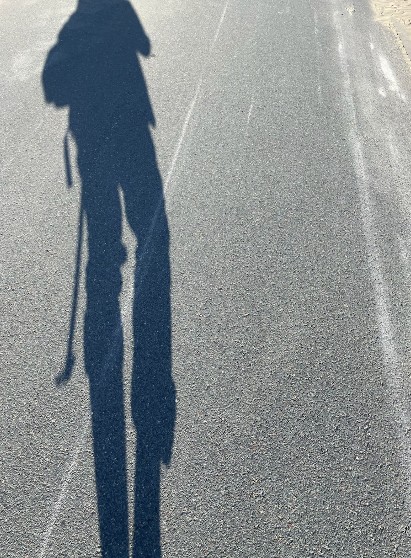
Yesterday I spent several hours walking through the Dutch countryside with Morgana — a High Priestess whose presence naturally dissolves the artificial boundaries between spirituality, ecology, poetry and everyday life.
She looked at me, smiled, and said, “You are carrying the backpack of a modern pilgrim.” Her words stayed with me.
What does it mean to become a pilgrim in our century? Not simply someone who travels; not merely someone who seeks, but someone who allows every encounter to become sacred territory. For thousands of years humanity has walked towards holy places, Mecca, The Camino de Santiago, Wirikuta, Jerusalem. Along the River Ganges, towards sacred mountains, in Ancient forests and Stone circles.
The pilgrim left home searching for God. The modern pilgrim still does; but perhaps today something beautiful is happening. The sacred destination has expanded. The boardroom can become a monastery; a train station may become a temple. A conversation over tea can become a ceremony. A project meeting may become an act of reconciliation. The Earth itself has become the pilgrimage.
As a cosmopolitan Mexican, I carry my own existential molcajete. Inside it, history, Indigenous memory, Catholic echoes, mystical traditions, political science, friendship, heartbreak, economics, poetry, entrepreneurship, meditation and laughter are slowly becoming a kind of ontological guacamole.
It may sound humorous. Yet perhaps wisdom has always been prepared this way: not by purity, but through loving integration. During these months my pilgrimage has taken me from Indigenous gatherings in Switzerland to conversations about Celtic spirituality in the Netherlands.
From serving initiatives inspired by the Charter for Compassion in Mexico to learning from communities in Yucatán. From preparing proposals on Ancestral Diplomacy to dreaming of educational models that may someday help political leaders remember their humanity. None of these experiences cancel one another. They illuminate one another. Modern pilgrimage is not escaping the world. It is entering it more deeply. It is discovering that spirituality does not end where economics begins, nor where science begins, nor where politics begins.
Perhaps our greatest mistake has been imagining that these worlds are separate. Through what I call Spiritual Politics, I have gradually come to understand politics differently. Politics is not first about governments. It is about relationships. It is about the quality of presence between human beings. It is about the invisible atmosphere from which decisions emerge. Before every public policy there is a human heart. Before every institution there is consciousness. Before every conflict there was once a forgotten conversation.
If consciousness changes, politics changes. People often ask whether a School of Conscious Politics is idealistic. Perhaps. But every civilization has been built upon someone’s impossible dream. The real question is different. Can we educate leaders whose intelligence includes compassion? Can courage coexist with tenderness? Can firmness coexist with humility? Can strategic thinking emerge from love rather than fear?
I believe it can. Not because humanity has already arrived there, but because countless people are quietly walking toward that possibility. They are modern pilgrims.
Morgana spoke lovingly about conversations with the Moon. About rituals that clear old energies. About feeding love into the spirit of the North Sea. Listening to her, I remembered something our technological age desperately needs: symbolic intelligence. The human soul does not live by information alone. It also lives through myth, beauty, silence, ritual, wonder and poetry. These are not luxuries; they are ancient technologies of consciousness.
A modern pilgrim may also be what I like to call a soulful entrepreneur. Not someone who builds companies merely to generate profit. But someone who builds living ecosystems capable of generating trust, healing, beauty and belonging.
Economic sustainability becomes another language through which love learns to organize itself. Perhaps business, too, can become pilgrimage. My own journey has slowly revealed a simple vocation.
To become a bridge, not the destination; not the owner of truth. Simply a bridge, connecting Indigenous wisdom with public institutions. Mysticism with academia; poetry with policy; finance with compassion; science with consciousness. Ancient traditions with emerging generations, with different religions without demanding sameness, with different nations without abandoning local roots.
The modern pilgrim remembers that healing does not come only from looking at trauma. We must also cultivate beauty. Generate hope. Radiate love. Feed the frequencies we wish future generations to inherit. This too is activism. Perhaps one of its deepest forms.
I increasingly feel that humanity is moving from the age of Me toward the age of We. Not because individuality disappears. But because individuality matures into relationship. Nothing meaningful is truly mine. Not my foundation. Not my country. Not my tradition. Not even my ideas. Everything meaningful eventually becomes ours. One Humanity. One Mother Earth. One shared future.
The tree has become one of my favourite teachers. Its roots grow downward while its branches reach outward. Without deep roots there is no expansion. Without expanding branches there is no offering. Perhaps we are invited to become living trees. Rooted in our ancestors. Open to the sky. Grounded in community. Reaching toward knowledge. Art. Science. Healing. Spirituality. Public service. Love.
Being a modern pilgrim is not about walking faster. Nor farther. It is about walking more consciously and listening more deeply, creating more courageously and serving more generously.
Allowing every encounter to remind us that every human being may carry a forgotten piece of our own soul. As my meditation teacher often says, “Welcome everything from the heart.”
Perhaps that is all pilgrimage has ever been. Not reaching a destination, but becoming one.
So I leave you with the same question Morgana unknowingly left with me.
When you hear the words “modern pilgrim”, what awakens within you?
What roads have shaped your soul? Who have you become while walking? And where is Love inviting you to go next?
With gratitude,
Rodmaro
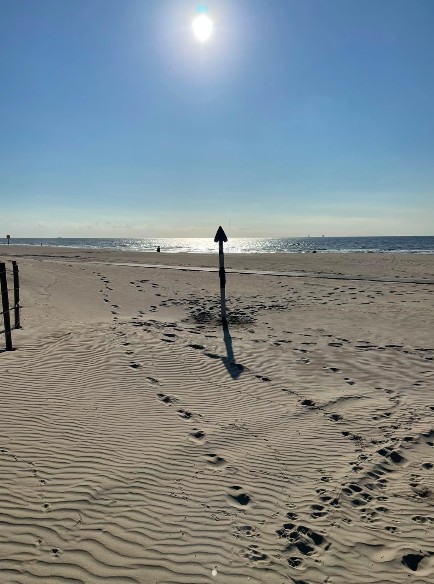
(At the beach, Kijkduin, the Hague, looking out to the North Sea.)
All photos by Rodmaro, July 2026