
- To continue – in my first article I explored the Neolithic sanctuaries and figurines and in the second I examined the living traditions of the Mamuthones and Issohadores. The Nuraghi provide the ideal bridge between Sardinia’s prehistoric spirituality and its enduring cultural identity. We are invited to consider how spiritual, social, and political life may have developed. The mystery surrounding the Nuraghi and the Nuragic civilisation is also part of this fascination.
The Nuraghi – Stone Towers of Mystery.
Definition: A nuraghi (plural: nuraghe) is an ancient, cone-shaped stone tower built by the Nuragic civilization between 1900 and 730 BC. Found exclusively on the Italian island of Sardinia, these megalithic structures feature thick dry-stone walls and hollow, dome-shaped inner rooms.
From this perspective the island of Sardinia is often described as an open-air museum. Nowhere is this more evident than in the thousands of Nuraghi that still rise above its hills, valleys, and plains. Built more than three and a half thousand years ago, these remarkable stone towers remain one of the Mediterranean’s greatest archaeological enigmas.
In my previous articles, we explored the sacred landscapes of the Neolithic peoples and the enduring traditions of the Mamuthones and Issohadores, whose mysterious rituals continue to animate Sardinia’s cultural life. We now journey further into the island’s distant past, to the monumental legacy of the Nuragic civilisation.
Who were the people who built these extraordinary towers? Were they warriors, astronomers, traders, or priests? Were the Nuraghi fortresses, places of worship, symbols of power — or perhaps all of these at different times? Despite more than two centuries of archaeological investigation, many questions remain unanswered.
What is beyond dispute is that the Nuragic people created one of Europe’s most remarkable Bronze Age civilisations. Their achievements in engineering, architecture, metallurgy, and maritime trade reveal a sophisticated society that was deeply connected to the wider Mediterranean world while retaining a distinctive identity all its own.
Although their language has vanished and their beliefs remain largely unknown, the Nuraghi continue to speak through their enduring presence. They remind us that history is not only written in books but also preserved in stone, in landscape, and in memory.
Perhaps that is the greatest mystery of Sardinia. The island never truly reveals all its secrets. Instead, it invites us to listen — to the whisper of the wind across basalt walls, to the silence of the sacred wells, and to the timeless dialogue between people and the land they have called home for millennia.
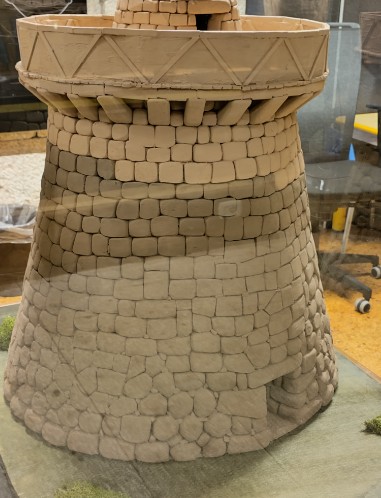
A Nuraghe Tower – Nat. Archaelogical Museum of Cagliari
The Nuraghi are among the greatest archaeological mysteries of the Mediterranean. They are the enduring monuments of a civilisation that flourished more than 3,500 years ago. They are uniquely Sardinian: nowhere else in the world do we find these extraordinary stone towers in such numbers or with such variety.
The Nuragic civilisation developed between approximately 1800 BCE and 238 BCE, spanning the Bronze Age and early Iron Age. It takes its name from the Nuraghi (singular: nuraghe), the monumental stone towers that dominate the Sardinian landscape.
More than 7,000 Nuraghi still survive today, although archaeologists estimate that between 10,000 and 20,000 may once have existed across the island. This remarkable density suggests a sophisticated and highly organised society.
Unlike many contemporary Mediterranean peoples, the Nuragic people left no written records. Everything we know comes from archaeology. Why they were built remains one of archaeology’s great debates. The traditional interpretation was that they served as fortresses or defensive towers. Certainly, many occupy commanding positions overlooking valleys, plains, and coastlines.
However, modern research suggests they fulfilled multiple roles. A nuraghe could simultaneously function as a residence for local leaders or as a communal gathering place, or a religious sanctuary. It was always a symbol of prestige and authority. As watchtowers controlling trade routes, they were also a refuge during times of danger. Many scholars now view them as the political and ceremonial centres of small territorial communities.
One of the most astonishing aspects of the Nuraghi is their construction. They were built without mortar. Enormous basalt, granite, or limestone blocks — some weighing several tonnes — were carefully shaped and stacked using cyclopean masonry. The inward-leaning walls create a corbelled dome that has survived earthquakes, weather, and more than three millennia. The tallest surviving examples originally reached around 20 metres (65 feet). Their builders possessed remarkable engineering knowledge despite having only Bronze Age tools.
Most Nuraghi did not stand alone. Around them grew villages consisting of circular stone houses with paved streets, wells, workshops, granaries, and meeting places. The best example is Su Nuraxi, now a UNESCO World Heritage Site, where over fifty huts surrounded a massive central fortress. This reveals communities that were organised, prosperous, and capable of large cooperative building projects.
For many years the Nuragic people were portrayed as isolated shepherds. Today that picture has changed dramatically. Excavations have uncovered Mycenaean pottery from Greece, Cypriot copper, Levantine luxury goods, Etruscan artefacts and Phoenician imports. These discoveries demonstrate that Sardinia formed an active part of Mediterranean trade networks. Copper, lead, silver, and possibly tin made the island an important centre during the Bronze Age.
One of the things that struck me about the design of the nuraghe was the corbelling. This is a building technique that stacks flat stones or bricks in steps. Each layer sticks out slightly farther than the one below it. This allows the walls to meet at the top to create a roof or an arch without using cement. I remember seeing the very same technique used at the temples and the uncemented walls in Hattusha.
Compare:
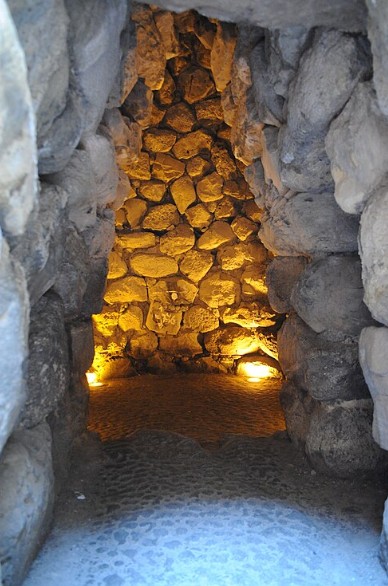
(“Site nuragique de Barumini Su Nuraxi en Sardaigne, Italie -030.JPG” by Domimf is licensed under CC BY-SA 3.0.)
And this:
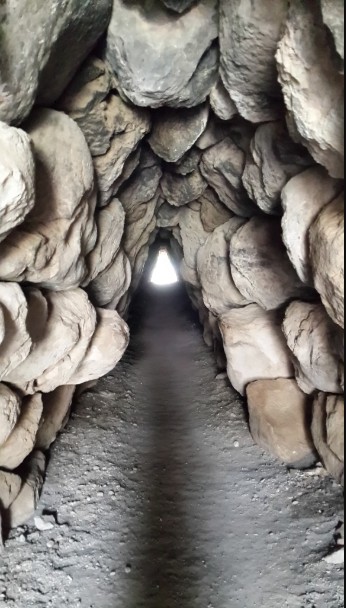
(Hattusha: Entrance to one of the posterns (= tunnels) in the Postern Wall)
There is no direct political or cultural alliance between the Hittite Empire of Anatolia and the Nuragic people of Sardinia. They lived on opposite sides of the Mediterranean Sea and spoke completely unrelated languages. However, they do share a fascinating, indirect connection through the Late Bronze Age Collapse (c. 1200 BCE) and a mysterious group of seafarers known as the “Sea Peoples”, or Shardana.
Egyptian records describe the Sea Peoples as a loose confederation of raiders who destabilized the Eastern Mediterranean. These raids culminated in the destruction of the Hittite Empire. One of the most prominent groups among these raiders was the Sherden (or Shardana). Many prominent archaeologists believe the Sherden were the Nuragic people of Sardinia.
Before the Hittite Empire collapsed, they fought the Egyptians under Ramesses II at the famous Battle of Kadesh (c. 1274 BCE). During this battle, Ramesses II used Egyptian temple reliefs show these Sherden guards — carrying round shields and wearing distinct horned helmets — fighting directly against the Hittites.
The link between the Sherden and the Nuragic civilization relies heavily on Bronze Age archaeology. Nuragic pottery from the 13th century BCE has also been found in Cyprus and the Levant. This seems to prove that Sardinian mariners were actively sailing the Eastern Mediterranean trade routes right alongside the Hittites.
A minority of scholars however argue the reverse migration path. They suggest the Sherden originated near western Anatolia (close to the Hittite sphere of influence). In this theory, the Sherden attacked Egypt, failed, and eventually fled west to settle on the island, giving their name of Shardana /Sea Peoples to Sardinia
In part 1 I mentioned Sabina Magliocco a folklorist and anthropologist whose expertise lies in Sardinian festivals, folklore, ritual, vernacular religion, and contemporary Paganism. Consequently, she does not attempt to write a comprehensive history of the Nuragic civilisation in the way that scholars such as Giovanni Lilliu, Gary Webster, or Fulvia Lo Schiavo do. Instead, she is interested in how modern Sardinians imagine, reinterpret, and use the Nuragic past.
One of her most relevant discussions appears in Coordinates of Power and Performance: Festivals as Sites of (Re)Presentation and Reclamation in Sardinia.
She observes that the Nuraghi have become powerful symbols of Sardinian cultural identity. She notes that they are far more than archaeological monuments; they are woven into the island’s sense of itself. Modern Sardinians invoke the Nuragic civilisation as evidence of an ancient, sophisticated, and independent culture that predates Roman rule and distinguishes Sardinia from mainland Italy. This is particularly important in the context of regional autonomy and cultural revival.
Magliocco also discusses a fascinating phenomenon from the 1990s: organisers of solstice celebrations at Nuragic sites promoted the towers as ancient astronomical temples and centres of solar and lunar worship. Advertising claimed that the mysteries of the Nuraghi had finally been solved and invited visitors to experience “the revival of the ancient traditions of the great Nuragic civilizations.”
She approaches these claims critically. She notes that while such events are culturally significant as examples of heritage-making, the archaeological evidence does not support many of the grander assertions. As she essentially argues that archaeology becomes mixed with imagination; tourism merges with spirituality and history is transformed into cultural performance.
She does not dismiss contemporary spiritual engagement with the Nuraghi. Rather, she suggests that people continually reinterpret the past to meet present needs. Ancient monuments become places where identity, spirituality, memory, and heritage intersect.
As a folklorist, she asks questions such as; why are people drawn to these places today? How do stories about the Nuraghi shape Sardinian identity? Why do ancient monuments continue to inspire spiritual experiences? These are different questions from those asked by archaeologists.
In my first article I cited Magliocco’s essay Aradia in Sardinia: The Archaeology of a Folk Character. There she explores survivals and transformations in Sardinian folk belief but is careful not to claim an unbroken line from the Nuragic civilisation to modern Paganism. Instead, she traces layers of influence – from prehistoric traditions to Roman, medieval, and Christian practices — showing how folklore evolves over time rather than remaining unchanged.
In any event, one of the most fascinating discoveries is the collection of Bronzetti — small bronze statues created between about 1200 and 700 BCE. These figures depict warriors wearing the exact same horned helmets, round buckler shields, and long straight swords seen on the Sherden in Egyptian carvings.
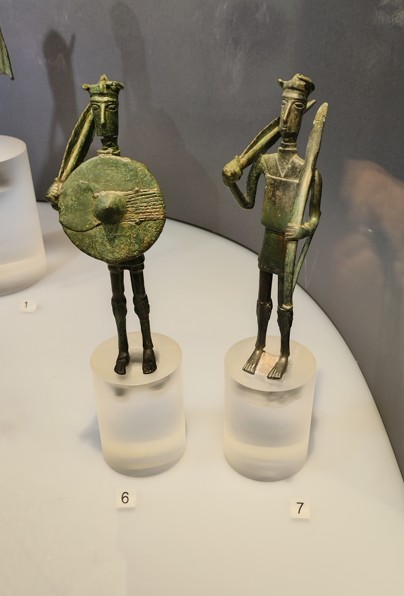
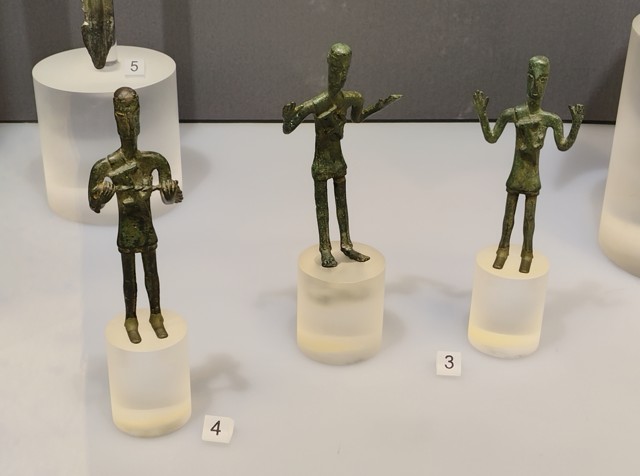
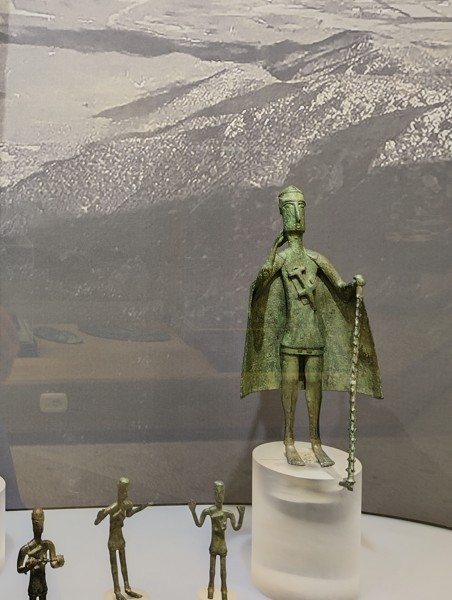
Bronzetti figurines – Nat. Archaelogical Museum Cagliari
The Bronzetti are, in my opinion, one of the most captivating artistic achievements of the Nuragic civilisation. Unlike the monumental Nuraghi, which impress through their scale, the Bronzetti reveal the human face of Bronze Age Sardinia. Through these small figures, we glimpse the people themselves — their appearance, occupations, beliefs, and aspirations.
The small bronze figurines were cast between approximately 1200 and 700 BCE using the sophisticated lost-wax technique. Ranging from only a few centimetres to around 35 centimetres in height, these remarkable sculptures are masterpieces of Bronze Age craftsmanship. Unlike the imposing Nuraghi, the Bronzetti bring us face to face with the people who inhabited them. They portray warriors proudly carrying shields, swords and bows; chieftains wearing elaborate cloaks; hunters, shepherds, musicians and craftsmen; mothers carrying children; priests and women making ritual offerings; as well as animals and beautifully detailed model ships. Together they form a miniature portrait gallery of Nuragic society.
The figures are immediately recognisable by their distinctive artistic style. Their large almond-shaped eyes, prominent noses, elongated limbs and carefully rendered clothing create a balance between realism and symbolism. Every detail — the intricate helmets, finely worked jewellery, ceremonial staffs and woven garments — reflects the extraordinary skill of Nuragic metalworkers.
Most Bronzetti were not decorative objects but votive offerings. They were dedicated at sacred wells, temples and sanctuaries, perhaps in gratitude for healing, successful harvests, safe journeys or victory in battle. Each figure may have represented the individual making the offering or embodied a prayer entrusted to the divine.
To modern eyes, the Bronzetti seem surprisingly alive. Although over three thousand years old, they convey movement, personality and emotion. A warrior stands alert, an archer prepares to draw his bow, a woman raises her hand in blessing, a mother cradles her child. They remind us that the Nuragic people were not anonymous builders of stone towers but men, women and children whose hopes, beliefs and daily lives were not so different from our own.
One fascinating point, I think, is that the Bronzetti were almost certainly not portraits of specific individuals. Rather, they represent social roles within Nuragic society — warriors, chiefs, priests, musicians, sailors, mothers, hunters, and devotees. In that sense, they function much like a visual catalogue of the civilisation itself.
The Bronzetti can be seen as expressing the values and identity of the community: who held authority, who protected society, who nurtured families, and who mediated the relationship between people and the sacred. They are not merely works of art but windows into how the Nuragic people understood themselves and wished to be remembered.
My favourite is the “The Sacerdotessa (“Priestess”)” – see the photo below of the replica I found in Cagliari. While warriors and archers dominate the Nuragic bronze repertoire, a small number of female ritual figures suggest that women also held important ceremonial roles.
From an online shop selling the statuette (see more information under ‘References’)
“The Sardinian bronzes from the Nuragic era representing priestesses are witnesses to the very strong religiosity of the Nuragic populations, closely linked to nature, water, woods, the sun and the moon, in which they acted as mediators between the people and the gods or between the living and the dead.
The Nuragic priestess is an elegant Sardinian bronze statuette. She wears a robe consisting of a large cloak, very similar to that of the tribal chief bronzes, representing a symbol of power and aristocracy. Her open arms symbolize a gesture of welcome, availability, and protection towards the Nuragic people. Her distinctive hat, with a wide brim and a conical tip, revealing her long hair falling to her shoulders, also serves to confer power and charisma to her personality.”
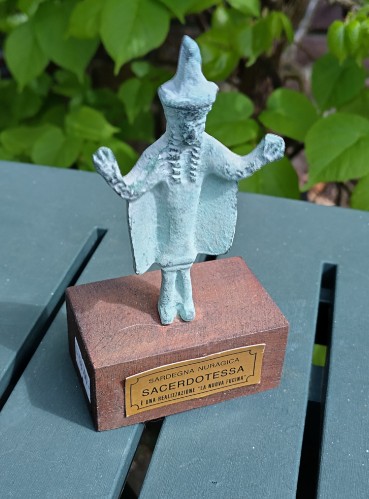
Sardinia’s Nuragic Priestess Wrought Iron Bronzes, a creation of ‘La Nuova Fucina’
One of the best-known examples is the Bronzetto di sacerdotessa orante (“Bronze figurine of the praying priestess”), discovered at the Nuragic complex of Albucciu near Arzachena and now housed in the Museo Nazionale “G. A. Sanna” in Sassari. It stands about 13 cm high and was cast using the lost-wax technique. This figurine is also similar to the one I mentioned above.
The figure wears a long cloak or mantle draped over the shoulders, with a short tunic beneath and a distinctive tall conical headdress. There is a tubular collar covering the neck and one arm raised in what appears to be a gesture of prayer or blessing. With the other hand she is holding a shallow bowl or offering vessel. The large eyes, aquiline nose, and stylised features are characteristic of Nuragic bronze sculpture.
Although we cannot reconstruct Nuragic religion in detail, the Sacerdotessa suggests several things. First, women clearly occupied visible positions within Nuragic society. The Bronzetti depict not only warriors and chiefs but also women engaged in what appear to be ceremonial acts. Secondly, the bowl almost certainly represents an offering — perhaps grain, wine, milk, water, or incense. Similar offering vessels occur throughout Bronze Age Mediterranean religions. Thirdly, the raised hand resembles the ancient Mediterranean gesture of prayer or invocation, found in Minoan, Mycenaean, Etruscan, and later Roman religious art. Whether this reflects a shared symbolic language or parallel development is still debated.
Sardinia contains over a hundred sacred wells and springs associated with the Nuragic civilisation. Many archaeologists believe that bronze figurines such as the Sacerdotessa were deposited at these sanctuaries as votive offerings. The Bronzetti were probably dedicated in thanks, in hope of healing, or in fulfilment of vows. Sacred wells such as Santa Cristina Sacred Well and the sanctuary at Santa Vittoria have yielded evidence of ritual activity consistent with this interpretation.
The little bronze figure known as the Sacerdotessa reaches across three millennia with a gesture that still feels familiar. Whether she was truly a priestess, a noblewoman, or a devotee presenting an offering, we cannot know. Yet her raised hand and offering bowl speak a universal language of reverence. She reminds us that long before temples of marble or written liturgies, people gathered in sacred places to honour the powers they believed sustained life. Across the centuries, her silent gesture continues to evoke humanity’s enduring search for relationship with the sacred.
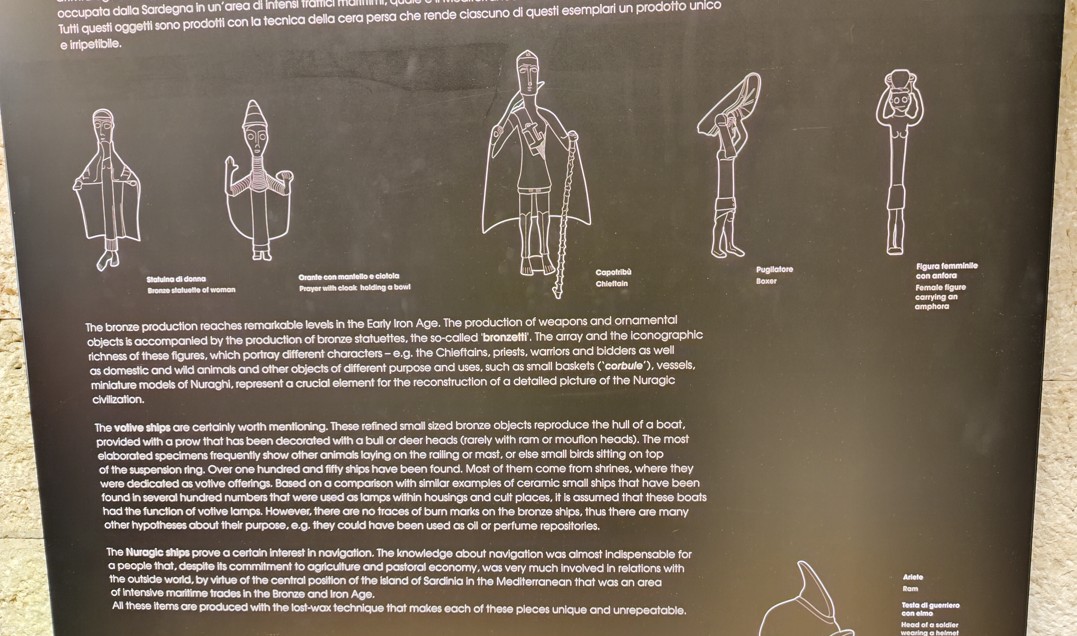
(Information about the Bronzetti figurines – Nat. Arch. Museum Cagliari)
In conclusion, they provide a vivid glimpse into Nuragic society and suggest a culture that celebrated warriors, spirituality, craftsmanship, and seafaring.
The Giants of Mont’e Prama
One of the most exciting archaeological discoveries came in 1974 with the unearthing of the colossal limestone statues at Mont’e Prama. They are monumental limestone statues created by the Nuragic civilisation of Sardinia between approximately the 11th and 8th centuries BC. They are also the oldest known life-sized stone statues in the western Mediterranean, predating the great Classical Greek sculptures by several centuries.
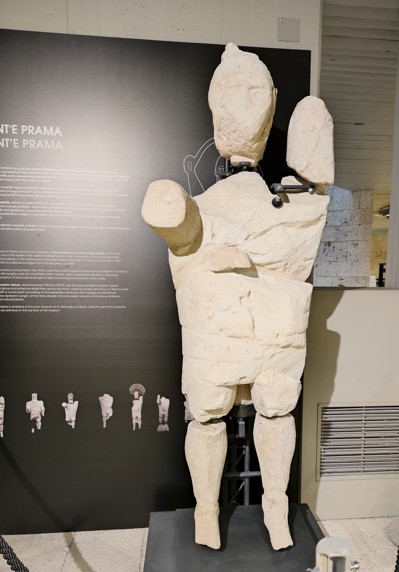
(Giants of Mont’e Prama – Nat. Arch Museum Cagliari)
These towering figures represent warriors, archers, and boxers, standing over two metres tall. They are among the earliest monumental sculptures in the western Mediterranean and challenge previous assumptions about the artistic achievements of the Nuragic civilisation.
The statues portray three principal types of figures:
Boxers – perhaps ritual champions, carrying an elongated shield over the head and wearing a distinctive armed glove Archers – equipped with bows, horned helmets, chest armour and greaves and thirdly Warriors – carrying round shields and swords, representing the military elite.
In addition to the human figures, archaeologists found stone models of the iconic Nuragic towers and sacred baetyl stones, suggesting the site held profound ceremonial significance.
The Giants have an unforgettable style standing 2 and 2.5 metres tall. Their faces are highly stylised and the eyes consist of two perfectly concentric circles, giving them an almost supernatural gaze. The strong geometric forms, prominent noses and simplified mouths create a powerful, timeless expression. Many people have remarked that they appear almost modern in design despite being nearly three thousand years old. It is still a mystery as to why they were made.
The prevailing theories include; a hero cult honouring legendary ancestors or founding heroes of an aristocratic lineage. Or perhaps they were guardians of a necropolis, as they stood watch over an elite cemetery, protecting the dead. They may have formed part of a sacred ceremonial landscape celebrating the relationship between ancestors, warriors and the divine.
Religion was central to Nuragic life. Across Sardinia archaeologists have identified sacred wells and springs built with astonishing precision. Sites such as Santa Cristina Sacred Well display extraordinary architectural skill, with carefully cut stone stairways descending to underground water chambers. Many researchers believe these were centres of water worship and seasonal ceremonies, reflecting the island’s deep reverence for springs and the life-giving power of water.
The Nuragic civilisation did not disappear overnight. Beginning around the 9th century BCE, Phoenician traders established coastal settlements, followed by Carthaginian expansion and eventually Roman conquest in 238 BCE. Rather than being destroyed, the Nuragic people gradually became part of these new political and cultural worlds while preserving many aspects of their own traditions.
Standing within a Nuraghe however, one senses more than remarkable engineering. These ancient towers seem to hold the memory of a people who understood the land, honoured the ancestors, watched the stars, and lived in relationship with the cycles of nature. Though their language has fallen silent, the stones continue to speak — not in words, but in endurance, mystery, and presence. Like the sacred wells and the timeless mountains of Sardinia, the Nuraghi remind us that some truths are carried not by books, but by landscapes themselves. Today we experience a profound sense of sacredness.
Whether this reflects the intentions of its Bronze Age builders is something archaeology cannot yet determine. As anthropologist Sabina Magliocco reminds us, the meanings attached to these ancient monuments continue to evolve. The Nuragic finds and particularly the Bronzetti are not only relics of a remarkable civilisation; they have also become powerful symbols through which modern Sardinians — and many visitors — explore questions of identity, heritage, and spirituality.
REFERENCES:
Tales of Anatolia – from Ankara to Hattuşa and the Hittites – part 2
Hattusha photo: Morgana June 2014, see: /https://wiccanrede.org/wp-content/uploads/2015/01/20140608_111747.jpg
Photos of the Bronzetti figurines – Nat. Archaelogical Museum Cagliari – Morgana 2025
Sardegna Nuragica ‘Sacerdotessa’ Bronzetti Ferro Battuto una realizzazione ‘La Nuova Fucina’/Sardinia’s Nuragic Priestess Wrought Iron Bronzes, a creation of ‘La Nuova Fucina’ photo Morgana 2025
Photo of the Giants of Mont’e Prama – Nat. Archaelogical Museum Cagliari – Morgana 2025
Nuragic bronze statuette depicting the Priestess. Colour: Copper Green, Total height with wooden base: 12 cm https://www.sardegnacommercioelettronico.it/shop/bronzetti-nuragici/prodotto/1552-bronzetto-nuragico-sacerdotessa-verde-rame.html
virtualarchaeology.sardegnacultura.it)
https://historica.fandom.com/wiki/Nuragic_tribes
Sabine Magliocci ‘Festivals as Sites of (Re)Presentation and Reclamation in Sardinia’;
https://www.erudit.org/en/journals/ethno/2001-v23-n1-ethno06889/1087921ar.pdf?
https://www.sardegnacultura.it/articolo/bronzetti?
NB For the archaeological & academic perspective, see the works & papers by Giovanni Lilliu, Gary Webster, and Fulvia Lo Schiavo.
See also, “The bronze statuettes and the identity of Nuragic people”:
And this YouTube clip from ‘Dan Davis History’, The Nuragic Civilisation of Bronze Age Sardinia.
