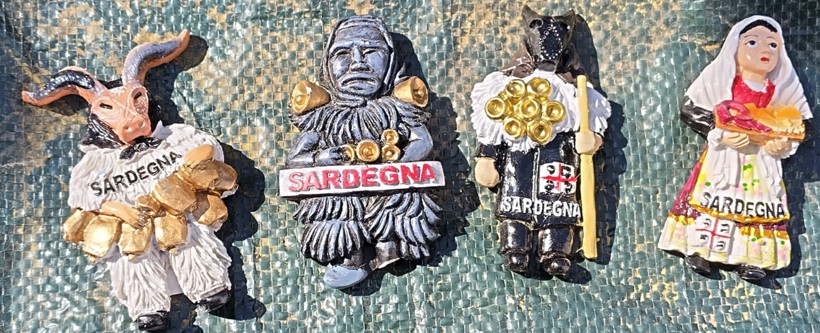
(Diverse magnets depicting Mamuthones and a Lady carrying a basket of bread.)
Continuation of Tales of the Mediterranean – the Enigma of Sardinia – Part 1
That I made a connection with what I later found out to be an Issohadores was the highlight of my visit to Sardinia. When I was in Cagliari I visited a couple of museums including the ‘Museo Archeologico Nazionale’. Afterwards I checked out the souvenir shops and found the 3 terracotta figurines I mentioned in the main article. I also found a dusty, long unnoticed figure of a masked person, dressed in red & white, with a rope, mounted on a piece of Cork. I asked how much it cost, thinking already that it would be way over budget. It wasn’t! The shopkeeper was amazed that I said yes, without hesitation, but also nodded as if it was a recognition of a fellow traveller.
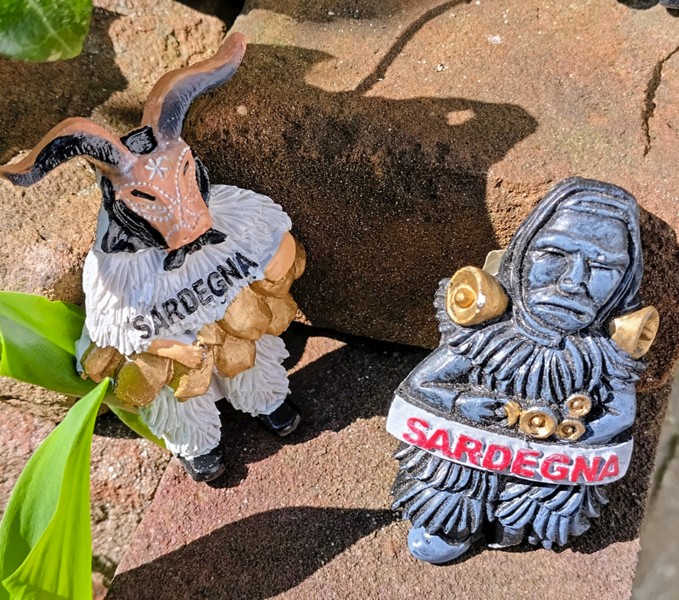
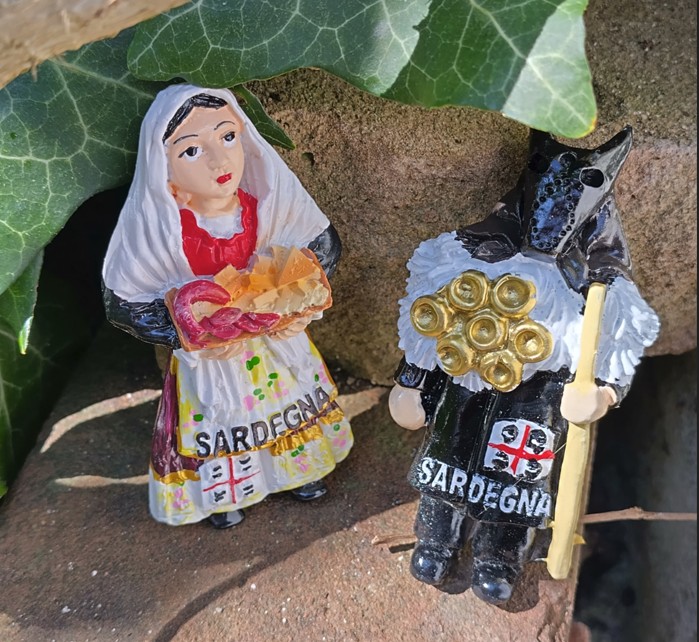 I also found several magnets with Mamuthones. See the corresponding photos. I think most tourists have no idea of who and what they are. Hopefully, this article (Part 2) will shed some light on the nature of them. Read on.
Who are the Mamuthones and Issohadores?
The Mamuthones are the most visually striking figures, dressed in black sheepskins, wearing heavy wooden masks (often dark, expressionless, almost mournful). They carry 30 kg or more of bronze bells (campanacci) strapped to their backs. They move in a slow, rhythmic, almost trance-like procession, stepping in unison so the bells produce a deep, resonant, almost hypnotic sound. Their presence feels ancient, Earth-bound, more like forces than individuals.
The Issohadores accompany and guide the Mamuthones. They wear white trousers, red jackets, and colourful sashes. They have lighter, more expressive masks and carry a rope (soha), which they use to “capture” spectators. Their role is more dynamic and interactive as they control the movement of the Mamuthones. They engage with the crowd and being caught by the rope is traditionally seen as a good omen.
The main performances take place during Carnival (January–February, leading up to Lent), and key dates in Mamoiada include Feast of Saint Anthony (January 16–17) – often considered the ritual beginning of the main Carnival days before Ash Wednesday. But, and this is crucial, the ritual clearly predates Christianity and has been absorbed into it rather than created by it.
There is no single explanation which fully accounts for the tradition, but several interpretations coexist. Looking at the Prehistoric / Agro-pastoral ritual, many scholars link the Mamuthones to the Seasonal Cycles, Fertility Rites and the relationship between humans, animals, and the land.
The heavy bells and animal skins suggest a transformation into animal or ancestral beings. There is a ritual “waking” of the land at the end of winter. This resonates strongly with the symbolic world of the Ozieri culture and later Sardinian traditions — where human identity, animal presence, and the unseen world are deeply intertwined.
Another theory suggests that the Mamuthones represent captives or subjugated people, whilst Issohadores represent controllers or elites. This is sometimes linked (speculatively) to conflicts with invaders, or social hierarchies within Sardinia.
However, this explanation feels less convincing to many researchers because it doesn’t fully account for the ritual intensity and symbolic depth. A more nuanced reading sees Mamuthones as forces of nature, chaos, or the underworld whilst the Issohadores represent order, control, social structure. The interaction between them becomes a ritual balancing of energies, not unlike seasonal rites elsewhere in Europe
The importance of sound and movement. The bells are not just decoration — they are central. The synchronized movement creates a collective rhythm and the sound is felt physically, not just heard. It induces a kind of shared altered state, both for performers and observers.
This aligns with many ancient ritual traditions where repetition, plus sound and movement, equals transformation.
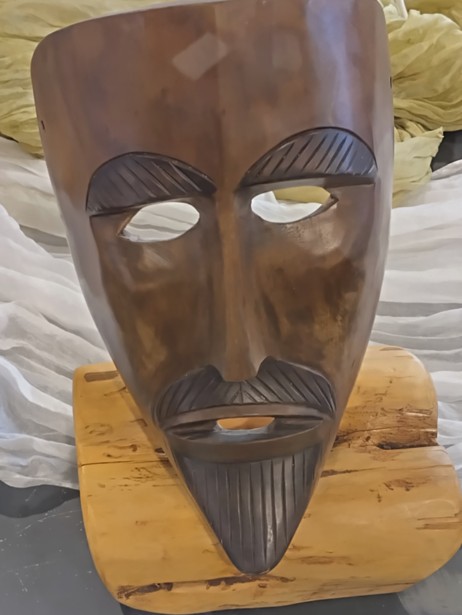
(Photos of masks seen at the airport at Olbia, promoting folklore in Sardinia – 1)
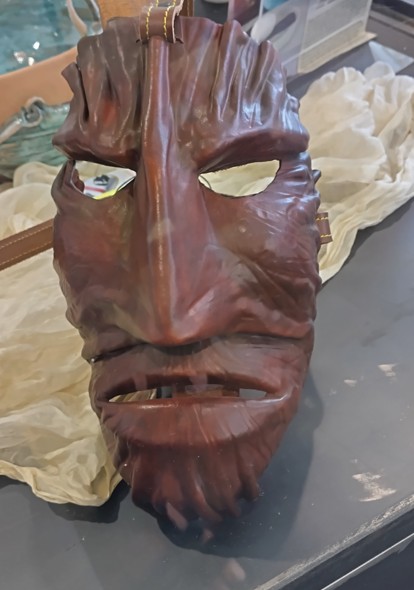
(Photos of masks seen at the airport at Olbia, promoting folklore on Sardinia – 2)
When I connected this to what I saw in the figurines and tombs (Domus Janus), the Mamuthones’ masks resemble faces without individuality. Their movement is deliberate, heavy, almost funerary. Their anonymity suggests they are not “people” but presences. They embody ancestors. They are the mediators between the living community, the land, the dead. This echoes the worldview behind the Domus de Janas, where the dead remain part of the community.
They present a living ritual in which the human form is masked, weighted, and transformed — continuing a Sardinian tradition that stretches from Neolithic figurines to Bronze Age bronzes, where identity is not fixed but negotiated between body, symbol, and presence.
Unlike many reconstructed traditions, this one is continuously practised. It is deeply rooted in local identity, still emotionally powerful. In a modern context, they raise questions about memory carried through ritual rather than text. The persistence of pre-Christian cosmologies beneath later layers and the relationship between humans, land, and unseen forces.
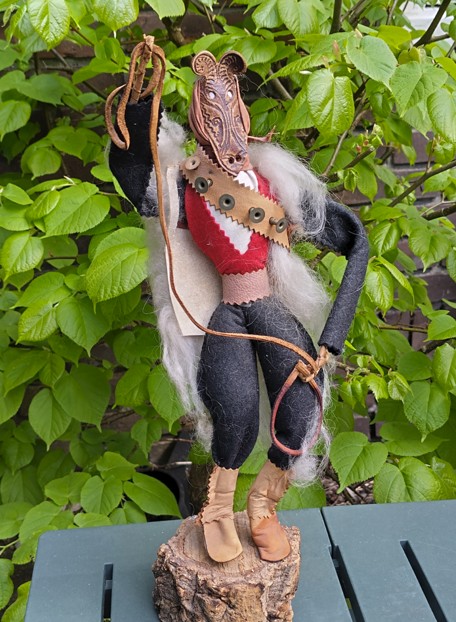
(Meet my Issohadores, frontview)
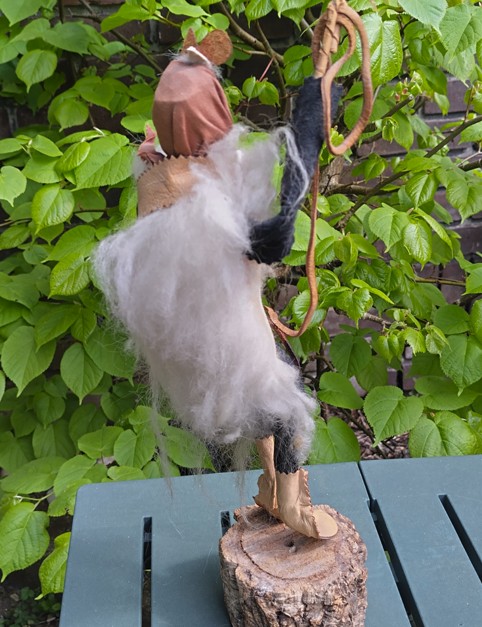
(My Issohadores from the back, with a sheepskin.)
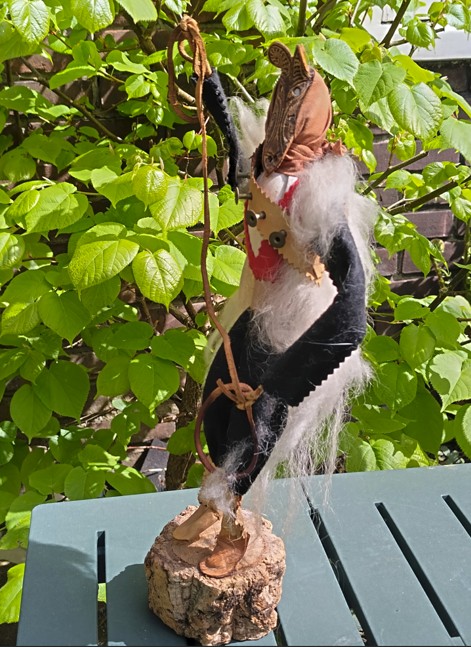
(And now from the left – note the Cork on which it is mounted. Cork is sacred to Sardinia.)
The more visually imposing Mamuthones often overshadow the Issohadores, but they are in many ways the key to understanding the ritual. Without them, the performance would lose its structure, its interaction, and much of its meaning. So, who are the Issohadores?
The Issohadores come from Mamoiada and appear alongside the Mamuthones during Carnival processions. Their defining features include white shirts and trousers, red waistcoat or jacket, and a brightly coloured sash (often across the chest). They wear a lighter, more human-like mask. A rope (soha) is carried coiled in the hand. They are fewer in number than the Mamuthones and move more freely, often stepping slightly ahead or to the side of the main group.
The most distinctive action of the Issohadores is lassoing people from the crowd. They throw the rope with precision, looping it around individuals. Traditionally, those caught are often young women, historically linked to fertility symbolism and visitors, or outsiders, when being captured is considered auspicious.
But this is not random play — it’s highly controlled and intentional. Symbolically, the rope may represent connection, binding individuals into the community, selection or initiation. This is a drawing in of life force or vitality. In a deeper reading, it echoes ancient ritual gestures of claiming, blessing, or marking someone as part of a shared field. If the Mamuthones embody weight, repetition, and anonymity, the Issohadores embody control and direction, agility and awareness, mediation between performers and public. They lead the procession, regulate the rhythm and spacing of the Mamuthones, and maintain order within what might otherwise feel overwhelming or chaotic.
This pairing creates a dynamic balance, not a hierarchy. Unlike the dark, almost featureless masks of the Mamuthones, the Issohadores wear masks that are lighter in colour, more expressive and closer to human features. This matters because it suggests they are not “otherworldly beings” in the same way, but rather, intermediaries, figures who can move between the masked world of the Mamuthones and the unmasked world of the community.
Several interpretations exist as to the origin of the Mamuthones and the Issohadores sit at the centre of many of them. As far as Pastoral Symbolism, the rope may echo herding practices, the capture and control of animals. The act of capturing may represent drawing individuals into community cohesion, reinforcing bonds during a liminal time of year. Carnival, after all, is a moment when boundaries loosen, and social roles are reconfigured. From a more symbolic or anthropological perspective, the Issohadores may function as threshold figures. They cross boundaries, they connect realms, they regulate transformation.
While the Mamuthones produce the deep sonic field with their bells, the Issohadores move around that sound, intervene within it and break and redirect its rhythm. They introduce variation, surprise, and interaction. Without them, the ritual would be immersive — but closed. With them, it becomes relational. The Issohadores are the agents of connection within the ritual field — figures who do not embody the force itself, but who guide, direct, and draw others into relationship with it.
If the Mamuthones feel like ancestral presences, then the Issohadores feel like those who know how to approach them, how to work with them and how to bring that encounter back into the human community. In that sense, they are not secondary figures at all — they are essential translators between worlds.
If the prehistoric figurines of the Ozieri culture suggest a human form becoming symbol, and the Mamuthones of Mamoiada embody a collective, ancestral presence, then the Issohadores introduce a vital third element: relationship.
Moving alongside the heavy, bell-laden figures during Carnival, the Issohadores are distinct in both appearance and function. Their lighter clothing, more expressive masks, and fluid movement set them apart. Most notably, they carry a rope — the soha — with which they skilfully “capture” individuals from the surrounding crowd. Far from being a playful gesture alone, this act carries an undercurrent of meaning: those caught are symbolically drawn into the ritual, marked not as spectators but as participants.
In this moment, the boundary between observer and performer dissolves. The rope becomes more than a tool; it is a line of connection, extending the ritual field outward into the community. What is enacted is not spectacle, but inclusion — a drawing-in of life, presence, and relationship.
Within the structure of the procession, the Issohadores guide and regulate the movement of the Mamuthones, whose slow, synchronised steps and resonant bells create an atmosphere that is both solemn and immersive. If the Mamuthones evoke forces that are ancient, collective, and beyond the individual, the Issohadores operate at the threshold between those forces and the human world. They are not separate from the ritual; they are its mediators.
Seen in the wider context of Sardinian cultural continuity, this role resonates with earlier forms of symbolic practice. The figurines found in the Domus de Janas were not merely objects to be observed; they participated in a relationship between the living and the dead. Similarly, the Issohadores do not simply accompany the Mamuthones — they translate their presence into lived experience, making the encounter accessible, relational, and shared.
From an interfaith perspective, this dynamic is strikingly familiar. Many traditions recognise figures whose role is not to embody the sacred directly, but to mediate access to it, such as priests, shamans, guides, or guardians of threshold spaces. The Issohadores can be understood in this light: not as authorities, but as facilitators of encounter, ensuring that what might otherwise remain distant or overwhelming becomes integrated into the life of the community.
Environmentally, too, this carries resonance. The rope, the gesture of drawing in, the act of connection all suggest a worldview in which separation is an illusion, and relationship is primary. To be “caught” is not to be constrained, but to be recognised as already part of a wider web: human, land, ancestry, and more-than-human presence intertwined.
In this way, the Issohadores complete the ritual triad. Where the figurine holds presence, and the Mamuthones embody it, the Issohadores activate it — extending its reach, grounding it in community, and ensuring its continuity across time.
The woman carrying bread, sometimes seen alongside the Carnival processions in Mamoiada, represents a quieter but essential dimension of Sardinian ritual life. Unlike the masked Mamuthones or the mediating Issohadores, she is unmasked, grounded, and unmistakably human. Her presence anchors the spectacle in the continuity of daily life, reminding us that ritual is not separate from the community it serves. The bread she carries is not merely symbolic; it is the outcome of labour, care, and a relationship with the land. In this sense, she embodies nourishment, stability, and the return from transformation to lived reality.
Bread itself holds deep cultural significance across Sardinia. Traditional forms such as pane carasau ** and elaborately decorated ceremonial loaves are central to both everyday sustenance and festive life. Bread-making has historically been a communal and often female-led practice, involving seasonal rhythms, shared knowledge, and ritualised preparation. It expresses a profound connection between soil, grain, fire, and community, transforming raw elements into something that sustains both body and culture.
Within the broader ritual context, the woman with bread can be understood as the embodiment of continuity and integration. Where masked figures evoke transformation, ancestry, and the more-than-human, she represents the re-grounding of those forces into human life. Her role highlights an important truth: that the sacred is not only encountered in moments of intensity or spectacle, but is also carried forward through everyday acts of making, feeding, and sustaining community.
Masked Winter Rituals in Europe: A Shared Language of Transformation
The ritual traditions of Sardinia do not stand in isolation. Across Europe, particularly in rural and mountainous regions, we find strikingly similar expressions in which the human form is masked, transformed, and set into motion at key moments of the seasonal cycle. Among these are the Kukeri of Bulgaria and the Alpine figures associated with Krampusnacht in Austria and neighbouring regions.
In each case, participants don elaborate costumes incorporating animal skins, horns, and masks that obscure individual identity. Bells – large, heavy, and sonically powerful – are worn on the body, producing rhythms that resonate through both landscape and community. Movement, whether slow and processional or energetic and chaotic, becomes a central means of expression. These are not merely performances to be watched; they are immersive acts that transform space, time, and relationship.
The Kukeri, with their vigorous dances and dramatic gestures, are often explicitly associated with fertility and the driving away of harmful forces. Krampus figures, emerging in the depths of winter, occupy a more ambivalent space, blending fear, discipline, and theatrical inversion within a Christianised framework. By contrast, the Mamuthones of Mamoiada move with a measured, almost solemn rhythm, their anonymity and weight suggesting not spectacle, but presence — something older, quieter, and more inwardly focused.
Despite these differences in tone, the underlying pattern is unmistakable. Across these traditions, the human body becomes a threshold: a site where boundaries blur between human and animal, individual and collective, living and ancestral. Masking does not conceal identity so much as reconfigure it, allowing the wearer to step into a role that is at once personal and transpersonal.
Importantly, there is no clear evidence that these traditions derive directly from one another. Rather, they appear to emerge from a shared substratum of agro-pastoral life in which seasonal uncertainty, dependence on the land, and the need for communal cohesion gave rise to ritual forms that could both express and mediate these realities. Whether through the slow resonance of the Mamuthones, the exuberant energy of the Kukeri, or the disruptive force of Krampus, each tradition enacts a moment of controlled transformation, marking the passage from darkness toward renewal.
Seen alongside the prehistoric figurines of the Ozieri Culture, a deeper continuity becomes visible. The same impulse that shaped small clay bodies into symbolic forms appears, millennia later, in the transformation of living bodies into masked presences. In both cases, the human figure is not fixed or self-contained, but open, capable of holding, expressing, and negotiating forces that exceed the individual.
What emerges, then, is not a single tradition, but a shared European language of ritual: one in which sound, movement, masking, and seasonal timing converge to create spaces of encounter. These are moments when identity is loosened, relationships are reconfigured, and the boundaries between worlds become permeable once more.
Ode to the Mamuthones and Issohadores
In the shadowed hills of Mamoiada, when winter loosens its final breath,
and the earth stirs beneath stone and root, you come. Not as men or women, but as memory.
Mamuthones – bearers of weight, keepers of the slow pulse –
You walk as if time itself were upon your shoulders.
Sheepskin and silence, faces carved into stillness,
You do not look at us – you look through us,
as though we too are passing.
The bells speak where you do not.
Deep-throated, iron-hearted, they call to the soil,
to the bones beneath, to seeds waiting in the dark.
Step… Sound…
Step…
Sound…
A rhythm older than speech,
older than fear – a remembering of how the world begins again.
And you, Issohadores, bright threads in the dark weaving – you move where others cannot.
White and red, breath and motion,
You circle the weight, you shape the path,
You cast your rope not to bind, but to gather. A loop through air – and suddenly, we are no longer watchers. Drawn inward, named without words, caught not by force but by belonging.
Between you, a world is held, the heavy and the light, the silent and the speaking, the ancient and the awakening. You do not perform – you become. And as the season turns – as green rises unseen beneath the surface,
as lambs stir in hidden fields, as the first warmth touches stone, your passage opens the way. Not by command, but by presence. Not by spectacle, but by remembering.
O Mamuthones, who walk with the weight of earth! O Issohadores, who cast the line between worlds!
In your steps, winter yields. In your sound, the sleeping stirs. In your turning, we are called again into the great weaving of land, of life, of all that was, and all that is becoming.
REFERENCES
** Pane carasau is a traditional, ultra-thin, and crispy flatbread originating from the island of Sardinia, Italy, with a history dating back to at least 1000 BCE
Booklet “Religious and Secular Festivals in Sardinia” / FFI SARDEGNA Turismo: www.sardegnaturismo.it
See also: https://www.facebook.com/VisitSardinia/
Instagram: https://www.instagram.com/visit.sardinia
The photos were all taken by @Morgana Sythove.
Continue with Tales of the Mediterranean – The Enigma of Sardinia – Nuragic Civilization – Part 3
