
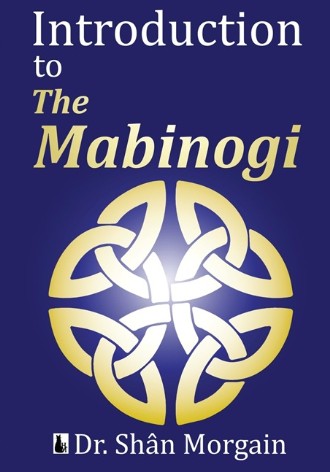
Introduction to the Mabinogi
Shân Morgain
House Morgain, 14 September 2025, 160 pages. ISBN 978-1869973070
Available from Amazon
For those who walk a Pagan path, myths are rarely simply stories of a distant past. They are landscapes of meaning, vessels of memory, and gateways into a deeper relationship with the seen and unseen worlds. Shân Morgain’s Introduction to the Mabinogi, published last September, offers readers a welcoming entrance into one of the great treasures of Welsh literature: the Four Branches of the Mabinogi.
With warmth, clarity, and respect for both scholarship and tradition, Morgain invites us to step into a world where boundaries between human and Otherworld, nature and spirit, life and death, are fluid. Here kings and queens, animals and birds, enchanted realms and ordinary landscapes exist within a web of relationship — a worldview that will resonate deeply with many contemporary Pagans seeking connection with ancestral stories and sacred landscapes.
The Mabinogi has long fascinated those drawn to Celtic traditions. The tales of Pwyll, Rhiannon, Branwen, Manawydan, and Math contain themes that continue to speak powerfully today: sovereignty, honour, transformation, sacrifice, healing, and the consequences of breaking harmony. Morgain’s approach allows these themes to emerge naturally, without forcing modern interpretations upon the material. She recognises the importance of approaching these medieval Welsh texts with care, while also acknowledging their enduring spiritual and imaginative power.
One of the greatest strengths of Introduction to the Mabinogi is that Morgain does not present the tales as simplistic remnants of a “pure” pre-Christian Celtic religion. Such interpretations can easily overlook the complexity of the medieval manuscripts and the centuries of transmission through which these stories have travelled. Instead, she honours the Mabinogi as living literature — a body of wisdom that can be appreciated historically, artistically, and spiritually.
For many Wiccans and Pagans, the attraction of Celtic mythology lies not only in gods and heroes but in the relationship between people, land, and the Otherworld. The Mabinogi reminds us that the landscape itself is alive with presence and meaning. Rivers, forests, animals, hills, and boundaries between worlds are not merely settings; they are participants in the unfolding of the story.
The figure of Rhiannon, in particular, continues to inspire many modern Pagans. Associated with sovereignty, mystery, horses, and Otherworldly power, she represents themes of dignity, endurance, and transformation. Yet Morgain wisely avoids reducing her to a single modern archetype. Instead, she allows Rhiannon — and all the characters of the Mabinogi — to remain complex figures whose meanings continue to unfold.
The book is also valuable for readers interested in the concept of sacred kingship and the relationship between ruler and land. Throughout the Mabinogi, personal actions have consequences not only for individuals but for communities and the wider world. Harmony must be restored when relationships are damaged. This understanding of interconnectedness feels remarkably relevant in an age when many Pagan traditions are once again exploring ecological spirituality, the rights of Nature, and humanity’s responsibilities towards the Earth.
Morgain’s writing style is particularly suited to those approaching the Mabinogi for the first time. She shares her knowledge without creating barriers of academic language, allowing the reader to experience the wonder of the stories themselves. Her affection for the material shines through, encouraging readers to continue their own exploration of Welsh mythology, folklore, and tradition.
Those already deeply familiar with Celtic studies may wish for a more extensive discussion of manuscript history, medieval Welsh society, or the complex debates surrounding possible pre-Christian influences. However, this is not the purpose of the book. Introduction to the Mabinogi is a doorway rather than a final destination — an invitation to enter the landscape and begin the journey.
For Pagan readers, the greatest gift of this book is perhaps the reminder that myths are not fossils preserved behind glass. They are seeds. When approached with respect, they continue to grow, offering insight, inspiration, and a deeper appreciation of the relationships between humans, the natural world, and the mysteries beyond ordinary perception.
Shân Morgain has created a thoughtful companion for anyone wishing to explore the Mabinogi with both heart and mind. Whether one approaches these tales as a scholar, storyteller, seeker, or practitioner of a Pagan path, this book provides a meaningful introduction to a tradition whose voices continue to echo across the centuries.
A highly recommended read for Wiccans, Pagans, lovers of Celtic traditions, and all those who feel called to explore the meeting place between myth, land, and spirit.

Shan Morgain (a.k.a. Shan Jayran)
A grand old matriarch. I live with my family of humans and cats in an ancient house in South Wales. It’s blessedly quiet as the mediaeval walls are 2ft thick. Heaven for a writer.
SEPTEMBER 2025 Introduction to the Mabinogi (House Morgain) followed by Book 2 Studying the Mabinogi; and Book 3 Pedeir Cainc y Mabinogi with parallel English translation, Plus 3rd editions of both Which Craft? and Circlework
MY EARLY BOOKS – new editions 2026 giving the 2nd editions with additional material. These books and associated events UK pioneered the new, modern, open and proud Paganism 1980s 1990s.
Shan (Jayran) WHICH CRAFT? (1985) Brief, intelligent introduction to modern Craft and Goddess Paganism. (House of the Goddess. Red cover. ISBN 978-1-869973003)
Shan (Jayran) CIRCLEWORK : Handbook of Basic Ritual in the style of the Craft (1986. House of the Goddess Red cover. ISBN 1869973011) Step by step guide to creating your own rituals. Not just recipes, how to cook.
Shan (Jayran) WHICH CRAFT? expanded 2nd edition (1993 House of the Goddess. ISBN 978-1869973001 Copper cover)
Shan (Jayran) CIRCLEWORK: a DIY Handbook of Ritual, Psychology and Magic. expanded 2nd edition (1994 House of the Goddess. ISBN 978-1-869973-06-3 Green cover)
Shan Jayran, THE PAGAN INDEX 1995 (1994, House of the Goddess. ISBN 978-1-869973-05-6) A-Z directory of Pagan groups & organisations UK of the 1990s. Contacts, descriptions. Categories of tradition. A powerful historical snapshot.
Some of these earlier books were published under my first name only.
REFERENCES:
House Morgain: Mabinogi series: www.mabinogistudy.com
https://www.amazon.co.uk/Introduction-Mabinogi-1-Shan-Morgain/dp/1869973070
Here is a wonderful review by Simon Rodway:
Readers of Nation.Cymru may well be familiar with Shân Morgain’s inimitable style. You may have read some of her entertaining, eccentric and insightful articles on medieval Welsh literature and other topics.
This useful little book, designed to be an introduction for the uninitiated to the Four Branches of the Mabinogi, is very much in the same vein.
