Modern Turkish Muslims generally do not celebrate pagan festivals like Hallowe’en, as holidays rooted in ancient polytheism, spirit worship, or non-monotheistic theology are considered impermissible (Haram) in Islam — even if modern participants view them as purely secular fun.
However, long before the arrival of Islam or the Turkic migrations, Anatolia (modern-day Turkey) was a cradle of complex ancient polytheistic civilizations. These cultures possessed rich traditions centred on death, the afterlife, and venerating ancestors.
To stand within the sacred landscape of Anatolia is to realize that the Earth does not forget its gods. Across millennia, the rugged peninsula of modern-day Turkey has served as a crucible for humanity’s shifting spiritual expressions. Empires have risen and crumbled; the names of the gods have changed from Luwian to Phrygian, Greek to Roman, and eventually to the Islamic calls to prayer that echo across the mountains today. Yet, beneath the surface layer of modern monotheism lies a vibrant, unbroken subterranean current where the ancient Earth Mother, the Keybearer of the Underworld, and the primordial Shaman meet.
For modern practitioners walking a path rooted in the Old Ways, exploring this unique intersection offers a profound lesson in liminality, syncretism, and the enduring power of the Ancestors.
The Ancient Steppe: The Yug and the Cult of Ancestors
To understand the spiritual tapestry of Anatolia, we must first look to the east—across the vast Eurasian steppes. Before their migration to Asia Minor between the 10th and 11th centuries, the ancient Turkic peoples practiced Tengrism, a worldview centered on the worship of Gök Tengri (the Eternal Blue Sky) and the animate spirits of nature (Yer-Su).
At the center of this cosmos stood the Kam (Shaman). The Kam was a walker between worlds, tasked with maintaining balance between the upper realm of light, the middle realm of humanity, and the dark underworld ruled by Erlik Khan.
When a member of the tribe passed away, they did not simply vanish; they transitioned into the Atalar Kültü—the Cult of the Ancestors. In Turkic, Altai, and Anatolian traditions, it represents a deeply rooted spiritual system centred on the veneration, honour, and remembrance of deceased ancestors.
Rather than viewing ancestors as absolute gods, this practice treats them as immortal protective spirits who continue to look after their living descendants, guide the lineage, and act as intermediaries between humanity and the supreme cosmic forces. Along with the Sky God (Tengri) and Nature Spirits (Yer-Su), the Atalar Kültü forms one of the three foundational pillars of ancient Tengrism.
The transition was marked by a massive, ecstatic funeral rite known as the Yug (or Yuğ). Driven by the steady, deep pulse of the Kam’s frame drum (tüngür), the community engaged in ritualized mourning dances, sometimes riding horses in furious circles around the deceased to safely herd the soul away from malevolent spirits. Over the grave, they erected anthropomorphic stone pillars called balbals, anchors linking the living to the protective power of the lineage.
When these nomadic steppe riders finally crossed the borders into Anatolia, they did not leave the Kam behind. Instead, their ancestral practices collided head-on with a landscape already steeped for thousands of years in the mysteries of the Great Mother and the Queen of the Night.
Long before the first Turkic tribes arrived, Anatolia belonged to Kybele (Matar Kubileya), the primordial, Phrygian Mountain Mother. Kybele was sovereignty personified—the raw, unyielding bedrock, the goddess of wild nature, fertility, and bees.
When the nomadic Turks encountered the lingering regional devotion to Kybele, an immediate spiritual recognition occurred. In the Turkic pantheon, the supreme feminine principle was Umay Ana, the gentle yet powerful goddess of earth, fertility, and the protector of women and children.
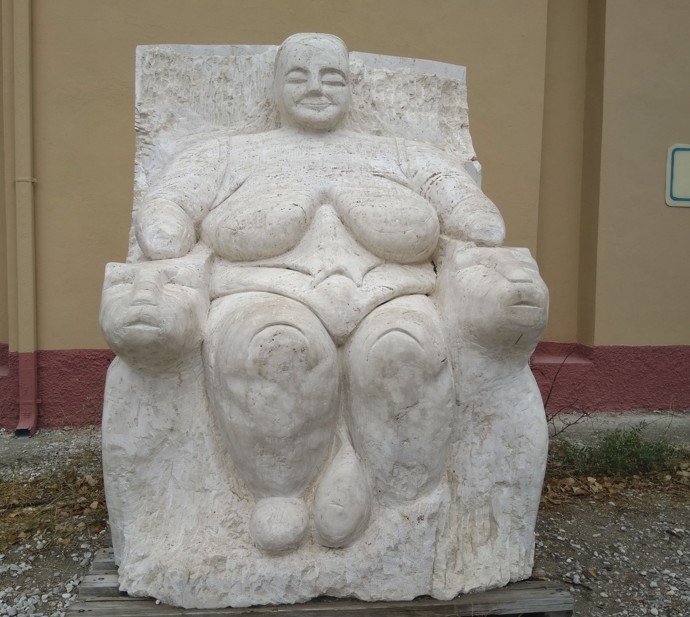
(Mother Goddess – found near to Çatalhöyük, Turkey – photo Morgana)
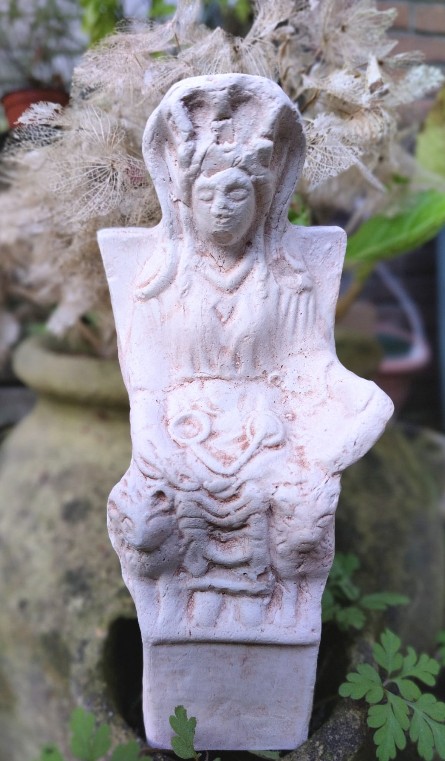
(Kybele – copy of a statue – Morgana’s own collection.)
| MATERNAL COSMOLOGY | |
| ANATOLIAN SOVEREIGNTY | STEPPE PROTECTION |
| • Kybele (Matar Kubileya) | • Umay Ana |
| • The Mountain Matrix | • The Cosmic Womb |
| • Ecstatic Frame Drumming | • Spirit of the Hearth |
The syncretism was seamless. Kybele’s ancient Phrygian priests, the Galli, had famously worshipped her through wild, ecstatic dances driven by the hypnotic, rattling beat of large frame drums—a practice that perfectly mirrored the Kam’s trance-inducing drum rituals (Kamlama). In the rural valleys of Anatolia, the roaring power of the Mountain Mother softly fused with the domestic warmth of Umay Ana, preserving a deeply matriarchal undercurrent within the land’s spiritual identity.
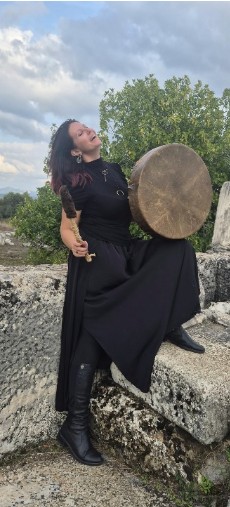
(Timea Kutlu with her Frame Drum at Lagina)
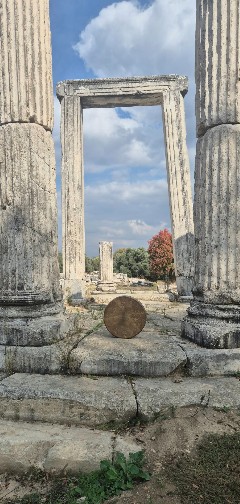
(Timea at the Sanctuary of Hekate, Lagina with her Frame Drum)
In her exploration of ritual spaces on Substack’s Pomegranate Sanctuary, researcher Timea Kutlu writes of the frame drum, and Kamlama and posits
“that the most vital human and spiritual processes are inherently non-linear. They rely on what complexity science calls ‘emergence’—the precise threshold where a system breaks free from rigid logic and dynamically comes alive. In the context of Kamlama, the frame drum functions exactly as this threshold crosser; its repetitive, earth-shattering rhythm acts as a non-linear hammer, purposefully shattering everyday cognitive structures so that the ecstatic, emergent state of the trance can take over.”
She describes her movement practice, Nardance, as an inquiry into the absolute ‘unity of body, sound, and space.‘ This directly mirrors the choreography of the ancient Turkic Kam. The sacred dance of Kamlama is not merely performance; it is a somatic mapping of the cosmos. By moving rhythmically through physical space, the Kam unifies body and sound to breach the boundaries of ordinary reality, allowing the physical body to act as an anchor while the soul travels the World Tree.
If Kybele provided the unyielding physical anchor for this syncretism, it was Hekate who held the keys to its unseen spaces. While modern pop-occultism often confines Hekate to classical Greece, archaeology points firmly to her origins in southwestern Anatolia—specifically the ancient region of Caria, where her grand, primary sanctuary at Lagina still stands.
At Lagina, Hekate was not feared as a malicious hag; she was revered as the Propylaia (the Gatekeeper), the Kleidouchos (the Keybearer), and the Psychopompos (the Guide of Souls). She stood at the physical and metaphysical crossroads, holding aloft her torches to illuminate the dark, liminal boundaries where the worlds bleed into one another.
This is precisely the cosmic jurisdiction of the Siberian and Central Asian Kam. During the Yug ritual, the shaman functioned exactly like Hekate: acting as the living keybearer who understood the hidden pathways of the underworld, negotiating with the dead, and ensuring that ancestral spirits found their rightful resting place.
The remnant of this shared worldview is palpable in Anatolian folklore today. In rural villages, crossroads and thresholds are still treated as highly volatile, sacred spaces (Teke). To this day, villagers strictly avoid stepping on doorways or pouring hot water onto the earth at night, lest they disturb the invisible, wandering spirits that dwell in Hekate’s—and the Kam’s—shadowy domains.
The true magic of Anatolian syncretism is that it is not a dead museum piece; it is a living, breathing reality. Walk into the tents of the traditional, nomadic Yörük or Turkmen clans in the Taurus Mountains today, and you will find women who identify devoutly as Muslim, yet carry the ancient traditions of the Goddess and the Shaman in their very bones.
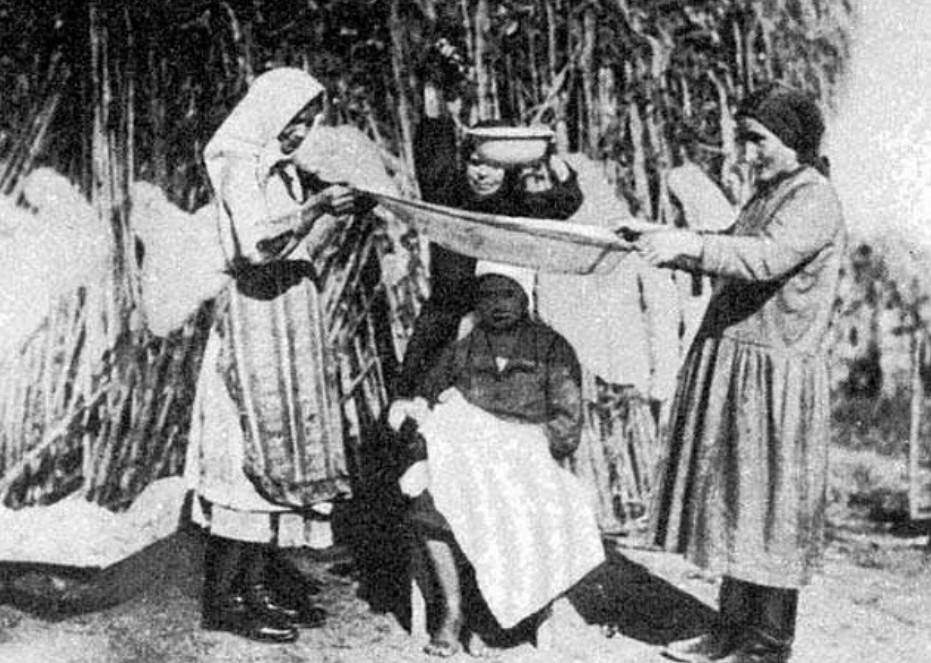
“Lead pouring / Kursun Dokme”
In these communities, spiritual transmission flows through the Ocak (the hearth)—a sacred lineage passed down predominantly through elder women. These matriarchs are the village healers, the keepers of the fire. They perform Kurşun Dökme (the ritual melting and pouring of lead to dispel the evil eye), tie prayer rags to sacred, solitary trees to commune with nature spirits, and invoke Fatma Ana (Mother Fatima) in a way that echoes the cosmic protection of both Umay and Kybele.
When a modern shamanic practitioner enters these spaces with a frame drum and a sacred dance, the local women do not see a stranger practicing an alien faith. They recognize the rhythm. They hear the heartbeat of the Earth Mother, the rustle of the crossroads, and the voice of the ancestors.
For the modern Wiccan or Pagan writer, the lessons of Anatolia are clear. The gods are resilient, and they are masters of disguise. They do not require pristine, undisturbed temples to survive; they require a hearth fire, a rhythmic beat, and a human heart willing to stand at the crossroads.
By weaving the steady, grounded power of Kybele, the boundary-crossing keys of Hekate, and the ancestral drumbeat of the ancient steppe into our personal practices, we honour an unbroken lineage of survival. We become a living Ocak—a sacred hearth keeping the old flames warm for generations yet to come.
REFERENCES
Photos of the ‘Mother Goddess’ and ‘Kybele statue‘ – Morgana Sythove
Photos of ‘Timea with her Frame Drum at Lagina’ – Timea Kutlu
Lead pouring: https://natolianyc.com/blogs/diaries/turkish-rituals-i-lead-pouring-kursun-dokme
NB the practice of ‘lead pouring’ at Hallowe’en and tying ‘prayer rags to sacred, solitary trees to commune with nature spirits’ are very similar to neo-Pagan, Wiccan practice.
Timea Kutlu: Pomegranate Sanctuary
Instagram timeakutlu
