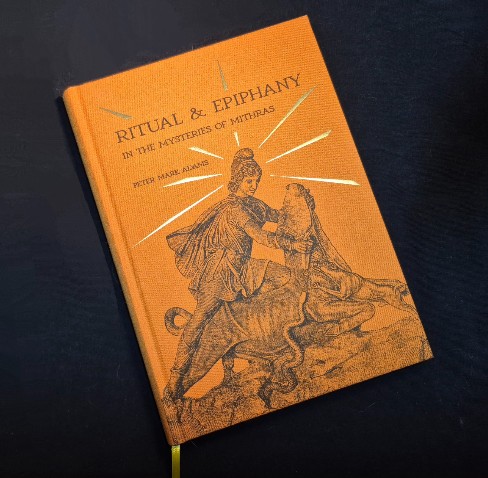
Ritual & Epiphany in the Mysteries of Mithras: The Secret Cult of Saturn in Imperial Rome
Peter Mark Adams
Theion Publishing, 2025, 272 p.
Fine Hardcover Edition, ISBN 978-3-9820654-2-7, manufactured in Munich, Germany. Limited to 888 copies. Features metallic auburn-coloured endpapers, gold headbands and a gold ribbon marker. Includes numerous colour and greyscale illustrations and photographs. €78 + shipping.
Peter Mark Adams has built a substantial body of work around the intersection of Western esotericism, ritual practice, and art history. His earlier books, particularly The Game of Saturn and Mystai, established an approach that takes seriously the lived, experiential dimension of ancient mystery traditions rather than treating them as purely historical curiosities. With Ritual & Epiphany in the Mysteries of Mithras, he turns that same lens on one of the ancient world’s most debated and least understood cults.
The book carries a provocative subtitle: The Secret Cult of Saturn in Imperial Rome. This framing signals Adams’s central argument from the outset. He challenges current academic conventions by restoring the term ‘mysteries’ to the cult of Mithras, placing it firmly within the esoteric traditions of the ancient world. This is a deliberate scholarly intervention. Much twentieth-century Mithraic scholarship, shaped in no small part by Franz Cumont’s influential but now substantially revised interpretation, tended to treat the cult through the lens of comparative religion or solar mythology. We have moved quite far from the time of Cumont, the creative architect of early 20th-century religious studies, whose interpretive models favouring a Persian root of Mithraism have been revised many times since. Adams builds on those revisions while pushing further, arguing that Mithraism under the Roman Empire was not merely a religion of belief but a ritual-centred initiatic path.
His method is what he calls an emic, or insider’s, perspective. Rather than approaching the cult from the outside as a detached analyst, Adams examines the cult’s hierarchical grade structure, ceremonial roles, and ritual mechanics, revealing how initiates invoked the serpent power and encountered the epiphany of Saturn-Kronos, the sovereign time-deity. This is not a purely speculative exercise. Adams draws on comparative ethnographies of initiation, first-hand accounts of mystery practices, and a close reading of the archaeological and iconographic record. The Mithraea scattered across the Roman world left behind a rich visual legacy, and Adams reads that material as what he calls ritual grammar: a coded record of the phenomenology of participation rather than simply decorative or narrative art.
The identification of Mithras with Saturn-Kronos is one of the book’s most significant and thought-provoking threads. Adams has traced this Saturnian dimension across his work, from the cryptic imagery of the Sola-Busca tarocchi in The Game of Saturn to the Dionysian mysteries of Mystai. In the present volume, he reveals the hidden mechanics of the cult’s invocation of the serpent power, culminating in a profound epiphany of Saturn-Kronos as the time-deity. The figure of Aion, the lion-headed deity wrapped in a serpent’s coils who appears repeatedly in Mithraic contexts, takes on fresh significance within this reading. Adams situates the cult’s cosmological architecture within a broader Orphic framework, drawing connections between Mithraic initiation and the metaphysical traditions circulating in the Hellenistic world.
Mithraism under the Roman Empire was an expression of a Hellenistic context in which ‘oriental mysteries’, such as the cults of Isis, Cybele, Serapis, Dionysus, and Orpheus, contributed to the knitting together of collective unity and diversity. Adams situates Mithraism within this broader matrix rather than treating it as an isolated phenomenon, and this contextual richness gives the book much of its depth. The grade structure of the cult, running from Corax (Raven) through to Pater (Father), is examined not merely as a social hierarchy but as a sequence of initiatic thresholds, each carrying its own ritual content, symbolic correspondences, and transformative function.
Two chapters in particular stand out as seminal: one devoted to the ‘Petrogenia‘, the stone-birth of Mithras, and the other to the ‘Sleep of Kronos’. These sections address some of the most enigmatic imagery in the Mithraic corpus and demonstrate Adams’s capacity to bring independent scholarly thinking to bear on questions that have resisted easy resolution.
The book is published by Theion Publishing in two limited editions. The fine hardcover edition runs to 272 pages, printed on premium wood-free paper, clothbound in tangerine-coloured fine linen manufactured in Germany, with an embossed cover, gold detailing, a ribbon marker, and colour and greyscale images throughout. The edition is limited to 888 copies. Theion’s production standards are consistently high, and the physical presentation of this volume does justice to the material it contains.
The book has been received warmly by both scholars and practitioners in the field. Andreu Abuín of The New Mithraeum described it as “a bold and compelling reassessment of Mithraic initiation and cosmology” that “stands out for its profound exploration of Orphic influences and theurgy, breathing new life into long-overlooked aspects of the cult.” Another reader noted that Adams “manages to pack so much information into his writing and yet retains a certain levity and readability despite the staggering amount of research and thinking it is based upon.” That combination of scholarly density and genuine readability is not easily achieved, and it is one of Adams’s consistent strengths as a writer.
Ritual & Epiphany in the Mysteries of Mithras sits naturally alongside Adams’s earlier work as the masculine counterpart to Mystai, which examined the female mystery tradition preserved in the Villa of the Mysteries at Pompeii. Together, the two books represent a sustained and serious attempt to recover the experiential core of ancient mystery practice, not as historical reconstruction for its own sake, but as a contribution to understanding the deeper roots of Western esoteric tradition. For anyone with a serious interest in that tradition, in Mithraic studies, or in the relationship between ritual practice and visionary experience in the ancient world, this book is essential reading.
See earlier review by Morgana: https://wiccanrede.org/2025/08/review-ritual-epiphany-in-the-mysteries-of-mithras/