In May 2025 I travelled to Sardinia for a Spring break. My journey into Sardinia’s deep past began in Olbia, a place that feels like a threshold — between sea and land, and between the present and something far older. From there, the island gradually revealed itself not just as a landscape, but as a repository of memory, shaped by thousands of years of human presence.
What drew me most strongly was not the imposing nuraghi, though they stand everywhere as silent witnesses to the Nuragic civilisation. Instead, it was something far smaller, more intimate: the human form rendered in miniature.
This interest deepened when I reached Cagliari and spent time in the National Archaeological Museum of Cagliari. There, behind glass yet somehow vividly present, were rows of prehistoric figurines — many of them in what is often described as a “cruciform” shape. Their forms are abstract, almost geometric: outstretched arms, simplified bodies, faces that are more suggestion than detail. And yet, they carry a striking presence.
Often referred to as “Venuses”, these figures echo a much older and widespread tradition of female figurines found across prehistoric Europe. But here in Sardinia, they feel distinctly of this place — rooted in the island’s Neolithic cultures, such as the Ozieri culture. Whether they represent fertility, divinity, ancestors, or something more elusive, they seem to hold a symbolic language that is both deeply human and ultimately unknowable.
Standing among them, I had the sense not of observing artefacts, but of encountering expressions of belief — traces of how people once understood life, death, and continuity. These were not grand monuments meant to dominate the landscape, but objects that could be held, carried, perhaps even used in ritual. Their power lies in their intimacy.
Later, I found myself drawn to bring that connection into my own hands. I bought two large and one small figurine — modern reproductions, perhaps, but still shaped by that same ancient aesthetic. Holding them, I was reminded that history is not only something we study at a distance; sometimes it is something we recognise, almost instinctively.
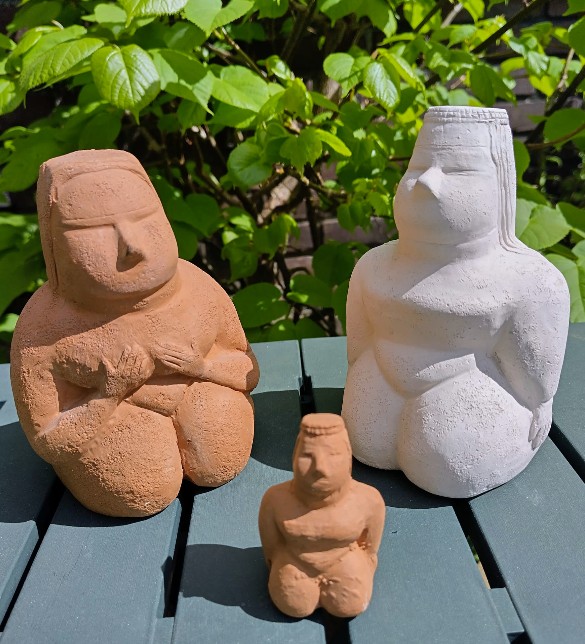
(Found in a souvenir shop in Cagliari – replicas of Neolithic figurines)
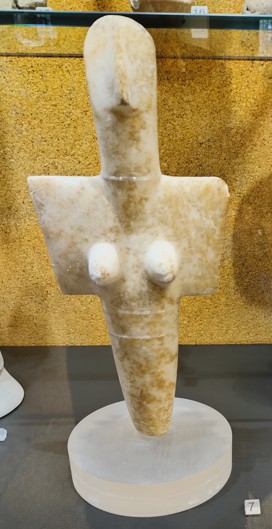
(An example of a cruciform figurine, now in the National Archaeological Museum of Cagliari.)
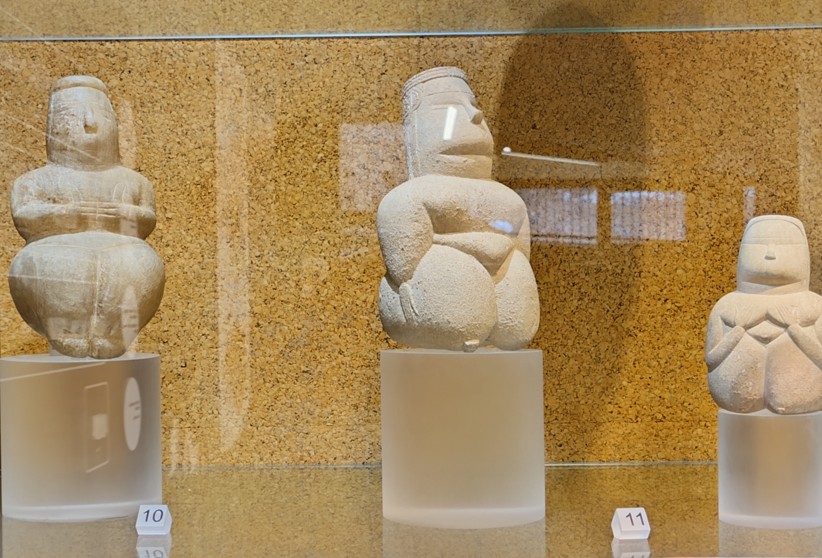
(Three ‘Venus’ figurines, now in the National Archaeological Museum of Cagliari.)
Sardinia’s past stretches back at least 20,000 years, from the earliest human presence in caves such as Grotta Corbeddu, through the agricultural transformations of the Neolithic, to the rise of the Nuragic towers and the later arrival of Phoenicians, Carthaginians, and Romans. Each layer has left its mark.
And yet, it is these relatively small figurines that remain with me most vividly. They seem to distil something essential — something about the human need to represent, to revere, to connect. In their quiet, stylised forms, they bridge an immense span of time, linking the hands that first shaped them with those that continue to hold them today. They, of course, reminded me of the figurines I had seen in Cyprus and also in the Cyclades, Greece.
Looking at the 3 figurines, they echo the visual language of the Ozieri culture and its immediate successors. Left figure (terracotta, seated, arms across chest), this is the most interesting in terms of symbolism. It features a seated, compact posture, with arms drawn inward across the torso. There is a strong emphasis on body mass (hips, thighs, torso). The stylised face with a prominent nose closely reflects Late Neolithic Ozieri-type figurines. The volumetric body and grounded seated pose are typical, whilst the inward arm position may suggest containment, gestation, or introspection. It carries the “embodied presence” typical of earlier figurines and is closest to the “living body” phase of representation. The right figure (white, more geometric, upright) shows a clear stylistic shift. The features are more upright, column-like forms, with the body simplified into geometric planes. The arms are reduced to angular shapes, and there is less emphasis on anatomy, more on structure.
This reflects the transition toward abstraction and moving away from the natural body toward a symbolic human form. It sits conceptually between Ozieri naturalism and later cruciform stylisation. This is a transitional form.
The small central figure in the photo is more simplified but still clearly anthropomorphic. The features include a compact, simplified body with minimal detail. There is more emphasis on posture rather than anatomy. This resembles reduced domestic or votive figurines, possibly inspired by Later Neolithic or Chalcolithic simplifications. Or even popular museum replicas, such as the one I found. In this sense, we can think of it as a didactic or symbolic miniature, rather than a precise archaeological type.
Taken as a group, the figurines unintentionally (or perhaps intentionally) illustrate a core developmental sequence in Sardinian prehistory. From ‘Embodied → Stylised → Abstract’ with on the left the ‘body as presence’, the Ozieri phase, to the right, ‘body as structure/symbol’, i.e. transitional. And in the centre, ‘body as sign or token’.
One could frame these figurines not as “goddesses”, but as material expressions of presence — objects that mediate between body, identity, and continuity across life and death. This becomes powerful when especially when linked to Domus de Janas / Houses of the Fairies . Rather than literal depictions, such figures may be understood as symbolic presences mediating between the living and the ancestral realms.
From a contemporary pagan or Wiccan perspective, it is tempting to read them as early expressions of the Goddess — the creative, sustaining force present in all living things. But what struck me most was not certainty, but openness. These figures do not insist on a single meaning; they invite relationship. They ask to be held, contemplated, perhaps even listened to.
Standing among them, I was aware of a continuity that transcends doctrine. The people who shaped these forms lived thousands of years ago, yet their impulse — to honour life, to give form to the unseen — remains recognisable. In that sense, these figurines are not relics of a lost belief system, but part of an ongoing human conversation.
Though modern in origin, they echo the same cruciform simplicity, the same quiet balance between abstraction and presence. Holding them, I felt less like an observer of history and more like a participant in a long, unbroken thread.
It is there, perhaps, in these small, cruciform forms, not as answers, but as gestures, towards life, towards continuity, towards the enduring human desire to honour the mystery of being.
Figurines and Symbolism in the Ozieri Culture
The Late Neolithic Ozieri culture (c. 3200–2800 BCE) represents one of the most artistically and symbolically sophisticated phases of prehistoric Sardinia. Known especially for its finely crafted ceramics and elaborate funerary architecture, it also produced a distinctive corpus of anthropomorphic figurines that offer insight into the inner life of these early communities.
These figurines, often described in earlier literature as “Venus” types, are typically small, stylised human forms. Unlike the more exaggerated fertility figures known from other parts of prehistoric Europe, Ozieri examples tend toward a refined abstraction: the body is simplified, yet still recognisably human, with subtle emphasis on form rather than explicit anatomical detail. While frequently interpreted as female, their meaning is not fixed; current archaeological thinking resists assigning them to a single “Mother Goddess” framework. Instead, they are understood as part of a broader symbolic language concerned with life, death, regeneration, and continuity.
As I pointed out earlier, the key context for these figurines is the remarkable funerary landscape of Sardinia, particularly the rock-cut tombs known as Domus de Janas / Houses of the Fairies). These subterranean structures, carved to resemble domestic interiors, suggest a worldview in which the boundary between the living and the dead was permeable and ongoing. Within this setting, figurines likely played a ritual role — not merely as representations, but as active participants in mediating relationships between the human community, its ancestors, and the unseen world.
Over time, a striking transformation occurs. The more rounded, volumetric figurines of the Ozieri phase gradually give way to increasingly abstract, cruciform representations in the later Neolithic and Chalcolithic periods. These figures — flattened, schematic, and often cross-shaped — distil the human form into its most essential geometry. Found in similar funerary contexts, including Domus de Janas tombs, they suggest not a loss of meaning, but a concentration and codification of symbolic expression.
The cruciform shape itself invites multiple readings. It may reflect a stylised human with outstretched arms, a gesture of invocation or offering; alternatively, it may encode a more cosmological idea, linking vertical and horizontal axes — earth and sky, life and death, the human and the ancestral. Importantly, this form long predates later religious associations with the cross, and should be understood within its own prehistoric framework.
This evolution — from embodied figurine to abstract sign — marks a profound shift in how human presence was conceived and represented. Yet continuity remains. Across the Ozieri culture and into the later Nuragic Civilization, the human figure persists as a central motif, carrying meanings that are at once personal, communal, and cosmological.
Sabina Magliocci, writing about ‘Aradia in Sardinia – The Archaeology of a Folk Character’) mentions the Fairies:
“There are said to be in Sardinia beings called Janas, whose name means ‘followers of Diana’, linking them directly to the medieval legends of roaming spirits. They are said to live in Neolithic shaft tombs, known as Domus de Janas, ‘homes of the fairies’, or in caves, both locations of prehistoric burials. They are expert spinners and weavers, and can interact with and in some cases even marry humans (Liori, 1992, 107-111). Like the Romanian iele, who are led by Irodeasa (Kligman, 1981, 54), Sardinian Janas have as their patroness Araja or Arada Turchi (2000, 78), whose name is a version of the medieval Italian Erodiade. It is, in fact, the rendering in Sardo of a hypothetical Italian word ‘Aradia’. This is a persuasive piece of evidence suggesting that at some time, a character called Aradia must have existed in Italian folklore, and that when her stories were brought to Sardinia, her name, as well as details of her legend, acquired a Sardinian flavour. In some cases, the leader of the Janas is called s’Araja dimoniu, ‘Aradia the demon’, a reflection of the demonisation of the legend at the hands of medieval clerics. If s’Araja dimoniu is the leader of the fairies, it is not an unreasonable leap to hypothesise that at some point in Sardinian legendry, this figure split into two, acquiring a counterpart who was not demonic, but righteous, rewarding industriousness and punishing laziness in young women who were spinning and weaving. The name of this spirit was s’Araja justa, ‘the just Aradia’ – and here we have the likely antecedent of sa Rejusta (Turchi, 2001, 79).”
Sabina continues: “Legends of Herodias and Diana most likely entered Sardinia during the 12th – 13th centuries, when the city-states of Pisa and Genoa vied for control over the island. This was exactly the time during which these legends were widely diffused in continental Italy, and when clerics were writing encyclicals warning against the dangers of believing these tales.
In fact, it is not unlikely that it was through the influence of clerics themselves that the legend was imported. By the 15th century, it could be found in Sardinian confessionals (Turchi, 2001, 84).
What seems not to have happened in Sardinia is the blending of this legend complex with the emergent myth of the diabolical sabbat; medieval Sardinian witch trial records lack confessions from women who reported going out at night with Aradia (Hennigsen, 1993; Pinna, 2000). Instead, s’Araja justa seems to have hybridised, over centuries, with indigenous legendary characters like sas mamas (‘the mothers’), who may be versions of pre-Christian spirits or deities connected with the sun, moon and water. She also merged with legends about night roaming”
From Figurine to Mask: continuity of presence in Sardinia
During my visit to Cagliari, I found a series of small prehistoric figurines — objects often described as “Venuses”, yet far more subtle than that label suggests. Their forms were simplified, poised between body and abstraction, carrying a presence that felt less representational than relational. Later, I acquired two modern ceramic pieces inspired by these ancient types. Holding them, I was struck not by what they depict, but by what they seem to do: they gather attention, centre awareness, and suggest a continuity between the human form and something beyond it.
These figurines find their origins in the Late Neolithic Ozieri culture (c. 3200–2800 BCE), one of the most artistically refined prehistoric cultures of Sardinia. Alongside intricately decorated ceramics, Ozieri communities created anthropomorphic figures that move between embodiment and abstraction. Over time, these forms undergo a striking transformation. The rounded, seated bodies of earlier figurines gradually give way to increasingly schematic, even cruciform shapes. The human figure is reduced, distilled, abstracted — yet not diminished. Instead, it becomes more concentrated, more symbolic. The body is no longer depicted; it is invoked.
This movement — from embodied form to symbolic essence — does not end in prehistory. It continues, unexpectedly, in the living ritual traditions of Sardinia.
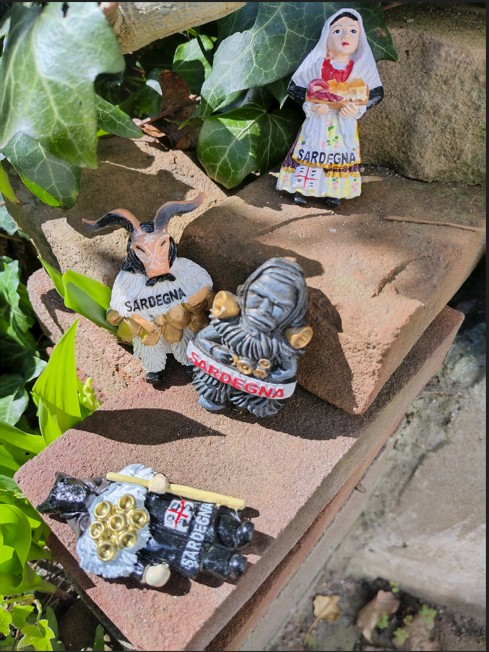
(Found in a souvenir shop in Cagliari, magnets depicting Mamuthones and the Lady carrying bread.)
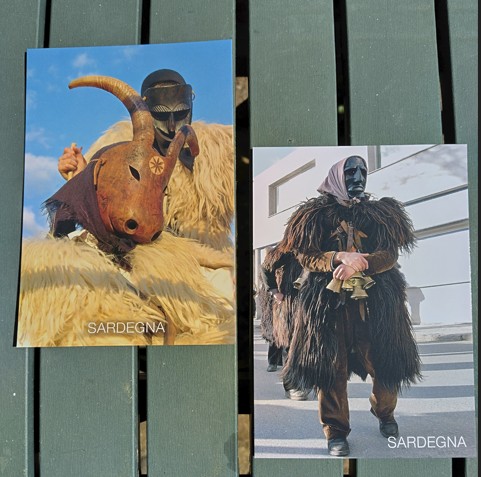
(Postcards from a souvenir shop in Cagliari depicting Mamuthones.)
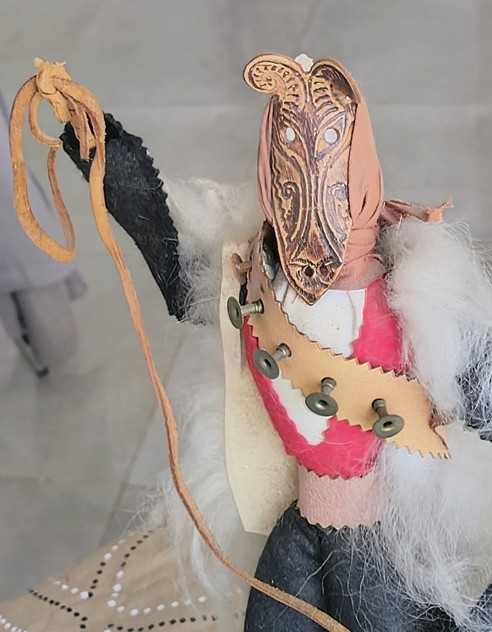
(Found in a souvenir shop in Cagliari, an Issohadores – approx 40 cms tall.)
Each year, during Carnival, the village of Mamoiada becomes the stage for one of the island’s most compelling performances: the procession of the Mamuthones and Issohadores. The Mamuthones, clad in black sheepskins and burdened with heavy bells, move in slow, synchronised steps, their dark wooden masks erasing individual identity. Beside them, the Issohadores — dressed in red and white — guide, control, and occasionally “capture” members of the crowd with a rope, drawing them into the ritual.
Here, too, the human form is transformed. Masked, weighted, and rhythmically constrained, the body becomes something other than itself. The Mamuthones do not perform as individuals; they move as a collective presence, their bells producing a deep, resonant sound that is felt as much as heard. The effect is both solemn and immersive, suggesting not spectacle but participation in a shared field of meaning.
Alongside them move the Issohadores, lighter in dress and more fluid in motion. With their white garments, red jackets, and colourful sashes, they stand in visual contrast to the dark, heavy Mamuthones. Most strikingly, they carry a rope — the soha — with which they skilfully “capture” individuals from the crowd. Those caught are not singled out for exclusion, but drawn into the ritual, becoming part of its unfolding. In this moment, the boundary between observer and participant dissolves.
If the Mamuthones embody a collective, ancestral force, the Issohadores mediate its relationship to the community. They guide the procession, regulate its rhythm, and extend its reach outward. The rope becomes a line of connection, linking performer and observer, ritual and daily life. What might otherwise remain distant or overwhelming is made accessible — translated into lived, shared experience.
Seen together, these elements form a continuity of sensibility that stretches back millennia. The figurines of the Ozieri culture, the carved interiors of the Domus de Janas, and the living ritual of Mamoiada all engage with a common question: how does the human form become a vessel for something beyond itself? Whether in clay, stone, or movement, the answer is not given through representation alone, but through presence, transformation, and relationship.
While often framed within the Christian calendar, this ritual clearly carries echoes of a far older worldview — one in which the boundaries between human, animal, and ancestral realms are fluid. The sheepskins, the masks, the repetitive movement, and the sonic weight of the bells all point toward a form of embodiment that is closer to transformation than representation.
Seen in this light, the connection to the prehistoric figurines becomes less speculative and more experiential. Both the small clay forms of the Ozieri culture and the masked figures of Mamoiada engage with a similar question: how does the human body become a vessel for something beyond itself? Whether held in the hand or encountered in procession, these forms do not simply depict — they mediate.
What emerges is not a linear history, but a continuity of sensibility. Across millennia, Sardinia preserves a way of relating to form, presence, and transformation that resists easy categorisation. The figurine, the tomb, the mask, and the ritual all participate in a shared language — one in which identity is not fixed, but negotiated between the visible and the unseen, the individual and the collective, the living and the dead.
From an interfaith perspective, this continuity resonates with traditions that recognise the sacred as immanent — present within land, body, and community rather than separate from it. The masked figure, the ancestral form, and the ritual gesture all suggest that identity is not fixed, but relational, shaped through connection with what lies beyond the visible.
From an environmental perspective, the same pattern emerges. The use of animal skins, the weight of the bells, the rhythmic engagement with the ground, and the act of drawing others into the ritual field all point toward a worldview in which human life is inseparable from the wider web of existence. To be “caught” by the rope is not merely to be included in a performance, but to be recognised as already part of a larger whole — human, animal, land, and ancestry intertwined.
What Sardinia offers, across these layers of time, is not simply a sequence of cultural expressions but a continuity of relationship. The figurine, the tomb, the mask, and the ritual all participate in a shared language — one in which the boundaries between living and dead, human and more-than-human, visible and unseen remain permeable.
In this way, the small figurine held in the hand and the masked figure moving through the village are not so distant from one another. Both serve as reminders that to be human is not only to stand apart, but to stand in relation: to the earth, to those who came before, and to those yet to come.
REFERENCES:
Sabina Magliocco: “Aradia in Sardinia – The Archaeology of a Folk Character” In Ten Years of Triumph of the Moon. (Harpenden: Hidden Publishing, 2009), pages 40-60.
Download the PDF here: https://www.academia.edu/584599/Aradia_in_Sardinia_the_Archaeology_of_a_Legend
Sabina Magliocco: “The Two Madonna’s – The Politics of Festival in a Sardinian Community”
© Sabina Magliocco 1992, 2005, 2019 Originally published by Peter Lang, Aug 1 1993. ISBN 9780820418964
Second edition published by Waveland Press, 2005. This is a typescript of the 2nd edition. All rights now belong to the author.
Download the PDF here: https://www.academia.edu/150895/The_Two_Madonnas_the_Politics_of_Festival_in_a_Sardinian_Community
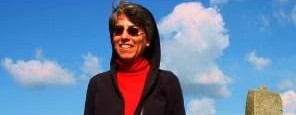 Sabina Magliocco, Ph.D., Professor of Anthropology, grew up in Italy and the United States. She has published on religion, folklore, foodways, festival, witchcraft and Neo-Paganism in Europe and the United States. Her research began in Sardinia, where she studied how globalization affects traditional religious festivals. She went on to study rituals, festivals and cultural politics among contemporary Pagans and Witches in the United States. A recipient of SSHRC, Guggenheim, National Endowment for the Humanities, Fulbright and Hewlett fellowships, and an honorary Fellow of the American Folklore Society, she also served as editor of Western Folklore 2004-09 . Her current research is on traditional healers in Italy; that will, she hopes, result in another book, tentatively entitled ‘The Enchanted Worldview in Italy’.
Booklet “Religious and Secular Festivals in Sardinia” / FFI SARDEGNA Turismo: www.sardegnaturismo.it
See also: https://www.facebook.com/VisitSardinia/
Instagram: https://www.instagram.com/visit.sardinia
The photos were all taken by @Morgana Sythove.
Continue with Tales of the Mediterranean – the Enigma of Sardinia – Part 2.
