
Lucifer: Princeps
Peter Grey
Originally published: Scarlet Imprint, 2015. Re-published: Scarlet Imprint, 2025 8vo (240 × 156 mm) 192 pp. Frontispiece Satan Arousing the Rebel Angels. William Blake, 1808. Issued in 4 editions – fine / standard hardback / paperback / digital
 Part 1 Introduction
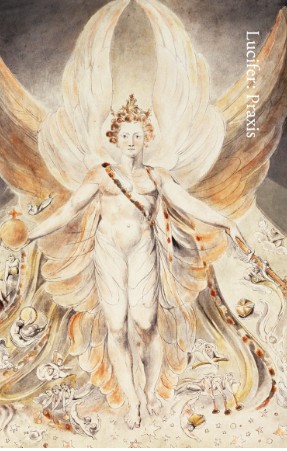
Grey’s Luciferian vision provides a re-framing of the Goetic tradition that infuses it with a new and far more positive light. We will return to consider how it does this shortly. Originally published in 2015 (and now again in 2025) Lucifer: Princeps is the first volume of a two-part study of the origins and evolution of the figure of Lucifer that has overshadowed Western culture generally, and the esoteric tradition in particular, for centuries. The second part of Grey’s comprehensive study, Lucifer: Praxis (2025) is covered in the second part of this review. The opus as we now have it is magisterial in scope, profound in its implications and surely destined to feature – much as Apocalyptic Witchcraft (2013) did over a decade ago – as one of the seminal works in the continuing evolution of the Western esoteric tradition. Is this opus now complete? Perhaps, perhaps not. Readers of Grey’s recent writing for his Substack account will know that he continues to pursue an insider track on the evolution of the esoteric tradition now reaching into the late twentieth century. Whether these pieces are the seeds of a concluding – or even a further – volume, we will have to wait and see. Concerning ‘Princeps’ and ‘Praxis’, Grey summarises their relationship as follows,
“[Whereas] Princeps gave a prehistory of the spirit of rebellion … Praxis engages with the emergent Lucifer in relation to the work of magic, and the exercise of power and influence in the world.” (Praxis: ix)
Evidently, Grey’s Luciferianism should not be thought of as one that is confined to private ritual practice, but rather encompasses larger issues of lifestyle and socio-political vision; though these issues remain unelaborated. As I have understood it, the motivation for writing ‘Princeps’ and ‘Praxis’ is a deeply felt need to re-align Goetic practice with contemporary realities, amongst which are the implications of Nietzsche’s famous statement to the effect that “God is dead”; though in Grey’s re-framing of esoteric history, Nietzsche’s pronouncement was at least a century too late. It is central to Grey’s Luciferian historical vision that the ‘death of god’ occurred sometime between 1789 and 1870 when a tide of Jacobin-inspired revolutionary fervour swept away Europe’s medieval political and economic order – dominated by the Church and absolute monarchies – and so gave birth to the modern nation states. From an esoteric perspective, Grey characterises this revolutionary tide as essentially ‘Luciferian’ in both ideology and inspiration; as ‘Praxis’ unfolds, we learn exactly why this is so. Returning to the key issues driving Grey’s Luciferianism, his drive for a reformation of Goetic theory and practice arises from the fact that,
“Given that we live in a post-Christian world, the challenge for modern practitioners is arguably not process, but theology. We can quickly grasp that there are a number of steps necessary to perform a successful conjuration, but where is our authority to be found when God, the guarantor of efficacy, is dead?” (Praxis: 85)
Briefly, Grey contends that contemporary practices continue to remain rooted in an unspoken, and largely unconscious, Christian monotheism and metaphysical dualism framed by the eschatology of the end-time. The operative residue of this worldview manifests as the characteristic modus operandi of Goetic practice: the demonisation of spirits and the employment of rites of coercion, of which the rite of exorcism remains paradigmatic. Grey’s Luciferian vision promulgates a radical re-visioning of both magical theoria and praxis. Grey’s alternative, Luciferian, approach is founded upon respectful, mutually beneficial pacts with spirits allied with equality and the development of “constructive relationships”.
Part 2: Lucifer: Princeps
Re-reading ‘Princeps’ after so many years, I was struck, once more, by the depth and thoroughness of its scholarly apparatus and the soundness of its arguments. ‘Princeps’ provides a dependable exposition of the origins and development of the Luciferian tradition – a “history of error” as Grey describes it – expertly navigating its labyrinth of false passageways, mistranslations, dubious genealogies and a ‘logic’ of ‘similarities’ rather than demonstrable identities; one that nevertheless renders a richly woven fabric of humanity’s profoundest spiritual and magical imaginings.
In particular, two key issues are raised in ‘Princeps’ that underpin the Luciferian mythos and therefore deserve closer scrutiny: the genealogy of Lucifer and the notion of cosmic rebellion.
Lucifer
“How art thou fallen from heaven, O Lucifer, son of the morning! How art thou cut down to the ground, which didst weaken the nations!”KJV Isaiah. 14:12.
These lines would appear – at least on the surface – to provide a starting point as well as a measure of clarity concerning the origins and nature of Lucifer and hence of the Luciferian mythos in general. In point of fact, as Grey explains, they entirely undermine the existence of any historical veracity concerning the name,
“Lucifer does not exist until the stroke of a pen in 382 CE. The genealogy is straightforward to plot. First, the apparent name given in Isaiah 14:12 is not Lucifer, but Hêlēl Ben Šaḥar; this is transformed in the Septuagint, the Greek translation of the Hebrew Bible, into Ἑωσφόρος (Heōsphóros): dawn bringer. This is the specific Greek term for the god of the planet Venus when it rises. There is no ambiguity in its astral identification as the morning star.” (Princeps: 13)
That “stroke of a pen in 382 CE” to which Grey is referring is Saint Jerome’s historic mistranslation of the Greek ‘Heōsphóros’ not as ‘dawn bringer’ – in other words, the morning star – but as ‘light bringer’ whose Latin equivalent, ‘Lucifer’, is the only warrant for the existence of the name. The resulting story of Lucifer,
“… can be read as the history of the falsehoods, myths, hopes, hatreds and dreams that this one line has engendered.” (Princeps: 1)
The Myth of Cosmic Rebellion
Whereas the Luciferian mythos is predicated upon the archetype of a cosmic rebellion, attempts to locate relevant precedents amongst the mythologies of the Near East has, by and large, failed.([1]) The search, however, has revealed a series of striking myths – such as that of Atrahasis (Princeps: 97-192); an ancient tale concerning the gods’ interactions with each other as well as with humanity. As Grey notes, as a possible precedent for cosmic rebellion, however, it misses its mark. The distinctive Luciferian flavour of cosmic rebellion entertains a quite different complexion from that of the various myths of usurpation and succession characteristic of the corpus of Near Eastern mythology.
Characteristically, it concerns the rejection and, ultimately, desertion of a supreme god in favour of following one’s own desires; and it is this that brings about a fatalistic intervention with humanity for which the myth of Prometheus is paradigmatic. As ‘Princeps’ makes clear, despite the conception of a ‘fallen Lucifer’ conveyed by Jerome’s mistranslation of Isaiah, there is no corresponding idea of a rebellious Lucifer-like deity in Near Eastern mythology. In other words, with the ‘Tale of the Watchers’, we have left the world of polytheism behind and are now immersed in an essentially monotheistic vision of reality that posits one supreme, all-ruling God who makes disobedience cosmically significant; and this is, in essence, exactly what we encounter in the comparatively late, Hellenistic, ‘Tale of the Watchers’.
Although only briefly alluded to in Genesis (6:1-4), the account appears in its fullest form in the ‘Book of Enoch’ (1 Enoch). There, we learn that the angels formed a compact with each other to defy the supreme god and, driven by lust, descend and exchange their know-how of diverse arts and sciences in exchange for intercourse with human women. The offspring of their miscegenation, the Nephilim or Giants, are then implicated in the myth of the great flood, so that at this point the tale rejoins the mainstream of Near Eastern mythology.
That said, the ‘Principate’ – the fallen angels whose names and specialities are clearly specified in the second, companion volume (Praxis: 176-180) – do not include one named ‘Lucifer’; so we are still short of a context in which these disparate traditions converge. In fact, the historical situation was such that the name ‘Lucifer’ was drawn, ineluctably, into the tale of the Watchers by the tendency of Christians to demonise the entire world of spirits,
“… the exorcistic ministry of Jesus and the eschatology of the Second Coming … swept a whole slew of entities into a single despised category lurking under the descriptor ‘demons.’ (Praxis: [1]).
Moving from ‘Princeps’ to ‘Praxis’, we leave the comprehensive charting of the mythological and biblical genealogies of the spirits to consider the means of their operationalisation. To those contemplating the purchase of these volumes, I can say that they constitute a definitive contemporary articulation of the Luciferian tradition from both a theoretical and an operative perspective, and a defining work in the evolutionary unfolding of the Western esoteric tradition. As such, they are modern classics.
Istanbul, August, 2025
[1] Page, H.R. (1996) The Myth of Cosmic Rebellion: A Study of its Reflexes in Ugaritic & Biblical Literature.