
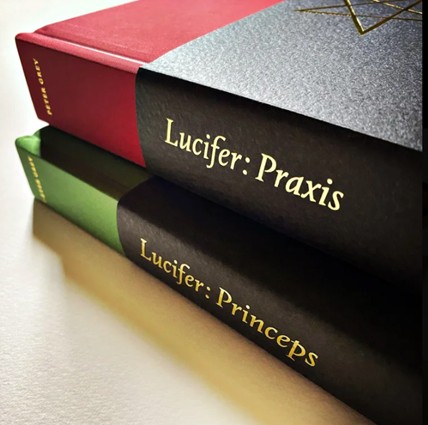
Lucifer: Praxis
Peter Grey
Scarlet Imprint, 2025. 8vo (240 × 156 mm) 248 p.
Frontispiece Satan in his Original Glory: ‘Thou wast Perfect till Iniquity was Found in Thee’. William Blake, c.1805. Including three drawings by Blake of the Book of Enoch. Issued in 4 editions – fine/standard hardback/paperback/digital
“I commenced this book in a thunderstorm, heavy plashing rain falling on our house beneath Buck’s Hill on the river of blood in the valley of the star temple. It is a place where the goshawks stare back at you, and the sky locks antlers with the oak-crowned slopes to clash and bellow. I had many questions: Who are the rebel angels named by Enoch, and who is the angel we call Lucifer? How is magic to be done in a world where the tyrant God is dead, but the spirit persists? What does our tradition amount to? Who are its heroes and what are their works? And what ritual actions are ours to perform?” Lucifer: Praxis: 210.
Part 1 Introduction
With these words, Grey encapsulates the key issues that he sought to resolve in ‘Lucifer: Praxis’. A revolutionary work, Grey’s Luciferian vision provides a re-framing of the Goetic tradition that infuses it with a new and far more positive light. We will return to consider how it does this shortly.
‘Praxis’ is the long-awaited companion volume to Lucifer: Princeps (2015). The opus as we now have it is magisterial in scope, profound in its implications and surely destined to feature – much as Apocalyptic Witchcraft (2013) did over a decade ago – as one of the seminal works in the continuing evolution of the Western esoteric tradition. Is this opus now complete? Perhaps, perhaps not. Readers of Grey’s recent writing for his Substack account will know that he continues to pursue an insider track on the evolution of the esoteric tradition now reaching into the late twentieth century. Whether these pieces are the seeds of a concluding – or even a further – volume, we will have to wait and see.
Concerning ‘Princeps’ and ‘Praxis’, Grey summarises their relationship as follows,
“[Whereas] Princeps gave a prehistory of the spirit of rebellion … Praxis engages with the emergent Lucifer in relation to the work of magic, and the exercise of power and influence in the world.” (Praxis: ix)
Evidently, Grey’s Luciferianism should not be thought of as one that is confined to private ritual practice but rather encompasses larger issues of lifestyle and socio-political vision, though these issues remain unelaborated. As I have understood it, the motivation for writing ‘Princeps’ and ‘Praxis’ is a deeply felt need to re-align Goetic practice with contemporary realities, amongst which are the implications of Nietzsche’s famous statement to the effect that “God is dead”; though in Grey’s re-framing of esoteric history, Nietzsche’s pronouncement was at least a century too late. It is central to Grey’s Luciferian historical vision that the ‘death of god’ occurred sometime between 1789 and 1870 when a tide of Jacobin-inspired revolutionary fervour swept away Europe’s medieval political and economic order – dominated by the Church and absolute monarchies – and so gave birth to the modern nation states. From an esoteric perspective, Grey characterises this revolutionary tide as essentially ‘Luciferian’ in both ideology and inspiration; as ‘Praxis’ unfolds, we will learn exactly why this is so.
Returning to the key issues driving Grey’s Luciferianism, his drive for a reformation of Goetic theory and practice arises from the fact that,
“Given that we live in a post-Christian world, the challenge for modern practitioners is arguably not process, but theology. We can quickly grasp that there are a number of steps necessary to perform a successful conjuration, but where is our authority to be found when God, the guarantor of efficacy, is dead?” (Praxis: 85)
Briefly, Grey contends that contemporary practices continue to remain rooted in an unspoken, and largely unconscious, Christian monotheism and metaphysical dualism framed by the eschatology of the end-time. The operative residue of this worldview manifests as the characteristic modus operandi of Goetic practice: the demonisation of spirits and the employment of rites of coercion, of which the rite of exorcism remains paradigmatic (Praxis: 69-77). Grey’s Luciferian vision promulgates a radical re-visioning of both magical theoria and praxis,
“It is here that a Luciferian approach fundamentally breaks with the Solomonic paradigm. Though we leverage hierarchy and command, our aim is to create constructive relationships with willing spirits.” (Praxis: 91)
The alternative, Luciferian, approach is therefore founded upon respectful, mutually beneficial pacts with spirits allied with equality and the development of “constructive relationships”,
“The sacred feast as an alternative to compulsion is an important formula, and one that can be missed in Western magic, which operates, for the most part, according to the principles of exorcism.” (Praxis: 69)
On a much deeper level, for Grey, the ultimate ‘driver’ of magical efficacy is the primaeval force of Eros articulated in a way that allows it to serve as the menstruum into which otherworldly spirits are drawn into communing,
“At the heart of magic is eros, and the myth of angelic desire that transgresses all boundaries, all laws and limits. It is a mystery of communion both carnal and sacred, of knowledge, forbidden and concealed …” (Praxis: ix).
This brief paragraph encapsulates the work in a way that does justice not only to archaic tradition but to the phenomenology of spiritual encounter.
Structurally, ‘Praxis’ egalitarian vision is articulated through the division of the work into two major parts.
Part one (Praxis: 1-116) introduces three fundamental building blocks of Grey’s Luciferian practice: firstly, the ‘Principate’, a spiritual hierarchy drawn from the annals of Near Eastern magical and spiritual practice over the course of many millennia; secondly, a series of some eleven rituals designed to operationalise magical activity in a way that is consistent with the egalitarian principles of Luciferianism; and, thirdly, and most importantly, introduces the ‘magical assistant’ or ‘Parhedros’, a key element of the Papyri Graecae Magicae (PGM),
“The Greek magical papyri are one of our primary sources for the practice of magic, which both preserves and demonstrates its enduring principles, drawn from the creative fusion of Egyptian temple magic, Graeco-Roman paganism, Judaism, Christianity and folk sources. For our purposes, the most valuable comparative example we can draw from this cache of treasures is the parhedros or magical assistant of PGM I.42:195 described as Lord of the Air, a blazing star …” (Praxis: 50).
Part two (Praxis: 117-209) examines the literary sources that contributed to the evolution of the Luciferian mythos and provided the ideological inspiration behind Europe’s revolutionary century, roughly between 1789 and 1870. We can gauge something of the ideological and revolutionary popularity of Lucifer-as-liberator by the successive appearance of monumental statues of Lucifer in Paris (1842), Liège (1843), Milan (1862), Madrid (1878), Turin (1879) and Prague (1898); heralding, as it were, the birth of Modernism and the overthrow of ossified forms in the arts as well as in the social, cultural and political life of Europe. However, any optimism engendered by this shift in sensibility needs to be tempered by the realisation that this was also the great age of the European empires. The elaborate architectural and decorative modernism known as Art Nouveau that graces cities like Brussels was paid for by exactions from the Empire; in this case, from the Belgian Congo, with all of the attendant horrors captured in Joseph Conrad’s Heart of Darkness.
By way of concluding this brief introductory paragraph, and before examining ‘Praxis’ in greater detail, I wish to note the quality of the scholarship and argumentation that Grey deploys as well as the literary quality of the prose, which is first-rate with respect to clarity of exposition and expressiveness.
Part 2: Lucifer: Praxis
“Failure to acknowledge the cognitive dissonance involved in the recounting of stories that enshrine the worldview of the tyrant Jehovah is the dirty little secret of contemporary practice. Perhaps that has arisen from an undue focus on props and process to the neglect of theology and a lack of understanding that power is leveraged on the fulcrum of narrative, historiola. The entire set of conjurations as they stand has to be repurposed.” (Praxis: 89).
From the outset, ‘Praxis’ declares its intent, renders a promise and asserts its warranty,
“I will tell of magic from before the Great Flood until today, and of who the angels were, and how we may converse with them. These are the teachings of the fallen angels as I have received them, the rites of pact, divination, charm, feast, evocation, congress and revolt.” (Praxis: ix).
‘Praxis’ is predicated upon a grand synthesis of traditions spanning millennia; a synthesis centred on well-attested commonalities evinced by spirits in their epiphanic appearances,
“My work, therefore, aims to encompass pre-, anti- and post-Christian perspectives, requiring the resources of the Bible, poetry, literature and art. Without this context, we are reduced to picking over a great Gehenna, a smouldering tip of broken and unclean material from which we can extract neither sense nor order.” (Praxis: 2)
We find these most defining encounters reprised in the PGM in connection with the unifying idea of the paredroi, the “assistants”, who,
“fall into various categories, such as the daimones, the god Eros, or the assistance of some verses. But the word can also refer to the spell itself, or to a deity who is manifested as a different entity.”
In a pivotal paragraph, Grey observes,
“The myth of the fallen angels has flowed through Christendom as a submerged current, breaking the surface at significant historical moments. As a spirit throng in exile, they will recall their origins when we tell their stories in our rituals and thence draw them forward into presence. Crucially, these stories mate and hybridise with the spirits of the lands into which they penetrate, whether sirens, giants or mighty men. Their transposition into our own cycles and seasons and houses of unlettered stone is as valid as the presence of Christianity itself, practised by gentiles beyond the holy land for some 2000 years.” (Praxis: 4).
It is this understanding that infuses the program of ‘Praxis’ and opens the opportunity for a synthesis of traditions subsumed under a common series of rites.
The Rites
The opening chapter of ‘Praxis’ – ‘The Angelic Principate’ (Praxis: 1 to 30) – usefully catalogues the qualities and relevance to particular types of working of a whole series of spiritual beings. Here we find the fallen angels described in terms of their epiphanic appearances and significance. As far as I am aware, this material is unique and can only be derived from extensive and intensive, firsthand work. The spirit catalogue is preparatory to the description of the proper form and invocation of the eleven complete rituals that follow (Praxis: 31-131).
Each ritual includes recommendations for ensuring its optimal performance, a visualisation and the invocation itself, including both words and ritual gestures. For example, the first ritual, Mons Angelorum, enacts the descent of the rebel angels and the swearing of a pact with them. The titles of the subsequent rituals are as follows: Spirit litany; The Marriage of Gods and Women; The Sons of God; The Children of Disobedience; A Wormwood Star; The Sworn Secret of Isis; Rite of the Blazing Star; Sacred Magic of Simon Magus, Centum Regum and The Burning Throne.
The Parhedros
“The Greek magical papyri are one of our primary sources for the practice of magic … the most valuable comparative example we can draw from this cache of treasures is the parhedros or magical assistant of PGM I 42:195 described as Lord of the Air, a blazing star …” (Praxis: 50)
The ‘shift’ that this rationalisation confers is from one organised around the imperious commands of the operator to a cooperative style of working that is far more attuned to a modern sensibility. ‘Praxis’ enumerates the dynamic range of capabilities that the ‘assistant’ enables, including, but not limited to,o sending dreams, fetching people, causing destruction, stirring winds, bringing wealth, liberating from bondage, making invisible, and even transporting in the air (Praxis: 51). In relation to these powers, Grey observes,
“Remarkably, the powers bestowed are an almost exact match to those we find in the later grimoires. It is astonishing to witness the depth of time at which these concepts emerge. However, in the grimoire,s these powers are for the most part distributed amongst a cacophony of demons beneath a ruler, inverted trinity and/or elemental quaternity.” (Praxis: 51)
Drawing the twinned, woven threads of Grey’s meta-thesis together, on the one hand, in words reminiscent of Crowley’s, “Abrogate are all rituals, all ordeals, all words and signs” Grey affirms,
“With the loss of Christianity and king, the infernal hierarchies lose their rationale and power … The words of power, even the four ‘great gods’ of Adonay, Elohim, Ariel and Jehowah enshrined in the blue grimoires, are abrogated.” (Praxis: 124).
Whilst on the other hand, the ‘demons’ of the ancien régime are restored to their true glory and splendour,
“The shapes of hell are turned once more to loveliness … The demons do not melt away but are infused with the energies of the ancient gods.” (Praxis: 125).
From Grey’s perspective, this transformation owed much to a sea-change heralded by the English poet, John Milton, in the 17th century, who began the process that Nietzsche subsequently dubbed the ‘transvaluation of all values’
Part 3: The Hourglass
“The pivotal ‘Hourglass’ chapter divides the book as we cross from ritual into vision. The visionary method departs from the formal workings of the first half of the study, but the bodies of these authors conspire to complete a circuit with the animating and terrifying forces of the angels of the Principate.” (Praxis: x)
As we noted in the introduction, Grey’s Luciferian vision is expressed through two connected movements captured in the metaphor of the hourglass. The emptying of sand through the narrow waist of one of the glasses represents the draining away of the foundations of one historical epoch dominated by a narrow absolutism of belief and power. The complementary filling of the other glass is symbolically illumined by the figure of Lucifer and ideologically informed by the emergence of a revolutionary literature.
In Grey’s view, this emergent literary tradition is exemplified first and foremost by John Milton’s Paradise Lost (1667); a work that fashioned the metaphors necessary to facilitate the emergence of new thinking and the warrant for radical action,
“There is no Lucifer we would recognise without John Milton. The protagonist of Paradise Lost is a creation of the most committed intellectual and spiritual endeavour in the English language.” (Praxis: 193)
Grey charts this emergent literary tradition through the work of subsequent writers, chiefly William Blake (Praxis: 132-163) and the so-called ‘Satanic School’ comprised of Lord Byron (Praxis: 170-176) and Percy Bysshe Shelley (Praxis: 176-192); both of whom recognised the liberating implications of ‘Paradise Lost’ and pushed open the door that Milton (Praxis: 193-201) had discovered.
With respect to Grey’s writing on literature, and on Blake and Shelley in particular, I was delighted to be able to encounter their work fully situated in the context of their esoteric interests, understanding and practice rather than having this aspect of their lives and works sanitised, in a way that has become normalised for mainstream scholarship. The profound interest in this literature that Grey both exhibits and extolls is not merely for didactic purposes; rather, it has a far more important, and profoundly esoteric, role for,
“The cultivation of the imaginal – in our waking thoughts, reveries, meditations and dreams – is the practice we must pursue. It is the dimension where we engage with the spiritual powers, creatures and intelligences. Freed from authority, we must learn to trust the personal visionary realm and give the encounter primacy … The senses are the doors to the realm where the extent of your powers and those of mankind wait to be discovered, with the angels as our teachers, co-creators and companions.” (Praxis: 162).
The development of the powers of the creative imagination – the phantasia of the Platonists – is instrumental to the development of a higher order of magical efficacy since,
“The poet and magician make themselves more ‘sensible’, in the Romantic sense, of the immanent sublime. They do not reject it but welcome it as Nietzsche does. At the limit of values, in shattering wrenching dislocating excess dawns the shock of the real. It exceeds definition. Part nature, part art, we take the path of ecstasy. The ritualist is both technician and witness to the sublime, where myth becomes alive, where nature and its angels speak to us and through us.” (Praxis: 209).
The reward for the cultivation of one’s imaginative sensibility – one’s phantasia – is made apparent,
“The angelic encounter is often experienced in the wild under open skies. It is in an atmosphere charged with eros that the angel speaks directly with us. Caught up in the phenomena which respond in turn to their organised attention, whether through prayer, meditation, invocation or rite, the magician opens him or herself to receive the angelic communication. The exchange occurs at the limits of the senses, in an ecstatic state: here the sign or vision is given, and the message or teaching imparted.” (Praxis: 3)
Part 4: Conclusion
As we noted in the introduction, at the close of Europe’s revolutionary decades, the success of the new paradigm, symbolised by the figure of Lucifer, was marked by the erection of monumental statues of Lucifer all across Europe. Concerning La Génie de la Liberté in Paris’ Place de Bastille, Grey remarks,
“The figure owes much to Milton, whom, as Shelley observed in 1821, ‘divested him of a sting, hoof, and horns, and clothed him with the sublime grandeur of a graceful but tremendous spirit.’” (Praxis: 127).
The hallmark of the esoteric sensibility is precisely the ability to discern the spiritual reality underlying physical appearances, and it is precisely in this sense that ‘Praxis’ charts a true history of the spirit. For the ‘history of Western esotericism’, so-called, is otherwise beset by a succession of formalist histories consisting of the (by now, all too familiar) publicly avowed movements, personalities and documents. In other words, the residue rather than the substance of what we all know to be the performative and visionary core of the ‘esoteric current’. It has been a great source of delight to this reviewer to encounter Peter Grey’s eloquent and profoundly insightful re-framing of European esotericism; one that takes delight in moving freely across the boundaries of history, art, literature and myth to embrace the ritually-mediated encounter that is the hallmark of genuine esoteric experience. Unlike these conventional histories, Praxis seeks to take the reader inside the tradition; to pull on the Ariadne-like thread that permits our navigation of what, from an outsider perspective, is the otherworldly unreality of the esoteric labyrinth. I cannot commend this work too highly.
To those contemplating the purchase of these volumes, I can say that they constitute a definitive contemporary articulation of the Luciferian tradition from both a theoretical and an operative perspective, and a defining work in the evolutionary unfolding of the Western esoteric tradition. As such, they are modern classics.
Istanbul, August, 2025
Originally published here: https://www.paralibrum.com/reviews/lucifer-praxis-by-peter-grey
image sources
- Review LUCIFER PRAXIS Peter Grey cover: publisher