Morgana: Introducing Timea Kutlu as guest author.
Timea is a Veterinary Doctor by profession. Also working as an interdisciplinary researcher and artist, her work integrates natural-scientific, ecological systems thinking with cultural analysis, as well as movement- and sound-based artistic practices. Her perspective is shaped by a Hungarian shamanistic worldview combined with long-term engagement in Turkish–Aegean culture.
Experiences rooted in the Aegean region and the Hellenistic legacy form key reference points in her work. Her primary artistic creation is Nardance, an intuitive, movement-centred artistic form that investigates the unity of body, sound, and space, reinterpreting Hellenistic ritual structures through contemporary practice and innovatively re-examining Aegean cultural knowledge.
In this article, she describes how Henna is used in Turkish Culture and how her Turkish family have involved her in celebrations and rituals using Henna.
Introduction – Symbolic and ritual significance
Across many cultures, henna (Lawsonia inermis) has played a prominent role for millennia, both in symbolic systems and everyday customs. In ancient Egypt, it gradually replaced red ochre, and since the,n it has remained a key element of body ornamentation and healing traditions in the Middle East and North Africa. The use of henna — whether for body painting, medicine, or cosmetics — has always meant more than mere decoration. The layers of meaning attached to the colour red — life and death, good and evil — endowed it with deeper spiritual significance. UNESCO recognised this rich cultural heritage in 2022, when “Henna rituals – aesthetic and social practices” were inscribed on the Representative List of the Intangible Cultural Heritage of Humanity.
Historically, henna also served as a ritual agent of purification and protection. Although these spiritual meanings have largely faded from common awareness, certain traditional communities — such as the Egyptian Zar cult — still preserve these older layers. Late 20th-century field research recorded beliefs that henna could ward off evil forces and bring bodily and spiritual purification. Today, henna is used primarily for cosmetic purposes: as hair dye and for decorating hands and feet, mainly among women from Morocco to Pakistan.
Its presence in rites of passage — especially wedding ceremonies — remains significant. The bride’s henna night (kına gecesi) is one of the rituals that has survived waves of modernisation — reinterpreted, yet still rooted in tradition. For centuries, henna has been part of the symbolic plant world of transitional rites. In many cultures, including Turkish tradition, its use marks bodily and spiritual transformation, supporting change in threshold situations. Its presence in ritual time and space signals renewal, rebirth, and transformation.
This study aims to examine the ritual dimensions of Turkish henna use — including biochemical, psychosomatic, and cultural aspects — in a region where henna continues to live, transform, and preserve layers of meaning now partly forgotten. Beyond its cultural and ritual dimensions, henna is also biochemically active. Understanding the physiological dialogue between henna and the human body opens deeper insight into ritual processes.
Henna (Lawsonia inermis L.) — known in Turkish as kına — is a plant whose history has long intertwined with ritual, medicine, and beauty practices. It belongs to the Lythraceae family and is its only known species. Originating in North Africa and South Asia, it is now widely cultivated in tropical and subtropical regions.
Powder made from dried leaves is traditionally used for body painting and hair colouring. Its real value lies in its complex phytochemical composition. More than seventy phenolic compounds have been identified, including naphthoquinones, terpenes, sterols, and alkaloids. These components underlie henna’s diverse medicinal effects recognised in traditional healing. Henna has antibacterial, antifungal, antioxidant, and wound-healing properties. Many cultures used it for beauty care, protection, and regeneration — for example, to prevent fungal infections on hands and feet or to treat lice and dandruff when applied to hair.
The complex interaction between henna and skin
Henna application is both a biochemical and a symbolic act, in which plant and human skin enter a living dialogue. The main active component, lawsone (2-hydroxy-1,4-naphthoquinone), does not function as a conventional dye. It penetrates the upper skin layer and forms a covalent bond with keratin, the skin’s fundamental protein. This bond is stronger and more durable than simple surface staining, meaning henna acts both on the surface and in deeper tissue layers. This is an active biological process: lawsone influences skin cell growth and renewal, modulates inflammatory responses, and contributes to natural skin defence. It can activate the aryl hydrocarbon receptor (AhR), which plays a key role in keratinocyte function, inflammation, and regeneration.
The Turkish expression kına yakmak — literally “to burn henna” — reflects this deep connection. The practice represents a transitional rite in which plant compounds and human skin bind at molecular level. The covalent bond between lawsone and keratin inscribes the plant into bodily tissue.
Through lawsone, the plant enters real molecular interaction with skin, leaving visible traces of transformation. The meeting point of body and plant becomes a space of transformation. As skin cells renew and old layers shed, the henna colour gradually fades — making change visible both symbolically and literally. Its anti-inflammatory, antibacterial, and regenerative properties protect the body while one enters a new state. The colour on the skin becomes proof of a bond with a plant that accompanies transformation like an ancient ally.
Cultural and symbolic meaning of henna
Henna is a deeply rooted cultural and symbolic carrier, interweaving ritual, medicine, and beauty for centuries. In Turkish culture, kına yakmak (“burning henna”) metaphorically expresses an initiation process where the plant leaves a mark on the body and consciousness. The imagery of burning refers to the warmth felt on the skin, but also symbolises transition, sacrifice, and permanent imprint. The plant “marks” the body, inscribing meaning, memory, and collective knowledge.
Henna’s cosmetic and medicinal use dates back to antiquity. In ancient Egypt, even mummies’ nails were dyed with henna. In Turkish folk culture, henna occupies a special place in healing, beauty, and traditional ceremonies. Across North Africa and the Middle East, it is essential to rituals, especially among women.
In Turkish tradition, henna has long been used to dye hands, feet, and hair, and folk medical records describe its use against eczema, burns, headaches, eye pain, ulcers, wounds, diarrhoea, leprosy, and fungal infections — confirming its multifunctionality.
Henna as a symbol of “flow” in nomadic culture
Field observations among Yörük nomads show henna carrying deep spiritual meaning. It is used to dissolve “heaviness” (fatigue, ageing, illness) and restore lightness, vitality, and freshness. Their ethnobotanical logic sees illness and ageing as a lack of “flow” in body and soul. Henna is an initiation returning the person to the flow of life — symbolically and physically renewing body and spirit. This reinforces henna’s role as a transformative and healing agent, restoring harmony.
In Turkish folk culture, bolluk (abundance) and bereket (fertility/blessing) go beyond economic meaning. They reflect a worldview linking natural cycles, social cohesion, and cosmic order. Their roots reach pre-Islamic Turkish beliefs and Anatolian traditions.
Bolluk denotes tangible abundance and wealth. Bereket signifies fertility, blessing, and harmony — invisible abundance. Folk imagination treats bereket as the sacred force from which visible abundance arises. Well-being is not merely material luck but the fruit of healthy spiritual and communal order.
Abundance is fragile, threatened by göz değmesi — the “touch of the eye”, harmful envy. Traditional protective devices like the nazar amulet express communal solidarity and defence. Henna rituals function as protection against such harm, maintaining bereket.
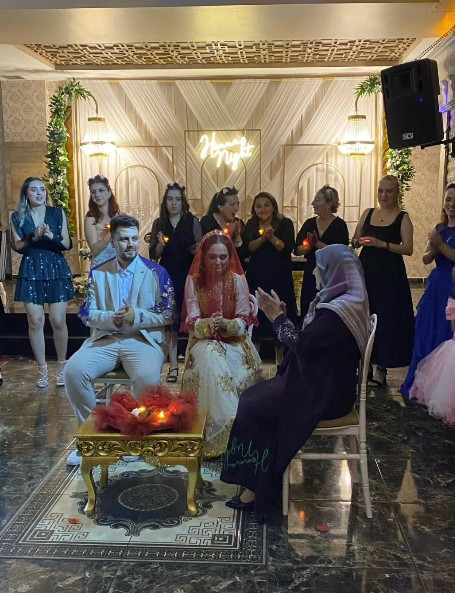
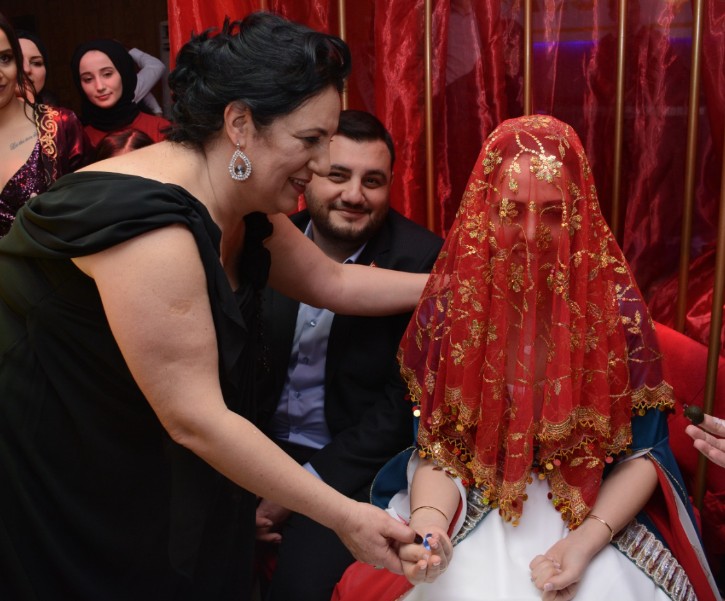
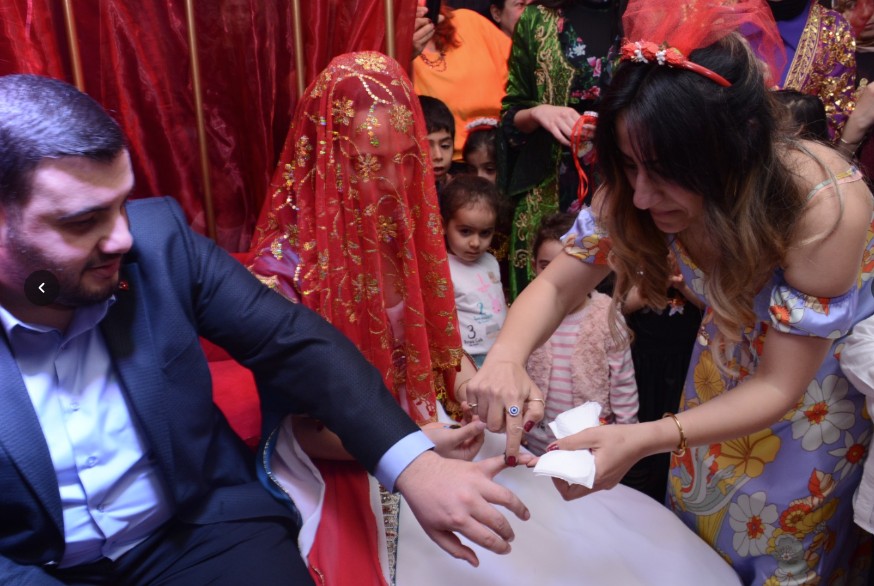
(Photos of using Henna in a Traditional Turkish wedding – used with permission)
 Henna in the Turkish cultural tradition
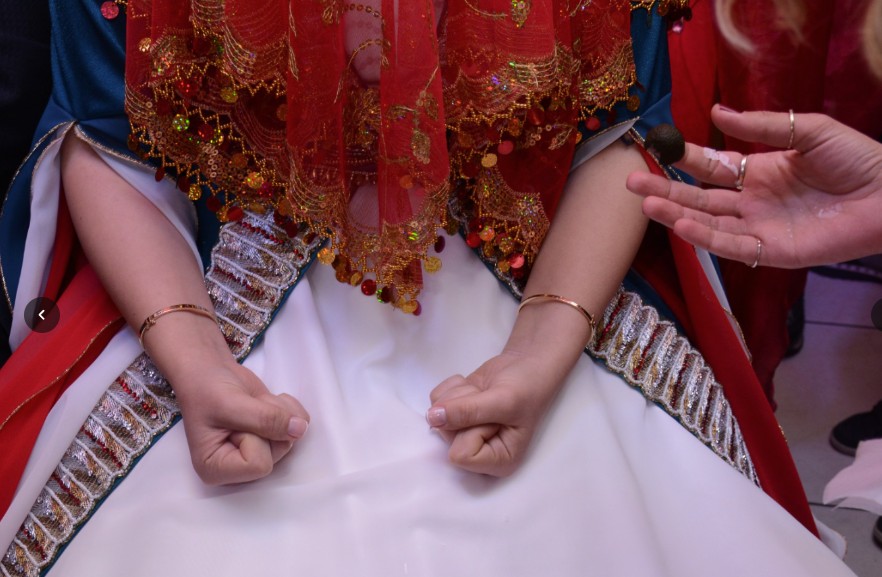
Henna is embedded in Mediterranean and Middle Eastern rites of passage. In Turkey, it marks weddings, military send-offs, healing practices, infant protection, and even sacrificial animals before religious festivals. Its role is communal and protective, not limited to female symbolism.
The most theatrical and elaborate form is the bride’s henna night (kına gecesi), where clothing, songs, weeping, and decoration enact the transition from girlhood to womanhood.
The Turkish henna night (kına gecesi)
This ceremony marks the bride’s emotional and social transition. It unfolds in stages: joyful gathering, preparation of the henna tray, singing, bathing rituals, and finally the application of henna.
The bride sits on a decorated ceremonial seat, covered with a red veil. A respected married woman applies henna. The bride initially keeps her hand closed; it opens only when the mother-in-law offers a gold coin. This symbolises entry into the new family and the blessing of prosperity. The coin is placed in the palm under the henna, sealing abundance.
The hennaed hand is wrapped in red tulle and covered, followed by ritual weeping — a socially expected act expressing farewell and transformation. The red colour symbolises life, protection, and defence against the evil eye.
The bride’s ritual tears are not signs of unhappiness but prescribed expressions of transition. They mark liminality — the threshold between old and new identity. Scholars like Van Gennep, Durkheim, Radcliffe-Brown, and Turner interpret such weeping as social performance, reinforcing communal bonds and renewing order.
Garments such as the embroidered bindallı and kına önlüğü embody female heritage, fertility, and protection. Colours and metallic threads symbolise prosperity and respect. The final phase is a communal celebration confirming acceptance of the bride’s new status.
Henna night in a modern urban context
In contemporary cities, the henna night blends tradition with secular modernity. It adapts to consumer culture, event venues, and services while preserving symbolic structure. Hammams (bathhouses) remain important ritual spaces, now combining heritage and entertainment.
The Turkish henna night is more than a celebration: it is a complex rite of passage supporting transformation, social cohesion, and continuity of tradition within modern change. Henna remains a living cultural system combining biological effect, symbolism, and communal meaning.
Henna rituals in Turkish culture demonstrate how a plant can unite biochemical reality with symbolic meaning, embedding transformation into skin and society alike. They reveal how traditions survive by adapting, carrying old meanings into new forms.
Ebru & Osman Kina Gecesi – Kina Klibi
References:
(Photos of using Henna in a Traditional Turkish wedding – used with permission)
